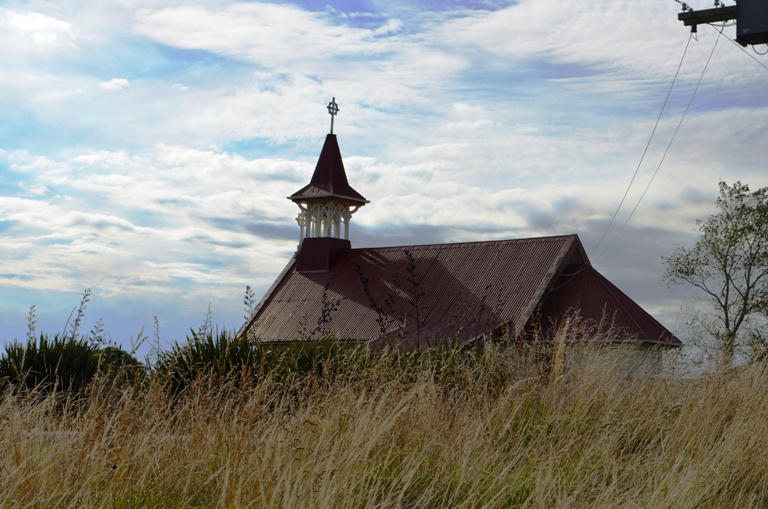
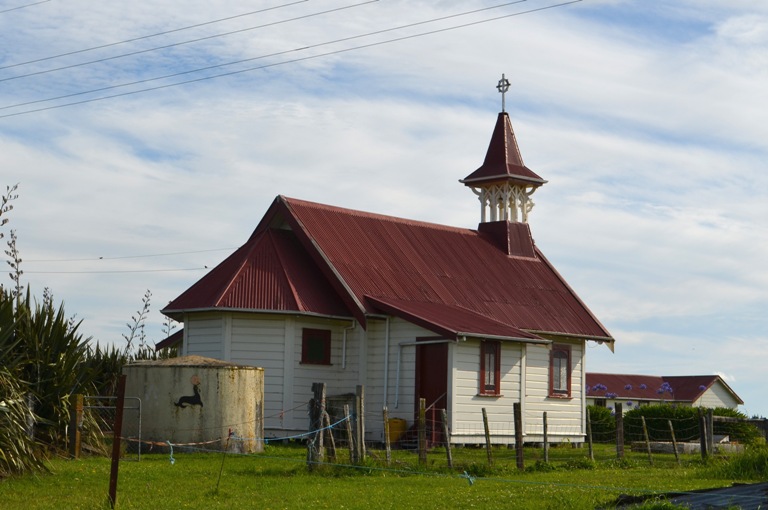
Hāto Hōhepa – St Joseph’s Church, Kākāriki, built in 1914 and opened on Easter Sunday in April of that year, is a largely intact Marist Māori mission church that demonstrates high cultural, spiritual, and architectural significance for Ngāti Rangatahi and associated iwi and for the region’s Catholic Māori communities. The building’s near-original interior fabric, and distinctive kōwhaiwhai on the walls and ceiling depicting a hammerhead shark motif, gives the place rarity value as a late example of a Marist church adapted to Māori congregational life. The church embodies continuity of faith, whakapapa, and community identity closely linked to Te Hiiri marae and broader Te Reureu networks, and its fabric and setting communicate the social history of Catholic mission activity and Māori agency in the lower North Island.
Descended from ancestors who journeyed south with Te Rauparaha from the Mōkau-Piopio-Āria-Southern Kāwhia region, Ngāti Rangatahi first settled Heretaunga (Hutt Valley) before being displaced and instructed by Te Rangihaeata to relocate to Kākāriki. Their kaitiaki was affirmed at Te Hiiri by the presentation of symbolic taonga – Te Rangihaeata’s patu and Te Rangitopeora’s korowai. Over generations, the people maintained ahi kaa (continuous occupation) and developed a strong spiritual and cultural base centred on Te Hiiri Marae, built in 1907 and recognised today as the principal Ngāti Rangatahi marae. Close kinship ties link this community with Ngāti Matakore through Te Marae o Hine, a nearby papa kāinga whose wharepuni was lost to a fire in the 1960s. Two main Ngāti Rangatahi cohorts are remembered – one that lived among Ngāti Toa on Kāpiti Island, and another that retained links with Maniapoto kin in Te Rohe Pōtae (King Country). These intertwined whakapapa reflect a network of relationships extending across Te Reureu, Manawatū, Whanganui, and Waikato rohe. Figures such as Te Puea Hērangi and Tā Edward Taihakurei Durie are associated with the marae’s inclusive tradition, which welcomes all who contribute to its life, regardless of lineage. The people of Kākāriki maintain affiliations with the wider Te Reureu iwi – Ngāti Raukawa, Te Ātiawa, Ngāti Toa, Ngāti Kauwhata, Ngāti Maniapoto, and Ngāti Tūwharetoa – reflecting both historical alliances and enduring kinship. Through sustained ahi kaa, whakapapa, and participation in the Kīngitanga, Te Hiiri Marae continues to embody the mana, history and cultural resilience of the Ngāti Rangatahi-Matakore people of Kākāriki.
From the late nineteenth century the French Marist mission re-established sustained pastoral work across the lower North Island, operating from bases at Ōtaki and Whanganui and conducting regional Easter hui (Hui Aranga) that drew Māori congregations from across Te Reureu, the Rangitīkei and neighbouring rohe. Father François Delachienne was a prominent Marist priest who organised Hui Aranga and supported the establishment of Catholic marae and mission chapels as focal points for Māori Catholic life. Local Catholic mobilisation, Marist pastoral leadership and the presence of a committed Māori Catholic community at Te Hiiri prompted fundraising and subscription drives in the years immediately prior to 1914, culminating in the large Easter dedication of St Joseph’s Church, presided over by Archbishop Redwood. Local oral tradition records that a chiefly woman, Riria Riwai, was pivotal along with Keremete Riwai and others in gifting the church site and contributing funds for the church’s construction.
Designed by Wellington architect John Sidney Swan in the Free Gothic style, the church is cruciform in plan with the apsidal chancel at the east end and a belltower with trefoil tracery positioned above the main (west) entrance. The original architectural contract survives to show that Swan specified high-quality native timbers for construction: heart tōtara for the exterior and belltower, and heart rimu for all visible interior joinery. The interior retains original liturgical fittings, including the pre-Vatican altar with a lockable tabernacle and altar stone inscribed ‘Ko ahau te whakamarama o te ao’. Original decorative schemes survive in the form of the painted kōwhaiwhai across the ceiling and walls. A small room to the right of the pressed tin-lined Sanctuary originally functioned as the confessional and now serves as an archive and storage area. Externally, the original porch over the west entrance was removed at some point during the later twentieth century; its reinstatement is currently proposed by the marae committee.
Hāto Hōhepa – St Joseph’s Church has remained in continuous use by the local Catholic Māori community, maintaining links with Hato Pāora College and other Māori Catholic institutions. The building has had limited exterior changes other than the removal of the entrance porch over the west door. Overall, the church retains high integrity to its 1914 design and finish. It is much beloved and esteemed by the local community who have worked to conserve the original interior timber finishes and kōwhaiwhai to protect the church’s cultural and physical values.
Descended from ancestors who journeyed south with Te Rauparaha from the Mōkau-Piopio-Āria-Southern Kāwhia region, Ngāti Rangatahi first settled Heretaunga (Hutt Valley) before being displaced and instructed by Te Rangihaeata to relocate to Kākāriki. Their kaitiaki was affirmed at Te Hiiri by the presentation of symbolic taonga – Te Rangihaeata’s patu and Te Rangitopeora’s korowai. Over generations, the people maintained ahi kaa (continuous occupation) and developed a strong spiritual and cultural base centred on Te Hiiri Marae, built in 1907 and recognised today as the principal Ngāti Rangatahi marae. Close kinship ties link this community with Ngāti Matakore through Te Marae o Hine, a nearby papa kāinga whose wharepuni was lost to a fire in the 1960s. Two main Ngāti Rangatahi cohorts are remembered – one that lived among Ngāti Toa on Kāpiti Island, and another that retained links with Maniapoto kin in Te Rohe Pōtae (King Country). These intertwined whakapapa reflect a network of relationships extending across Te Reureu, Manawatū, Whanganui, and Waikato rohe. Figures such as Te Puea Hērangi and Tā Edward Taihakurei Durie are associated with the marae’s inclusive tradition, which welcomes all who contribute to its life, regardless of lineage. The people of Kākāriki maintain affiliations with the wider Te Reureu iwi – Ngāti Raukawa, Te Ātiawa, Ngāti Toa, Ngāti Kauwhata, Ngāti Maniapoto, and Ngāti Tūwharetoa – reflecting both historical alliances and enduring kinship. Through sustained ahi kaa, whakapapa, and participation in the Kīngitanga, Te Hiiri Marae continues to embody the mana, history and cultural resilience of the Ngāti Rangatahi-Matakore people of Kākāriki.
From the late nineteenth century the French Marist mission re-established sustained pastoral work across the lower North Island, operating from bases at Ōtaki and Whanganui and conducting regional Easter hui (Hui Aranga) that drew Māori congregations from across Te Reureu, the Rangitīkei and neighbouring rohe. Father François Delachienne was a prominent Marist priest who organised Hui Aranga and supported the establishment of Catholic marae and mission chapels as focal points for Māori Catholic life. Local Catholic mobilisation, Marist pastoral leadership and the presence of a committed Māori Catholic community at Te Hiiri prompted fundraising and subscription drives in the years immediately prior to 1914, culminating in the large Easter dedication of St Joseph’s Church, presided over by Archbishop Redwood. Local oral tradition records that a chiefly woman, Riria Riwai, was pivotal along with Keremete Riwai and others in gifting the church site and contributing funds for the church’s construction.
Designed by Wellington architect John Sidney Swan in the Free Gothic style, the church is cruciform in plan with the apsidal chancel at the east end and a belltower with trefoil tracery positioned above the main (west) entrance. The original architectural contract survives to show that Swan specified high-quality native timbers for construction: heart tōtara for the exterior and belltower, and heart rimu for all visible interior joinery. The interior retains original liturgical fittings, including the pre-Vatican altar with a lockable tabernacle and altar stone inscribed ‘Ko ahau te whakamarama o te ao’. Original decorative schemes survive in the form of the painted kōwhaiwhai across the ceiling and walls. A small room to the right of the pressed tin-lined Sanctuary originally functioned as the confessional and now serves as an archive and storage area. Externally, the original porch over the west entrance was removed at some point during the later twentieth century; its reinstatement is currently proposed by the marae committee.
Hāto Hōhepa – St Joseph’s Church has remained in continuous use by the local Catholic Māori community, maintaining links with Hato Pāora College and other Māori Catholic institutions. The building has had limited exterior changes other than the removal of the entrance porch over the west door. Overall, the church retains high integrity to its 1914 design and finish. It is much beloved and esteemed by the local community who have worked to conserve the original interior timber finishes and kōwhaiwhai to protect the church’s cultural and physical values.