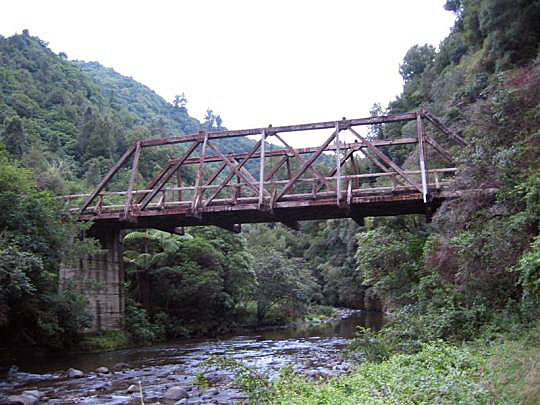
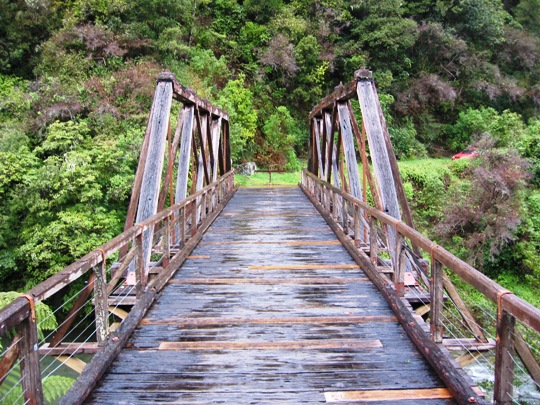
The Manganuku Bridge is a rare surviving example of a Howe truss bridge, and is located in the scenic Waioeka Valley, near Opotiki. Probably erected in 1928-1929, the timber structure was part of a major roadmaking effort in the valley, providing a shorter route between the Bay of Plenty and Poverty Bay than that previously used. A route via the Waioeka was discussed in 1914, and became a reality after local settlers petitioned the Minister of Public Works, Gordon Coates (1878-1943) in June 1920. As well as providing better communications between different parts of the North Island, the new road was to improve access to farms in the Upper Waioeka. Established from 1911, these marginal holdings consisted mostly of sheep runs, which had been offered by ballot to small-scale farmers as part of government efforts to expand agricultural production in the back blocks. Road construction was also a valuable source of income for settlers who struggled to make a living from farming due to poor-quality soil, high rainfall and difficult terrain. Early roadbuilding took place using picks and shovels, although shortly before the Manganuku Bridge was built, pneumatic drills and tractors were introduced.
Located some distance from the nearest substantial settlement, the bridge at Manganuku was among the last to be built along the route. It was erected across the Manganuku Stream, which was one of the many watercourses in the Waioeka Gorge to be traversed. Replacing an earlier structure of swing-bridge type, the bridge lay next to a school site on the southern side of the river, and a homestead belonging to the Gibson family on the opposite bank. The Gibsons farmed approximately 809 hectares (2,000 acres) in the Manganuku Valley from 1919. Probably following the bridge's completion, the first service car ran from Gisborne to Opotiki through the Waioeka in late 1929.
The bridge was designed and built by the Public Works Department (PWD), using Australian hardwood timber. Accommodating a road 4.7 m wide, it consisted of a 9.5 m land span of rolled steel joists and a modified Howe truss span of 24.8 m sitting on a concrete pier and abutments. Howe trusses combined timber technology with the use of metal by employing timber diagonals for compression and vertical iron or steel rods for tension. This method was patented in the USA in 1840, where it was particularly employed in the construction of railway bridges. With the widespread adoption of timber technology in New Zealand, it became a common means of bridge construction, with standard features developed by the PWD in the 1880s. It was widely used until the 1930s, with the Manganuku Bridge being a comparatively late example.
The bridge occupied a solitary position on the road after the Gibson family abandoned their homestead in 1934, and was superseded by a new structure a short distance downstream some thirty years later, when the Waioeka Road was widened and improved. Recognised as historically significant, it was repaired in 1992 with the help of the Institution of Professional Engineers New Zealand (IPENZ) after being in danger of complete collapse. It currently enables foot traffic to access the Manganuku Track in the Waioeka Gorge Scenic Reserve.
The Manganuku Bridge is a rare surviving Howe truss bridge in New Zealand, with most other examples having been lost through decay or demolition. It reflects a once-common engineering tradition and vernacular carpentry skills, from a time when timber technology was widely employed. The bridge is significant for its association with the expansion of New Zealand's road network in the 1920s, and the specific improvement of communications between the Bay of Plenty and Poverty Bay. It is also connected with farming history, and government settlement policies in the early 1900s. The bridge occupies a scenic location, with public access from State Highway 2. It is associated with a broader historical and archaeological landscape, which includes remnants of its approach roads. It is one of at least two bridges in the Waioeka Valley of recognized heritage significance.
Located some distance from the nearest substantial settlement, the bridge at Manganuku was among the last to be built along the route. It was erected across the Manganuku Stream, which was one of the many watercourses in the Waioeka Gorge to be traversed. Replacing an earlier structure of swing-bridge type, the bridge lay next to a school site on the southern side of the river, and a homestead belonging to the Gibson family on the opposite bank. The Gibsons farmed approximately 809 hectares (2,000 acres) in the Manganuku Valley from 1919. Probably following the bridge's completion, the first service car ran from Gisborne to Opotiki through the Waioeka in late 1929.
The bridge was designed and built by the Public Works Department (PWD), using Australian hardwood timber. Accommodating a road 4.7 m wide, it consisted of a 9.5 m land span of rolled steel joists and a modified Howe truss span of 24.8 m sitting on a concrete pier and abutments. Howe trusses combined timber technology with the use of metal by employing timber diagonals for compression and vertical iron or steel rods for tension. This method was patented in the USA in 1840, where it was particularly employed in the construction of railway bridges. With the widespread adoption of timber technology in New Zealand, it became a common means of bridge construction, with standard features developed by the PWD in the 1880s. It was widely used until the 1930s, with the Manganuku Bridge being a comparatively late example.
The bridge occupied a solitary position on the road after the Gibson family abandoned their homestead in 1934, and was superseded by a new structure a short distance downstream some thirty years later, when the Waioeka Road was widened and improved. Recognised as historically significant, it was repaired in 1992 with the help of the Institution of Professional Engineers New Zealand (IPENZ) after being in danger of complete collapse. It currently enables foot traffic to access the Manganuku Track in the Waioeka Gorge Scenic Reserve.
The Manganuku Bridge is a rare surviving Howe truss bridge in New Zealand, with most other examples having been lost through decay or demolition. It reflects a once-common engineering tradition and vernacular carpentry skills, from a time when timber technology was widely employed. The bridge is significant for its association with the expansion of New Zealand's road network in the 1920s, and the specific improvement of communications between the Bay of Plenty and Poverty Bay. It is also connected with farming history, and government settlement policies in the early 1900s. The bridge occupies a scenic location, with public access from State Highway 2. It is associated with a broader historical and archaeological landscape, which includes remnants of its approach roads. It is one of at least two bridges in the Waioeka Valley of recognized heritage significance.