

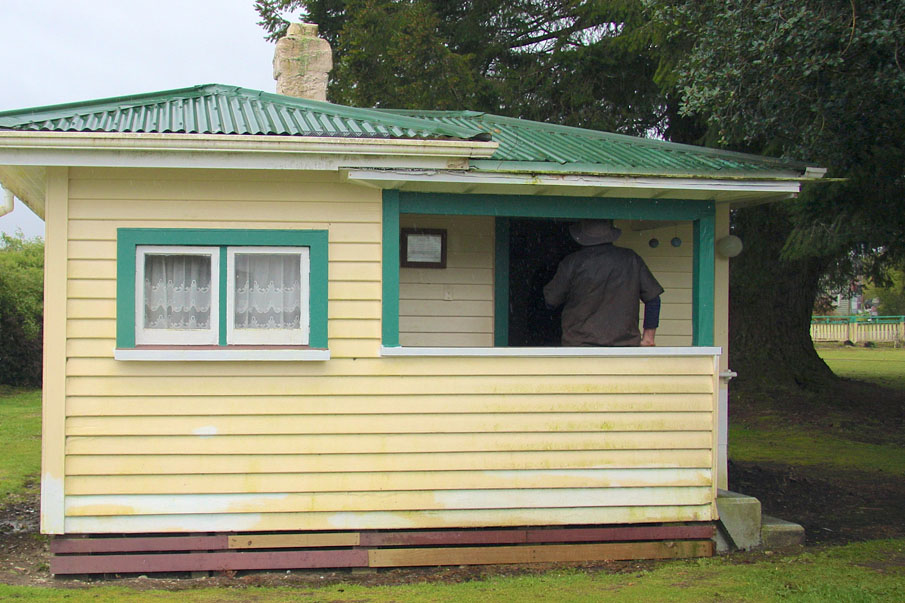
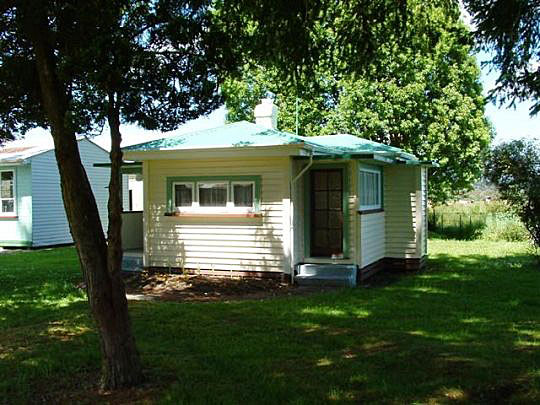
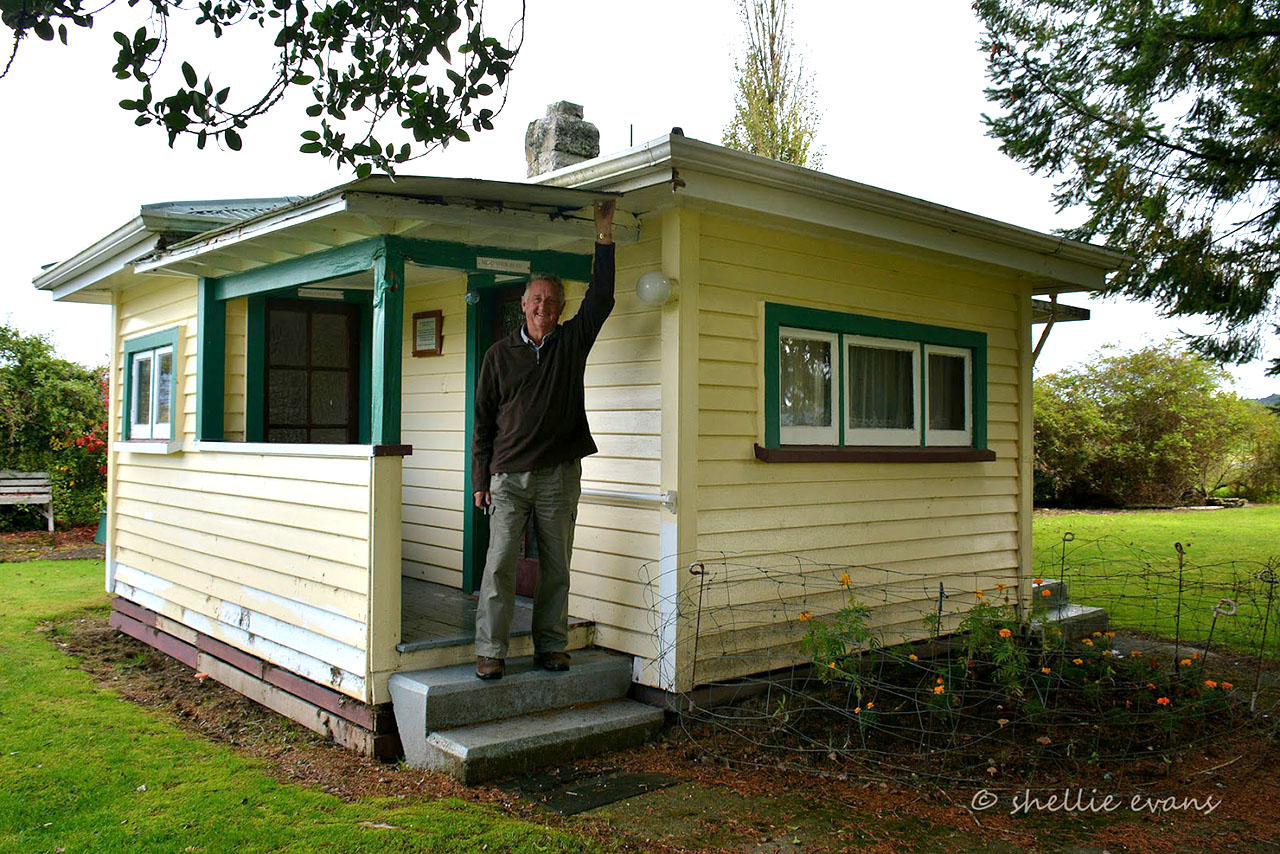
Other examples of a model bungalow like this are non-existent and if one were looking for examples to compare it with, the nearest parallel one could make is with the first State Houses produced by the Department of Housing Construction of the first Labour Government after 1937. The style of the Model Bungalow and that of the first State Houses is approximately the same, essentially fitting into the English Cottage style with (as Peter Shaw comments) an oblique reference to Modernism. There is of course no known connection between State Housing ideas and the Model bungalow at Kotuku and it would be misleading to suggest, even on a comparative basis, that there was. The extraordinary fact is however, that somehow a twelve and a half year old girl, Rosemary O'Brien, managed to put into her design all of the ideas that were in the minds of private architects like Swan & Lavalle, Horace Massey, and the England Brothers, who at precisely that point in time were submitting their first open plan English Cottage style State Housing designs to the D.H.C.
A cursory examination of the standard 1930s house features embodied in Rosemary O'Brien's design, e.g., the standard joinery, window casements, architraves and doors, and the modem 'Cubo-eclectic' interior decoration, makes this fact seem a little less extraordinary although it doesn't alter the fact that she was working in isolation on the remote West Coast, did not have any major contact with an architect - except where Darracott mentions that a Christchurch architect assisted them later on, apparently with the design of the bathroom - and that the ideas she had for a model home were new in 1938 and were only just being accepted by more advanced architects in New Zealand. Perhaps this begs the question as to what extent Darracott himself had influence over the final design. It must have been there in some degree although he doesn't say so in his report and modestly gives all the credit to the children. Still, one is tempted to think that if Darracott was a radical in the education field, he must have known about Modernism in the architectural and fine arts field. One can only guess the photograph he took of the 7' x 6' carpet square which the children designed (still surviving in the Canterbury College of Education) shows a Modernist abstract design of surprisingly high quality.
In summary, the Model Bungalow project, as an exercise in practical education, was conceived in terms of designing a model, ideal home of the 1930s. In achieving this objective the finished building in fact represented a modem, quasi-standard style of cottage architecture which was coming into vogue at the time and which became embodied in the first state houses of the first Labour Government. In keeping with this style, the Model Bungalow incorporated contemporary ideas concerning the use of standard joinery and, in a limited sense, ideas of open planning, all of which were
relatively new at the time (1938) but which characterised a "modern" home.
List Entry Information
Status
Listed
List Entry Status
Historic Place Category 1
Access
Private/No Public Access
List Number
7232
Date Entered
14th July 1995
Date of Effect
14th July 1995
City/District Council
Grey District
Region
West Coast Region
Extent of List Entry
Extent includes part of the land described as RES 698 (NZ Gazette 2004 p 2336, RT WS8A/559), Westland Land District and the building known as Model Bungalow thereon. (Refer to the extent map tabled at the Heritage List/Rārangi Kōrero Committee meeting on 8 October 2015.)
Legal description
RES 698 (NZ Gazette 2004 p 2336, RT WS8A/559), Westland Land District
Status
Listed
List Entry Status
Historic Place Category 1
Access
Private/No Public Access
List Number
7232
Date Entered
14th July 1995
Date of Effect
14th July 1995
City/District Council
Grey District
Region
West Coast Region
Extent of List Entry
Extent includes part of the land described as RES 698 (NZ Gazette 2004 p 2336, RT WS8A/559), Westland Land District and the building known as Model Bungalow thereon. (Refer to the extent map tabled at the Heritage List/Rārangi Kōrero Committee meeting on 8 October 2015.)
Legal description
RES 698 (NZ Gazette 2004 p 2336, RT WS8A/559), Westland Land District
Why is this place significant?
Cultural Significance
This historic place was registered under the Historic Places Act 1993. The following text is from the original Recommendation for Classification report considered by the NZHPT Board at the time of registration. Social: Jack's Mill School was a focal point for this small West Coast community in the 1930s with the model bungalow project involving many of its residents.
Historic Significance
Historical Significance or Value This historic place was registered under the Historic Places Act 1993. The following text is from the original Recommendation for Classification report considered by the NZHPT Board at the time of registration. Historical: The model bungalow, Kotuku, being an exercise in experimental education, is an important link with the sweeping innovations that were undertaken within the New Zealand primary school system during the 1930s, a time in which, according to historian Graeme Dunstall, "a new freedom was now introduced into primary schools."
Physical Significance
This historic place was registered under the Historic Places Act 1993. The following text is from the original Recommendation for Classification report considered by the NZHPT Board at the time of registration. Aesthetic: The principal aesthetic appeal of the Model Bungalow is its remarkable size, having all the standard features of a contemporary modern house, but only in three quarters the size they would normally be. Architectural: The model bungalow project, as an exercise in practical education, was conceived in terms of designing a model, ideal home of the 1930's. It incorporated contemporary ideas concerning the use of standard joinery and, in a limited sense, ideas of open planning, all of which were relatively new at the time (1938) but which characterised a "modern" home.
Why is this place Category 1 / Category 2?
Detail Of Assessed Criteria
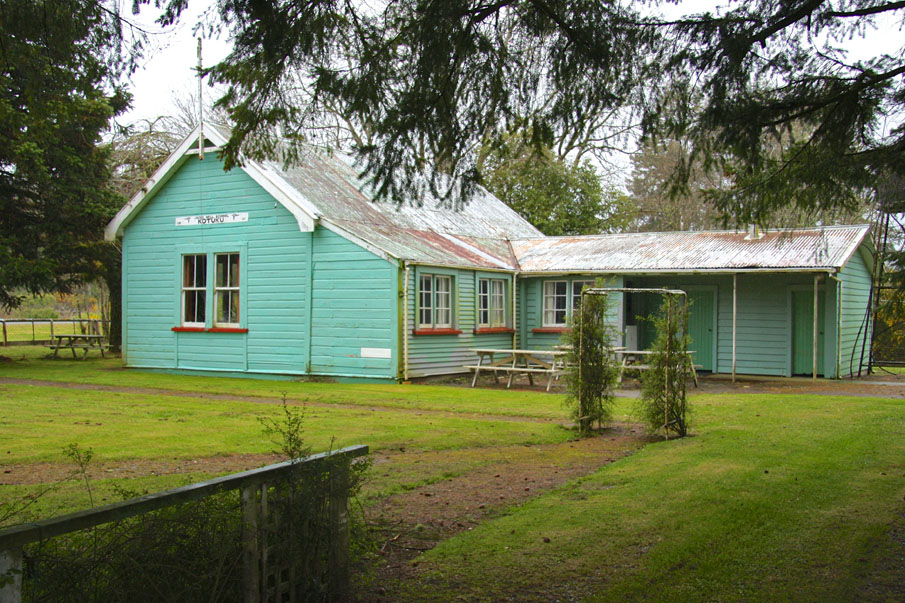
This historic place was registered under the Historic Places Act 1993. The following text is from the original Recommendation for Classification report considered by the NZHPT Board at the time of registration. a) The extent to which the place reflects important or representative aspects of New Zealand history: The model bungalow is representative of an important period of innovation in a major sector of the New Zealand educational system. Encouraged by a senior administrator and later by the Minister of Education, reformers such as Darracott at Kotuku, and Somerset, Wild and Strachan elsewhere in the country, had enormous influence on the primary school system in the 1930s. b) The association of the place with events, persons, or ideas of importance in New Zealand history: Edward Darracott, who was the headmaster of Jack's Mill School in the 1930s and about whom there is little documentary evidence, appears to have been an innovator and to have had influence beyond his province, since the school attracted visitors from throughout the world, and the attention of the Prime Minister/Minister of Education. Although little appears to have been published about this movement in experimental education, the link with Dr C.E. Beeby, the reforming Assistant Director of Education, and Peter Fraser, who encouraged Beeby, is significant. The 1930's was a time of great innovation for primary school education. Influential reformers in small rural schools - L.J. Wild at Fielding, J.E. Strachan at Rangiora and Crawford Somerset at 'Littledene', Oxford - published seminal works. Graeme Dunstall comments on the education reforms of the 'thirties': " ... the Fraser-Beeby credo also insisted that schools 'that cater for the whole population must also offer courses that are as rich and varied as are the needs and abilities of the children that enter them.' Freed from the strait-jacket of the Proficiency examination in 1936, primary school teachers sought to tailor the national syllabus to the abilities of individual children, using a range of teaching methods." c) The potential of the place to provide knowledge of New Zealand history: The model bungalow provides a tangible expression of the innovation undertaken in the New Zealand primary school system during the 1930s. g) The technical accomplishment or value, or design of the place: The model bungalow, built 1938-40, relates comfortably in technical and design terms with a set of contemporary ideas, both social and architectural, which broke new ground in the housing design and construction field in the 1930s. The building was designed by one of the school's pupils, Rosemary O'Brien who was twelve and a half years old. O'Brien's design embodies standard 1930s house features - the standard joinery, window casements, architraves and doors and modern interior decoration. It is interesting that she was working in isolation on the West Coast, did not have any major contact with an architect - except where Darracott mentions that a Christchurch architect assisted them later on, apparently with the design of the bathroom - and that the ideas she had for a model home were new in 1938 and were only just being accepted by more advanced architects in New Zealand. It is unclear to what extent Darracott himself had influence over the final design. It must have been there in some degree although he doesn't say so in his report and modestly gives all the credit to the children. j) The importance of identifying rare types of historic places: There are no known comparative examples of a model bungalow built at that, or any time. Pam Wilson notes that Mr Colin McGeorge of the Education Department of the University of Canterbury, "believes this is the only example in New Zealand where pupils of a two teacher primary school undertook such a project. There are examples where similar projects were undertaken in later years, usually by secondary school students on manual training courses. He knows of nothing similar in scale and complexity from this date carried out by pupils of this age group." k) The extent to which the place forms part of a wider historical and cultural complex or historical and cultural landscape: This structure is a tangible link with the experimental reforms of the 1930s conducted under the aegis of the Beeby-Fraser partnership. As such, it should be seen in the same context as the Oxford District High School, J.E. Strachan's school at Rangiora, or Wild's community centre at Fielding. On a strictly local level, the bungalow and school buildings clearly act as landmarks for the truncated town of Kotuku. Conclusion: The Model Bungalow, Kotuku is recommended for registration as a Category I as a place of special and outstanding historical and cultural heritage significance and value. The model bungalow project is the only known one of its kind in terms of practical education and demonstrates the innovative approach to New Zealand education in the 1930s.
Why is this place significant?
Cultural Significance
This historic place was registered under the Historic Places Act 1993. The following text is from the original Recommendation for Classification report considered by the NZHPT Board at the time of registration. Social: Jack's Mill School was a focal point for this small West Coast community in the 1930s with the model bungalow project involving many of its residents.
Historic Significance
Historical Significance or Value This historic place was registered under the Historic Places Act 1993. The following text is from the original Recommendation for Classification report considered by the NZHPT Board at the time of registration. Historical: The model bungalow, Kotuku, being an exercise in experimental education, is an important link with the sweeping innovations that were undertaken within the New Zealand primary school system during the 1930s, a time in which, according to historian Graeme Dunstall, "a new freedom was now introduced into primary schools."
Physical Significance
This historic place was registered under the Historic Places Act 1993. The following text is from the original Recommendation for Classification report considered by the NZHPT Board at the time of registration. Aesthetic: The principal aesthetic appeal of the Model Bungalow is its remarkable size, having all the standard features of a contemporary modern house, but only in three quarters the size they would normally be. Architectural: The model bungalow project, as an exercise in practical education, was conceived in terms of designing a model, ideal home of the 1930's. It incorporated contemporary ideas concerning the use of standard joinery and, in a limited sense, ideas of open planning, all of which were relatively new at the time (1938) but which characterised a "modern" home.
Why is this place Category 1 / Category 2?
Detail Of Assessed Criteria
This historic place was registered under the Historic Places Act 1993. The following text is from the original Recommendation for Classification report considered by the NZHPT Board at the time of registration. a) The extent to which the place reflects important or representative aspects of New Zealand history: The model bungalow is representative of an important period of innovation in a major sector of the New Zealand educational system. Encouraged by a senior administrator and later by the Minister of Education, reformers such as Darracott at Kotuku, and Somerset, Wild and Strachan elsewhere in the country, had enormous influence on the primary school system in the 1930s. b) The association of the place with events, persons, or ideas of importance in New Zealand history: Edward Darracott, who was the headmaster of Jack's Mill School in the 1930s and about whom there is little documentary evidence, appears to have been an innovator and to have had influence beyond his province, since the school attracted visitors from throughout the world, and the attention of the Prime Minister/Minister of Education. Although little appears to have been published about this movement in experimental education, the link with Dr C.E. Beeby, the reforming Assistant Director of Education, and Peter Fraser, who encouraged Beeby, is significant. The 1930's was a time of great innovation for primary school education. Influential reformers in small rural schools - L.J. Wild at Fielding, J.E. Strachan at Rangiora and Crawford Somerset at 'Littledene', Oxford - published seminal works. Graeme Dunstall comments on the education reforms of the 'thirties': " ... the Fraser-Beeby credo also insisted that schools 'that cater for the whole population must also offer courses that are as rich and varied as are the needs and abilities of the children that enter them.' Freed from the strait-jacket of the Proficiency examination in 1936, primary school teachers sought to tailor the national syllabus to the abilities of individual children, using a range of teaching methods." c) The potential of the place to provide knowledge of New Zealand history: The model bungalow provides a tangible expression of the innovation undertaken in the New Zealand primary school system during the 1930s. g) The technical accomplishment or value, or design of the place: The model bungalow, built 1938-40, relates comfortably in technical and design terms with a set of contemporary ideas, both social and architectural, which broke new ground in the housing design and construction field in the 1930s. The building was designed by one of the school's pupils, Rosemary O'Brien who was twelve and a half years old. O'Brien's design embodies standard 1930s house features - the standard joinery, window casements, architraves and doors and modern interior decoration. It is interesting that she was working in isolation on the West Coast, did not have any major contact with an architect - except where Darracott mentions that a Christchurch architect assisted them later on, apparently with the design of the bathroom - and that the ideas she had for a model home were new in 1938 and were only just being accepted by more advanced architects in New Zealand. It is unclear to what extent Darracott himself had influence over the final design. It must have been there in some degree although he doesn't say so in his report and modestly gives all the credit to the children. j) The importance of identifying rare types of historic places: There are no known comparative examples of a model bungalow built at that, or any time. Pam Wilson notes that Mr Colin McGeorge of the Education Department of the University of Canterbury, "believes this is the only example in New Zealand where pupils of a two teacher primary school undertook such a project. There are examples where similar projects were undertaken in later years, usually by secondary school students on manual training courses. He knows of nothing similar in scale and complexity from this date carried out by pupils of this age group." k) The extent to which the place forms part of a wider historical and cultural complex or historical and cultural landscape: This structure is a tangible link with the experimental reforms of the 1930s conducted under the aegis of the Beeby-Fraser partnership. As such, it should be seen in the same context as the Oxford District High School, J.E. Strachan's school at Rangiora, or Wild's community centre at Fielding. On a strictly local level, the bungalow and school buildings clearly act as landmarks for the truncated town of Kotuku. Conclusion: The Model Bungalow, Kotuku is recommended for registration as a Category I as a place of special and outstanding historical and cultural heritage significance and value. The model bungalow project is the only known one of its kind in terms of practical education and demonstrates the innovative approach to New Zealand education in the 1930s.
Construction Details
Start Year
1938
startYearCirca
Type
Original Construction
Construction Details
Start Year
1938
startYearCirca
Type
Original Construction
Historical and Associated Iwi / Hapū / Whānau
Information Sources
Shaw, P., 1991
Peter Shaw, New Zealand Architecture: From Polynesian Beginnings to 1990, Auckland, Hodder & Stoughton, 1991.
Rice, 1992
G Rice (ed), The Oxford History of New Zealand, Auckland, 1992
Other Information
A copy of the original report is available from the NZHPT Southern region office Please note that entry on the New Zealand Heritage List/Rarangi Korero identifies only the heritage values of the property concerned, and should not be construed as advice on the state of the property, or as a comment of its soundness or safety, including in regard to earthquake risk, safety in the event of fire, or insanitary conditions. This place is part of an historic area that was registered under the Historic Places Act 1993. The following text is from the original Historic Area Assessment Under Section 23 Criteria report considered by the NZHPT Board at the time of registration of the historic area.
Historical and Associated Iwi / Hapū / Whānau
Information Sources
Shaw, P., 1991
Peter Shaw, New Zealand Architecture: From Polynesian Beginnings to 1990, Auckland, Hodder & Stoughton, 1991.
Rice, 1992
G Rice (ed), The Oxford History of New Zealand, Auckland, 1992
Other Information
A copy of the original report is available from the NZHPT Southern region office Please note that entry on the New Zealand Heritage List/Rarangi Korero identifies only the heritage values of the property concerned, and should not be construed as advice on the state of the property, or as a comment of its soundness or safety, including in regard to earthquake risk, safety in the event of fire, or insanitary conditions. This place is part of an historic area that was registered under the Historic Places Act 1993. The following text is from the original Historic Area Assessment Under Section 23 Criteria report considered by the NZHPT Board at the time of registration of the historic area.
Former Usages
General Usage: Education
Specific Usage: Education - other
Former Usages
General Usage: Education
Specific Usage: Education - other
Location
Related listings
Sign up to hear more
Get the latest heritage news, features and events delivered
straight to your inbox.
