

Originally from Dorset, England, William and Sarah Randell arrived in Wellington in 1855. Only weeks earlier, a magnitude 8.2 earthquake had altered the landscape of the Wellington region and caused significant damage to chimneys and foundations. As a stonemason and bricklayer, William’s skills were in high demand for repairs and new construction. Initially the Randells lived on Ghuznee Street, before purchasing the leasehold on a cottage on the Wesleyan Reserve in Thorndon, now part of the Wellington Botanic Garden. In May 1865 William purchased part of the nearby Town Acre 624, on the eastern slopes of Te Ahumairangi (Tinakori Hill), and over the following years levelled the site and built the cottage, as time and funds allowed. In 1868 the Randells sold the Wesleyan Reserve cottage, presumably once their St Mary Street home was ready for occupation.
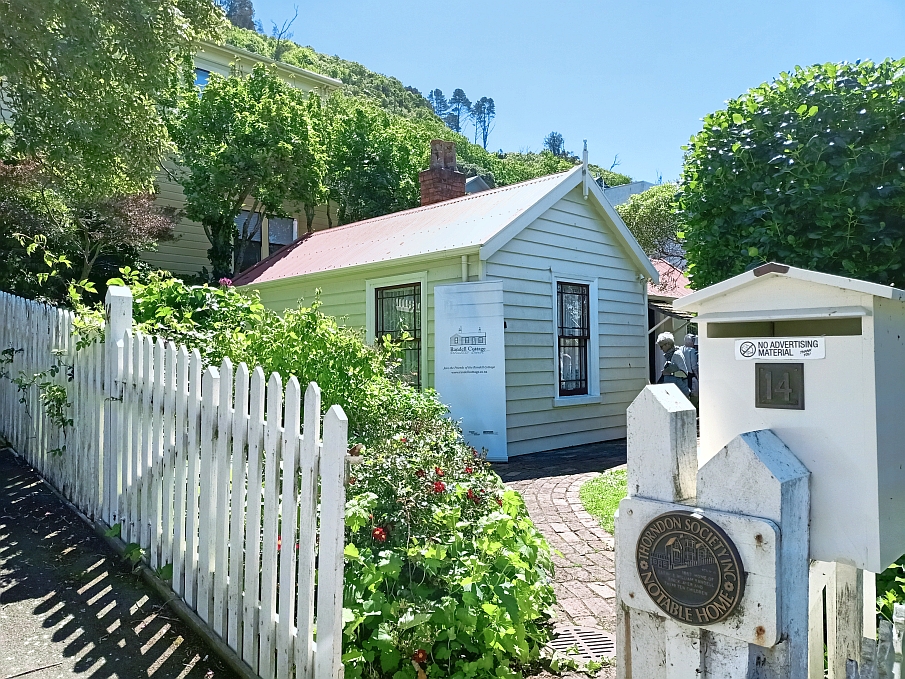
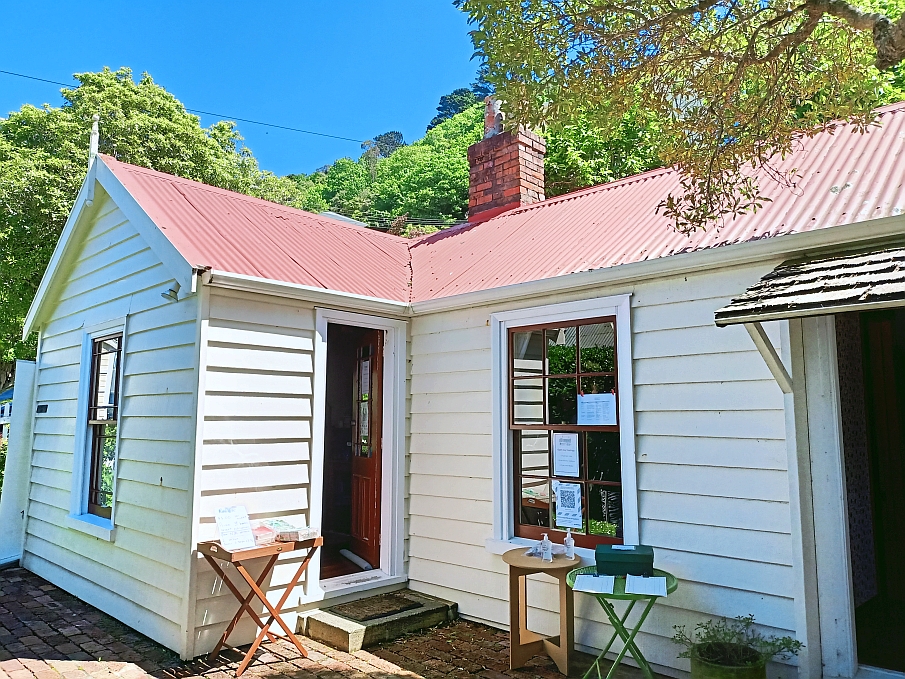
Randell Cottage has been identified as a simple box cottage (rectangular plan) double gable design, consisting of two long timber ‘boxes’ built perpendicular to the street, each one-room wide and with a gable roof, joined by a central wall. The eastern box contained two bedrooms and a hallway leading from the front door to the western box, which held the long kitchen-living-dining room and a third bedroom. Another one-room wide gabled box was added in 1874. Constructed at the south end of the cottage, running parallel to the street, it created two more rooms for the family of twelve.
One of William and Sarah’s daughters, Harriet, became a celebrated soloist and gave singing lessons in one of the newer rooms. In the 1880s, an exterior door was added to this room to allow her pupils to come and go without entering the main part of the house. After Sarah Randell left the house in about 1912 the windows were altered by her son, but despite various owners during the twentieth century, the house remained largely unchanged. In 1994 William’s great-granddaughter Beverley Randell, a writer, purchased the cottage with her husband Hugh Price and their daughter Susan. They carefully restored the cottage and a collection of household items found during the renovations is held in the collection of Te Papa Tongarewa. In 2001 the cottage was gifted to a trust, which works with partner organisations to host one French writer and one New Zealand writer each year.
List Entry Information
Status
Listed
List Entry Status
Historic Place Category 2
Access
Private/No Public Access
List Number
7281
Date Entered
14th December 1995
Date of Effect
14th December 1995
City/District Council
Wellington City
Region
Wellington Region
Extent of List Entry
Extent includes the land described as Pt Lot 1 DP 5610 (RT WN430/38), Wellington Land District, and the building known as Randell Cottage thereon.
Legal description
Pt Lot 1 DP 5610 (RT WN430/38), Wellington Land District
Status
Listed
List Entry Status
Historic Place Category 2
Access
Private/No Public Access
List Number
7281
Date Entered
14th December 1995
Date of Effect
14th December 1995
City/District Council
Wellington City
Region
Wellington Region
Extent of List Entry
Extent includes the land described as Pt Lot 1 DP 5610 (RT WN430/38), Wellington Land District, and the building known as Randell Cottage thereon.
Legal description
Pt Lot 1 DP 5610 (RT WN430/38), Wellington Land District
Why is this place significant?
Historic Significance
Historical Significance or Value This historic place was registered under the Historic Places Act 1993. The following text is from the original Recommendation for Registration considered by the NZHPT Board at the time of registration. The cottage is of local Wellington significance because of its long and well-recorded association with the Randell family, and because of its representative evocation of the lifestyles of late 19th century European settlers.
Physical Significance
This historic place was registered under the Historic Places Act 1993. The following text is from the original Recommendation for Registration considered by the NZHPT Board at the time of registration. Aesthetic: The cottage is a plain and simple example of an early New Zealand dwelling. Such cottages did not have a great deal of ornamentation, and it could be argued that this plainness itself contributes to an aesthetic quality through simplicity. Archaeological: The cottage was built on town section 624 which had been purchased in May 1865. The cottage was built in 1867-68, and has been in continuous occupation since then. Architectural: Randell Cottage is an example of the colonial simple box cottage type, c.1840-1906. Certain aspects of its construction are of interest, and were standard practice at this time.
Why is this place Category 1 / Category 2?
Detail Of Assessed Criteria
This historic place was registered under the Historic Places Act 1993. The following text is from the original Recommendation for Registration considered by the NZHPT Board at the time of registration. Information in square brackets indicates modifications made after the paper was considered by the NZHPT Board. The following comments are made in relation to the criteria identified under S.23(2) of the Historic Places Act 1993. a) The extent to which the place reflects important or representative aspects of New Zealand history: The cottage at 14 St Mary St is a representative example of the working class residences built in late 19th century colonial New Zealand. The information on the Certificate of Title suggests it remained a working class residence until very recently. In terms of family size, house style and layout the building is representative of the houses built for the colonial working class. c) The potential of the place to provide knowledge of New Zealand history: The cottage is relatively unmodified and, as such, gives an idea of the physical conditions of a working class lifestyle of the period. g) The technical accomplishment or value, or design of the place: Randell Cottage is an example of the colonial New Zealand simple box cottage, constructed in 1867-68. This cottage style was preferred by colonial families, as it could easily be adapted to changing requirements, such as the addition of a lean-to or an extra storey. This can be seen in the St Mary St cottage, [which had a two-roomed extension added in 1874. Unlike a simple lean-to, this third box had a pitched roof. It had gables at both ends, just like the original cottage built in 1868.] The original cottage had two chimneys, features which, with windows, were often luxuries for working class families. However William Randell was a bricklayer, and probably constructed the chimneys from the simple technique of placing them up against the built walls and cutting a hole in the wall for the fireplace. The original 12 pane double-hung sash windows have been replaced, and a 1920s porch and hoods of the same period over windows have been added. These changes all reduce the integrity of what was an original 19th century worker's cottage, but enough original material and form remain to give the cottage local significance. Conclusion: Randell Cottage at 14 St Mary St, Thorndon, Wellington, is recommended for registration as a Category II as a place of historical and cultural heritage significance and value. It has a long and well-recorded association with the Randell family. The building is a representative example of the working class residences built in late 19th century colonial New Zealand. Architecturally it is an example of the colonial simple box cottage type, c.1840-1906, and demonstrates common stylistic and construction features of this time.
Why is this place significant?
Historic Significance
Historical Significance or Value This historic place was registered under the Historic Places Act 1993. The following text is from the original Recommendation for Registration considered by the NZHPT Board at the time of registration. The cottage is of local Wellington significance because of its long and well-recorded association with the Randell family, and because of its representative evocation of the lifestyles of late 19th century European settlers.
Physical Significance
This historic place was registered under the Historic Places Act 1993. The following text is from the original Recommendation for Registration considered by the NZHPT Board at the time of registration. Aesthetic: The cottage is a plain and simple example of an early New Zealand dwelling. Such cottages did not have a great deal of ornamentation, and it could be argued that this plainness itself contributes to an aesthetic quality through simplicity. Archaeological: The cottage was built on town section 624 which had been purchased in May 1865. The cottage was built in 1867-68, and has been in continuous occupation since then. Architectural: Randell Cottage is an example of the colonial simple box cottage type, c.1840-1906. Certain aspects of its construction are of interest, and were standard practice at this time.
Why is this place Category 1 / Category 2?
Detail Of Assessed Criteria
This historic place was registered under the Historic Places Act 1993. The following text is from the original Recommendation for Registration considered by the NZHPT Board at the time of registration. Information in square brackets indicates modifications made after the paper was considered by the NZHPT Board. The following comments are made in relation to the criteria identified under S.23(2) of the Historic Places Act 1993. a) The extent to which the place reflects important or representative aspects of New Zealand history: The cottage at 14 St Mary St is a representative example of the working class residences built in late 19th century colonial New Zealand. The information on the Certificate of Title suggests it remained a working class residence until very recently. In terms of family size, house style and layout the building is representative of the houses built for the colonial working class. c) The potential of the place to provide knowledge of New Zealand history: The cottage is relatively unmodified and, as such, gives an idea of the physical conditions of a working class lifestyle of the period. g) The technical accomplishment or value, or design of the place: Randell Cottage is an example of the colonial New Zealand simple box cottage, constructed in 1867-68. This cottage style was preferred by colonial families, as it could easily be adapted to changing requirements, such as the addition of a lean-to or an extra storey. This can be seen in the St Mary St cottage, [which had a two-roomed extension added in 1874. Unlike a simple lean-to, this third box had a pitched roof. It had gables at both ends, just like the original cottage built in 1868.] The original cottage had two chimneys, features which, with windows, were often luxuries for working class families. However William Randell was a bricklayer, and probably constructed the chimneys from the simple technique of placing them up against the built walls and cutting a hole in the wall for the fireplace. The original 12 pane double-hung sash windows have been replaced, and a 1920s porch and hoods of the same period over windows have been added. These changes all reduce the integrity of what was an original 19th century worker's cottage, but enough original material and form remain to give the cottage local significance. Conclusion: Randell Cottage at 14 St Mary St, Thorndon, Wellington, is recommended for registration as a Category II as a place of historical and cultural heritage significance and value. It has a long and well-recorded association with the Randell family. The building is a representative example of the working class residences built in late 19th century colonial New Zealand. Architecturally it is an example of the colonial simple box cottage type, c.1840-1906, and demonstrates common stylistic and construction features of this time.
Construction Professional
Name
Randell, William
Type
Builder
Biography
No biography is currently available for this construction professional
Construction Details
Finish Year
1874
finishYearCirca
Type
Addition
Description
Addition of southern gabled box
Type
Modification
Description
Addition of exterior door
Period
c. 1880s
Start Year
1910
startYearCirca
Finish Year
1920
finishYearCirca
Type
Modification
Description
Windows altered
Start Year
1865
startYearCirca
Finish Year
1868
Type
Original Construction
Description
Levelling of site, construction of cottage
Construction Professional
Name
Randell, William
Type
Builder
Biography
No biography is currently available for this construction professional
Construction Details
Finish Year
1874
finishYearCirca
Type
Addition
Description
Addition of southern gabled box
Type
Modification
Description
Addition of exterior door
Period
c. 1880s
Start Year
1910
startYearCirca
Finish Year
1920
finishYearCirca
Type
Modification
Description
Windows altered
Start Year
1865
startYearCirca
Finish Year
1868
Type
Original Construction
Description
Levelling of site, construction of cottage
Historical and Associated Iwi / Hapū / Whānau
Completion Date
13th August 2019
Report Written By
Cherie Jacobson
Information Sources
Dominion Post
Dominion Post, Wellington
Land Information New Zealand (LINZ)
Land Information New Zealand
New Zealand Historic Places Trust (NZHPT)
New Zealand Historic Places Trust
Te Ara - The Encyclopedia of New Zealand
www.TeAra.govt.nz
Randell, 1992
B Randell, A Crowded Thorndon Cottage, Gondwanaland Press, Wellington, 1992
Randell Conservation Plan 2017
Report prepared by Cochran & Murray Conservation Architects 15 December 2017
Wellington City Council
Wellington City Heritage website, published and maintained by WCC
Black et al, 2008
Black, Jane, Michael Kelly and Chris Cochran, ‘Thorndon Heritage Project’, Wellington City Council, Dec 2008, p.3, https://wellington.govt.nz/~/media/services/community-and-culture/heritage/files/thorndonheritage-report.pdf
Randell Cottage Writers Trust
Randell Cottage Writers Trust, https://www.randellcottage.co.nz
Other Information
Please note that entry on the New Zealand Heritage List/Rarangi Korero identifies only the heritage values of the property concerned, and should not be construed as advice on the state of the property, or as a comment of its soundness or safety, including in regard to earthquake risk, safety in the event of fire, or insanitary conditions. A fully referenced upgrade report is available on request from the Central Region Office of Heritage New Zealand.
Historical and Associated Iwi / Hapū / Whānau
Completion Date
13th August 2019
Report Written By
Cherie Jacobson
Information Sources
Dominion Post
Dominion Post, Wellington
Land Information New Zealand (LINZ)
Land Information New Zealand
New Zealand Historic Places Trust (NZHPT)
New Zealand Historic Places Trust
Te Ara - The Encyclopedia of New Zealand
www.TeAra.govt.nz
Randell, 1992
B Randell, A Crowded Thorndon Cottage, Gondwanaland Press, Wellington, 1992
Randell Conservation Plan 2017
Report prepared by Cochran & Murray Conservation Architects 15 December 2017
Wellington City Council
Wellington City Heritage website, published and maintained by WCC
Black et al, 2008
Black, Jane, Michael Kelly and Chris Cochran, ‘Thorndon Heritage Project’, Wellington City Council, Dec 2008, p.3, https://wellington.govt.nz/~/media/services/community-and-culture/heritage/files/thorndonheritage-report.pdf
Randell Cottage Writers Trust
Randell Cottage Writers Trust, https://www.randellcottage.co.nz
Other Information
Please note that entry on the New Zealand Heritage List/Rarangi Korero identifies only the heritage values of the property concerned, and should not be construed as advice on the state of the property, or as a comment of its soundness or safety, including in regard to earthquake risk, safety in the event of fire, or insanitary conditions. A fully referenced upgrade report is available on request from the Central Region Office of Heritage New Zealand.
Current Usages
Uses: Accommodation
Specific Usage: House
Former Usages
General Usage: Accommodation
Specific Usage: House
Web Links
description: Homepage of the Randell Cottage Writers Trust with brief history of the cottage
Current Usages
Uses: Accommodation
Specific Usage: House
Former Usages
General Usage: Accommodation
Specific Usage: House
Web Links
description: Homepage of the Randell Cottage Writers Trust with brief history of the cottage
Location
Sign up to hear more
Get the latest heritage news, features and events delivered
straight to your inbox.
