

List Entry Information
Status
Listed
List Entry Status
Historic Place Category 2
Access
Private/No Public Access
List Number
7339
Date Entered
25th October 1996
Date of Effect
25th October 1996
City/District Council
Christchurch City
Region
Canterbury Region
Extent of List Entry
Extent includes the land described as Lot 1 DP 48863 (RT CB27K/663) and Lot 2 DP 58639 (RT CB36C/445), Canterbury Land District, and the buildings and structures known as Wood's Mill, and their fittings and fixtures. [Wood’s Mill suffered damage in the Canterbury Earthquakes. Some of the buildings in the complex have been demolished following the Canterbury Earthquakes.]
Legal description
Lot 1 DP 48863 (RT CB27K/663) and Lot 2 DP 58639 (RT CB36C/445), Canterbury Land District
Status
Listed
List Entry Status
Historic Place Category 2
Access
Private/No Public Access
List Number
7339
Date Entered
25th October 1996
Date of Effect
25th October 1996
City/District Council
Christchurch City
Region
Canterbury Region
Extent of List Entry
Extent includes the land described as Lot 1 DP 48863 (RT CB27K/663) and Lot 2 DP 58639 (RT CB36C/445), Canterbury Land District, and the buildings and structures known as Wood's Mill, and their fittings and fixtures. [Wood’s Mill suffered damage in the Canterbury Earthquakes. Some of the buildings in the complex have been demolished following the Canterbury Earthquakes.]
Legal description
Lot 1 DP 48863 (RT CB27K/663) and Lot 2 DP 58639 (RT CB36C/445), Canterbury Land District
Why is this place significant?
Historic Significance
Historical Significance or Value This historic place was registered under the Historic Places Act 1993. The following text is from the original Recommendation for Registration considered by the NZHPT Board at the time of registration. The beginnings of Wood Brothers Ltd can be traced back to Suffolk, where William Derisley Wood's family was involved with flour milling. Wood arrived in Christchurch in 1850, serving as Godley's provincial secretary before setting up his first mill, a wind-powered plant, in Antigua Street during the mid 1850s. Still nights limited that mill's efficiency and Wood set up a new mill at Riccarton. He converted that mill to roller operation in 1889, but when it proved incapable of keeping up with demand, Wood moved his business to a new roller mill sited alongside the rail line at Addington in 1890/91. The complex, expanded over time and equipped with modern buildings and machinery, produced flour under the 'Imperial' brand name. Woods closed in 1970. Leased out after that, it was acquired by tenant baker Clive Brooker in the 1980s. In recent years the redundant complex has been developed for cultural, social and residential users.
Physical Significance
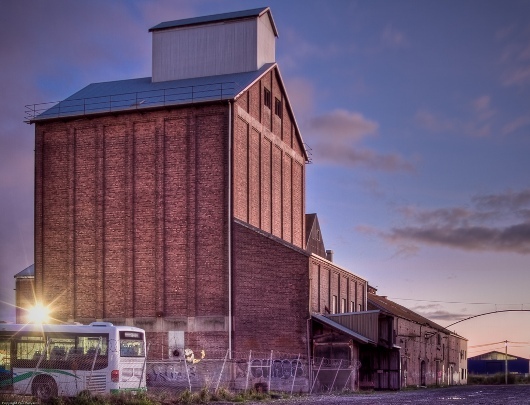
This historic place was registered under the Historic Places Act 1993. The following text is from the original Recommendation for Registration considered by the NZHPT Board at the time of registration. Architectural: Wood's Mill consists of six built items constructed between 1891-1960 which were all directly associated with the manufacture of flour at the mill, and therefore functionally related in a technical design sense. Associated with the main building is the landmark grain silo (1913) which exhibits quite a different aesthetic owing a great deal to the contemporary ideas of the time about industrial architecture. The rectangular gable ended structure with strong vertical brick piers is European in design.
Why is this place Category 1 / Category 2?
Detail Of Assessed Criteria
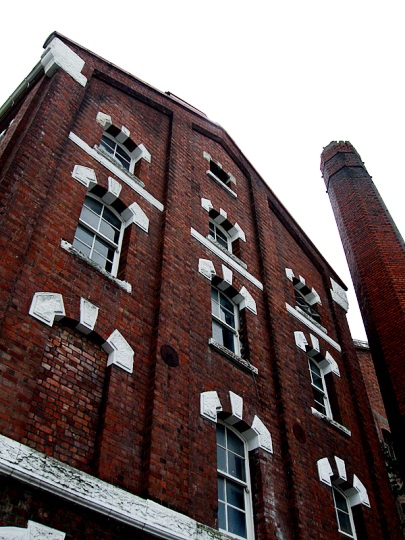
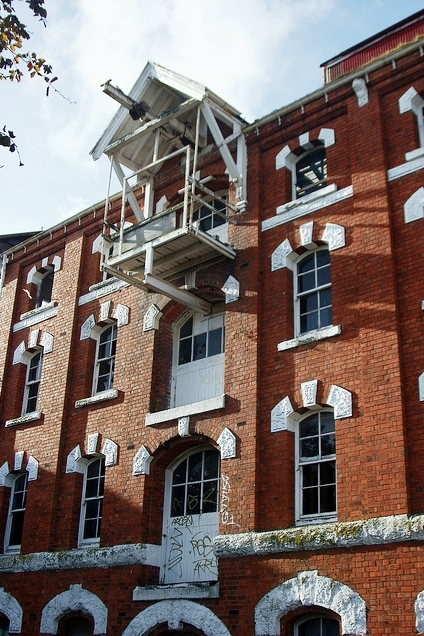
This historic place was registered under the Historic Places Act 1993. The following text is from the original Recommendation for Registration considered by the NZHPT Board at the time of registration. The following comments are made in relation to the criteria identified under S.23(2) of the Historic Places Act 1993. a) The extent to which the place reflects important or representative aspects of New Zealand history: The history of flour milling can be traced back to Samuel Marsden's largely unsuccessful attempts to get Maori and missionaries to plant and mill wheat. The industry became especially important in Canterbury and North Otago, both of which shipped large quantities of product to northern markets. Unfortunately no comprehensive history of the milling industry exists. Wood's Mill was clearly a large enterprise, but its market share, contribution to technological innovation or sector leadership are impossible to quantify. b) The association of the place with events, persons or ideas of importance in New Zealand history: William Derisley Wood was born in Gipping Valley, Suffolk, in 1824, one of six sons in a family of millers which operated a mill at Great Blankenham. He sailed to New Zealand in 1850 to take a tuberculosis cure. As it turned out, he was not suffering from TB and lived to be 80. He served as Godley's provincial secretary and from 1852 to 1855 engaged in various farming and business ventures around Christchurch. Wood returned to England in 1856, where in just five weeks he married Anne Marie Wilson and acquired the machinery for a windmill, which he erected in Antigua Street, Christchurch later that year. That mill's limitations lead him to construct a larger one in Riccarton in 1861 on land that he first leased and then bought from John Deans. Wood converted that mill to roller operation in 1889, but when it, too, proved incapable of keeping up with demand, he moved his business to a new roller mill sited alongside the rail line at Addington in 1890/91. The Riccarton plant, sold initially to Richard Allen, passed into the hands of Invercargill's Fleming & Co. in 1918 and later the Northern Roller Milling Co., General Foods and Watties. It was demolished in the mid 1970s. Woods was also elected to the Christchurch City Council in 1875. g) The technical accomplishment or value, or design of the place: Wood's Flour Mill comprises six items of which five were built between 1891-1924, and one (the small Grain Silo) in 1960. The main building (1891) was designed by Joseph Maddison and extended by him with the addition of two more bays in 1896-98. Maddison's specialty was in the design of industrial buildings, particularly freezing works, and he was considered to be one of the chief exponents in this field in the nineteenth century. Wood's Mill is one of the most substantial surviving examples left of Maddison's pioneer industrial buildings. The 1924 extension, behind the main building, was for a new wheat cleaning system and was designed by the Luttrell Brothers. Sydney and Alfred Luttrell were as outstanding and well known as Maddison was for his industrial and commercial buildings. They were best known for their innovative use of reinforced concrete as a building material. Wood's Mill is a relatively early example of their industrial work in brick rather than concrete. The earliest buildings in the present complex demonstrate the Victorian concern for designing industrial buildings according to certain fashionable, eclectic architectural styles and stand as good and informative examples of industrial architecture of this period. As a large late nineteenth century industrial structure, the main building (1891) is elaborate in detailing. The second and fourth storeys are defined by string courses where the second storey string course, in particular, is executed in a heavy rusticated stone. The theme is picked up in the window arches of all the floors, and in the upper string course, where the rusticated detail is set out in half-relief on an ashlar base. The breaking up of the stone window arches on the upper floors into a pattern of three with a keystone in the centre and a brick voussoir arch in the interstices, creates an effect which has otherwise been described as the "Blood and Bandages" style of the middle to late Victorian era. There is also a brick hexagonal industrial chimney which appears to be contemporary with the main building. Wood's Mill has had its working machinery removed and therefore no longer functions as a working flour mill. Conclusion: Wood's Mill, Addington, Christchurch, is recommended for registration as a Category II as a place of historical and cultural heritage significance and value. The complex is unique as a complete group of half a dozen flour mill buildings, all original and showing clearly how the flour mill complex would have worked in its hey-day. The two main buildings are good examples of industrial buildings designed by prominent Christchurch architects Joseph Maddison and the Luttrell Brothers.
Why is this place significant?
Historic Significance
Historical Significance or Value This historic place was registered under the Historic Places Act 1993. The following text is from the original Recommendation for Registration considered by the NZHPT Board at the time of registration. The beginnings of Wood Brothers Ltd can be traced back to Suffolk, where William Derisley Wood's family was involved with flour milling. Wood arrived in Christchurch in 1850, serving as Godley's provincial secretary before setting up his first mill, a wind-powered plant, in Antigua Street during the mid 1850s. Still nights limited that mill's efficiency and Wood set up a new mill at Riccarton. He converted that mill to roller operation in 1889, but when it proved incapable of keeping up with demand, Wood moved his business to a new roller mill sited alongside the rail line at Addington in 1890/91. The complex, expanded over time and equipped with modern buildings and machinery, produced flour under the 'Imperial' brand name. Woods closed in 1970. Leased out after that, it was acquired by tenant baker Clive Brooker in the 1980s. In recent years the redundant complex has been developed for cultural, social and residential users.
Physical Significance
This historic place was registered under the Historic Places Act 1993. The following text is from the original Recommendation for Registration considered by the NZHPT Board at the time of registration. Architectural: Wood's Mill consists of six built items constructed between 1891-1960 which were all directly associated with the manufacture of flour at the mill, and therefore functionally related in a technical design sense. Associated with the main building is the landmark grain silo (1913) which exhibits quite a different aesthetic owing a great deal to the contemporary ideas of the time about industrial architecture. The rectangular gable ended structure with strong vertical brick piers is European in design.
Why is this place Category 1 / Category 2?
Detail Of Assessed Criteria
This historic place was registered under the Historic Places Act 1993. The following text is from the original Recommendation for Registration considered by the NZHPT Board at the time of registration. The following comments are made in relation to the criteria identified under S.23(2) of the Historic Places Act 1993. a) The extent to which the place reflects important or representative aspects of New Zealand history: The history of flour milling can be traced back to Samuel Marsden's largely unsuccessful attempts to get Maori and missionaries to plant and mill wheat. The industry became especially important in Canterbury and North Otago, both of which shipped large quantities of product to northern markets. Unfortunately no comprehensive history of the milling industry exists. Wood's Mill was clearly a large enterprise, but its market share, contribution to technological innovation or sector leadership are impossible to quantify. b) The association of the place with events, persons or ideas of importance in New Zealand history: William Derisley Wood was born in Gipping Valley, Suffolk, in 1824, one of six sons in a family of millers which operated a mill at Great Blankenham. He sailed to New Zealand in 1850 to take a tuberculosis cure. As it turned out, he was not suffering from TB and lived to be 80. He served as Godley's provincial secretary and from 1852 to 1855 engaged in various farming and business ventures around Christchurch. Wood returned to England in 1856, where in just five weeks he married Anne Marie Wilson and acquired the machinery for a windmill, which he erected in Antigua Street, Christchurch later that year. That mill's limitations lead him to construct a larger one in Riccarton in 1861 on land that he first leased and then bought from John Deans. Wood converted that mill to roller operation in 1889, but when it, too, proved incapable of keeping up with demand, he moved his business to a new roller mill sited alongside the rail line at Addington in 1890/91. The Riccarton plant, sold initially to Richard Allen, passed into the hands of Invercargill's Fleming & Co. in 1918 and later the Northern Roller Milling Co., General Foods and Watties. It was demolished in the mid 1970s. Woods was also elected to the Christchurch City Council in 1875. g) The technical accomplishment or value, or design of the place: Wood's Flour Mill comprises six items of which five were built between 1891-1924, and one (the small Grain Silo) in 1960. The main building (1891) was designed by Joseph Maddison and extended by him with the addition of two more bays in 1896-98. Maddison's specialty was in the design of industrial buildings, particularly freezing works, and he was considered to be one of the chief exponents in this field in the nineteenth century. Wood's Mill is one of the most substantial surviving examples left of Maddison's pioneer industrial buildings. The 1924 extension, behind the main building, was for a new wheat cleaning system and was designed by the Luttrell Brothers. Sydney and Alfred Luttrell were as outstanding and well known as Maddison was for his industrial and commercial buildings. They were best known for their innovative use of reinforced concrete as a building material. Wood's Mill is a relatively early example of their industrial work in brick rather than concrete. The earliest buildings in the present complex demonstrate the Victorian concern for designing industrial buildings according to certain fashionable, eclectic architectural styles and stand as good and informative examples of industrial architecture of this period. As a large late nineteenth century industrial structure, the main building (1891) is elaborate in detailing. The second and fourth storeys are defined by string courses where the second storey string course, in particular, is executed in a heavy rusticated stone. The theme is picked up in the window arches of all the floors, and in the upper string course, where the rusticated detail is set out in half-relief on an ashlar base. The breaking up of the stone window arches on the upper floors into a pattern of three with a keystone in the centre and a brick voussoir arch in the interstices, creates an effect which has otherwise been described as the "Blood and Bandages" style of the middle to late Victorian era. There is also a brick hexagonal industrial chimney which appears to be contemporary with the main building. Wood's Mill has had its working machinery removed and therefore no longer functions as a working flour mill. Conclusion: Wood's Mill, Addington, Christchurch, is recommended for registration as a Category II as a place of historical and cultural heritage significance and value. The complex is unique as a complete group of half a dozen flour mill buildings, all original and showing clearly how the flour mill complex would have worked in its hey-day. The two main buildings are good examples of industrial buildings designed by prominent Christchurch architects Joseph Maddison and the Luttrell Brothers.
Historical and Associated Iwi / Hapū / Whānau
Information Sources
Christchurch Press
Christchurch Star
Christchurch Star
Thornton, 1982
Geoffrey G. Thornton, New Zealand's Industrial Heritage, A.H. & A.W. Reed, Wellington, 1982
Other Information
A copy of the original report is available from the NZHPT Southern region office. Please note that entry on the New Zealand Heritage List/Rarangi Korero identifies only the heritage values of the property concerned, and should not be construed as advice on the state of the property, or as a comment of its soundness or safety, including in regard to earthquake risk, safety in the event of fire, or insanitary conditions.
Historical and Associated Iwi / Hapū / Whānau
Information Sources
Christchurch Press
Christchurch Star
Christchurch Star
Thornton, 1982
Geoffrey G. Thornton, New Zealand's Industrial Heritage, A.H. & A.W. Reed, Wellington, 1982
Other Information
A copy of the original report is available from the NZHPT Southern region office. Please note that entry on the New Zealand Heritage List/Rarangi Korero identifies only the heritage values of the property concerned, and should not be construed as advice on the state of the property, or as a comment of its soundness or safety, including in regard to earthquake risk, safety in the event of fire, or insanitary conditions.
