Current Description
Setting
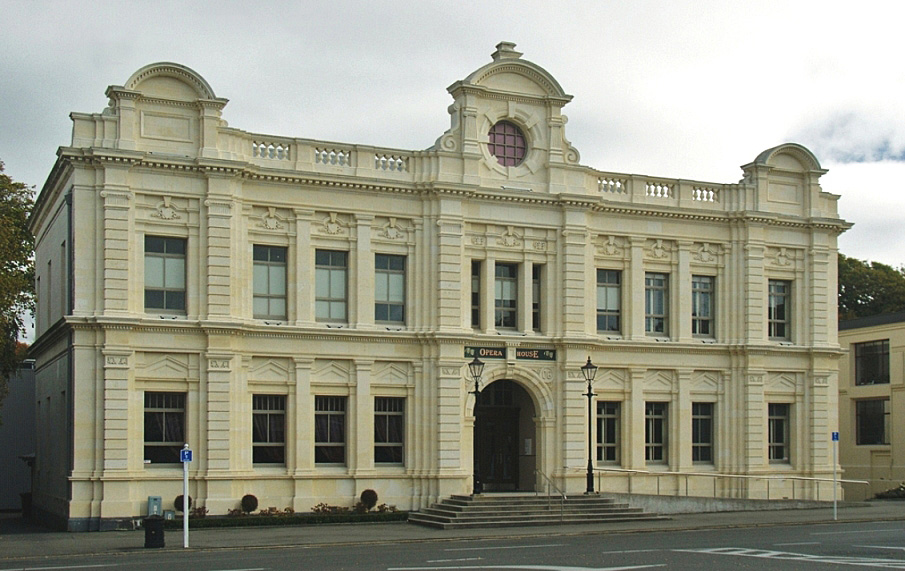
Oamaru Town Hall and Opera House sits on the west side of Thames Street, the main thoroughfare of Oamaru. The west side of Thames Street between Severn Street and Oamaru Creek is the site of the grand civic and government buildings in Oamaru, as well as striking commercial buildings. With the Fallen Trooper’s Memorial and the World War One Memorial marking either end, this is an outstanding townscape, within which the Oamaru Town Hall and Opera House make a special contribution – confirming the town’s identity with its heart of stone – the civic representation of Oamaru’s identity.
Conservation architect Chris Cochran writes that ‘the aesthetic value of the Oamaru Opera House is very high, both for its architectural design and for its townscape value.’ He states that the building ‘is a significant example nationally of the Edwardian Baroque style, a bold and assertive design that proclaims the prosperity and pride of the town of Oamaru.’ Cochran considers the quality of John Megget Forrester’s work and architectural legacy as nationally significant.
Cochran writes that the building is a landmark – an ‘imposing termination’ to the views west from Wear Street, ‘impressive in size, yet in scale with its neighbours’ and continuing the Classical theme of nearby buildings. The building is a ‘significant building in an area of very great heritage significance’, and ‘strengthens the character of the area (Thames Street from the Severn Street to Itchen Street intersections) perhaps more than any other single building.’
Exterior
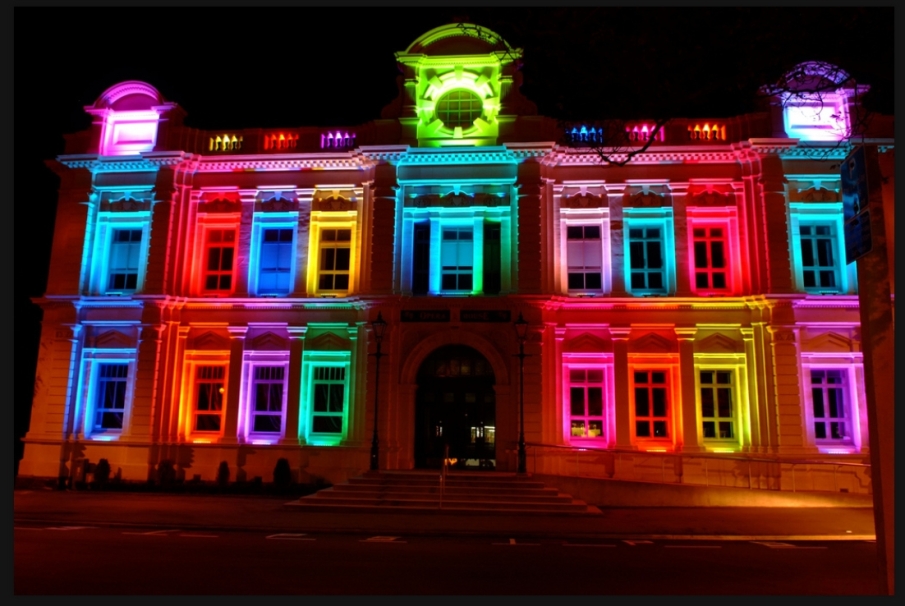
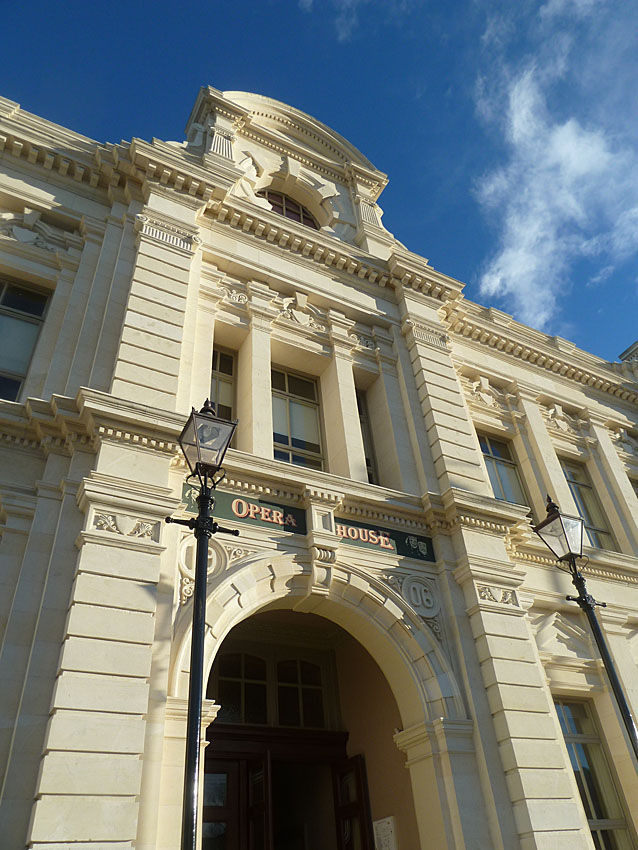
The main elevation on Thames Street faces east. It is symmetrical about the central arched doorway, which stands forward from the main line of the façade, and is flanked by a pavilion at each end. The central section and the two end pavilions have rusticated pilasters, giving them a prominence against the plain pilasters that separate the windows; the pavilions are dominated by high pediments with segmental arches, at the central one with a circular oriel window and with volutes on either side. The circular window now features the coat of arms of the town; the original window (still intact in the roof space) was a simple geometric pattern of squares.
Horizontally the face is divided by a strong base, a first-floor cornice, and a roof cornice with dog-tooth moulding; an open balustrade finishes the building at roof level, linking the three pediments. Within this framework, there is rich Classical decoration, especially in the capitals of the pilasters, and the pediments over the windows. The ground floor pediments are triangular, while those of the first floor are segmental arches with keystones and ornamented shields; all the windows are set within reveals of stepped pilasters, giving a strongly modulated, three-dimensional character to the façade.
The side and rear facades are severely plain, with only the simplest of moulding used to finish the stonework at eaves level. The Edwardian Baroque styling is characterised by Classical elements used in a free and original manner; bold details, shapes and forms; a strong roof silhouette, but with the order, logic and symmetry of the Classical style.
The building is load-bearing stone masonry with walls up to 450mm thick and to a height of 17.5 metres around the flytower. The stone is Oamaru limestone, specified as ‘Gays XL’ locally quarried. The stone face shows outside, while inside, the stonework is plastered and painted. Significant structural elements of the building are built in in-situ concrete.
The roof trusses that span the full width of the auditorium, approximately 18 metres, are steel with riveted connections, the western-most truss has the words ‘J Jack Engineer’ painted on one of the chords. The trusses over the fly tower are built of timber components. The roof to the front is timber-framed and supported by the wall partitions below.
Floors are laid in tongue and groove timber. The circle floor is framed in timber and supported on ten cast iron columns.
Cochran describes the ‘very distinct technical value in the structure of the building – as a large-scale load-bearing masonry structure. The building provides evidence of stonemasonry, materials, methods and construction techniques from the early twentieth century. Also of technical value are the steel roof trusses, the concrete foundations and proscenium beam, the timber construction of floors and roofs, as well as the timber joinery and decorative plasterwork. While there has been change, the change has been gradual and has maintained the building’s technical value.’
Plan
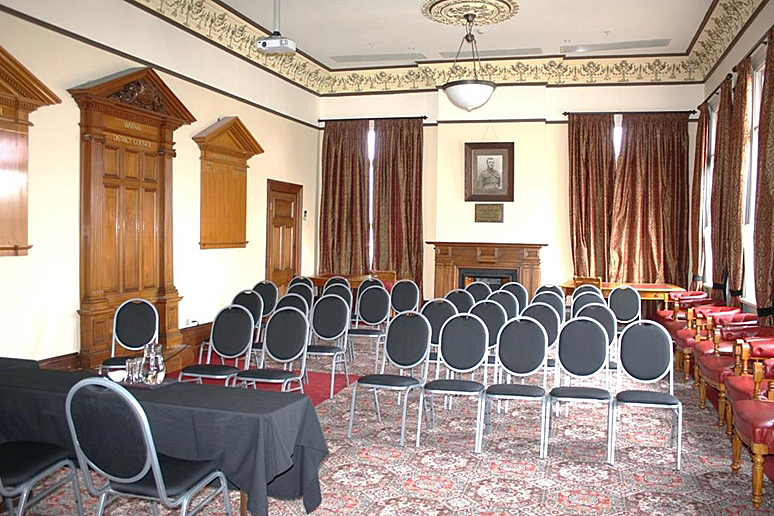
Inside, the ground floor foyer space is largely modern and fills most of the space to the left of the entrance, where it has been used as a café space. A small foyer to the right gives access to a space created for a theatre. From the foyer, stairs go down to the stalls in the auditorium, and up to the circle. The stairwell is an impressive space – with the stairs dividing into two flights and coming together again at the circle foyer. Another flight leads on up to the Council Chamber and the mayor’s office to the right, and the Municipal offices to the left.
The stairs link the offices and the auditorium. The stalls were divided into orchestral stalls, stalls and pit (under the circle). The circle is supported on 10 cast iron columns and wraps around the auditorium in a horse-shoe shape, to finish against the proscenium wall on either side of the stage. The circle balustrade is richly embellished in plasterwork.
The proscenium arch frames a deep stage. There is an orchestra pit which has been floored over. The fly tower rises above the stage floor. The back stage and flys were modernised in 2009 as part of the redevelopment.
The building is heated with piped hot water to cast iron radiators – some of the original radiators are still in place. When the building opened the front office part was lit by gas, while the auditorium and the back stage were lit electrically.
Comparative Analysis
Town Halls as a Building Type
Like their British antecedents, New Zealand towns and cities had places for public meetings and where public affairs could be administered. In England, the history of town halls in the nineteenth century is linked to the Municipal Reform Act of 1835. With the creation of municipal boroughs and their associated administering authority, came the need for a place for officials to meet and work. Some towns adapted existing buildings while others commissioned new buildings, buildings that city fathers saw as representing and promoting the ‘wealth, culture and independent standing of their cities and improve the morals and taste of their inhabitants’, while also outdoing rival towns – civic pride as a competitive sport.
Democracy and architecture have been linked – town halls have provided the spaces for citizens or their representatives to make decisions and the buildings are representations of the value of democracy, a ‘reminder of the aspirations of nations and their values.’ The form of town halls was not dictated by their function, but the representation of the importance of democracy. Many such buildings use classical styles – harking back to the prestige of classical architecture and its association ‘with the democratic republican character of Athens and Ancient Rome.’ The form of the debating chambers also varied, with many British or colonial town halls adopting adversarial chambers with facing sets of benches. Local town halls ‘embody the ideal of local, more or less democratic self-rule.’
Colonial towns, like the fast developing British industrial towns, created ‘identifiable civic buildings signifying the very city itself.’ In the Victorian and Edwardian periods, town halls had certain key elements ‘a grand entrance hall and stair, mayor reception room, council chamber, committee rooms, offices as a minimum, with other civic and culture amenities added, such as public halls, auditoriums for lectures, festivities, sometimes also libraries, museums, galleries or fire stations.’ Town halls were prominently located and imposing, often with a clock tower. Such buildings were also to be architecturally up to date – Britain saw ‘the emergence of a more eclectic style bringing together different elements – Gothic, French Renaissance, Tudor, Jacobean and Queen Anne – in increasingly ornate facades.’ The eclectic style gave way to ‘Edwardian baroque’ and after the First World War was replaced by stripped-down classicism.
Architectural historian Colin Cunningham writes that ‘[l]ooking back, it is tempting to dismiss 19th and early 20th century town halls as essentially patrician institutions, more about pomp and display than democracy. But these buildings were always highly ambiguous. Certainly, the municipal government of this period was a relatively patrician affair – Victorian councils were dominated either by wealthy local businessmen or the established professional classes – and this was reflected in their architecture. The buildings were commissioned and often financed by the urban elite who had first claim over them. Public galleries…were set apart from the council chamber proper and usually accessed through a concealed spiral stair or attic passage. Council meetings were extremely formal, intimidating affairs, with not only the mayor but aldermen and councillor attending ‘in state’, committee meetings were hardly more welcoming. The division between patricians and plebeians, moreover, was often extended to other parts of the building [for example separate offices of relief of the poor].’
The nature of democracy changed and by the end of the nineteenth century, the councils were ‘elected by an increasingly broad franchise and councillors themselves were by no means all upper class. Moreover charges for the buildings’ main amenities…were subsidised, bringing ‘the buildings into the daily ambience of many, indeed most, of the townspeople.’ ‘The main meeting hall, in particularly, was used by almost all sectors of the town.’ Even those built as concert halls hosted political gatherings, or civil events.
‘World War One brought to an end of the great era of town hall building. The classes who dominated local government had lost a little of both their money and confidence and demands on the public purse had grown.’ Town halls continued to be built but they tended to make more provision for offices and less provision for public facilities, and the exuberant architecture gave way to more austere styles. ‘Revealingly, some of these new constructions called themselves not town halls but ‘municipal offices.’ The twentieth century has seen councils less ‘states within a state’ and associated buildings have added little to the ‘civic realm.’ ‘The arrival of the car led to council headquarters often being placed away from the city centre….Civic halls found it hard to compete with the attractions of cinema, TV and the spacious centrally-heated home. Added to which, the sheer size of the bureaucracy they had to house changed their nature, overshading political and civic activities and squeezing out cultural ones. Originally conceived as grand council chambers with offices attached, town halls now become offices adjoined by a modest council chamber.’
In New Zealand, Category 1 town halls are recognised for their special architectural, townscape, social and historical values. The most prominent and well known are in cities – Auckland’s Town Hall (1909-11); Dunedin Municipal Chambers (List Entry No. 2197); Christchurch’s Municipal Chambers (Former) (List Entry No. 1844); and Wellington Town Hall (List Entry No. 3275).
Like their grander city relations, the Category 1 provincial town halls/municipal chambers represent the social and community history, civic administration, and status of the smaller towns. They are recognised for their architectural style and contribution to local affairs. Some, like the Port Chalmers Municipal Buildings, represent the multi-purpose facilities typical of nineteenth century civic buildings – with its fire station, customs department, court facility and council chambers. Others are special examples of architectural styles – such as Westport’s superb Moderne Municipal Chambers.
The closest comparison to Oamaru’s Town Hall and Opera House is the Category 1 Invercargill Town Hall and Civic Theatre, opened in 1906, a year earlier than Oamaru’s new building, which resembles it. Architecture and arts writer Peter Shaw writes that Forrester’s design is most closely related to E.R. Wilson’s design. Like Forrester’s design, Wilson’s building provides for a town hall and theatre. Like Wilson’s design, Forrester’s makes a strong statement in the townscape – promoting the civic identity of Oamaru. Shaw describes Forrester’s composition – ‘[a] towering central pediment which dominates the façade has rusticated pilasters repeated on the two end bays; elsewhere decoration is more restrained though hardly deserving the faint praise sometimes given this building.’ Shaw believes that perhaps people were misled by the ‘Opera House’ in the title.
Compared to the Category 2 places on the Heritage New Zealand List, the Oamaru Town Hall and Opera House is grander, larger scale, and has a stronger street presence. It is a key building in this already outstanding townscape, and as such entry on the List as a Category 1 historic place is appropriate.
Examples of Category 1 Town Halls/Municipal Chambers – Main Cities
Auckland Town Hall (List Entry No. 549)
The Town Hall (built 1910-11) is a prominent civic landmark in the heart of commercial Auckland. Its grand architectural style is Imperial Baroque, the exterior combining stone and early reinforced concrete.
Wellington Town Hall (List Entry No. 3275)
This is Wellington's second town hall (built 1902-04). The main auditorium (and the concert chamber, until its demolition) has been used for a remarkably diverse range of activities.
Municipal Chambers (List Entry No. 2197, Category 1)/ Dunedin Town Hall and Concert Chamber (List Entry No. 2150, Category 2)
The Municipal Chambers upon its completion in 1880 was the most impressive town hall in New Zealand reflecting Dunedin's economic prosperity at the time, and is a major work by an architect of national importance.
Municipal Chambers (Former), Christchurch (List Entry No. 1844, Category 1)
The former Municipal Chambers building was erected in 1886-1887 as chambers and offices for the Christchurch City Council, and is a rare example of a town hall built in the Queen Anne style.
Category 1 Town Halls and Municipal Chambers – Provincial Centres
Invercargill Town Hall and Civic Theatre (List Entry No. 2521, Category 1)
The Invercargill Town Hall and Civic Theatre is a prominent landmark on one of Invercargill's main streets. It officially opened in November 1906 and was built for the local council, which had previously been housed in the former Southland Provincial Council Chambers. The combination of city hall and the up-to-date theatre was seen as unusual at the time of the building's opening. The Town Hall and Civic Theatre play an important part in Invercargill's social and cultural life and the building is historically significant as the centre of city governance for most of the twentieth century. It is architecturally significant as a fine Edwardian Baroque building and an impressive part of the Tay Street townscape.
Hastings Municipal Buildings (List Entry No. 177, Category 1)
The buildings, constructed in 1916, are of very considerable historical significance as the civic and administrative centre of Hastings for a period of sixty years.
Municipal Chambers, Westport (List No. 5000, Category 1)
Built for the Westport Borough Council in 1938-1941, the Municipal Chambers are the most distinctive architectural feature in Westport today.
Port Chalmers Municipal Chambers (List Entry No. 4373, Category 1)
The building (constructed 1888-89) was designed as a combined government and local body office. It originally housed Customs, the Police, Fire Brigade offices, the Court House, Town Hall and Borough Council Chamber and offices.
Buller County Council Chambers, Westport (List Entry No. 5001, Category 1)
The former Buller County Council (built 1940) is a modestly proportioned building which enhances the low-rise character of Westport's main thoroughfare, Palmerston Street, and introduces an element of variety to the local streetscape.
Category 2 Town Halls/Municipal Chambers
Category 2 town halls tend to be smaller with modest facilities and less architectural presence than their Category 1 counterparts. Compared with these halls, the Oamaru Town Hall and Opera House is grand, has a special role in the streetscape of Oamaru and is the town’s chosen expression of its civic value in stone. This is particularly important given Oamaru’s outstanding historic townscape. The examples shown below illustrate the typical scale and design of these buildings. Oamaru’s Town Hall and Opera House has more in common with the Category 1 buildings illustrated above.
Cambridge Town Hall (List Entry No. 4187, Category 2)
Designed by Arthur Bibra Herrold, who by 1908 was practising architecture in Auckland, winning a competition for the design of Cambridge Town Hall (erected 1909).
Clyde Town Hall and Public Library (List No. 2367, Category 2)
The former Clyde Town Hall built in 1869, and the former Clyde Public Library built in 1874 have historical, architectural and social significance.
Eltham Town Hall (List Entry No. 7127, Category 2)
An important building within the community of Eltham, the town hall (built 1910) is distinguished by its size and function, and by what was originally an impressive façade.
Lakes County Council Chambers (Former), Queenstown (List Entry No. 2337, Category 2)
The former Lake County Council Chambers (built 1881) is a prominent and striking building with aesthetic, architectural, historical, and social significance.
Rangiora Town Hall (List Entry No. 3788, Category 2)
The Town Hall is a prominent civic landmark constructed in 1925-6 in the commercial heart of the rural North Canterbury town of Rangiora. The building has historic significance, demonstrating the profile of civic government in the inter-war years in provincial New Zealand.
Waverley Town Hall (List Entry No. 944, Category 2)
The Waverley Town Hall (built 1908) is a local landmark, reflecting people's confidence and pride in their town and district, and the hall has contributed enormously to the identity of the area.
Council Chambers and Fire Station (Former), Grey Lynn (List Entry No. 572, Category 2)
The former Council Offices and Fire Station (built 1889) in Grey Lynn, Auckland is an unusual example of a dual-purpose municipal building whose striking design represents an expression of civic pride.