

List Entry Information
Status
Listed
List Entry Status
Historic Place Category 1
Access
Private/No Public Access
List Number
7418
Date Entered
20th February 1998
Date of Effect
20th February 1998
City/District Council
Wellington City
Region
Wellington Region
Legal description
part of Lots 8 & 9, DP 1660
Status
Listed
List Entry Status
Historic Place Category 1
Access
Private/No Public Access
List Number
7418
Date Entered
20th February 1998
Date of Effect
20th February 1998
City/District Council
Wellington City
Region
Wellington Region
Legal description
part of Lots 8 & 9, DP 1660
Why is this place significant?
Historic Significance
Historical Significance or Value This historic place was registered under the Historic Places Act 1993. The following text is from the original Historic Place Assessment Under Section 23 Criteria report considered by the NZHPT Board at the time of registration. Historical: C&A. Odlin Ltd was established in 1903. The company developed as a partnership between Wellington builder, Charles Odlin and his younger brother, Alfred. Sons of Wellington builder, John Odlin, the brothers built up C&A. Odlin from Charles's timber merchant's business, which was operating from a site in Jervois Quay in 1906 when the Wellington Harbour Board offered leases on reclaimed land in Cable Street. The rapidly-expanding firm secured a lease and embarked on the construction of a large, five-storey building to house, amongst other things, a new hardware business being built up on the recently-acquired hardware assets of Herron, Raine and Hodder. Odlins became a public company in 1907 and continued to grow rapidly. The company expanded considerably over the next 50 years, diversifying into timber milling, house building, joinery manufacturing and electrical retailing through a range of subsidiaries. After surviving a hostile takeover bid from New Zealand Forest Products in 1983, C&A. Odlin Ltd was taken over by Winstones in 1985 and on-sold by Brierley Investments Ltd 18 months later, by which time the Odlins name had disappeared from public notice. The Cable Street building played an important role in this history of the company, serving as its headquarters from 1907 until the early 1970s in addition to housing retailing and warehouse activities.
Physical Significance
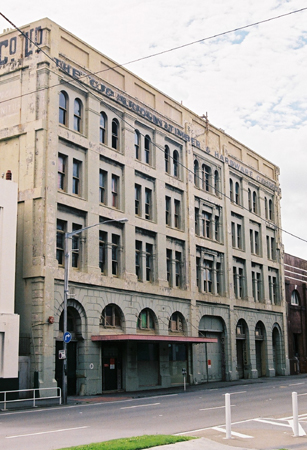
This historic place was registered under the Historic Places Act 1993. The following text is from the original Historic Place Assessment Under Section 23 Criteria report considered by the NZHPT Board at the time of registration. Aesthetic: Very few registered Victorian/Edwardian warehouse buildings are to be found today that are still contained within their original environment or streetscape. As a group, the Italianate warehouses located within the Britomart area of Auckland can still be seen more or less within their original environment. The warehouses located in Harbour/Tyne streets in Oamaru are another group of buildings which can be seen in an entirely original context. The Odlins Building is also favourably placed in this regard insofar as its immediate neighbours (particularly Shed 22 adjacent, which picks up the same architectural rhythms as the Odlins building) are historic buildings from the two decades immediately following the building of Odlins. The result is that a definite sense of the turn of the century commercial warehouse environment on the Wellington waterfront has been preserved by the continued existence of the Odlins Building. Architectural: The Odlins Building was designed in the Edwardian Warehouse style of the period 1901-1915. Style indicators are: - Rectangularity of facade emphasised by treatment of parapet or cornice. - Strongly emphasised pier. - Strongly emphasised arch on window heads and entrances. - Plain or plastered face brickwork. - Flat spandrels recessed behind plane of piers. - Strongly emphasised base in rusticated form. - Restrained classical detailing on piers and archways.
Why is this place Category 1 / Category 2?
Detail Of Assessed Criteria
This historic place was registered under the Historic Places Act 1993. The following text is from the original Historic Place Assessment Under Section 23 Criteria report considered by the NZHPT Board at the time of registration. a) The extent to which the place reflects important or representative aspects of New Zealand history: The Odlins Building was built in 1906 for C&A. Odlin Ltd, a Wellington-based business which operated in the sawmilling, construction and retailing sectors, all important to New Zealand's commercial history. There is no independent guide to the relative importance of the company, which published its own histories in 1957 and 1977. While clearly smaller than the two transnational giants, New Zealand Forest Products (later Fletcher Challenge) and Carter Holt Harvey, Odlins was a significant operator, which built up an extensive network of subsidiary companies and outlets throughout the North Island and Nelson. In his History of New Zealand Forestry, John Roche observes that Odlins expanded during the 1960s at the same time as Fletchers. By the late 1970s, the group had over 1,200 staff. Fletcher launched an unsuccessful $65 million takeover bid for Odlins in 1983, which was withdrawn when NZFP shares came under assault from Watties and the Goodman Group. Two years later control passed to Winstones, then through BIL to Fletchers. In significance, C&A. Odlins may be equivalent to John Edmond & Co., a mainly South Island-based chain of timber merchants and retailers. No New Zealand building better symbolises the history of the company. It was built for Odlins soon after the company's formation, was a surprisingly substantial investment for such a young company, was a rare private sector warehouse on the Wellington Harbour Board's waterfront and served as the company's headquarters for all but the last decade or so of its history. It is the only surviving private Edwardian commercial/industrial building left on the waterfront. (b) The association of the place with events, persons, or ideas of importance in New Zealand history: Events: No events of significance are known to have been associated with this building apart from the normal practices of commercial. Persons: The Odlins Building is an important reminder of the C&A. Odlin Ltd group of companies. This company grew out of the pre-1900 activities of John Odlin and his sons, of whom Charles and Alfred would be the driving force behind C&A. Odlin Ltd. The new company grew vigorously, securing the choice WHB leasehold site near Cable Street, building this large waterfront building, listing publicly and going on until the mid 1980s to build up a national portfolio of construction, sawmilling and retailing assets. Charles Camperdown Odlin (1876-1955) was born on the voyage out to New Zealand. He served as managing-Director until his death in 1955 and as Chairman from 1936 to 1955. In addition to his business activities, Charles Odlin supported the Wellington Free Ambulance Service, which erected its building alongside the Odlins Building in 1936. Alfred Ernest Odlin (1881-1969) served as secretary and director of C&A. Odlin Ltd and from the 1920s oversaw the expansion of Odlins into the Auckland market, serving as Chairman 1955-61. Ideas: Not applicable.
Why is this place significant?
Historic Significance
Historical Significance or Value This historic place was registered under the Historic Places Act 1993. The following text is from the original Historic Place Assessment Under Section 23 Criteria report considered by the NZHPT Board at the time of registration. Historical: C&A. Odlin Ltd was established in 1903. The company developed as a partnership between Wellington builder, Charles Odlin and his younger brother, Alfred. Sons of Wellington builder, John Odlin, the brothers built up C&A. Odlin from Charles's timber merchant's business, which was operating from a site in Jervois Quay in 1906 when the Wellington Harbour Board offered leases on reclaimed land in Cable Street. The rapidly-expanding firm secured a lease and embarked on the construction of a large, five-storey building to house, amongst other things, a new hardware business being built up on the recently-acquired hardware assets of Herron, Raine and Hodder. Odlins became a public company in 1907 and continued to grow rapidly. The company expanded considerably over the next 50 years, diversifying into timber milling, house building, joinery manufacturing and electrical retailing through a range of subsidiaries. After surviving a hostile takeover bid from New Zealand Forest Products in 1983, C&A. Odlin Ltd was taken over by Winstones in 1985 and on-sold by Brierley Investments Ltd 18 months later, by which time the Odlins name had disappeared from public notice. The Cable Street building played an important role in this history of the company, serving as its headquarters from 1907 until the early 1970s in addition to housing retailing and warehouse activities.
Physical Significance
This historic place was registered under the Historic Places Act 1993. The following text is from the original Historic Place Assessment Under Section 23 Criteria report considered by the NZHPT Board at the time of registration. Aesthetic: Very few registered Victorian/Edwardian warehouse buildings are to be found today that are still contained within their original environment or streetscape. As a group, the Italianate warehouses located within the Britomart area of Auckland can still be seen more or less within their original environment. The warehouses located in Harbour/Tyne streets in Oamaru are another group of buildings which can be seen in an entirely original context. The Odlins Building is also favourably placed in this regard insofar as its immediate neighbours (particularly Shed 22 adjacent, which picks up the same architectural rhythms as the Odlins building) are historic buildings from the two decades immediately following the building of Odlins. The result is that a definite sense of the turn of the century commercial warehouse environment on the Wellington waterfront has been preserved by the continued existence of the Odlins Building. Architectural: The Odlins Building was designed in the Edwardian Warehouse style of the period 1901-1915. Style indicators are: - Rectangularity of facade emphasised by treatment of parapet or cornice. - Strongly emphasised pier. - Strongly emphasised arch on window heads and entrances. - Plain or plastered face brickwork. - Flat spandrels recessed behind plane of piers. - Strongly emphasised base in rusticated form. - Restrained classical detailing on piers and archways.
Why is this place Category 1 / Category 2?
Detail Of Assessed Criteria
This historic place was registered under the Historic Places Act 1993. The following text is from the original Historic Place Assessment Under Section 23 Criteria report considered by the NZHPT Board at the time of registration. a) The extent to which the place reflects important or representative aspects of New Zealand history: The Odlins Building was built in 1906 for C&A. Odlin Ltd, a Wellington-based business which operated in the sawmilling, construction and retailing sectors, all important to New Zealand's commercial history. There is no independent guide to the relative importance of the company, which published its own histories in 1957 and 1977. While clearly smaller than the two transnational giants, New Zealand Forest Products (later Fletcher Challenge) and Carter Holt Harvey, Odlins was a significant operator, which built up an extensive network of subsidiary companies and outlets throughout the North Island and Nelson. In his History of New Zealand Forestry, John Roche observes that Odlins expanded during the 1960s at the same time as Fletchers. By the late 1970s, the group had over 1,200 staff. Fletcher launched an unsuccessful $65 million takeover bid for Odlins in 1983, which was withdrawn when NZFP shares came under assault from Watties and the Goodman Group. Two years later control passed to Winstones, then through BIL to Fletchers. In significance, C&A. Odlins may be equivalent to John Edmond & Co., a mainly South Island-based chain of timber merchants and retailers. No New Zealand building better symbolises the history of the company. It was built for Odlins soon after the company's formation, was a surprisingly substantial investment for such a young company, was a rare private sector warehouse on the Wellington Harbour Board's waterfront and served as the company's headquarters for all but the last decade or so of its history. It is the only surviving private Edwardian commercial/industrial building left on the waterfront. (b) The association of the place with events, persons, or ideas of importance in New Zealand history: Events: No events of significance are known to have been associated with this building apart from the normal practices of commercial. Persons: The Odlins Building is an important reminder of the C&A. Odlin Ltd group of companies. This company grew out of the pre-1900 activities of John Odlin and his sons, of whom Charles and Alfred would be the driving force behind C&A. Odlin Ltd. The new company grew vigorously, securing the choice WHB leasehold site near Cable Street, building this large waterfront building, listing publicly and going on until the mid 1980s to build up a national portfolio of construction, sawmilling and retailing assets. Charles Camperdown Odlin (1876-1955) was born on the voyage out to New Zealand. He served as managing-Director until his death in 1955 and as Chairman from 1936 to 1955. In addition to his business activities, Charles Odlin supported the Wellington Free Ambulance Service, which erected its building alongside the Odlins Building in 1936. Alfred Ernest Odlin (1881-1969) served as secretary and director of C&A. Odlin Ltd and from the 1920s oversaw the expansion of Odlins into the Auckland market, serving as Chairman 1955-61. Ideas: Not applicable.
Historical and Associated Iwi / Hapū / Whānau
Completion Date
30th October 1997
Report Written By
Gavin McLean
Other Information
A copy of the original report is available from the NZHPT Central region office Please note that entry on the New Zealand Heritage List/Rarangi Korero identifies only the heritage values of the property concerned, and should not be construed as advice on the state of the property, or as a comment of its soundness or safety, including in regard to earthquake risk, safety in the event of fire, or insanitary conditions.
Historical and Associated Iwi / Hapū / Whānau
Completion Date
30th October 1997
Report Written By
Gavin McLean
Other Information
A copy of the original report is available from the NZHPT Central region office Please note that entry on the New Zealand Heritage List/Rarangi Korero identifies only the heritage values of the property concerned, and should not be construed as advice on the state of the property, or as a comment of its soundness or safety, including in regard to earthquake risk, safety in the event of fire, or insanitary conditions.
Former Usages
General Usage: Trade
Specific Usage: Warehouse/storage area
Former Usages
General Usage: Trade
Specific Usage: Warehouse/storage area
Location
Sign up to hear more
Get the latest heritage news, features and events delivered
straight to your inbox.
