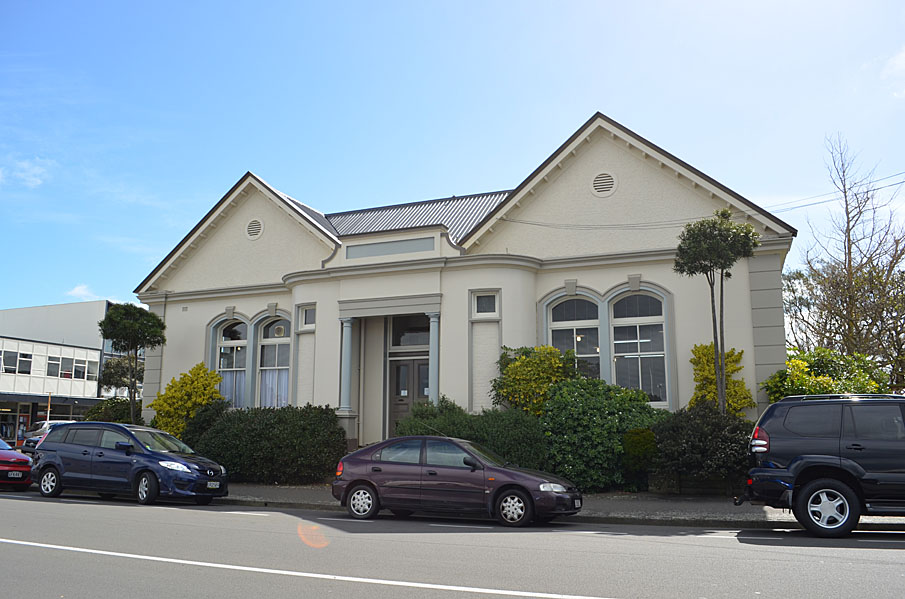
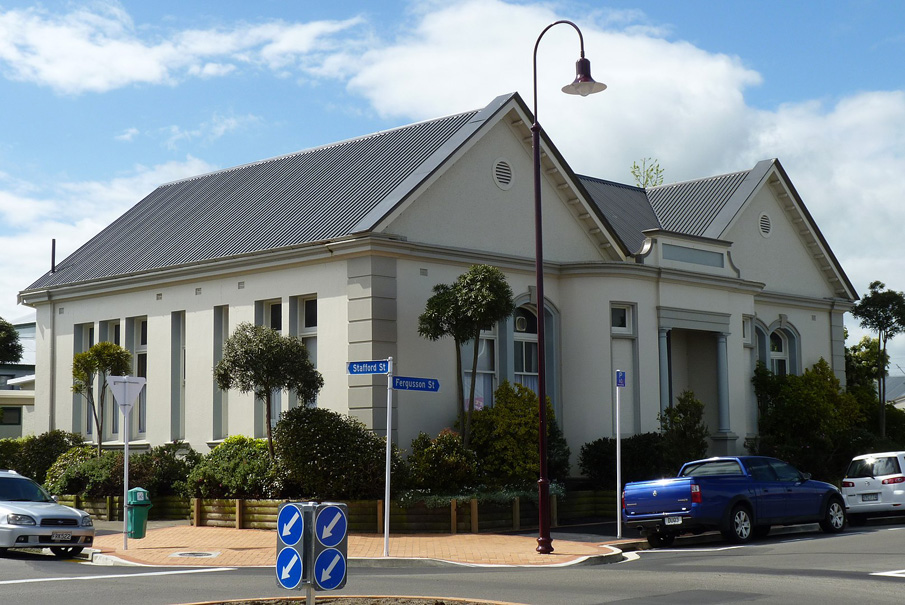
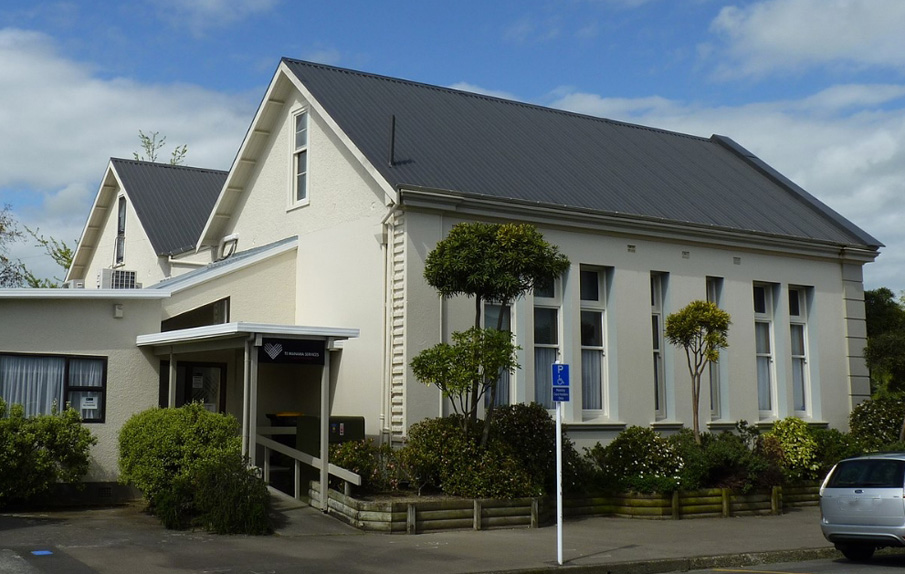
The Feilding Community Centre, New Zealand's first community centre, was established in 1938 as a social experiment in adult, rural education. The experiment commenced in a building that was constructed close to the town centre in 1907 and officially opened as the Feilding Technical School the following year. Technical Schools were part of a programme designed by the New Zealand Government to supplement the academic syllabus taught in secondary schools. Designed to 'be in accord with actual life', technical schools taught subjects such as science, art, cookery and woodwork.
The Feilding Technical School building was typical of those erected for the purpose in the early 1900s. It had two large classrooms, a kitchen and two offices on the ground floor, and one large space that could be subdivided on the upper storey. The School was designed by the architect for the Wanganui Education Board, Thomas Harvey James, and was constructed by building contractor William Wilkinson. Originally two storeys high, the building was made from red brick and had cream-coloured plaster facings. Designed in the Edwardian Free Classical style that was then popular, it featured elements such as pedimented gables and an elegant staircase just inside the elaborate entranceway.
The Feilding Technical School was a success and by 1921 the school was forced to expand into premises on the outskirts of town. The use of the Technical School building gradually diminished. Following the Hawke's Bay earthquake of 1931, the building's spacious upper storey was removed, further limiting its use. In 1938 the building's role as an education centre was revived. It became New Zealand's first 'community centre'.
A new concept in New Zealand, community centres were commonly used overseas to foster learning opportunities outside of the school environment. Promoted by the principal of the Feilding Agricultural High School, Leonard John Wild (1889-1970), the concept was well received by the then Minister of Education Peter Fraser (1884-1950), who supplied the funds necessary for the 'bold experiment'. A married couple, Hugh Crawford Somerset (1895-1968) and Gwendolen Lucy Somerset (1894-1988) were appointed as co-directors of the centre. Under the directorship of the Somersets, both of whom are recognised for their important contributions to the development of New Zealand's education system, the Feilding experiment flourished.
Existing clubs and societies were invited to use the premises as a base for their activities while the Somersets and their successors established a variety of well-attended classes and workshops in areas such as drama, art appreciation, domestic economy and physical welfare. Of particular importance was Gwendolen Somerset's decision to run classes for parents on parenting and child psychology and to offer care facilities for their children during each session. The classes were the forerunner of the New Zealand Playcentre movement. Somerset, appointed an MBE for her work in 1965, is responsible for the Playcentre movement's philosophy that children reach their fullest potential when their parents understand their development and take part in their learning.
By 1946 over 50 communities had made preliminary approaches to the government to found community centres and a number were established throughout the country. Yet in the 1950s there was a change in policy towards adult education. Government support for the community centre scheme declined and by 1962 the Feilding Community Centre was forced to fight for the funding needed to keep the centre functioning. The centre revived in the early 1970s when renewed interest was shown in rural, adult education. In 1978 the Feilding Community Centre took part in the government-established Rural Education Activities Programme (REAP). Today the building, commonly known as the Feilding Community Learning Centre, continues to serve the changing needs of Feilding residents. Yet, due to the proposed sale of the building by its current owner, the Manawatu District Council, the future of the Centre remains uncertain.
The Feilding Community Centre has national significance as the first community centre in New Zealand. It was the site of a social experiment intended to reform rural, community education. As such, the history of the building provides an important and unique insight into government policy and direction in the 1930s and 1940s. The building's long association with rural educational reform adds to its importance. Constructed in 1907 as a technical school, the building serves as a physical reminder of the changing governmental responses to the needs of the rural community throughout the twentieth century. The building is also noteworthy for its association with eminent education specialists, Hugh and Gwendolen Somerset. The Centre is particularly important for its role fostering Gwendolen Somerset's principles about childcare, which were later adopted by the Playcentre movement. The Feilding Community Centre is also noteworthy for its cultural contribution to and fostering of talent in the Feilding community. It remains in good condition and is highly regarded by the local public.
The Feilding Technical School building was typical of those erected for the purpose in the early 1900s. It had two large classrooms, a kitchen and two offices on the ground floor, and one large space that could be subdivided on the upper storey. The School was designed by the architect for the Wanganui Education Board, Thomas Harvey James, and was constructed by building contractor William Wilkinson. Originally two storeys high, the building was made from red brick and had cream-coloured plaster facings. Designed in the Edwardian Free Classical style that was then popular, it featured elements such as pedimented gables and an elegant staircase just inside the elaborate entranceway.
The Feilding Technical School was a success and by 1921 the school was forced to expand into premises on the outskirts of town. The use of the Technical School building gradually diminished. Following the Hawke's Bay earthquake of 1931, the building's spacious upper storey was removed, further limiting its use. In 1938 the building's role as an education centre was revived. It became New Zealand's first 'community centre'.
A new concept in New Zealand, community centres were commonly used overseas to foster learning opportunities outside of the school environment. Promoted by the principal of the Feilding Agricultural High School, Leonard John Wild (1889-1970), the concept was well received by the then Minister of Education Peter Fraser (1884-1950), who supplied the funds necessary for the 'bold experiment'. A married couple, Hugh Crawford Somerset (1895-1968) and Gwendolen Lucy Somerset (1894-1988) were appointed as co-directors of the centre. Under the directorship of the Somersets, both of whom are recognised for their important contributions to the development of New Zealand's education system, the Feilding experiment flourished.
Existing clubs and societies were invited to use the premises as a base for their activities while the Somersets and their successors established a variety of well-attended classes and workshops in areas such as drama, art appreciation, domestic economy and physical welfare. Of particular importance was Gwendolen Somerset's decision to run classes for parents on parenting and child psychology and to offer care facilities for their children during each session. The classes were the forerunner of the New Zealand Playcentre movement. Somerset, appointed an MBE for her work in 1965, is responsible for the Playcentre movement's philosophy that children reach their fullest potential when their parents understand their development and take part in their learning.
By 1946 over 50 communities had made preliminary approaches to the government to found community centres and a number were established throughout the country. Yet in the 1950s there was a change in policy towards adult education. Government support for the community centre scheme declined and by 1962 the Feilding Community Centre was forced to fight for the funding needed to keep the centre functioning. The centre revived in the early 1970s when renewed interest was shown in rural, adult education. In 1978 the Feilding Community Centre took part in the government-established Rural Education Activities Programme (REAP). Today the building, commonly known as the Feilding Community Learning Centre, continues to serve the changing needs of Feilding residents. Yet, due to the proposed sale of the building by its current owner, the Manawatu District Council, the future of the Centre remains uncertain.
The Feilding Community Centre has national significance as the first community centre in New Zealand. It was the site of a social experiment intended to reform rural, community education. As such, the history of the building provides an important and unique insight into government policy and direction in the 1930s and 1940s. The building's long association with rural educational reform adds to its importance. Constructed in 1907 as a technical school, the building serves as a physical reminder of the changing governmental responses to the needs of the rural community throughout the twentieth century. The building is also noteworthy for its association with eminent education specialists, Hugh and Gwendolen Somerset. The Centre is particularly important for its role fostering Gwendolen Somerset's principles about childcare, which were later adopted by the Playcentre movement. The Feilding Community Centre is also noteworthy for its cultural contribution to and fostering of talent in the Feilding community. It remains in good condition and is highly regarded by the local public.