Early Railways in New Zealand
The first railways in New Zealand were built in the South Island. As early as 1859 the Canterbury Provincial Council reserved strips of pastoral and agricultural land to provide for future railway development. Canterbury's railway lines carried the first steam locomotive in regular service, providing an early nucleus for the development of a nationwide rail system. The earliest steam railway linked Christchurch and Ferrymead, and opened for traffic on 1 December 1863. Further south, the Southland Provincial Council had authorised construction of a 29km (18 mile) line from Invercargill to Winton in 1863, which was completed towards the end of 1869. Another line, between Invercargill and Bluff, opened in 1867.
The Auckland and Drury Railway (1865-67)
The earliest steam railway construction project undertaken in the North Island was the Auckland to Drury line. Initiated by the Auckland Provincial Council in the early 1860s, this was intended to run from the centre of Auckland to Drury - a distance of 35km - with a branch line to Onehunga. Two factors were responsible for the project being planned. In the first instance, coal mined in Drury was urgently needed for the development of industry in the Auckland, the colonial capital, which was importing £30,000 worth of coal from New South Wales. At the same time, fear of unrest from the King Movement in the Waikato presented a military reason for building an efficient transport system for soldiers and supplies. Drury was located on the southern fringe of the land controlled by the colonial authorities and was to form a launching pad for efforts to invade the Waikato in the Second New Zealand - or Waikato - War (1863-64). The project was considered in the mid 1860s to be the largest undertaken by the Auckland Provincial Council.
In February 1862, the Auckland Provincial Council authorised £500 for a survey to be carried out by the noted surveyor Charles Heaphy, and engineers James Stewart and Samuel Harding. Two years later, a Railway Commission was appointed and authorised to construct a £100,000 railway, with a 4'8 1/2" (1435mm) wide gauge. Delays caused by landowners unwilling to gift land for the project, obtaining finance, letting of tenders and the appointment of an engineer lasted throughout 1864. At the end of that year, a contract was offered to Messrs. Higgins and Bloomfield of Melbourne, but they subsequently withdrew.
With the military conquest of the Waikato now effectively over, the Commission focused on constructing an initial line between Auckland and Onehunga, the main port for supplying the occupying military forces and future settlers in the Waikato. It was decided to let the work in small sections with the first, from Mechanics Bay to Newmarket, being granted to Peter Grace on 11 February 1865, with completion planned in sixteen months. Work on this section was to include construction of an embankment in Mechanics Bay, a long cutting across the base of the hill to Parnell and a 265m tunnel under the Auckland Domain beyond. It was considered to be the most important of the sections to complete, and the most difficult to carry out. Grace's initial tender was for nearly £20,000, although the eventual contract appears to have been worth £21,574, a very considerable sum.
Commencement of construction was welcomed for the jobs it afforded the large number of unemployed in Auckland who "clung to the town" during 1864 and 1865, being unwilling to strike out as settlers until the future of the Waikato was decided. By letting out the work in sections the Commissioners expected to save up to £5,000 on the first two legs of the project. The Daily Southern Cross cautioned, however, that the Railway Commissioners did not have the guarantee that a well-established and experienced railway construction contractor could have provided. As Grace appears to have previously been a scoria contractor, the complexity and scale of the work is likely to have exceeded anything he had previously undertaken.
The first sod was turned at a ceremony at Mr Dilworth's field opposite the Junction Hotel, Newmarket on 16 February 1865. Work on Grace's section began immediately, and the digging of the Domain tunnel was going well until rain set in turning the whole area into an unmanageable sea of mud. Plans were revised. It was decided that a viaduct should be built in Mechanics Bay rather than an embankment in order to avoid rendering waterfront land less valuable by preventing access to the foreshore. There is a possibility that this decision was made in response to complaints from local businessmen whose industries were concentrated in the Mechanics Bay area.
Construction of the Mechanics Bay Bridge and Viaduct
From the earliest period of Auckland's colonial history, Mechanics Bay was a major commercial and industrial suburb. Known as Waipapa by Maori, the locality was renamed Mechanics Bay at the foundation of Auckland in 1840, when it was the designated area for occupation by workmen and artisans. Huts, or whare, made of raupo were erected to provide temporary accommodation for the first influx of Pakeha settlers, while in September 1841, suburban sections of land were on the market. Subsequently, substantial industrial enterprises developed, including the sawpits of Messrs Carson and Clark, James Robertson's ropeworks - which produced rope of all kinds for export to Australia - and the business of Henry Nicol and William Sharpe, shipwrights, which remained on the foreshore until 1872. The main thoroughfare between Auckland and Parnell ran along the foreshore, crossing the tidal inlet at the eastern end of the bay via a small timber bridge.
Industrial activity co-existed with Waipapa's function as the main landing reserve for Maori who were importing and exporting goods to the colonial capital by waka, particularly after Tamaki had been sold. In 1848, 20,000 tons of potatoes, apples, peaches and wheat passed through the reserve. Two years later, Ngati Whatua built the Waipapa hostel to house Maori visitors to the town. The reserve upon which the hostel stood was the only piece of Ngati Whatua land in Auckland.
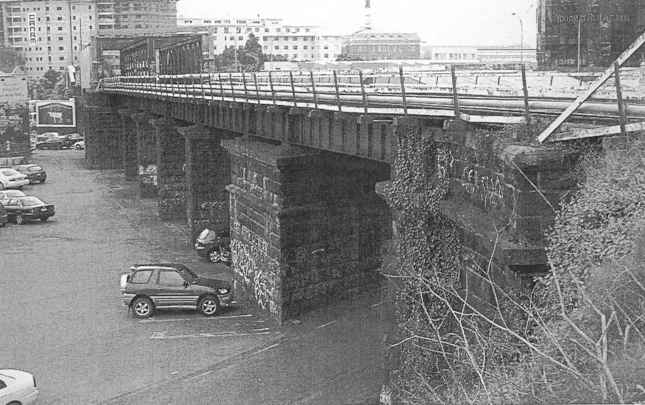
The railway line in Mechanics Bay was surveyed for construction between the Swan Inn on the Parnell Road and Henry Nichol's shipyard. Plans for a bridge and viaduct were in existence by May 1865, produced by James Stewart and Samuel Harding, who had by now been appointed engineers to the Auckland and Drury Railway Board. Stewart appears to have had the main responsibility for the Mechanics Bay to Newmarket section, possibly including the design of the associated works. Changes to the bridge design before its construction included raising its height by 1.3m (4 feet) and widening its arches for foot traffic by 0.6m (2 feet). The design evidently involved a triple-span bridge with scoria piers and a bowstring truss, with further scoria piers forming a viaduct immediately to the south. The structure was erected early in the railway project to allow spoil from the Domain tunnel to be used for an embankment across Mechanics Bay towards the proposed terminus in central Auckland. The proposed embankment would have considerably affected waka transport to Waipapa, and can be seen as reflecting Pakeha attitudes towards Maori at the time of the Waikato War. It can also be perceived as heralding the domination of new transport networks, with less reliance on Maori modes of transportation.
The viaduct piers were due to be laid out in August 1865 but were delayed because Fraser and Tinne, a local engineering concern, failed to remove a large set of rollers from the site. The site of the works may have previously been taken up by sawpits, while a door sill of the adjacent Swan Inn was to be used as the bench mark for the levels. Parts of the piers were built by January 1866, when they were inspected by a Commission of Enquiry, and evidently consisted of ashlar with rubble backing. The Commissioners found fault with the piers, believing the mortar to be of inferior quality, although Stewart responded that the mortar was of slow-drying type and that the masonry 'would bear comparison with any in the Province of its class.' Later engineers noted that the foundations of the piers nearest the foreshore had not been built on top of solid rock.
The Commissioners of Enquiry had been appointed to investigate progress on the line as considerable delays and additional costs had accrued. The overruns on the Mechanics Bay to Newmarket section alone totalled £9,000 by the beginning of 1866. Having taken over the direct running of the project, the Auckland Provincial Council put a stop to as much of the work as possible, although in May 1866 the Provincial Superintendent specifically authorised completion of the bridge and viaduct. Auckland was experiencing a severe economic slump after the removal of the colonial capital to Wellington in 1865, and cutbacks were required. In October 1866, Thomas Cheeseman, Chairman of the Railway Commissioners, reported that the Mechanics Bay bridge and viaduct constructed by Grace were in a 'very forward state' and would be finished the following month. With work on the embankment across Mechanics Bay towards central Auckland not having been started, the structure stood stranded on the foreshore, "a railway to nowhere" until work resumed on the railway line in late 1871 or early 1872.
Julius Vogel and the Waikato Railway
In 1870 the Colonial Treasurer, Julius Vogel (1835-1899), announced a policy of public works that would open up the whole country for settlement with a network of railways. Under the Railways Act 1872, lines were authorised in some fourteen centres, many of which were the forerunners of trunk lines completed later. One of these was the Waikato Railway from Auckland to Mercer, at the new national gauge of 3'6". Work on part of this line, between Auckland and Onehunga, began in the summer of 1871-1872, at which time the Auckland and Drury works were in a state of disrepair. Portions of the line between the Mechanics Bay bridge and the Domain tunnel were buried in clay, with much of the woodwork decayed. Equipment had also been sold to the Bay of Islands Coal Mining Company at Kawakawa, which operated the earliest functioning steam railway in the North Island from 1870.
It appears that by January 1872, rails had been laid down along the Mechanics Bay section to run ballast wagons so that trucks of material could be shot over the end of the bridge, allowing the creation of the embankment that had initially been planned in the 1860s. This occurred as part of an ambitious 7.5 hectare reclamation scheme undertaken between 1872 and 1877, which also involved the quarrying of Fort Britomart Hill, between Mechanics Bay and central Auckland. Modifications to the bridge and viaduct appear to have been carried out, probably during 1872-1873. From photographic evidence, these included raising the outward-facing parts of the bridge piers to create a more imposing-looking structure. The identity of the designer and contractors for the modifications are unknown, although by 1870 James Stewart was employed by the General Government to resurvey the Auckland to Drury line, and by 1874 was in charge of all railway works in the Auckland Province.
The Auckland to Onehunga line - 13km long - opened for use on 24 December 1873, with the Auckland terminus being a simple timber structure near the present intersection of Anzac Avenue and Beach Road. The Auckland to Onehunga line was the first of the 'Vogel Railways' and the first section of railway line to be operated by the General Government. This line, connecting the Waitamata and Manukau Harbours on the east and west coasts, facilitated the linkage of local and international trade operating from Auckland. By May 1875 the line had opened for traffic as far as Mercer, and by 1880 extended south to Te Awamutu. In February 1882 instructions were given for full surveys to determine the best route for connecting Marton with the northern railhead, in anticipation of an uninterrupted trunk line between Auckland and Wellington.
Later alterations
By the 1890s growth in rail traffic increased demand for heavier locomotives and greater bridge strength. In 1896 some timber girders of the viaduct were renewed with iron plate girders imported from the United Kingdom. The remaining kauri beams were renewed in iron bark, while some of the piers were also raised.
By 1907 the main trunk line between Auckland and Wellington was nearing completion, and construction work began on widening the Mechanics Bay bridge and viaduct to accommodate double tracks on this section of the line. Planning for the alterations was already underway in September 1899 when John Coom, the Chief Railways Engineer in Wellington, requested that the District Engineer supply all information required for the design of a new superstructure with 10m spans. This was to replace the pre-existing bowstring bridge, while reusing the existing basalt piers and abutments. Coom's signature, dated 3 August 1907, appears on the first of twelve sheets of plans prepared for the modification of the viaduct and bridge, suggesting that he at least approved the plans if not designed them himself.
Alterations included the replacement of the bow truss by a 39m double-intersection Warren truss. The two secondary-sized piers supporting the bridge over Parnell Rise were consequently removed, enabling the road to be broadened to its current width. The viaduct, now comprising riveted plate girders, carried the track on to the southern abutment. The masonry piers were doubled in width and increased in height to accommodate the new structure. The stone for the new portions of the piers was quarried locally at the Newmarket quarry, and the tops of the piers were finished with concrete. Notwithstanding the increased cost, additions to the wing walls of the abutments were completed to a curved design in keeping with the original stonework. Coom rejected the suggestion of the District Engineer that straight wing walls should be constructed. This construction work was carried out by Railways Department staff.
The eastern side of the structure was ready to take rail traffic on 14 April 1909, with the bridge being fully complete by the end of the financial year (31 March 1910). This coincided with the completion of the Auckland to Wellington Trunk Line in 1909, which was ready in time for crews of a visiting American Fleet to travel the North Island. Completion of the Main Trunk has been considered the most important single event in the history of railways in New Zealand, bringing tremendous improvements in communication, social growth and increased prosperity as a result of the economic boom linked to export of agricultural produce. The North Island line had taken 23 years to build at a capital cost of over £2.5m, more than twice the original estimate.
The bridge at Mechanics Bay formed part of the Main Trunk line until the opening of the 14 km Orakei-Westfield deviation in 1930. Thereafter only commuter trains and rolling stock on the North Auckland line climbed Parnell Bank's steep grade to the Remuera/Newmarket Junction. Minor alterations since then have included the replacement of rails in the 1930s and 1940s, and repairs on the structure in 1945. By 1974, overhead ties were added to the truss.41 Recent work on the Grafton Motorway extension project has resulted in the removal of much of the earlier embankment immediately to the north of the bridge, which has been replaced a new rail bridge. The bridge and viaduct at Mechanics Bay continue in use, and form part of the regional rail network.