DonateSupporterVisit Heritage
  • Tūrangawaewae
    Places
  • Tira Māori
    Māori Heritage
  • Poutairangahia
    Archaeology
  • Rauemi
    Resources
  • Mō Tātou
    About Us
  • New Zealand Heritage List
  • Nominate and submit
  • Explore the List
  • National Historic Landmarks
  • Plaques
  • Rainbow List Project
  • Lost heritage
  • Visit Heritage
  • Our properties
  • Turnbull House Project
  • Collections
  • Shop
  • Tohu Whenua
  • Tira Māori
  • Conserving Māori heritage
  • Marae built heritage
  • Māori heritage on the List
  • Hinemihi—Te Hokinga Mai
  • What is archaeology?
  • Is there a site on my property?
  • What are my legal requirements?
  • Affecting an archaeological site
  • Declaring an archaeological site
  • Archaeology FAQs
  • Archaeology Digital Library
  • Archaeology guidelines and templates
  • Resources
  • Funding
  • Publications
  • Sustainable management guides
  • Disaster recovery
  • Podcasts & digital resources
  • Education Hub
  • Conservation plans
  • About
  • Board
  • Māori Heritage Council
  • Senior Staff
  • Offices
  • Contact us
  • Careers
  • Covenants
  • Fast-track
  • Corporate documents
  • Currently consulting on
  • Our submissions
  • News
Quick links
Rārangi Kōrero | The List
Explore the List
National Historic Landmarks
Ngā Manawhenua o Aotearoa me ōna Kōrero Tūturu
Quick links
Tapuwae
A Vision for Places of Māori Heritage
Funding for Māori Heritage
Resources
Quick links
Archaeological Authority Portal
Applying for an archaeological authority
Archaeology FAQs
Browse the most frequently asked questions about archaeological authorities and the archaeological process.
Quick links
Quick links
Contact us
Offices
DonateSupporterVisit Heritage
  • Tūrangawaewae
    Places
  • Tira Māori
    Māori Heritage
  • Poutairangahia
    Archaeology
  • Rauemi
    Resources
  • Mō Tātou
    About Us
  • New Zealand Heritage List
  • Nominate and submit
  • Explore the List
  • National Historic Landmarks
  • Plaques
  • Rainbow List Project
  • Lost heritage
  • Visit Heritage
  • Our properties
  • Turnbull House Project
  • Collections
  • Shop
  • Tohu Whenua
  • Tira Māori
  • Conserving Māori heritage
  • Marae built heritage
  • Māori heritage on the List
  • Hinemihi—Te Hokinga Mai
  • What is archaeology?
  • Is there a site on my property?
  • What are my legal requirements?
  • Affecting an archaeological site
  • Declaring an archaeological site
  • Archaeology FAQs
  • Archaeology Digital Library
  • Archaeology guidelines and templates
  • Resources
  • Funding
  • Publications
  • Sustainable management guides
  • Disaster recovery
  • Podcasts & digital resources
  • Education Hub
  • Conservation plans
  • About
  • Board
  • Māori Heritage Council
  • Senior Staff
  • Offices
  • Contact us
  • Careers
  • Covenants
  • Fast-track
  • Corporate documents
  • Currently consulting on
  • Our submissions
  • News
Quick links
Rārangi Kōrero | The List
Explore the List
National Historic Landmarks
Ngā Manawhenua o Aotearoa me ōna Kōrero Tūturu
Quick links
Tapuwae
A Vision for Places of Māori Heritage
Funding for Māori Heritage
Resources
Quick links
Archaeological Authority Portal
Applying for an archaeological authority
Archaeology FAQs
Browse the most frequently asked questions about archaeological authorities and the archaeological process.
Quick links
Quick links
Contact us
Offices
  • Places
  • Nominate and submit
  • National Historic Landmarks
  • Places
  • Nominate and submit
  • National Historic Landmarks
  • Tira Māori
  • Conserving Māori heritage
  • Marae built heritage
  • Tira Māori
  • Conserving Māori heritage
  • Marae built heritage
  • Archaeological authorities
  • Archaeology Digital Library
  • Archaeological authorities
  • Archaeology Digital Library
  • All resources
  • Publications
  • Funding
  • All resources
  • Publications
  • Funding
  • FAQs
  • FAQs
Follow us on:
Places
  • Places
  • Nominate and submit
  • National Historic Landmarks
Tira Māori
  • Tira Māori
  • Conserving Māori heritage
  • Marae built heritage
Archaeology
  • Archaeological authorities
  • Archaeology Digital Library
Resources
  • All resources
  • Publications
  • Funding
FAQs
  • FAQs
Follow us on
HomePrivacyTerms and conditionsAbout this site
© Heritage New Zealand Pouhere Taonga 2026.
 
Brandon Hall Homestead

Brandon Hall Road, RD 1, BULLS

Private

Historic Place Category 2

List No. 7615

Quick links:
List GalleryLocationDetails
Brandon Hall Homestead is located on the outskirts of present-day Bulls, overlooking the Tutaenui Stream. Named after the original Pakeha purchaser of the land, the house was completed in 1865 and remains in close to its original condition.

The Rangitikei Block was acquired from its Maori owners by the Crown in 1849, and in 1851 prominent Wellington lawyer and Provincial Secretary Alfred de Bathe Brandon purchased 624 acres (253 hectares) in the area. A Crown Grant was issued for the property in 1861. The land was purchased by speculators until 1864, when disputes between local iwi groups allowed the Bewley family to purchase the former Brandon estate cheaply.

That same year Bewley employed James Bull to construct a house on the property. Bull, a local carpenter and sawmiller, contributed greatly to the development of the local township from this period onwards and the town was later re-named in his honour. The homestead, for which the original plan and specifications survive, was completed for £260. The one and a half storey structure was made from timber and clad in weatherboards. It featured a verandah, and a lobby and five rooms on the ground floor. A narrow stair led to three bedrooms on the upper storey.

The Bewley family rapidly enlarged both the estate and their flock. Events turned against the apparently prosperous family when their greatly expanded flock of sheep developed scab. The infection was spread to neighbouring farms and the family was taken to court. The Bewelys lost their case and were required to pay for the treatment of their neighbours' flocks. During the same period, the price of wool dropped dramatically, possibly through over supply to the international market and the New Zealand Wars. Bewley became depressed about his future prospects in the area.

In 1867, just a year after the dispute between local iwi was resolved, Ngati Ruanui military leader Riwha Titokowaru [? - 1888] began his advance from Wanganui to Foxton. Rangitikei settlers were forced to re-mobilise and construct a series of defensive redoubt for protection. It may be during this period that a 'secret' room was developed for protection at the Brandon Hall Homestead. In 1868 the Brandon Hall Estate foreman Frederik Kornerup was fatally injured on the banks of the Ohau River by a Maori wielding a mere. The following year, Te Kooti Rikirangi Te Turuki (?-1893) and his forces killed over 60 Maori and 7 settlers at Mohaka. Financially destitute and in fear of their safety, the Bewley family made the decision to leave their new life behind, and return to England. The family left the property in 1870. The house and land passed to their mortgage holders, Johnston & Co.

After the departure of the Bewleys, the house served as the farm manager's home and then as rental accommodation. A subsequent owner broke up the estate in 1906, and most of the resultant properties were developed as dairy farms. The homestead block had regular changes of ownership, possibly due to the low productivity of the sandy soil. Ownership stabilised from the 1920s. Around 1960, additions were made to the exterior of the structure.

The Brandon Hall Homestead is significant as physically important as an example of a well-preserved, early colonial dwelling. It is historically significant for the connection to James Bull, and its social history provides insight into the flight of Pakeha settlers from New Zealand in the second half of the nineteenth-century. The property is held in high esteem by the local community and the descendants of its inhabitants.
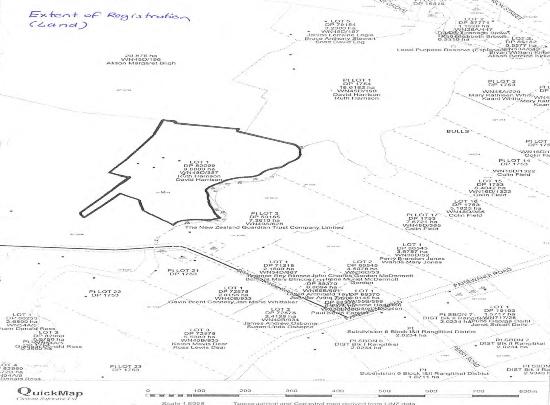
Brandon Hall Homestead. Map from QuickMap® | QuickMap®

List Entry Information

Overview

Status
Listed

List Entry Status
Historic Place Category 2

Access
Private/No Public Access

List Number
7615

Date Entered
24th June 2005

Date of Effect
24th June 2005

City/District Council
Rangitīkei District

Region
Horizons (Manawatū-Whanganui) Region

Extent of List Entry

The registration includes part of the land comprised in Certificate of Title WN48D/357, as shown on 'Extent of Registration Map' in Appendix 2, and the original (pre 1900) portion of the building, and its fittings and fixtures thereon.

Legal description

Lot 1 DP 82099 (RT WN48D/357), Wellington Land District

Detailed List Entry
Significance

Historic Significance

Historical Significance or Value The house is historically important for its link to James Bull. As a prominent local settler, and the man after whom the town was named, the link has intrinsic importance. The importance of the link is strengthened by the nature of the house and the date at which it was constructed. Bull was a sawmiller and a builder / carpenter, and it was through his work that the town of Bulls was developed. The Brandon Hall Homestead is an example of his work in this area. Bull was also responsible for constructing a number of private and public buildings in Bulls, and it appears that a large number of them were constructed in the mid-1860s, the date around which Brandon Hall was also completed. The house was therefore constructed as part of a 'boom' in the local town and thus provides insight into the town's history during this period. The building's historical interest is also enhanced by the name of the building, which recalls the original, Pakeha purchaser of the land. The social history of the house is also important. The hardiness of New Zealand's early Pakeha pioneers has become part of the nation's memory and identity. The settlers who did not make it, the settlers who gave up and returned to their home country, are less often discussed. The story of the Bewley family brings this story to light, and gives some indication of the combined factors that contributed to a decision to leave. The Bewley family purchased their estate at a time of unrest between local iwi groups. Escalating tensions between the two caused settlers considerable concern in the Rangitikei, and prompted them to develop defensive strategies. The perceived threat to the settlers by Maori was increased by the local murder of Robert Stillingfleet Rayner, in which two Maori employees were implicated. This initial unrest may have initially worked to the advantage of the Bewley family by lowering land prices and enabling John Bewley to enlarge the estate to up to 10,000 acres (4047 hectares), making his property one of the largest in the region. However, the Bewley's sheep developed scab, and the family lost a court case over the infection of neighbouring flocks. The price of wool then dropped dramatically. At the same time, the threat of war increased with the daily advance of Ngati Ruanui military leader Riwha Titokowaru and the murder of the estate's foreman by a Maori. Financially destitute and in fear of their safety, the Bewley family made the decision to leave their new life behind. Reportedly not the only family to consider departure, the Bewleys left in 1870, having slaughtered their un-saleable 7000 flock for tallow.

Physical Significance

Commissioned in 1864 and completed in 1865, the core of the Brandon Hall Homestead is physically important as an example of a well-preserved, early colonial dwelling. The house retains much of its original character and, when considered in conjunction with the original specifications and the original plan, the house provides valuable information on colonial building materials, techniques, and attitudes to house design in the nineteenth century. Although the original, simple, homestead is partially obscured from the exterior by extensions, it remains easily distinguishable from these, and the internal areas within the house retain much of their original character. Historic paintings and photographs document the additions and changes to the house, which are also reflected in the construction methods used.

Detail Of Assessed Criteria

(b) The association of the place with events, persons, or ideas of importance in New Zealand history The estate is named after its first Pakeha purchaser, Alfred de Bathe Brandon, who was an early Wellington settler, crown prosecutor and MLC. The Brandon Hall Homestead was designed and constructed by James Bull. Bull, a carpenter trained in London, arrived in Wellington in 1857. He relocated to the Rangitikei district in 1858, after completing a contract working on the government buildings in Wellington. In 1859 he established a saw-milling business in the area, which led to the development of the settlement. Bull was employed to construct a number of houses in the area, including the Brandon Hall Homestead, and many of the public buildings in the township. In 1872 the town, which had originally been called Rangitikei, was officially renamed 'Bulls', in recognition of James Bull's contribution to it. The house was constructed when the Rangitikei district was in a state of unrest. Tensions between local iwi groups Ngati Apa and Ngati Raukawa over the distribution of money made from illegal rental arrangements with settlers had escalated. Settlers were forced to develop defensive strategies and strengthen their militia. The dispute was resolved in 1866. The following year, in 1867 Ngati Ruanui military leader Riwha Titokowaru [? - 1888] had begun his advance from Wanganui to Foxton, forcing the Parewanui settlers to mobilise and construct a series of defensive redoubts. The year after that the Brandon Hall Estate foreman and former lieutenant in the Danish Army, Frederik Kornerup, was fatally injured on the banks of the Ohau River by a Maori wielding a mere. The threat may have prompted the construction of a safe area within the Brandon Hall Homestead, later described as 'a secret room' by former resident Laurel Brander. The threat contributed to the Bewley family's decision to leave the area, with relation Donald Dean Parker recording that due to the constant fear that the wars would spread to Rangitikei, 'all' of the neighbouring farmers wanted to sell their properties. (e) The community association with, or public esteem for, the place Since they moved into the house, the current owners, the Harrisons have had a number of former occupants visit the house. This includes people who lived there before T.R. Allan and family moved in, as in his father's day it was rented out, possibly to farm employees (i.e. 1937 - 1950s) and his father, who lived in Wanganui, only stayed at the house at weekends. The front room that is now part of the sitting room, was reserved for his use. Several American descendants of the Bewley family have written to ask about the house. In recent years an email inquiry also notified the Bulls Library if the existence of two books covering the house (published in 1946). The Bulls Library now holds copies of these books. Bulls local historian, Greg Bradley, has been contacted twice in recent years by members of the Bewley family in the United States. The first was an email that included a picture of the house, which Jane Bewley had painted when they lived there. The sender asked if the house was still there. The second contact was a cousin of the email-sender who arrived on a tour bus and contacted Greg. As a result, the tour bus visited Brandon Hall Road to enable one person to have an impromptu long distance view of the old house where his forebears once lived. Bradley has since lost the contact details, but he thinks the man who emailed him was the son of Donald Dean Parker who wrote the family books. (g) The technical accomplishment or value, or design of the place Brandon Hall Homestead is technologically significant as an example of early house construction in the Rangitikei region. Much of the original portion of the house is extant, including the steep, winding stairs to the three small, upstairs bedrooms, wall claddings, and internal doors. Although the original, simple homestead is partially obscured from the exterior, it can be easily identified both internally and externally. (i) The importance of the identifying historic places known to date from early periods of New Zealand settlement The Brandon Hall Homestead was commissioned in 1864 and completed in 1865. All the characteristic parts of the original areas remaining indicate the earliest forms of construction used by the settlers in New Zealand. The house shows clear, transitional adaptations to different phases in building and social history. Although the original, simple, homestead is partially obscured from the exterior, it can be easily identified internally. Historic paintings and photographs document the additions and changes to the house, which are also reflected in the construction methods used.

Construction Professional

Name

Bull, James

Type

Builder

Biography

No biography is currently available for this construction professional

Construction Details

Start Year

1864

Type

Designed

Start Year

1865

Type

Original Construction

Start Year

1865

Finish Year

1870

Type

Addition

Start Year

1960

Finish Year

1961

Type

Addition

Construction Materials

Constructed from heart timber with rimu floorboards, the house is clad in weatherboards, and has a corrugated iron roof. Modern cladding/re-cladding is of manufactured materials.

Reference

Completion Date

11th February 2005

Report Written By

V. Burr

Information Sources

Wilson, 1976

James G. Wilson, 'Early Rangitikei', (first published Christchurch, 1914), Capper Press, Christchurch, 1976

Manawatu Branch Committee, nd

Manawatu Branch Committee of NZHPT, New Houses from Old, photocopies from this document (booklet) outlining the house during the Allans' occupancy, including the 1961 alterations. (Copy held in the house's file at NZHPT)

Parker, 1946

Donald Dean Parker, 'Some English Country Gentlemen and their Families' (published by the author, Brooking, South Dakota, US, 1946) Contains details of documents, letters, sketch maps, plans etc. Photocopy held at Bulls Library since 2004.

Parker, 1946 (2)

Donald Dean Parker, ' The Bewley and Related Families' (published by the author, Brooking, South Dakota, US, 1946) Contains a family narrative. Photocopy held at Bulls Library since 2004.

Report Written By

This place was identified as significant under previous legislation with different information requirements. It remains significant under the current legislation. There is opportunity under our legislation and policies to add to this information. Further information about this place may be available from the Central Regional Office of Heritage New Zealand Pouhere Taonga. A fully referenced registration report is available from the Central Region of the NZHPT. Please note that entry on the New Zealand Heritage List/Rarangi Korero identifies only the heritage values of the property concerned, and should not be construed as advice on the state of the property, or as a comment of its soundness or safety, including in regard to earthquake risk, safety in the event of fire, or insanitary conditions.

Further Information

Current Usages

Uses: Accommodation

Specific Usage: House

Former Usages

General Usage:: Accommodation

Specific Usage: House

Themes

Web Links

Overview

Status

Listed

List Entry Status

Historic Place Category 2

Access

Private/No Public Access

List Number

7615

Date Entered

24th June 2005

Date of Effect

24th June 2005

City/District Council

Rangitīkei District

Region

Horizons (Manawatū-Whanganui) Region

Extent of List Entry

The registration includes part of the land comprised in Certificate of Title WN48D/357, as shown on 'Extent of Registration Map' in Appendix 2, and the original (pre 1900) portion of the building, and its fittings and fixtures thereon.

Legal description

Lot 1 DP 82099 (RT WN48D/357), Wellington Land District

Status

Listed

List Entry Status

Historic Place Category 2

Access

Private/No Public Access

List Number

7615

Date Entered

24th June 2005

Date of Effect

24th June 2005

City/District Council

Rangitīkei District

Region

Horizons (Manawatū-Whanganui) Region

Extent of List Entry

The registration includes part of the land comprised in Certificate of Title WN48D/357, as shown on 'Extent of Registration Map' in Appendix 2, and the original (pre 1900) portion of the building, and its fittings and fixtures thereon.

Legal description

Lot 1 DP 82099 (RT WN48D/357), Wellington Land District

Significance

Why is this place significant?

Historic Significance

Historical Significance or Value The house is historically important for its link to James Bull. As a prominent local settler, and the man after whom the town was named, the link has intrinsic importance. The importance of the link is strengthened by the nature of the house and the date at which it was constructed. Bull was a sawmiller and a builder / carpenter, and it was through his work that the town of Bulls was developed. The Brandon Hall Homestead is an example of his work in this area. Bull was also responsible for constructing a number of private and public buildings in Bulls, and it appears that a large number of them were constructed in the mid-1860s, the date around which Brandon Hall was also completed. The house was therefore constructed as part of a 'boom' in the local town and thus provides insight into the town's history during this period. The building's historical interest is also enhanced by the name of the building, which recalls the original, Pakeha purchaser of the land. The social history of the house is also important. The hardiness of New Zealand's early Pakeha pioneers has become part of the nation's memory and identity. The settlers who did not make it, the settlers who gave up and returned to their home country, are less often discussed. The story of the Bewley family brings this story to light, and gives some indication of the combined factors that contributed to a decision to leave. The Bewley family purchased their estate at a time of unrest between local iwi groups. Escalating tensions between the two caused settlers considerable concern in the Rangitikei, and prompted them to develop defensive strategies. The perceived threat to the settlers by Maori was increased by the local murder of Robert Stillingfleet Rayner, in which two Maori employees were implicated. This initial unrest may have initially worked to the advantage of the Bewley family by lowering land prices and enabling John Bewley to enlarge the estate to up to 10,000 acres (4047 hectares), making his property one of the largest in the region. However, the Bewley's sheep developed scab, and the family lost a court case over the infection of neighbouring flocks. The price of wool then dropped dramatically. At the same time, the threat of war increased with the daily advance of Ngati Ruanui military leader Riwha Titokowaru and the murder of the estate's foreman by a Maori. Financially destitute and in fear of their safety, the Bewley family made the decision to leave their new life behind. Reportedly not the only family to consider departure, the Bewleys left in 1870, having slaughtered their un-saleable 7000 flock for tallow.

Physical Significance

Commissioned in 1864 and completed in 1865, the core of the Brandon Hall Homestead is physically important as an example of a well-preserved, early colonial dwelling. The house retains much of its original character and, when considered in conjunction with the original specifications and the original plan, the house provides valuable information on colonial building materials, techniques, and attitudes to house design in the nineteenth century. Although the original, simple, homestead is partially obscured from the exterior by extensions, it remains easily distinguishable from these, and the internal areas within the house retain much of their original character. Historic paintings and photographs document the additions and changes to the house, which are also reflected in the construction methods used.

Why is this place Category 1 / Category 2?

Detail Of Assessed Criteria

(b) The association of the place with events, persons, or ideas of importance in New Zealand history The estate is named after its first Pakeha purchaser, Alfred de Bathe Brandon, who was an early Wellington settler, crown prosecutor and MLC. The Brandon Hall Homestead was designed and constructed by James Bull. Bull, a carpenter trained in London, arrived in Wellington in 1857. He relocated to the Rangitikei district in 1858, after completing a contract working on the government buildings in Wellington. In 1859 he established a saw-milling business in the area, which led to the development of the settlement. Bull was employed to construct a number of houses in the area, including the Brandon Hall Homestead, and many of the public buildings in the township. In 1872 the town, which had originally been called Rangitikei, was officially renamed 'Bulls', in recognition of James Bull's contribution to it. The house was constructed when the Rangitikei district was in a state of unrest. Tensions between local iwi groups Ngati Apa and Ngati Raukawa over the distribution of money made from illegal rental arrangements with settlers had escalated. Settlers were forced to develop defensive strategies and strengthen their militia. The dispute was resolved in 1866. The following year, in 1867 Ngati Ruanui military leader Riwha Titokowaru [? - 1888] had begun his advance from Wanganui to Foxton, forcing the Parewanui settlers to mobilise and construct a series of defensive redoubts. The year after that the Brandon Hall Estate foreman and former lieutenant in the Danish Army, Frederik Kornerup, was fatally injured on the banks of the Ohau River by a Maori wielding a mere. The threat may have prompted the construction of a safe area within the Brandon Hall Homestead, later described as 'a secret room' by former resident Laurel Brander. The threat contributed to the Bewley family's decision to leave the area, with relation Donald Dean Parker recording that due to the constant fear that the wars would spread to Rangitikei, 'all' of the neighbouring farmers wanted to sell their properties. (e) The community association with, or public esteem for, the place Since they moved into the house, the current owners, the Harrisons have had a number of former occupants visit the house. This includes people who lived there before T.R. Allan and family moved in, as in his father's day it was rented out, possibly to farm employees (i.e. 1937 - 1950s) and his father, who lived in Wanganui, only stayed at the house at weekends. The front room that is now part of the sitting room, was reserved for his use. Several American descendants of the Bewley family have written to ask about the house. In recent years an email inquiry also notified the Bulls Library if the existence of two books covering the house (published in 1946). The Bulls Library now holds copies of these books. Bulls local historian, Greg Bradley, has been contacted twice in recent years by members of the Bewley family in the United States. The first was an email that included a picture of the house, which Jane Bewley had painted when they lived there. The sender asked if the house was still there. The second contact was a cousin of the email-sender who arrived on a tour bus and contacted Greg. As a result, the tour bus visited Brandon Hall Road to enable one person to have an impromptu long distance view of the old house where his forebears once lived. Bradley has since lost the contact details, but he thinks the man who emailed him was the son of Donald Dean Parker who wrote the family books. (g) The technical accomplishment or value, or design of the place Brandon Hall Homestead is technologically significant as an example of early house construction in the Rangitikei region. Much of the original portion of the house is extant, including the steep, winding stairs to the three small, upstairs bedrooms, wall claddings, and internal doors. Although the original, simple homestead is partially obscured from the exterior, it can be easily identified both internally and externally. (i) The importance of the identifying historic places known to date from early periods of New Zealand settlement The Brandon Hall Homestead was commissioned in 1864 and completed in 1865. All the characteristic parts of the original areas remaining indicate the earliest forms of construction used by the settlers in New Zealand. The house shows clear, transitional adaptations to different phases in building and social history. Although the original, simple, homestead is partially obscured from the exterior, it can be easily identified internally. Historic paintings and photographs document the additions and changes to the house, which are also reflected in the construction methods used.

Why is this place significant?

Historic Significance

Historical Significance or Value The house is historically important for its link to James Bull. As a prominent local settler, and the man after whom the town was named, the link has intrinsic importance. The importance of the link is strengthened by the nature of the house and the date at which it was constructed. Bull was a sawmiller and a builder / carpenter, and it was through his work that the town of Bulls was developed. The Brandon Hall Homestead is an example of his work in this area. Bull was also responsible for constructing a number of private and public buildings in Bulls, and it appears that a large number of them were constructed in the mid-1860s, the date around which Brandon Hall was also completed. The house was therefore constructed as part of a 'boom' in the local town and thus provides insight into the town's history during this period. The building's historical interest is also enhanced by the name of the building, which recalls the original, Pakeha purchaser of the land. The social history of the house is also important. The hardiness of New Zealand's early Pakeha pioneers has become part of the nation's memory and identity. The settlers who did not make it, the settlers who gave up and returned to their home country, are less often discussed. The story of the Bewley family brings this story to light, and gives some indication of the combined factors that contributed to a decision to leave. The Bewley family purchased their estate at a time of unrest between local iwi groups. Escalating tensions between the two caused settlers considerable concern in the Rangitikei, and prompted them to develop defensive strategies. The perceived threat to the settlers by Maori was increased by the local murder of Robert Stillingfleet Rayner, in which two Maori employees were implicated. This initial unrest may have initially worked to the advantage of the Bewley family by lowering land prices and enabling John Bewley to enlarge the estate to up to 10,000 acres (4047 hectares), making his property one of the largest in the region. However, the Bewley's sheep developed scab, and the family lost a court case over the infection of neighbouring flocks. The price of wool then dropped dramatically. At the same time, the threat of war increased with the daily advance of Ngati Ruanui military leader Riwha Titokowaru and the murder of the estate's foreman by a Maori. Financially destitute and in fear of their safety, the Bewley family made the decision to leave their new life behind. Reportedly not the only family to consider departure, the Bewleys left in 1870, having slaughtered their un-saleable 7000 flock for tallow.

Physical Significance

Commissioned in 1864 and completed in 1865, the core of the Brandon Hall Homestead is physically important as an example of a well-preserved, early colonial dwelling. The house retains much of its original character and, when considered in conjunction with the original specifications and the original plan, the house provides valuable information on colonial building materials, techniques, and attitudes to house design in the nineteenth century. Although the original, simple, homestead is partially obscured from the exterior by extensions, it remains easily distinguishable from these, and the internal areas within the house retain much of their original character. Historic paintings and photographs document the additions and changes to the house, which are also reflected in the construction methods used.

Why is this place Category 1 / Category 2?

Detail Of Assessed Criteria

(b) The association of the place with events, persons, or ideas of importance in New Zealand history The estate is named after its first Pakeha purchaser, Alfred de Bathe Brandon, who was an early Wellington settler, crown prosecutor and MLC. The Brandon Hall Homestead was designed and constructed by James Bull. Bull, a carpenter trained in London, arrived in Wellington in 1857. He relocated to the Rangitikei district in 1858, after completing a contract working on the government buildings in Wellington. In 1859 he established a saw-milling business in the area, which led to the development of the settlement. Bull was employed to construct a number of houses in the area, including the Brandon Hall Homestead, and many of the public buildings in the township. In 1872 the town, which had originally been called Rangitikei, was officially renamed 'Bulls', in recognition of James Bull's contribution to it. The house was constructed when the Rangitikei district was in a state of unrest. Tensions between local iwi groups Ngati Apa and Ngati Raukawa over the distribution of money made from illegal rental arrangements with settlers had escalated. Settlers were forced to develop defensive strategies and strengthen their militia. The dispute was resolved in 1866. The following year, in 1867 Ngati Ruanui military leader Riwha Titokowaru [? - 1888] had begun his advance from Wanganui to Foxton, forcing the Parewanui settlers to mobilise and construct a series of defensive redoubts. The year after that the Brandon Hall Estate foreman and former lieutenant in the Danish Army, Frederik Kornerup, was fatally injured on the banks of the Ohau River by a Maori wielding a mere. The threat may have prompted the construction of a safe area within the Brandon Hall Homestead, later described as 'a secret room' by former resident Laurel Brander. The threat contributed to the Bewley family's decision to leave the area, with relation Donald Dean Parker recording that due to the constant fear that the wars would spread to Rangitikei, 'all' of the neighbouring farmers wanted to sell their properties. (e) The community association with, or public esteem for, the place Since they moved into the house, the current owners, the Harrisons have had a number of former occupants visit the house. This includes people who lived there before T.R. Allan and family moved in, as in his father's day it was rented out, possibly to farm employees (i.e. 1937 - 1950s) and his father, who lived in Wanganui, only stayed at the house at weekends. The front room that is now part of the sitting room, was reserved for his use. Several American descendants of the Bewley family have written to ask about the house. In recent years an email inquiry also notified the Bulls Library if the existence of two books covering the house (published in 1946). The Bulls Library now holds copies of these books. Bulls local historian, Greg Bradley, has been contacted twice in recent years by members of the Bewley family in the United States. The first was an email that included a picture of the house, which Jane Bewley had painted when they lived there. The sender asked if the house was still there. The second contact was a cousin of the email-sender who arrived on a tour bus and contacted Greg. As a result, the tour bus visited Brandon Hall Road to enable one person to have an impromptu long distance view of the old house where his forebears once lived. Bradley has since lost the contact details, but he thinks the man who emailed him was the son of Donald Dean Parker who wrote the family books. (g) The technical accomplishment or value, or design of the place Brandon Hall Homestead is technologically significant as an example of early house construction in the Rangitikei region. Much of the original portion of the house is extant, including the steep, winding stairs to the three small, upstairs bedrooms, wall claddings, and internal doors. Although the original, simple homestead is partially obscured from the exterior, it can be easily identified both internally and externally. (i) The importance of the identifying historic places known to date from early periods of New Zealand settlement The Brandon Hall Homestead was commissioned in 1864 and completed in 1865. All the characteristic parts of the original areas remaining indicate the earliest forms of construction used by the settlers in New Zealand. The house shows clear, transitional adaptations to different phases in building and social history. Although the original, simple, homestead is partially obscured from the exterior, it can be easily identified internally. Historic paintings and photographs document the additions and changes to the house, which are also reflected in the construction methods used.

Construction Information

Construction Professional

Name

Bull, James

Type

Builder

Biography

No biography is currently available for this construction professional

Construction Details

Start Year

1864

Type

Designed

Start Year

1865

Type

Original Construction

Start Year

1865

startYearCirca

Finish Year

1870

finishYearCirca

Type

Addition

Start Year

1960

Finish Year

1961

Type

Addition

Construction Materials

Constructed from heart timber with rimu floorboards, the house is clad in weatherboards, and has a corrugated iron roof. Modern cladding/re-cladding is of manufactured materials.

Construction Professional

Name

Bull, James

Type

Builder

Biography

No biography is currently available for this construction professional

Construction Details

Start Year

1864

Type

Designed

Start Year

1865

Type

Original Construction

Start Year

1865

startYearCirca

Finish Year

1870

finishYearCirca

Type

Addition

Start Year

1960

Finish Year

1961

Type

Addition

Construction Materials

Constructed from heart timber with rimu floorboards, the house is clad in weatherboards, and has a corrugated iron roof. Modern cladding/re-cladding is of manufactured materials.

Reference

Historical and Associated Iwi / Hapū / Whānau

Completion Date

11th February 2005

Report Written By

V. Burr

Information Sources

Wilson, 1976

James G. Wilson, 'Early Rangitikei', (first published Christchurch, 1914), Capper Press, Christchurch, 1976

Manawatu Branch Committee, nd

Manawatu Branch Committee of NZHPT, New Houses from Old, photocopies from this document (booklet) outlining the house during the Allans' occupancy, including the 1961 alterations. (Copy held in the house's file at NZHPT)

Parker, 1946

Donald Dean Parker, 'Some English Country Gentlemen and their Families' (published by the author, Brooking, South Dakota, US, 1946) Contains details of documents, letters, sketch maps, plans etc. Photocopy held at Bulls Library since 2004.

Parker, 1946 (2)

Donald Dean Parker, ' The Bewley and Related Families' (published by the author, Brooking, South Dakota, US, 1946) Contains a family narrative. Photocopy held at Bulls Library since 2004.

Other Information

This place was identified as significant under previous legislation with different information requirements. It remains significant under the current legislation. There is opportunity under our legislation and policies to add to this information. Further information about this place may be available from the Central Regional Office of Heritage New Zealand Pouhere Taonga. A fully referenced registration report is available from the Central Region of the NZHPT. Please note that entry on the New Zealand Heritage List/Rarangi Korero identifies only the heritage values of the property concerned, and should not be construed as advice on the state of the property, or as a comment of its soundness or safety, including in regard to earthquake risk, safety in the event of fire, or insanitary conditions.

Historical and Associated Iwi / Hapū / Whānau

Completion Date

11th February 2005

Report Written By

V. Burr

Information Sources

Wilson, 1976

James G. Wilson, 'Early Rangitikei', (first published Christchurch, 1914), Capper Press, Christchurch, 1976

Manawatu Branch Committee, nd

Manawatu Branch Committee of NZHPT, New Houses from Old, photocopies from this document (booklet) outlining the house during the Allans' occupancy, including the 1961 alterations. (Copy held in the house's file at NZHPT)

Parker, 1946

Donald Dean Parker, 'Some English Country Gentlemen and their Families' (published by the author, Brooking, South Dakota, US, 1946) Contains details of documents, letters, sketch maps, plans etc. Photocopy held at Bulls Library since 2004.

Parker, 1946 (2)

Donald Dean Parker, ' The Bewley and Related Families' (published by the author, Brooking, South Dakota, US, 1946) Contains a family narrative. Photocopy held at Bulls Library since 2004.

Other Information

This place was identified as significant under previous legislation with different information requirements. It remains significant under the current legislation. There is opportunity under our legislation and policies to add to this information. Further information about this place may be available from the Central Regional Office of Heritage New Zealand Pouhere Taonga. A fully referenced registration report is available from the Central Region of the NZHPT. Please note that entry on the New Zealand Heritage List/Rarangi Korero identifies only the heritage values of the property concerned, and should not be construed as advice on the state of the property, or as a comment of its soundness or safety, including in regard to earthquake risk, safety in the event of fire, or insanitary conditions.

Further Information

Current Usages

Uses: Accommodation

Specific Usage: House

Former Usages

General Usage: Accommodation

Specific Usage: House

Current Usages

Uses: Accommodation

Specific Usage: House

Former Usages

General Usage: Accommodation

Specific Usage: House

Location

Loading
Sign up to hear more

Get the latest heritage news, features and events delivered
straight to your inbox.

Subscribe
