Archibald Chalmers lived in the Cardrona/Wānaka area in the 1870s. Around 1879, with business partner John Kerin, he established a butchery and slaughteryard. An 1880 survey of the town of Pembroke on the shores of Lake Wānaka shows a structure on section 15, the adjoining section to the current property (likely to be an error) which is labelled ‘Chalmer’s House’, with Chalmers slaughteryard and other buildings nearby. A newspaper article from December 1879 noted that Kerin and Chalmers had erected a slaughteryard on Crown land prior to a license being granted.
Town sections in Pembroke were offered for sale in November 1881 – including sections 1 to 16 Block XXX. Section 16 was ‘burdened’ with a valuation of £60 – indicating a building on site. This is the section on which the cottage stands. The cottage, then, looks likely to be associated with Chalmer’s occupation. In September 1880, Kerin and Chalmers offered for sale their ‘EXTENSIVE BUTCHERING BUSINESS’ including ‘Butchers’ Shop and Residence, Slaughter Yards, & c., all substantially built.’ Chalmers was intending to visit the ‘Old Country’.
Tragically, Chalmers committed suicide 8 April 1886. On his deathbed he wrote a will leaving his property to his partner John Ironside. John Ironside carried on the Chalmer’s butchering business and the cottage remained in the Ironside or Matheson (Ironside’s daughter married a Matheson) families until 1946.
Pembroke was renamed Wānaka in 1940. Although tourism had begun early (the first hotel opened in 1867), for many years Wānaka was a quiet summer holiday place. However, in the closing years of the twentieth century the town grew. The influx of people and the associated building boom have changed the town’s landscape, with large residences replacing the early houses and cottages. Chalmers’ Cottage (Former) is now surrounded by substantial residences and may be the only residence of its type in the town that represents the lives of the town’s first European settlers.
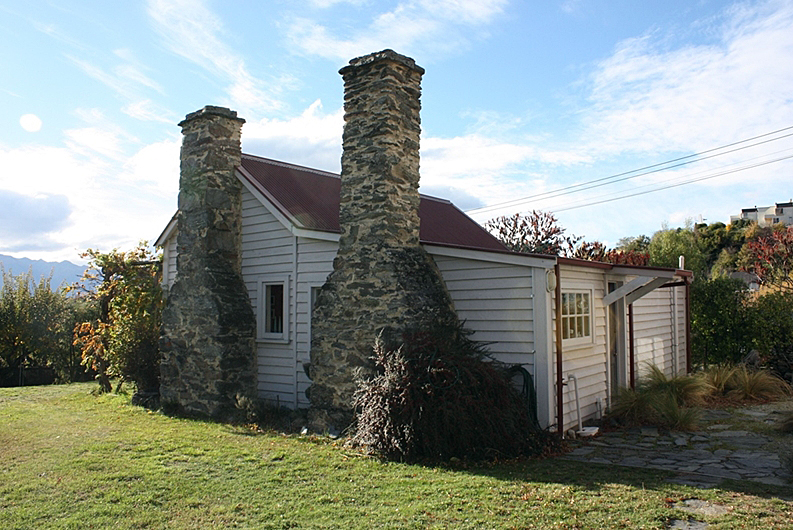
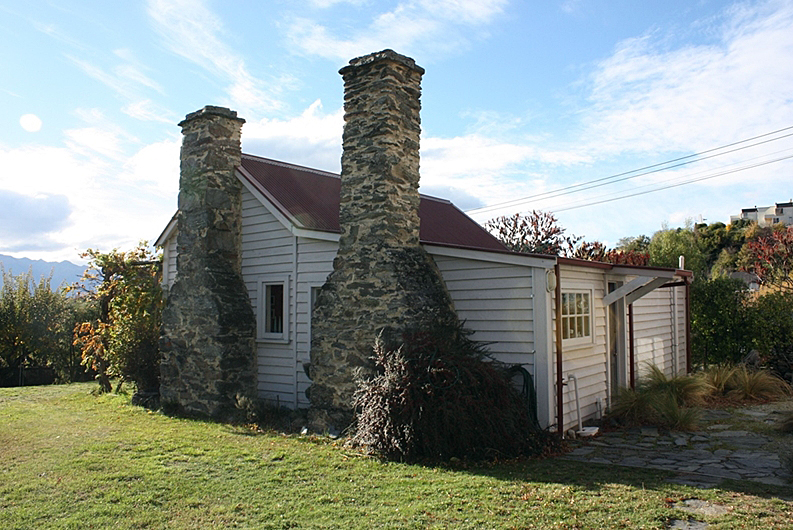
There is little information available about the early history of the cottage. Early photographs show the cottage as built in the vernacular style of the 1870s-1880s. It is a single storey colonial cottage with symmetrical façade with a central front door flanked by multi-pane double hung sash windows and a lean-to at the rear.
The current owners purchased the cottage in 1994 and returned it to its original form. In 2017, Chalmers’ Cottage remains a holiday home.

List Entry Information
Status
Listed
List Entry Status
Historic Place Category 2
Access
Private/No Public Access
List Number
9045
Date Entered
7th December 2017
Date of Effect
18th January 2018
City/District Council
Queenstown-Lakes District
Region
Otago Region
Extent of List Entry
Extent includes the land described as Sec 16 Blk XXX Town of Wanaka (RT OT1D/19), Otago Land District and the building known Chalmers’ Cottage (Former) thereon. The List entry does not include the carport (Refer to map in Appendix 1 of the List entry report for further information).
Legal description
Sec 16 Blk XXX Town of Wanaka (RT OT1D/19), Otago Land District
Status
Listed
List Entry Status
Historic Place Category 2
Access
Private/No Public Access
List Number
9045
Date Entered
7th December 2017
Date of Effect
18th January 2018
City/District Council
Queenstown-Lakes District
Region
Otago Region
Extent of List Entry
Extent includes the land described as Sec 16 Blk XXX Town of Wanaka (RT OT1D/19), Otago Land District and the building known Chalmers’ Cottage (Former) thereon. The List entry does not include the carport (Refer to map in Appendix 1 of the List entry report for further information).
Legal description
Sec 16 Blk XXX Town of Wanaka (RT OT1D/19), Otago Land District
Why is this place significant?
Historic Significance
Historical Significance or Value Chalmers’ Cottage provides a largely original example of an 1870s cottage, reflecting the establishment of Wānaka. The materials, plan form and natural site development all combine to provide authentic and historic insights into its construction and the everyday living experiences of pioneers in Wānaka. The history of the cottage relates to the experience of Wānaka’s earliest settlers and businessmen, with ties to the goldfields and pastoralism.
Physical Significance
Aesthetic Significance or Value Chalmers’ Cottage (Former) has a picturesque quality set within mature hawthorn hedges and drystone walls on the street corner. The cottage is significant in the Wānaka townscape, and may be one of the only early buildings remaining. It provides a stark visual contrast to the opulent residences characteristic of the modern town. Archaeological Significance or Value Chalmers’ Cottage as a building is an archaeological site - the core of the building being built in the 1870s. Through buildings archaeology, the cottage has the potential to provide evidence about the construction methods and materials. Architectural Significance or Value Chalmers’ Cottage displays a high degree of historic authenticity in its construction materials and form. As a rare survivor of an 1870s cottage in Wānaka it is valuable for the example it contributes to both understanding of early settler’s residences and the construction methods of the period.
Why is this place Category 1 / Category 2?
Detail Of Assessed Criteria
(a) The extent to which the place reflects important or representative aspects of New Zealand history Chalmers’ Cottage represents small-town family life in nineteenth and twentieth century New Zealand, and its intactness and authenticity mean that it can represent this aspect of New Zealand history particularly well. Locally, the Ironside/Matheson families were long term residents of Wānaka from the 1880s and the cottage is part of the cultural heritage fabric of Wānaka and a reminder of the town’s humble past. (i) The importance of identifying historic places known to date from an early period of New Zealand settlement Chalmers’ Cottage dates from the late 1870s prior to the town survey of Wānaka in 1880. As such it is a significant early survivor of the earliest period of Wānaka’s development as a town.
Why is this place significant?
Historic Significance
Historical Significance or Value Chalmers’ Cottage provides a largely original example of an 1870s cottage, reflecting the establishment of Wānaka. The materials, plan form and natural site development all combine to provide authentic and historic insights into its construction and the everyday living experiences of pioneers in Wānaka. The history of the cottage relates to the experience of Wānaka’s earliest settlers and businessmen, with ties to the goldfields and pastoralism.
Physical Significance
Aesthetic Significance or Value Chalmers’ Cottage (Former) has a picturesque quality set within mature hawthorn hedges and drystone walls on the street corner. The cottage is significant in the Wānaka townscape, and may be one of the only early buildings remaining. It provides a stark visual contrast to the opulent residences characteristic of the modern town. Archaeological Significance or Value Chalmers’ Cottage as a building is an archaeological site - the core of the building being built in the 1870s. Through buildings archaeology, the cottage has the potential to provide evidence about the construction methods and materials. Architectural Significance or Value Chalmers’ Cottage displays a high degree of historic authenticity in its construction materials and form. As a rare survivor of an 1870s cottage in Wānaka it is valuable for the example it contributes to both understanding of early settler’s residences and the construction methods of the period.
Why is this place Category 1 / Category 2?
Detail Of Assessed Criteria
(a) The extent to which the place reflects important or representative aspects of New Zealand history Chalmers’ Cottage represents small-town family life in nineteenth and twentieth century New Zealand, and its intactness and authenticity mean that it can represent this aspect of New Zealand history particularly well. Locally, the Ironside/Matheson families were long term residents of Wānaka from the 1880s and the cottage is part of the cultural heritage fabric of Wānaka and a reminder of the town’s humble past. (i) The importance of identifying historic places known to date from an early period of New Zealand settlement Chalmers’ Cottage dates from the late 1870s prior to the town survey of Wānaka in 1880. As such it is a significant early survivor of the earliest period of Wānaka’s development as a town.
Construction Details
Start Year
1997
Type
Refurbishment/renovation
Description
Renovations begun
Construction Materials
Timber, corrugated iron, schist
Construction Details
Start Year
1997
Type
Refurbishment/renovation
Description
Renovations begun
Construction Materials
Timber, corrugated iron, schist
Early history Wānaka was a hub for Māori travelling through Central Otago and a staging place for journeys to the West Coast. Seasonal migrations for food and mahika kai were a cornerstone of Kāi Tahu culture. The Mata-au/Clutha headwaters and catchment were a focus of such migrations, with access to resources determined by whakapapa. A pre-European settlement was located at the south end of Lake Wānaka, recorded on Taiaroa’s 1879 map as Takekarara, although the exact location is not known. The name Wānaka itself is a South Island variant on ‘wānanga’ which ‘refers to the ancient schools of learning.’ Archibald Chalmers buys the land Archibald Chalmers was a farmer and butcher in the Cardrona/Wānaka area in the 1870s. Chalmers applied for an agricultural lease at Cardrona in January 1875, one that bounded his business partner John Kerin’s. Kerin and Chalmers were also partners in The Resolute Gold Sluicing Company that held a ground sluicing claim east of Boundary Creek, Cardrona. Kerin and Chalmers extended their business to Pembroke on the shores of Lake Wānaka where they established a butchery and slaughteryard. An 1880 survey of the town of Pembroke shows a structure on section 15, the adjoining section to the current property, which is labelled ‘Chalmer’s House’, with Chalmers’ slaughteryard and other buildings nearby. The lack of alignment with the surveyed sections indicates the building was there prior to the survey. A newspaper article from December 1879 noted that Kerin and Chalmers had erected a slaughteryard on Crown land prior to a license being granted. There was a bitter dispute in the local papers about its location being too close to town. Town sections in Pembroke were offered for sale in November 1881 – including sections 1 to 16 Block XXX. Section 16 was ‘burdened’ with a valuation of £60 – indicating a building on site. The title to land on which this cottage sits was issued to ‘Pembroke butcher Archibald Chalmers’ in April 1886. This was a formalisation of his earlier Crown Grant of September 1883. The cottage, then, looks likely to be associated with Chalmers’ occupation and early photographs show the cottage as built in vernacular style of the 1870s-1880s – a single gable cottage with exterior stone chimneys and a lean-to at the rear. The central door was flanked by two-double hung sash windows. In September 1880, Kerin and Chalmers offer for sale their ‘EXTENSIVE BUTCHERING BUSINESS’ including ‘Butchers’ Shop and Residence, Slaughter Yards, & c., all substantially built.’ Chalmers was intending to visit the ‘Old Country’, hence the sale advertisement. The business does not seem to have sold. Kerin and Chalmers dissolved their partnership in June 1881 – Kerin carried on the pair’s pastoral run on Wilkin River, while Chalmers ran the butchery business. Chalmers also ran butchery businesses at Criffel, a small goldmining settlement. Chalmers committed suicide on 8 April 1886 (after a two week drinking binge). The coroner’s verdict was that he died through poisoning ‘by strychnine administered by himself, he being then in a sound state of mind.’ His heavy drinking had led to the local constable obtaining a ‘prohibition order’ against him, with Chalmers threatening to ‘jump into the lake rather than appear before the magistrate.’ As a suicide, Chalmers’ interment took place at 11pm with ‘almost all the men about the place’ attending ‘with lanterns to follow the remains.’ The coroner’s ‘felo de se’ verdict was unusual. An obituary in Lake County Press reported that Chalmers’ was a ‘very old resident’ of the district, resident some 22 years, where he had followed the business of ‘slaughterman and stock dealer.’ On his deathbed he wrote a will leaving his property to his partner John Ironside. His will does not have a schedule of property and provides no information about his estate. Later history and occupants John Ironside carried on the Chalmer’s butchering business. The cottage remained in the Ironside or Matheson (Ironside’s daughter married a Matheson) families until 1946. Pembroke was renamed Wānaka in 1940. Although tourism had begun early (the first hotel opened in 1867), for many years Wānaka was a quiet summer holiday place (except at New Year’s Eve celebrations). The opening of the nearby ski fields in the 1970s made the town into an all-season tourist resort. The population doubled between 1996 and 2006. The influx of people and the associated building boom has changed the town’s landscape, with large residences replacing the early houses and cottages. Chalmers’ Cottage is now surrounded by substantial residences and it may be the only remaining residence of its type in the town that represents the lives of the town’s first European settlers. Over subsequent years the cottage had several owners, with the current owners buying the property in 1994. The current owners removed the tacked-on enclosed veranda on the front elevation, and rebuilt the rear lean-to, returning the cottage to its original form. In 2017, Chalmers’ Cottage remains a holiday house.
Current Description Setting While early photographs show Chalmers’ Cottage in an isolated position on the flats back from the beach of Lake Wānaka, the area is now built up and largely residential. Nearby houses reflect the intensification of development in this area over a long period – with Summerhill stone houses from the 1960s, stone-clad 1980s residences as well as modest weatherboard houses. This area of Wānaka, located close to the modern town centre, but tucked against the hill that rises at the rear of the town, is notable for its mature gardens. Further west, the townscape is newer and less settled in its planting. The cottage is set on a corner section, a drystone wall demarcating the section boundary. A sympathetically designed carport/garage is located on the corner. Plantings screen the cottage from the adjacent modern residence on Warren Street. The Cottage Chalmers’ Cottage is a single storey colonial cottage of a form typical from the 1860s through until the 1880s - symmetrical façade with a central front door flanked by multi-pane double hung sash windows and a lean-to at the rear. Conservation architect Jeremy Salmond describes the typical early cottage as being two small rooms under a gable roof, with a lean-to at the rear. The cottage is clad in weatherboard with a corrugated iron roof. There are two stacked stone chimneys on the south elevation. Much of the cladding is original fabric, as are some of the windows. The interior doors are original. Where window joinery was replaced, it was matched to the original. The interior is made up of the living room and bedroom at the front of the cottage, and the kitchen, a second bedroom, and bathroom to the rear.
Historical and Associated Iwi / Hapū / Whānau
Completion Date
13th September 2017
Report Written By
Heather Bauchop
Information Sources
Archives New Zealand (Dun)
Archives New Zealand (Dunedin)
Salmond, 1986
Jeremy Salmond, Old New Zealand Houses, 1880-1940. Auckland: Reed, 1986.
Other Information
A fully referenced New Zealand Heritage List report is available on request from Otago/Southland Area Office of Heritage New Zealand. Please note that entry on the New Zealand Heritage List/Rarangi Korero identifies only the heritage values of the property concerned, and should not be construed as advice on the state of the property, or as a comment of its soundness or safety, including in regard to earthquake risk, safety in the event of fire, or insanitary conditions.
Historical and Associated Iwi / Hapū / Whānau
Completion Date
13th September 2017
Report Written By
Heather Bauchop
Information Sources
Archives New Zealand (Dun)
Archives New Zealand (Dunedin)
Salmond, 1986
Jeremy Salmond, Old New Zealand Houses, 1880-1940. Auckland: Reed, 1986.
Other Information
A fully referenced New Zealand Heritage List report is available on request from Otago/Southland Area Office of Heritage New Zealand. Please note that entry on the New Zealand Heritage List/Rarangi Korero identifies only the heritage values of the property concerned, and should not be construed as advice on the state of the property, or as a comment of its soundness or safety, including in regard to earthquake risk, safety in the event of fire, or insanitary conditions.
Current Usages
Uses: Accommodation
Specific Usage: House
Current Usages
Uses: Accommodation
Specific Usage: House
Location
Stay up to date with Heritage this month

