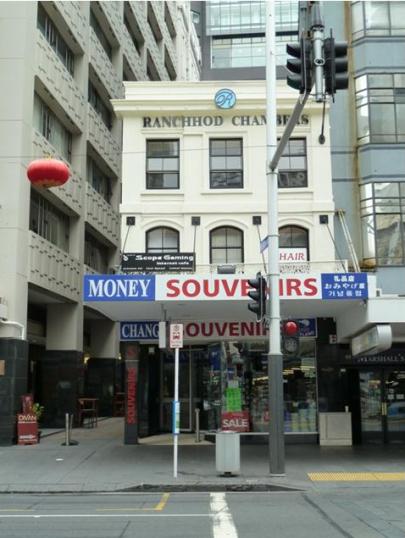
Early history of the site:
Prior to European colonisation, Maori occupied numerous sites beside the Waitemata Harbour and used its associated bays for transport, food-gathering and other purposes. The bay which now borders Auckland’s commercial centre was linked with settlement in the Waihorotiu Valley and its adjoining headlands, which have been traditionally connected with Ngati Huarere, Te Waiohua and Ngati Whatua. The mouth of Waihorotiu Stream was situated near the current intersection of Queen Street, and Swanson Street. Nearby, Te Whatu waka landing and mooring area was a rocky ledge at the foot of what became Shortland Street. On the western headland, a site known as Ngaa Uuwera - burnt breasts - extended south towards the current Exchange Lane.
Ngati Whatua’s offer to transfer a large area of land to the British Crown for the creation of a colonial capital was formally agreed in September 1840. In 1841, at the Crown’s first land sale, Alexander Dingwall (1804?-89) purchased Allotment 8 located on the southwest fringe of the Commercial Bay foreshore, the main harbour and key landing point for goods and settlers. The purchase was jointly financed with fellow Scottish carpenters Alexander Black (1813-81) and Alexander Marshall (1810?-75), who were collectively known as the three Alexanders or the three Sandies. The site lay partly within the tidal area at the foot of the Smales Point peninsula, and may have been purchased for the landing of timber. The rear boundary adjoined a proposed government lane, known by 1854 as Mill Lane. Intended as back entrances lanes were a notable feature of acting Surveyor General, Felton Mathew’s 1840-1 town layout. The eastern end of the property may have been reclaimed shortly after, and the western end cut back into Smales Point, minor works by comparison with other nineteenth-century earthworks in the commercial centre.
The allotment held in common by the three from 1843 was formally partitioned in 1845. In association with an adjoining owner, a strip of land was set aside to create a side lane off Queen Street for the loading and unloading of bulky goods from barrows and carts. Alexander Marshall was allocated the southernmost portion of the holding.
Marshall had arrived in the Bay of Islands in 1838 and moved to Auckland shortly after. He undertook building work including - in association with Black and Dingwall - the construction of Smales Point township, a cluster of timber buildings in what became Albert Street.
Marshall’s wife Mary (1807?-70) was related to influential Auckland entrepreneurs Henderson and Macfarlane who were early tenants of the Sandies’ warehouses constructed in the 1840s.
The two-storey warehouses stood immediately west of the Queen Street Wharf completed in 1852. A major entrepot and trading centre from its earliest days, Auckland enjoyed a more diverse trade than other ports in the colony and except for brief periods, remained New Zealand’s main seaport. Merchants played a key role as importers, receivers of consignments, distributing agents, and also operated as land and shipping agents. Maori, indispensable to the town’s pioneer economy as suppliers of food and labour, were significant customers.
Brothers John Anderson Gilfillan (1821-75) and Robert Gilfillan (1823-1909) set up as merchants and commission agents in the colonial capital in 1848-9 and appear to have moved into premises on Marshall’s site as early as August 1849. A two-storey brick building referred to as Gilfillan’s Warehouse was erected in the rear of Marshall’s Queen Street property as early as 1854 and operated as a bond store at least from early 1859.
In 1861-2, three-storey, brick warehouses began to occupy the west end of the nearby Fort Street reclamation opposite. By 1863, some investors were beginning to regard Queen Street as the future rival of Shortland Street, Auckland’s main commercial thoroughfare.
Construction of Gilfillan’s new store (1865):
In March 1865, Gilfillan and Company took a lease over the front three quarters of Marshall’s holding where they were longstanding tenants. The agreement provided for the removal or sale of buildings, provided that ‘a good and substantial brick building suitable for a merchant’s store, warehouse and office was erected within six months of the demolition.
The planning and design of the new premises occurred at the end of Auckland’s period as colonial capital in 1865, when Gilfillan was chair of the Auckland Chamber of Commerce. Construction of a three-storey store, warehouse and offices, ‘for Messrs Gilfillan, merchants, Queen-street, upon the site of their old premises’ was well advanced by June 1865. The new store was erected in brick on a ‘concrete foundation’, evidently scoria and mortar constructed circa 1849-54.
The three-storey premises had a plastered front and a slate roof with lead ridging. The design was of a simple Italianate architectural style, marginally less plain than the two- and three-storey Georgian-style brick buildings erected in the commercial centre in the late 1850s and early 1860s following the prohibition of timber construction under the City of Auckland Building Act 1856. Unlike Gilfillan’s earlier store which incorporated a large retail display window, the ground floor store-front was symmetrical. Within the rusticated base was a centrally located doorway flanked by two equal sized windows with segmental arch heads.
The incorporation of an arched entrance, arch-headed window openings contrasting with rectangular window openings, and the use of simple rustication illustrated a transition from the Georgian style characteristic of the early Victorian period to the Italianate architectural style adopted for commercial buildings in mid- and late-Victorian Auckland.
Internally the structure lacked cross walls and appears to have had a cellar space and at least one fireplace.
Gilfillan’s Store was a comparatively early work by local architect Richard Keals (1817?-85). A prolific designer of commercial buildings in the 1860s and 1870s, Keals had arrived in New Zealand in 1858 and set up architectural practice in the city by late 1861 after initially working as a builder. The comparative simplicity of Gilfillan’s Store was a marked contrast to later Italianate-style commercial buildings designed in a more ornate style by Keals’ practice for Queen Street sites in the 1870s and 1880s.
The contractor was a Mr Gunn who may or may not have been associated with a short-lived 1860s Auckland partnership Messrs Rhodes and Gunn.
Use of the premises by John Gilfillan (1865-8):
Scottish-born John Gilfillan was the son of an excise officer. He was a founding member of the colony’s first Legislative Council in 1854, and a member of the Auckland Chamber of Commerce in 1856 - an influential body in Auckland’s development as a city of capital. As a united voice for business, the Chamber (of which Gilfillan was a chair in the 1860s) sought measures including improvements to postal services, subsidies for coastal shipping services, improved protection against fire and the provision of an adequate water supply.
Gilfillan and Company’s Queen Street store offered a wide variety of merchandise including imported food, tobacco, alcohol, building materials, machinery and clothing, and was an auction venue for other merchants’ stock. Hoisting-beams on the side walls adjoining Gilfillan Lane enabled bulky goods to be transferred, it being suggested in 1869 that the weight carried by the various floors was causing the building foundations to sink. The premises was also a bond store, where customs duties were calculated on incoming goods and collected for the public purse.
From offices in the building, Gilfillan administered his own affairs and those of the business interests he represented. These included the Australian Mutual Provident Society, of which Sydney-based Robert was a director. Gilfillan was the Auckland agent for Hull steamship owners Pearson and Coleman. As the Intercolonial Royal Mail Steam Packet Company, the firm held contracts for mail services between Australia and New Zealand; for fortnightly shipping services between the provinces; and a direct trans-Tasman steamship service between Auckland and Sydney, greatly enhancing communications and business opportunities. He was secretary of the Bay of Islands Coal Company (1868) one of several companies encouraged into existence by the opening of the Thames goldfields which stimulated engineering and coastal shipping activities, saving the economy after relocation of the colonial capital to Wellington in 1865.
An 1866 map of the city depicts two structures separated by a right of way on Marshall’s site. The accompanying schedule (1867) refers only to a single three-storey brick building. It is unclear whether the 1850s bond store may have been the free-standing structure at the rear.
At this time Mills Lane remained only partially formed, although the portion in the vicinity of Gilfillan’s store may have been completed as early as circa 1869.
Use of the premises by Robert Lusk (1869-80) and Collins Brothers (1881-9):
Following Gilfillan’s relocation to premises nearer the wharf, Robert Lusk (1823?-80) commission agent and wholesaler, became Marshall’s new tenant in 1869. Lusk’s business interests extended to gold mining enterprises and benefited from proximity to ‘Scrip Corner’ (the Queen and Shortland Street intersection) where stockbrokers, agents and investors waited for telegrams from the Thames gold fields. The mining companies were primarily Auckland-based and the bullion was exported from the city’s wharves. The New Zealand Insurance Building erected in 1870 included a stock exchange (largely financed by local brokers and mining agents) accessed from Gilfillan Lane and Queen Street.
The exterior of Marshall’s building suffered fire damage in 1869. Testimony that ‘about three fourths of the building is new’, suggests that part of an earlier structure was incorporated within the 28-metre long building erected in 1865. Replacement buildings erected on Black and Dingwall’s sites replicated the design of Marshall’s building, the three addresses presenting a unified façade in the city’s insurance and financial district after 1869.
Following Marshall’s death in 1875, the income from the Queen Street property was paid to his two daughters under a trust established by his son John who had inherited the asset.
A substantial three-storey addition was made to the rear at an unknown date prior to 1882 - possibly between 1869 and 1877 - extending the premises above a right of way and almost to the rear boundary.
Through Robert Lusk and his father Robert Baillie Lusk (1798-1891), in 1881 the building became the first New Zealand premises of Collins Brothers, a forerunner of the influential publisher Harper Collins New Zealand (1978). Prior to his arrival from Scotland in 1849, Lusk Senior was a stationer. As an acquaintance of William Collins II, he voluntarily represented the Glasgow printing and publishing firm’s interests in the colony for a time.
The antecedents of what appears to have been the colony’s first wholesale manufacturing stationery house date from circa 1870 and the Queen Street address. The first manager was reported seventy years later to have been ‘Mr J. Lusk’, succeeded by David Cattanach who arrived in November 1880, the month of Robert Lusk’s death. Robert Lusk ‘paper merchant’ was the occupier of the address in January 1878, and at the time of his death was the ‘New Zealand agent for Collins and Co. of Glasgow’. Collins enjoyed a virtual monopoly of school book supplies to Australasia. The first Collins dairy was published for the colony in 1881, eight years before the company relocated to Commerce Street where it began local production of stationery.
Arthur Yates Limited (1889-96):
The Queen Street address was taken over by Arthur Yates and Company seed merchants in 1889. The enterprise founded in 1883 in nearby Victoria Street by Arthur Yates (1861-1926) who moved to Australia in 1887, was continued locally by his brother Ernest (1864?-1947). ‘Yates’ Reliable Seeds’ and Yates’ Garden Guide, synonymous with home gardening on both sides of the Tasman, remain a national institution.
The Mining Chambers and Exchange Lane (1896-1907):
In late 1896, the lease was briefly taken up by mining agents John Porter and William Hampson at a time of increasing gold yields from Waihi and the Ohinemuri district following the introduction of the cyanide extraction process earlier in the decade. The building became known as the Mining Chambers; and, the adjoining lane as Exchange Lane reflecting two decades of use as an access to Auckland’s stock exchange.
Following Auckland’s recovery from the late nineteenth-century economic depression, the Mining Chambers’ tenants included share brokers, legal managers, a small printing and publishing firm, a patents bureau, and the architect R. W. de Montalk who designed the pavilion for the 1897-8 Auckland Industrial and Mining Exhibition. From circa 1897 until 1906 the international tourist agency Thomas Cook and Sons occupied part of the ground floor, overseeing the nine branch offices and sub-agencies that promoted the colony’s developing tourist industry. During this period the front section of the Mining Chambers was known as Cook’s Building.
Changing use and ownership, formalisation of Exchange Lane as a public thoroughfare (1907- ):
During the early 1900s Auckland expanded significantly faster than the other three main urban centres in New Zealand, consolidating its role as the country’s largest city and financial power house.
In 1907, Alexander Richardson Dickey Watson (1878?-1917) an actuary and later a noted public benefactor, took a 42-year lease of the building. The area formerly occupied by Thomas Cook was partitioned into two shops, requiring replacement of the central entrance by a triangular lobby with two separate doors. By circa 1908 a single-storey verandah had been constructed along the Queen Street frontage and a bridge connected the rear of the building with Mills Lane. New Zealand’s first weekly newspaper, The New Zealand Truth founded in 1905, opened an Auckland branch office in the building in 1910.
In 1913, offensive odours from a men’s lavatory constructed over thirty years before off the south of Exchange Lane prompted complaints from nearby offices. Reflecting the high water table of the original shoreline, the smell evidently worsened depending on the tide. Other hazards in the Lane included conflict between pedestrian and wheeled traffic; insanitary conditions due to heaps of manure and rubbish; drunken brawling; and risk of robbery. The City Council considered dedicating the space as public road. The private owners erected gates at the lane entrance. Reflecting attitudes to public sanitation in the early twentieth century, a men’s public lavatory was constructed in 1914, work that involved excavation under Mills Lane. Exchange Lane remained in private ownership, but was concreted by the Council in 1917 who took over its cleaning the following year.
By 1917, the Mining Chambers had been extended to the rear boundary. The small addition had concrete floors and enabled access from the second floor directly onto Mills Lane via a loading bay. Outfitter Hugh Wright (1870-1948) was assigned the lease in 1919, a time of prosperity for tailors as men were targeted as consumers in the immediate aftermath of the First World War (1914-18). Eight-decades of Marshall-family ownership ended when Wright purchased the property in 1922.
The Mining Chambers including its retail tenancies continued to be rented out, Wright retaining nearby rental premises for his retail outlets. The Quoin Club (1916-30) a group of Auckland artists occupied rooms on the building’s upper floor. Influential members of the Club included the noted New Zealand sculptor Richard Oliver Gross (1882-1964); and the architects William Gummer (1884-1966), and Malcolm Draffin (1890-1964).
At an unknown date prior to 1928, kerbside verandah posts were removed following installation of a suspension verandah. Fire damaged the middle and upper floors in 1928 with water spoilage to stock in Hugh Wright’s ground floor drapery. The southeast corner of the brick wall was removed in 1929 to provide for a retail display window.
Hugh Wright’s show rooms were briefly listed at the address. Other tenants including a sports goods retailer, a radio dealer, and a dancing school reflected popular 1930s leisure activities. In 1935 the Mining Chambers re-emerged as a discrete visual entity when the two adjoining buildings were demolished. Retail tenancies were redesigned in 1937 by Auckland architect George Tole. Brick partition walls were constructed on steel girder supports; a corner entrance was created; and openings to Exchange Lane were enlarged. A light well provided natural light after the erection of the Dingwall Building on the adjoining site in 1935-6. A brick wall is said to have been built across the right of way on the Dingwall boundary for the duration of the Second World War (1939-45) to stop potential damage by bomb blast.
Council plans to extend the public lavatory in 1947 led to Exchange Lane’s gazetting as a service lane in 1951. But the toilets, the alleged ‘nightly haunt of a band of sexual perverts’, were permanently closed and street cleaning equipment stored there until 1955. The space then accommodated an Auckland Electrical Power Board transformer until late 1969, and the entrance to the toilets was subsequently bricked up.
Inspired by Melbourne’s first boulevard café, a smart coffee shop opened in the Mining Chambers in February 1958. A successful campaign by Hugh John Wright (1908-94) for outdoor seating resulted in the coffee bar becoming one of the first outdoor pavement cafés in New Zealand. Since his father’s death in 1948, Wright had led New Zealand’s largest men’s-wear retail chain. Although Wright declined to sell the Mining Chambers for demolition in the 1950s, consideration was given to redevelopment of the site in 1964.
A number of travel agents tenanted the building from the 1960s when the advent of long-range jets and completion of the Auckland International Airport (1965) made Auckland the world gateway to the South Pacific. The local publicity division of the Government Tourist Bureau based in the Mining Chambers since 1958 moved to larger premises in 1963, the same year Watts Sports Depot ended its 33-year tenancy. Coinciding with Wright’s appointment as Italian consular agent in 1965, a programme of remodelling commenced which may have included removal of the building’s brick chimney. Stars Travel Agency expanded a shop tenancy into the basement area requiring a new stairway that was subsequently repositioned. Other travel industry tenants included Alitalia Airlines, United Travel and American Express International.
In 1971, three years after the transformation of Auckland’s Vulcan Lane, Exchange Lane was developed as Queen Street’s second mall. The new pedestrian precinct was linked to Mills Lane above by a spiral staircase. The concept by architects Nyall Coleman, Gibson and Associates was funded by Auckland City Council with contributions from three adjoining property owners including Hugh Wright. Reflecting popular culture of the time, the Mining Chambers’ tenants included a television rental firm and an RCA Victor record store.
The upper floor including several sets of rafters was refurbished after fire damage in 1984. The same year, steel straps and bolts were introduced to secure sections of the front exterior walls; cracks in the parapets and window lintels were repaired; and windows were replaced. A coffee roasting shop, the first in the central city, opened in a ground floor tenancy in 1989.
Ending a 75-year association with the Wright family whose nineteen men’s wear stores made them a household name, the Queen Street property was bought by an associated company, Bradstreets Limited in 1994. A bar was established on the Mining Chambers’ upper floor fronting Mills Lane in circa 1997. At an unknown date prior to 2003 a decorative balustrade was added at first floor level overlooking Queen Street. The property changed hands in 2009 and is now known as the Ranchhod Chambers.