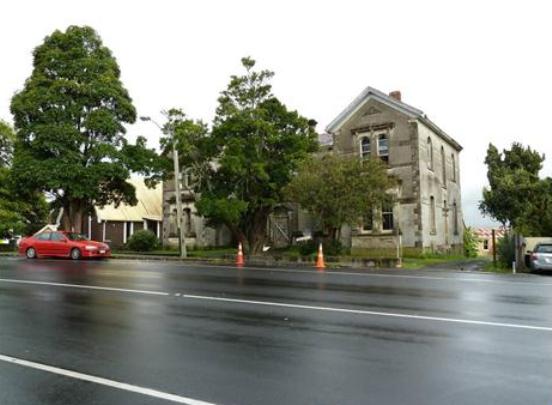
Early history of the site:
Prior to European colonisation, Maori occupied numerous sites beside the Waitemata Harbour and the Whau and used its associated bays for transport, food-gathering and other purposes. The bay which now borders Auckland’s commercial centre was linked with settlement in the Waihorotiu Valley and its adjoining headlands, which has been traditionally connected with Ngati Huarere, Te Waiohua and Ngati Whatua. Beyond the headlands to the southwest lay Opoutukeha / Opou, the current Cox’s Creek, an ancient boundary of the Ngati Huarere rohe. The catchment drained the southern slopes of the current Ponsonby / Grey Lynn ridge. Gardens were located on the northern slopes above Opou and flax fibre was beaten out at Tukitukimuta near present day upper Pollen Street.
Ngati Whatua’s offer to transfer a large area of land to the British Crown for the creation of a colonial capital was formally agreed in September 1840 with Opou forming a defining boundary.
Commencing in 1844, land in present-day Grey Lynn and Westmere (well beyond the formal extent of the colonial town) was auctioned. In 1884, the 1845 Crown Grant for Allotments 40 and 41 of Section 8 became subsumed within the Surrey Hills Estate, an extensive low-cost suburban subdivision promoted by the Auckland Agricultural Company a venture linked with large Waikato land interests. A seven-lot parcel was purchased in Richmond Road in 1885 by William Crush Daldy (c.1815-1903), Shirley Whitfield Hill (1849?-1908) and Theodore Minet Haultain (1817-1902) as trustees for the proposed Costley Training Institution. The three trustees were official visitors of the Auckland Industrial School where they had conducted an inquiry in 1883.
Construction of the Costley Training Institute (1886):
The CostIey Training Institute was purpose-designed as a boys’ home and training institution. Founded under special legislation, the facility was established to train disadvantaged but deserving young people selected from industrial schools in or near Auckland. It reflected a developing institutional approach to welfare in late-nineteenth century New Zealand; a growing focus by voluntary organisations on working with selected clienteles; and the establishment, design and construction of institutions as solid memorials to philanthropy.
The two-storey brick building with stone detailing was the first of four substantial structures erected with funds from a large bequest left by an early Auckland resident and businessman, Edward Costley (1796?-1883). Costley had specified that his fortune should be used to benefit charitable institutions in Auckland including the Auckland Hospital, the Parnell Orphan Home, the Auckland Free Public Library, the Sailors’ Home, and the Kohimaramara Naval Training School.
The Kohimarama facility opened under the Naval Training Schools Act 1874 catered for boys aged ten to fifteen who were destitute; those charged with a punishable offence; or those whose parents wished to have them committed for training. The school was designed primarily to train boys for the merchant navy, although inmates received a general education and could opt to serve an apprenticeship for a land-based trade. The facility closed in 1882 whereupon the leased premises became the boys’ branch of the Auckland Industrial School, raising doubt as to whether the Costley bequest could be paid to the government-controlled school. The Auckland Industrial School founded in 1869 under the Neglected and Criminal Children Act 1867 was one of ten institutions predominantly run by local or church bodies for children in the colony.
The Costley Training Institution Act 1885 provided for the founding of a new facility to cater for suitable children of ‘ages fit to be apprenticed’ who had been committed to local industrial schools by a magistrate due to destitution or parental neglect. The legislation was sponsored by Premier (later Sir) Robert Stout, a strong supporter of technical education and the development of self reliance.
The large Richmond Road site selected for the new institution was located near the industries of Grey Lynn and lay within the working-class residential subdivision of Surrey Hills. Rural or semi-rural locations were generally favoured as sites for institutions in order to keep inmates away from what was perceived as the corrupting influences of towns, and to enable development of moral character through physical work such as gardening. Slow land sales during the economic depression of the late 1880s and the early 1890s resulted in much of the Surrey Hills estate being leased for stock grazing, prolonging the area’s semi-rural character.
Auckland architect Robert Jones Roberts (c.1832-1911) was commissioned to design the two-storey Costley Training Institute which was to provide living quarters for a custodian and accommodation for twenty five boys of apprenticeship age who would remain under the Trust until capable of earning a living from their trade and controlling their own affairs. Roberts, a preacher in the Congregational Church, may have won the commission through the influence of fellow-Congregationalist William Daldy who was one of the Institute’s trustees.
The design of the Institute premises was of a Classical-Italianate style. The nineteenth-century Neo-classical architectural form combining symmetry and order was generally preferred for Non-conformist places of worship and civic or public buildings. Elaborate detailing included stone quoins, arched window openings, pediments and corbelled eaves, elements more commonly associated with the commercial premises and grand villas of wealthy professionals and merchants. The visually interesting building echoed Costley’s objective of giving worthy orphan and destitute children advantages which could not reasonably be provided from public funds, and was one of an increasing number of structures erected in brick, a material highlighting Auckland’s transition from a former colonial frontier settlement to an established urban centre.
The contract was awarded in December 1885 to builder Thomas Colebrook, the lowest of the twenty two tenderers. The project coincided with the onset of the late-nineteenth century depression in Auckland, saving the trustees an estimated £500 in cost and employing a number of artisans in need of work.
The residential institution completed in August 1886 stood behind a low brick wall with decorative cast iron railings similar to those commonly associated with the homes of Auckland’s well-to-do. The privately-funded, non-denominational institution with a relatively small number of residents was a marked contrast to a number of government and Catholic industrial schools which occupied premises of austere design or buildings originally erected for other purposes.
The two-storey building of ‘H’ plan layout encouraged fresh air and adequate light. The strictly symmetrical facade terminated in slightly projecting wings and had a centrally-located portico. For economy and convenience the kitchen and storerooms were centrally located in a rear wing. Internally, a dining room; a sitting room with a recess for a library; the manager’s quarters; and service rooms including kitchen, pantry, scullery and storerooms were located on the ground floor. Stairways were located at either end of a hall that ran along the front of the building on both floors. Upstairs were six bedrooms and an infirmary. The facility was said to offer more comforts and conveniences than those enjoyed by the sons of nine out of ten tradesmen in the city.
Use as the Costley Institute (1886-1908):
In common with many other charities in the 1880s, the Costley Training Institution focused on a specific field of need and ideas of ‘deservedness’, secure in the knowledge that public sector institutions and the charitable aid system provided a safety net for more challenging cases. The Institute took pride in rearing as useful citizens, lads who otherwise might have proved a source of danger and expense to the community.
The indenturing of children from orphanages and charitable institutions was a well established practice under the Master and Apprentice Act 1865, one of the first pieces of New Zealand labour legislation, and the apprenticeship system was seen as vital for supplying the skilled labour required to build and service the growing colony. Although economic recession and the growth of the cities made social problems more visible in the 1880s and 1890s, the trustees reiterated that applications from parents and others wishing to place children in training were not granted.
The focus of the Costley trustees was on boys whose character and antecedents were good, or those likely to profit by or be a credit to the institution. The boys were maintained, a portion of their earnings being deducted for their keep, until they were capable of controlling of their own affairs. Younger boys attended the nearest school until the end of standard four.
In 1886 the Costley Training Institute received a £672 endowment under the will of a Mrs Rebecca Hodge (d.1884), to be invested for the benefit of girls. Although girls were catered for from the outset, they were boarded out with reputable families. The older ones entered domestic service, the single largest employment category for women; or received training for factory work, a growing area of employment less favourably regarded by guardians.
The capably managed institution was likened to a Man-of-War. As in similar mid-to-late nineteenth-century institutions, cleanliness and respectability were synonymous; and order, discipline and habit formation were seen as an essential part of training. The boys assisted with housework and the garden, and regularly attended church and daily family worship. They were encouraged to regard the institution as their home and corporal punishment was strictly controlled. In 1902, a welcome home function was held for old boy Captain Wood on his return from the Boer War.
Carpentry skills were taught four evenings a week. In 1891, the workshop on the site was relocated and converted into a tool shed. A larger workshop was erected in brick, by contractor J. J. Holland, and housed a wood turning lathe and a blacksmith forge. A gymnasium was constructed at the rear of the property in 1898, a year before the holding was slightly enlarged with the purchase of an adjoining lot.
Under Auckland sports trainer Professor Carrollo, gymnastic displays were staged for visitors and dignitaries, and at community events. The boys also undertook drill training, and on the occasion of Governor and Lady Plunket’s 1906 visit formed a guard of honour and performed lancers’ exercises.
Boys in Auckland had been instructed in drill since mid-1894 to encourage discipline and abate larrikin nuisance. School Cadets had taken strong root in Australasia by 1902 and became compulsory for male students over the age of twelve under the Defence Act 1909. Around the turn of the century a regime of exercise, cold bathing and strict training was widely promoted in education circles, for buoyant health and purity.
Several of those in charge of the Costley Training Institution had military connections, including a former naval petty officer and a manager with seventeen years army service. Upon his retirement as a trustee, Sandhurst-trained Colonel Haultain - a retired regimental commander and a former Minister of Colonial defence (1865-9) - was replaced by Major R. B. Morrow. William Crush Daldy, a sea captain in early life, was replaced in 1900 by George Fowlds (1860-1934) who was later a minister of education in Ward’s Liberal Government and a noted educational administrator associated with tertiary institutions.
Like architect Robert J. Roberts, Costley Training Institute trustees William Daldy, George Fowlds and Wesley Spragg (1848-1930) were members of the Congregational Church, a denomination with influence out of proportion to its modest numbers in New Zealand. All three men were actively involved in the temperance and prohibition movement, a strong force for the reform of liquor laws in New Zealand between 1881 and 1911. Entertainments provided for the boys included a visit by the Band of Hope, and speakers including former New Zealand Premier Sir William Fox (1812?-93) who was also a noted social reformer. It was reported in 1890 that all the Costley inmates had joined the temperance movement.
Other social reformers associated with the institution included the manager from 1897 until 1905, William Hendre and his wife Sada Russell Hendre. Both were actively involved in trade union matters in the early 1890s. Sada Hendre was an official visitor to the Auckland Hospital and Mental Asylum throughout her period as matron of the Costley Training Institute. She was also said to be a former secretary of the influential Tailoresses’ Union, a body in which Daldy’s wife Amey was also involved.
Governor and Lady Ranfurly visited the home in 1900 and 1901. Members of the public were also encouraged to visit as the institution began to experience annual deficits due to low rates of interest on its investments. In 1904 an annual government subsidy was sought and two years later bequests were solicited. Girls, never great in number, were no longer accepted for training.
Changes in government policies to favour boarding-out rather than the institutional care of children reduced the number of boys available for apprenticeships. In 1907 respected Auckland businessman and dairy pioneer Wesley Spragg became a trustee but, notwithstanding his business acumen and reputation for efficiency, was unable to rescue the institution. Facing increasing expenditure on repairs and improvements required by the Education Department, the Institute closed in December 1908. Investment returns on the proceeds from the sale of the property continue to contribute to the maintenance of selected young people apprenticed to trades or in higher education.
Richmond Road Children’s Home (1909-30):
The Richmond Road premises were taken over shortly after for use as an Anglican, children’s home. At a time when the Education Department was closing its institutions in favour of fostering and other forms of community supervision, New Zealand’s Christian denominations were increasing their commitment to orphanage care.
Sister Cecil’s Home accommodating 54 children opened in the premises in 1909. Cecil Mary Sophia Beresford Kenyon (?-1912) had arrived in New Zealand a decade before, from Melbourne’s Mission to the Streets and Lanes which was the forerunner of the Order of the Good Shepherd. Sister Cecil became responsible for the Ayr Street Children’s Home in Parnell, an institution founded in 1893 (by Eliza Jane Cowie (1835-1902) the wife of the Anglican Bishop) for the care of young children ineligible for admission to the Parnell Orphanage. The local Order of the Good Shepherd founded in 1905, to provide help for the urban poor in early twentieth-century Auckland and was the first of only two orders of Anglican religious women established in New Zealand.
The purchase of the Richmond Road property was finalised in 1910, the year a two-storey addition was built for boys, and enlargement of the kitchen area occurred. Funds raised included a £1000 donation by Sir John Logan Campbell, ‘the Father of Auckland’. Campbell’s gift, one of several benefactions he made in aid of young children from deprived backgrounds, and a further £2000 donated to the Order of the Good Shepherd, greatly enhanced his reputation as Auckland’s greatest philanthropist.
During the first year of the Home’s operation the children received schooling within the institution from the sisters who gave lessons in the dining room and play room, there being no school room. The following year the children attended Richmond Road public school which by 1911 was suffering overcrowding and could not take all of the Home’s children. The Auckland Board of Education pressed the play room into service as a class room, although the presence of a number of children not under the control of the Richmond Road Children’s Home posed on-going problems.
Following Sister Cecil’s death in 1912, a chapel erected in her memory was consecrated by Bishop Walter Averill (1865-1957) in December 1913. The Arts-and-Crafts-influenced brick building had a tiled roof and shingling in the upper gables and was designed by Auckland architect Arthur Daw (1865-1957). The interior included exposed brick walls, timber beams and sarking.
Management of the Home passed out of the hands of the Order of the Good Shepherd after 1912, although it remained an Anglican institution. Church orphanage work reached its zenith in the early-twentieth century. Although the government strengthened financial support for families and women rearing children alone after the First World War (1914-18) and introduced a family allowance for low-income married mothers with three or more children in 1926, it was not until the Social Security Act 1938 that benefits were provided for the unemployed or sick.
The informal admission process of church orphanages provided a flexible and possibly less stigmatised form of family relief in times of financial stress, family breakdown and health emergencies. Children living in the Richmond Road Home included those committed by a living parent. While in care the eldest child generally minded siblings. When the Home first opened in 1909, most of the children were under ten years of age. Due to the low number of staff, the children did a great part of the work, ‘at an age when very little should be required of them’. After 1911 some of the teenage girls were employed for household duties to assist the staff.
By the mid 1920s over 70 children lived in. The extension of the Child Welfare Act 1927 introduced more stringent controls and contributed to closure of the Richmond Road Children’s Home in 1930. The property was unsuccessfully offered for sale.
Following the Hawkes Bay earthquake in 1931, Hukarere Anglican girls’ boarding school for Maori students occupied the building for about a year.
New Zealand Church Army (1935-76):
In 1935 the property became Carlile House, the New Zealand headquarters of the Church Army, an Anglican evangelical organisation. The chapel was known as St Michael’s and All Angels and served as an Anglican place of worship for the local community.
Evangelistic outreaches in large urban centres commenced in the nineteenth century and became an important part of social work during the 1930s depression and its aftermath. The first New Zealand appeal to the Church Army (which had been founded by Londoner Wilson Carlile (1862-1942) in 1882 to undertake social work in slums) had come in 1926, from Bishop Sedgwick of Waiapu who was concerned for the welfare of those in public works camps.
An autonomous Church Army was launched in New Zealand in November 1935, with Richmond Road as the headquarters. For many years one wing of Carlile House was the home of Captain S. R. Banyard, the leader of a team who had come from England in 1933 to found the local organisation. Two-year residential training courses were run at Carlile House. During the Second World War (1939-1945) 75 laymen were trained to represent the Anglican Church in spiritual and social welfare matters within the Armed Forces. The first New Zealander to become an officer of the Church Army, Canon Douglas Caswell, later became Auckland City Missioner.
Carlile House contained two offices, a dining room, a large living room, a large kitchen, two store rooms, a vestry, a lecture room, and a lounge. Two rooms with four cubicles in each, accommodated students. In addition to two flats (for Church Army captains and their wives) were three bedrooms, two bathrooms, a library and seven lavatories. The Church Army Press operated in the former gymnasium, producing its own literature as well as parish newsletters and church histories. The plastering of some of the exterior walls of the main building may have been undertaken in 1942, the year repairs costing £90 were made.
The Church Army headquarters, the chapel, and the Church of England Boy’s Society (CEBS) - a boys’ club which met three nights a week - became a central element in Derek Hansen’s, Remember Me: A Novel, set in the 1950s. For part of his boyhood Hansen lived in residential accommodation attached to the shop on the corner of Chamberlain Street and Richmond Road. His portrayal of Carlile House during that period is as a rabbit warren of long corridors and few people in the big old building. The Church Army lounge was evidently a cavernous room with ill-matched furniture; and the dormitory with its curtained cubicles offered no more privacy than a public hospital. Regular chapel attendance was a prerequisite for membership of the boys’ club which closed down following the arrival of television in New Zealand.
After the Church Army moved out in circa 1969, the building was briefly leased to the Department of Social Welfare as a remand home. In 1973 it became the Auckland Alternative School, a secondary school based on the policies of Alexander Sutherland Neill, the 1921 founder of Summerhill School, Suffolk. In May 1975 fire damaged one wall of Carlile House. The Church Army sold the property in 1977, and recently celebrated 75 years of operation in New Zealand.
Ownership by the Tongan Community (1976 - ):
Reflecting Grey Lynn’s growing Pacific Island population during the 1970s, Carlile House was purchased by the Tonga Development and Agency Company for use as a hostel to assist workers in New Zealand on temporary work schemes and as a place of community gathering. The property was the home of the United Church of Tonga in New Zealand of which Clive Edwards (1934- ) was a founding member and the Chairman of the Board of Trustees. A lawyer, Edwards was closely involved in deportation cases during the era of dawn raids in the 1970s, but returned to Tonga in 1994 where he entered politics.
New Zealand’s Pacific Island population had increased rapidly during the 1960s as people came on temporary permits to learn trades, to undertake tertiary education and to gain professional qualifications. In the early 1970s, short-term contractual agreements between New Zealand and Tonga brought an influx of unskilled workers. Following an amnesty in 1976, many Tongan people were granted permanent residence and immigration resumed, by which time church services were being conducted in the Tongan language.
Reflecting the importance of the church in Tongan society, in 1978 the former chapel seating 100 people was redeveloped into a church accommodating 300. Lancet windows in the Richmond Road façade were replaced by a full height church window of modern design, and the building was substantially rebuilt in an enlarged form with a basement hall. In 1979 the church was dedicated to the memory of Queen Salote Tapou III (1900-65). Queen Salote’s 47-year reign included transformation of Tonga’s government by means of a modern public service staffed by Tongans, an increasing number of who had received tertiary education overseas.
The nineteenth-century main building gradually became run down and vandalised as a lack of finance hampered plans for its full re-use. The property was cross leased and transferred to the United Church of Tonga in New Zealand Trust Board in 1990.
Oamaru stone detailing on the northwest pediment of Carlile House was removed in circa 1992. During the 1990s the property was scheduled in the District Plan as a ‘Category A’ heritage place, but the deteriorating state of the main building and its uncertain future remains a matter of ongoing public concern.
A conservation plan was prepared in 2003, but deterioration steadily worsened due to broken windows and the inadequate state of the roof. After almost a century, the former chapel - now part of a larger church - remains an important place of worship and gathering for members of Auckland’s Tongan community.