Te Tai o Poutini
Te Tai o Poutini (West Coast) has a long history of Maori occupation. The Ngati Wairangi and Patea people occupied the area largely undisturbed until about 1700 when Ngāi Tahu from the east coast of Te Wai Pounamu began to predate on their territory in order to claim the highly prized pounamu (greenstone) resource. A succession of battles ensued over the next century and the descendants of the 18th century Ngāi Tahu chiefs form the foundation of Poutini Ngāi Tahu today. The small town of Runanga is situated 10 kilometres north-west of the Mawhera/Grey River, on the South Island’s West Coast. Major settlement areas for Poutini Ngāi Tahu were located near Runanga at Te Aka Aka o Poutini (Cobden) and later at Mawhera Pa on the south bank of the Mawhera River.
State Coal Town
When the Seddon government passed the State Coal Mines Act in 1901, a model residential town for miners was planned a few kilometres north-east of Greymouth near Point Elizabeth mine. Through the State Coal Mines Act, Premier Richard Seddon was aiming to compete with private mines, not only to provide cheaper coal but, more importantly, higher safety standards and better working conditions. As Runanga was one of those towns where this was to be achieved, its very origins are linked to the organised labour movement.
The town was initially named Kotare (Kingfisher) but was changed to Runanga (meeting place) by an Order in Council in 1903. According to Te Ara, the Online Encyclopedia of New Zealand, the name Runanga was agreed in discussion between Premier Richard Seddon and Poutini Ngai Tahu leader Tahuru, apparently commemorating a past meeting place in the area. The Runanga township was established on Crown land. From 1904, when the first coal was produced at the Point Elizabeth mine, the government has operated a series of large-scale coal mines in the district. The land for the settlement was withdrawn from coal reserve and leasehold residential sections were subdivided in 1903. The town began to progress in 1904 when the coal mines began producing coal in the area. A sawmill was established in the town to supply timber for building and some houses were erected and occupied by 1905. The population was made up of miners and their families.
Birth of Labour Party
In the 1890s industrial relations had reached a crisis in New Zealand. Unions were formed by workers in significant industries such as maritime, agriculture and mining. Confrontations with employers, including strikes, took place around the country. However, after suffering some defeats, the unions began to look to politics as another way of addressing their issues. Initially many of the unions supported the Liberal Party, though in due course the Labour Party emerged with its own particular identity.
Runanga mine, as a State Mine, and the town itself, became particularly important to the growing union movement. As labour historian Len Richardson notes, the mine ‘became a mecca for socialists who saw it as an experiment in public enterprise and the forerunner of wider nationalisation within their industry. In the meantime, Runanga offered activists like [Patrick] Webb a safer environment in which to spread their socialist gospel’.
Miners had always been part of the organised labour movement. The State Miners’ Union was formed in 1905. Soon after this, Robert (Bob) Semple, coalminer, trade unionist and politician, proposed the Union construct their own hall in Runanga. This original Runanga Miners’ Hall, built on the corner of Mills and McGowan Streets in Runanga, opened in December 1908. While impetus for its construction came about through the Miners’ Union, resources to construct it were provided by employees, by way of the union, the mines as employers, Greymouth business people, as well as the State. As such, it was hailed as the first co-operatively built hall in the country. It was a key meeting venue for the union.
That original hall was a place where significant decisions were made affecting politics nationally. The New Zealand Labour Party as it exists today had its origins in a number of socialist groups coming together, including the organised labour movement represented by key figures from the West Coast mines. Since 1916 these various groups had coalesced to become the modern Labour Party. The original hall hosted notable local, national and international labour speakers on socialism and the Labour movement. They included figures such as Harry Holland, Peter Fraser, Bob Semple, Pat Hickey, Patrick (Paddy) Webb and Robert Hogg.
Replacement Miners Hall
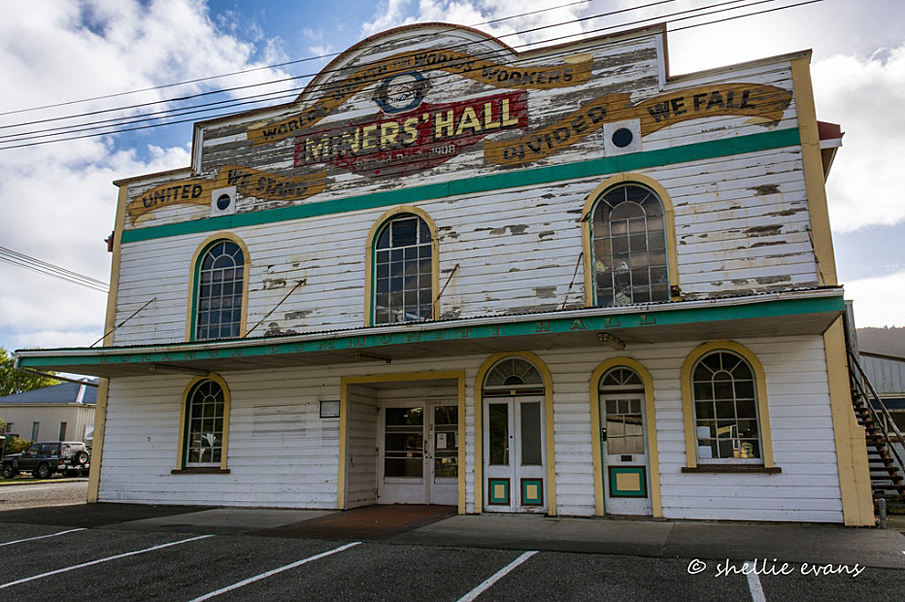
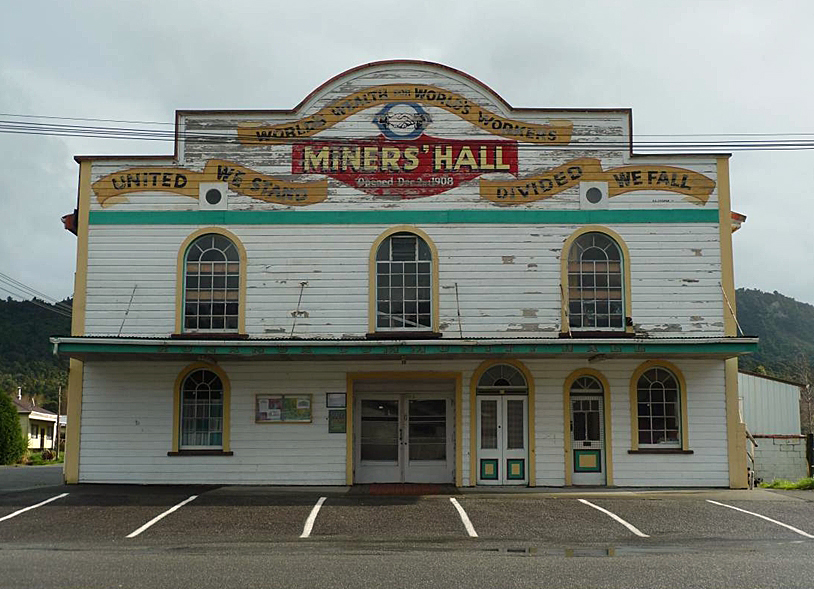
The original Runanga Miners’ Hall was destroyed by fire on 2 January 1937, possibly as a result of politically motivated arson. Its replacement building, the present Runanga Miners’ Hall, was built and opened on the same site in less than nine months, on 20 August 1937. It was designed by the same mine engineer who had designed the original miners’ hall, George Millar, and was built by Jack McMillan of Cobden. Typically large scale, its design differed from the original hall. In recognition of the opening of the new Miners’ Hall in August 1937, Minister of Mines in the first Labour Government, Patrick (Paddy) Webb, noted that the old hall ‘ …was of wonderful service to the Labour Movement. It might truthfully be said that with the opening of the old Miners Hall, the dawn of a new day for Labour commenced. … No town in Australasia has played a more important part in the building up of the Labour Movement than the town of Runanga. May the new Hall ever last to be the Temple of Labour for the West Coast.’ Indeed, although the replacement hall was not the specific venue associated with such momentous political change as its predecessor, this new hall did continue to serve the functions as the original hall. That is, it provided a venue for union meetings, and political and public gatherings. The hall is reputed to have seated 158 upstairs and at least four times that on the ground floor. The opening of the new hall followed only two years after the election of the first Labour Government in New Zealand, in 1935, and its political connection remained. It also happened to serve the community at a time when coal mining activity was peaking in the general district (between 1939 and 1942). It therefore continued its role in the Labour movement but the new hall does not appear to have been the place of significant political change that its predecessor had been.
Nevertheless, the replacement 1937 hall was specifically the site of some notable happenings. It was the site of a large memorial service at the death of Michael Joseph Savage in 1940. The following year, in 1941, John A Lee spoke at the hall, campaigning for his Democratic Labour Party after splitting away from the government. The hall was also the venue for speeches by Paddy Webb, as Minister of Mines, and by miners’ leaders during the conflict between the Runanga Miners’ Union and the Labour Government in 1942. In 1951 the hall was the headquarters for the union when they struck in support of the locked out watersiders.
As in other mining towns, the union hall was a centre for numerous social activities such as dances, formal dinners, talks by visiting speakers on a range of subjects, theatrical performances, wedding receptions and the showing of movies. The latter was a key long-standing function; for 33 years the 1937 Runanga Miners’ Hall was the community’s movie theatre until it closed down in 1975 due to declining patronage following the widespread introduction of the television.
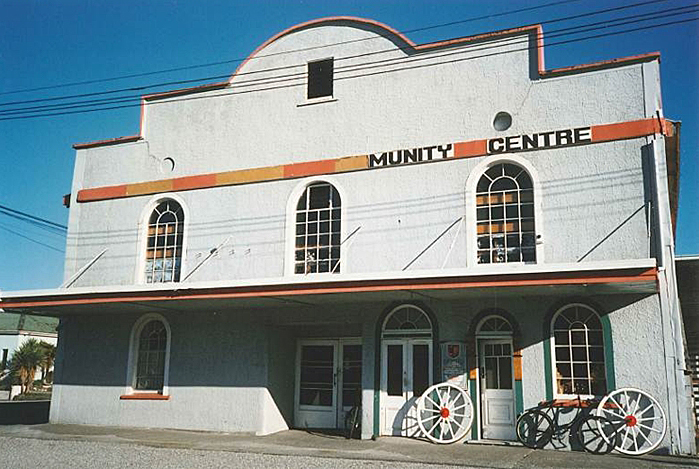
The State Miners Union ceased to exist in the 1960s and it relinquished its ownership of the hall. The building was used as a factory by Matai Industries, making wooden goods under a Labour Party initiative through Prime Minister Norman Kirk until 1975. Cement render was added to the exterior of the building, probably during this time as a factory. After a period of about five years of closure, in circa 1980 the hall became the Runanga District Community Centre. In 1983 it was renovated by the Grey District Council and was opened by the then Governor General, Sir David Beattie. The original slogans that had been painted on both the 1908 and the replacement 1937 halls were repainted as part of a Millennium project refurbishment of the Runanga Miners’ Hall in circa 2000. The hall continued to be used for various community purposes until it was closed in early 2012 following a report suggesting that it is earthquake-prone.
‘World’s Wealth for the World’s Workers: United We Stand Divided We Fall’
Slogans adoring the 1908 hall, and repainted on the 1937 hall, were originally painted by a young sign writer, James Begg Kent. Kent later became Labour MP for Westland from 1947 to 1960. Kent stated that he painted the slogans at the instigation of Pat Hickey, who was based at Runanga in 1907 and again in 1909-10. In 1906 Hickey had returned from the United States of America where he had been involved with the militant Western Federation of Miners (WFM). The WFM were in turn one of the founding groups behind the Industrial Workers of the World (IWW). The slogans ‘World’s Wealth for the World’s Workers: United We Stand Divided We Fall’ were used by the IWW and other militant unionists around the world.
Contextual analysis
Miners’ Halls
There were a number of miners’ halls throughout New Zealand but the Runanga Miners’ Hall appears to have played a particularly significant role in the labour movement. The Thames Aluminium Co Building, originally constructed in 1886, is a rare survivor of a miners’ hall (Category 2 historic place, Register No. 1886). Another building, the Miner’s Café situated in Waihi (Register No. 2688), was initially built as the Waitekauri Miners Union Hall in circa 1895 but was moved to Waihi in 1903 for use as a Baptist Chapel. Many miners’ halls have been demolished, including the Blackball, Millerton, Waihi and the original Waiuta Miners’ Halls. The original Waiuta hall (built 1910) was destroyed by fire in 1941. The replacement Waiuta hall is comparable to, but not as grand as, the present Runanga hall, and stands relocated at Totara Flat in the Grey Valley.
Most New Zealand towns and cities have community or memorial halls. However, while of a similar type and serving a similar function to those halls, Miners’ Halls were specifically for mining communities.
The Runanga Miners’ Hall can also be considered in an international context. The Runanga Miners’ Hall provides a direct link with an international workers’ movement, and this is expressed in a practical sense through the financial help that British, Australian and New Zealand miners gave each other during strikes. Miners and mining unionists travelled between the mines of Colorado, British Columbia, Broken Hill, Witwatersrand and New Zealand’s West Coast. In all these places they lived in communities like Runanga and met in halls like the Runanga Miners’ Hall. However, few such halls are left anywhere in the world.
Associated historic places
The hall is in the near vicinity of a number of other historic sites that recognise aspects of coal mining history. These include: the memorial to State Mine employees, John Coulthard and William Hall (killed in 1917 during a payroll robbery near Runanga); the Brunner coal mining remains historic area (Register No.7051), the Suspension Bridge at Brunner (Register No. 7399), the Stillwater Cemetery graves relating to the Brunner mining disaster of 1896, the Blackball Coal Mine Chimneys (Register No. 5005); the Blackball Community Centre (Former miner manager’s house, Register No. 5043), and the Buck’s Head Hotel in Taylorville (the site of the hotel where union meetings were held in the 1880s).