Built in 1835, Christ Church is the oldest surviving church in New Zealand. However, alterations after 1871 transformed its appearance and its original simple and plain character was considerably lessened.
The church originally exhibited a highly ordered symmetrical façade. Rectangular in plan, without a proper chancel, it was clad in weatherboard with a hipped roof and Gothic arched windows. The church was built by Gilbert Mair, a former ship's carpenter, with money from public subscription.
During the battle in 1845 between British forces and [Maori toa (warriors), Kawiti and Hone Heke], the church became the centre of fighting and received a number of bullet holes. It also came under the line of fire from the naval ship, HMS Hazard, and was splintered by musket balls. The churchyard contains the graves of men from the Hazard who died in the battle, in addition to the graves of Tamati Waka Nene and Hannah King.
In 1971 the hipped roof was replaced with a gabled roof form and the old box pews were used for panelling, arranged as wainscoting on the walls. The church was named 'Christ Church' by Bishop Cowie in 1873, in recognition that it was the oldest surviving church. A porch and buttresses were added later in the 1870s and a belfry was erected in 1890. The additions had the effect of Victorianising the church.
Still a simple and unpretentious building, Christ Church is significant for its history and its setting.
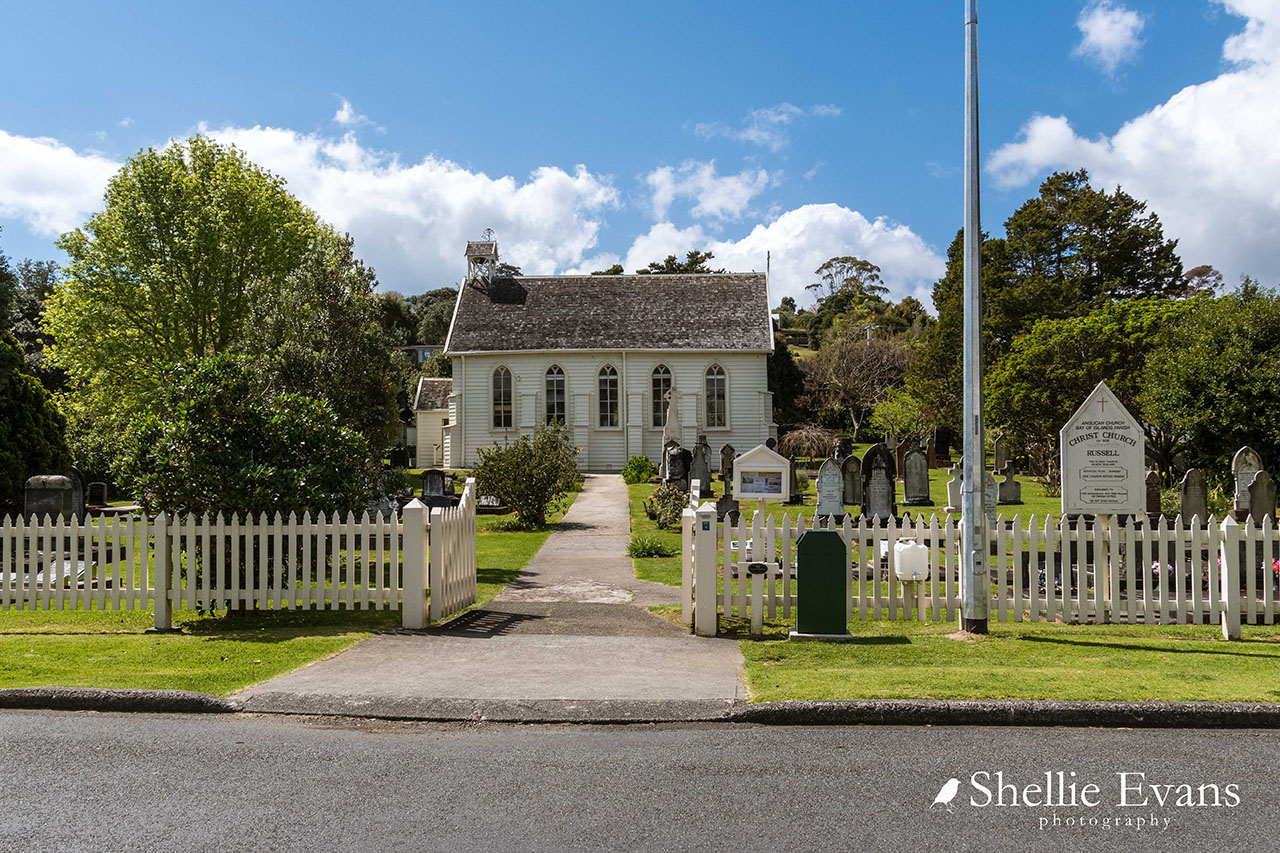
Christ Church (Anglican), Russell. CC BY-NC-ND 2.0 Image courtesy of www.flickr.com | Shellie Evans – flyingkiwigirl | 07/10/2018 | Shellie Evans

Christ Church (Anglican), Russell. CC BY-NC-ND 2.0 Image courtesy of www.flickr.com | Shellie Evans – flyingkiwigirl | 07/10/2018 | Shellie Evans

Christ Church (Anglican), Russell. CC BY-NC-ND 2.0 Image courtesy of www.flickr.com | Shellie Evans – flyingkiwigirl | 07/10/2018 | Shellie Evans

Christ Church (Anglican), Russell. Interior 2015 Image courtesy of www.nzhistory.govt.nz | Bruce Ringer | Auckland Libraries

Chris Church (Anglican), Russell. C.1920 Township of Russell with the Anglican Christ Church on the left. Ref: 1/2-100983-G. Alexander Turnbull Library, Wellington New Zealand. /records/23148744 | Unidentified | Unknown
Christ Church (Anglican), Russell. CC BY-NC-ND 2.0 Image courtesy of www.flickr.com | Shellie Evans – flyingkiwigirl | 07/10/2018 | Shellie Evans
Christ Church (Anglican), Russell. CC BY-NC-ND 2.0 Image courtesy of www.flickr.com | Shellie Evans – flyingkiwigirl | 07/10/2018 | Shellie Evans
Christ Church (Anglican), Russell. CC BY-NC-ND 2.0 Image courtesy of www.flickr.com | Shellie Evans – flyingkiwigirl | 07/10/2018 | Shellie Evans
Christ Church (Anglican), Russell. Interior 2015 Image courtesy of www.nzhistory.govt.nz | Bruce Ringer | Auckland Libraries
Chris Church (Anglican), Russell. C.1920 Township of Russell with the Anglican Christ Church on the left. Ref: 1/2-100983-G. Alexander Turnbull Library, Wellington New Zealand. /records/23148744 | Unidentified | Unknown