From the 1880s there was demand for an agricultural college to be established in the North Island, to meet the needs of its farming community and to help New Zealand keep up with agricultural developments around the world. However, the Act which established Massey Agricultural College was only passed in 1926. The campus site was then acquired by the local council and donated for the purpose of creating the college.
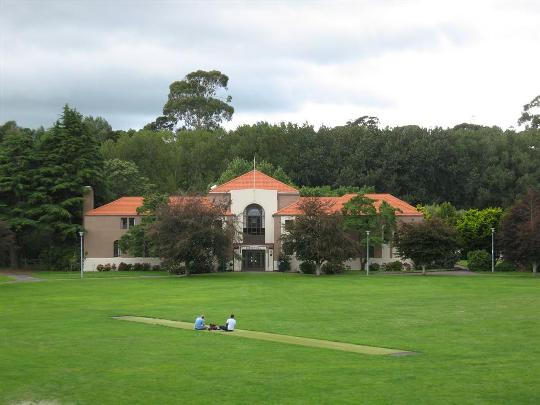
Lippincott designed the Refectory in 1929. It was built as an eating, meeting and social area for staff and students, but until Lippincott’s Massey University Main Building (Category 1 historic place, List No. 184) and other facilities opened it also provided temporary lecture and accommodation space. A few years earlier, Lippincott and Fletcher Construction were also responsible for Auckland University buildings, such as the Old Arts Building, Category 1 historic place (List No. 25).
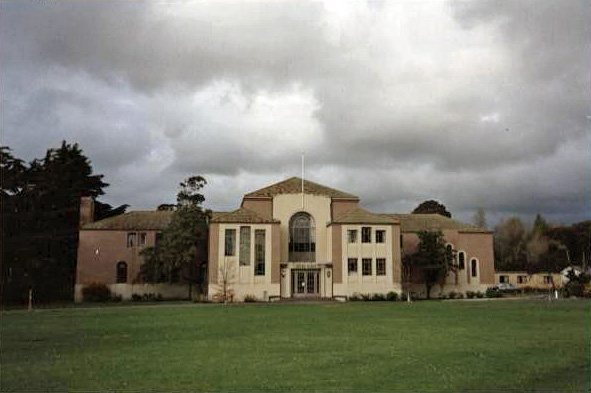
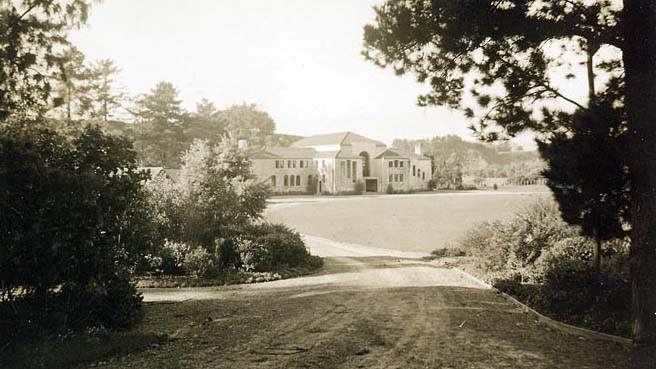
The Refectory has been described as ‘notable for its simple, dramatic forms’. Originally, it featured a central main space with flanking wings. The Spanish Mission style influences include its tiled roof and the large, double-height, arched windows. Motifs are typical in Lippincott’s designs and the Refectory features Māori motifs on its exterior window and door frames, as well as pilaster capitals, and this theme continues in the interior plasterwork.
During the Second World War, the Refectory was one of the campus buildings commandeered by the New Zealand Army. This, combined with increasing student numbers, led to extensions and alterations including a two storey annex and extra kitchen facilities completed by the Public Works Department in January 1944. By the 1960s student numbers were increasing to the point where it was necessary to significantly extend the campus’ facilities. New buildings took over the original functions of the Refectory and it was converted into a lecture and office building in 1962. In 1981, the Refectory was renovated to provide teaching and research space for the Faculty of Business Studies and the Student Health Service.
The building closed in 2012 because it was assessed as being a seismic risk. A restoration and seismic strengthening project, as well as fundraising to pay for it, was underway in 2018. One of the project aims for the Refectory was to make it the campus’ ‘central social space’ again.
List Entry Information
Status
Listed
List Entry Status
Historic Place Category 2
Access
Private/No Public Access
List Number
1187
Date Entered
2nd July 1982
Date of Effect
2nd July 1982
City/District Council
Palmerston North City
Region
Horizons (Manawatū-Whanganui) Region
Extent of List Entry
Extent includes part of the land described as Lot 2 DP 8981 (RT WN40D/260), Wellington Land District and the building known as Massey University Refectory thereon. Refer to the extent map tabled at the Heritage List/ Rārangi Kōrero Committee meeting on 30 January 2020.
Legal description
Lot 2 DP 8981 (RT WN40D/260), Wellington Land District
Status
Listed
List Entry Status
Historic Place Category 2
Access
Private/No Public Access
List Number
1187
Date Entered
2nd July 1982
Date of Effect
2nd July 1982
City/District Council
Palmerston North City
Region
Horizons (Manawatū-Whanganui) Region
Extent of List Entry
Extent includes part of the land described as Lot 2 DP 8981 (RT WN40D/260), Wellington Land District and the building known as Massey University Refectory thereon. Refer to the extent map tabled at the Heritage List/ Rārangi Kōrero Committee meeting on 30 January 2020.
Legal description
Lot 2 DP 8981 (RT WN40D/260), Wellington Land District
Construction Professional
Name
Fletcher Construction Company
Type
Builder
Biography
Fletcher Construction Company was founded by Scottish-born James Fletcher (1886 - 1974), the son of a builder. Six months after his arrival in Dunedin in 1908, Fletcher formed a house-building partnership with Bert Morris. They soon moved into larger-scale construction work, building the St Kilda Town Hall (1911), and the main dormitory block and Ross Chapel at Knox College (1912). Fletcher's brothers, William, Andrew and John joined the business in 1911, which then became known as Fletcher Brothers. A branch was opened in Invercargill. While holidaying in Auckland in 1916, James tendered for the construction of the the Auckland City Markets. By 1919 the company, then known as Fletcher Construction, was firmly established in Auckland and Wellington. Notable landmarks constructed by the company during the Depression included the Auckland University College Arts Building (completed 1926); Landmark House (the former Auckland Electric Power Board Building, 1927); Auckland Civic Theatre (1929); the Chateau Tongariro (1929); and the Dominion Museum, Wellington (1934). Prior to the election of the first Labour Government, Fletcher (a Reform supporter) had advised the Labour Party on housing policy as hbe believed in large-scale planning and in the inter-dependence of government and business. However, he declined an approach by Prime Minister Michael Joseph Savage in December 1935 to sell the company to the government, when the latter wanted to ensure the large-scale production of rental state housing. Although Fletchers ultimately went on to build many of New Zealand's state houses, for several years Residential Construction Ltd (the subsidiary established to undertake their construction) sustained heavy financial losses. Fletcher Construction became a public company, Fletcher Holdings, in 1940. Already Fletchers' interests were wide ranging: brickyards, engineering shops, joinery factories, marble quarries, structural steel plants and other enterprises had been added the original construction firm. Further expansion could only be undertaken with outside capital. During the Second World War James Fletcher, having retired as chairman of Fletcher Holdings, was seconded to the newly created position of Commissioner of State Construction which he held during 1942 and 1943. Directly responsible to Prime Minister Peter Fraser, Fletcher had almost complete control over the deployment of workers and resources. He also became the Commissioner of the Ministry of Works, set up in 1943, a position he held until December 1945. In 1981 Fletcher Holdings; Tasman Pulp and Paper; and Challenge Corporation amalgamated to form Fletcher Challenge Ltd, at that time New Zealand's largest company. Williamson Construction Company - main contract
Name
Lippincott, Roy Alstan
Type
Architect
Biography
Roy Alstan Lippincott (1885-1969) was born in Pennsylvania and graduated Bachelor of Architecture from Cornell University, New York, in 1909. He became involved with the "Chicago School" of architects including H.V. Von Holst, Marion Mahoney and Walter Burley Griffin who were in turn greatly influenced by Louis Sullivan and Frank Lloyd Wright. In 1912 Griffin won the competition for the design of Australia's Federal Capital, Canberra, and offered Lippincott a junior partnership shortly afterwards. They moved to Sydney in 1914 and to Melbourne about a year later. Lippincott entered several design competitions with draughtsman Edward F. Billson and in June 1921 they won the competition for the design of the Auckland University College Arts Building. Lippincott and Billson established a partnership and Lippincott moved to Auckland later that year. The Arts building with clock tower is the best known of the buildings designed by Lippincott for Auckland's University campus. The Students' Association building (1921-1926), Caretaker's Cottage (1928-31) and Biology building (1938) were also to his design, as was the north-west wing of Choral Hall added in 1925. Other buildings designed by Lippincott during his time in Auckland were Smith and Caughey's Department Store building (1927-29), Massey University Science building, Palmerston North (1929-31), Farmers Trading Company Tearooms (1934-36) and St Peter's Preparatory School, Cambridge (1936-37). He was elected Associate of the New Zealand Institute of Architects in 1922 and a Fellow in 1924. He was actively involved in both Auckland Branch and National Council Affairs, particularly in the field of architectural education. Lippincott remained in New Zealand until 1939 when he returned to the United States and practised in Los Angeles. He became a partner in the firm of Kaufmann, Lippincott and Eggers, Los Angeles, and retired in 1958 when he moved to Santa Barbara. Roy Alstan Lippincott (1885-1969) was born in Pennsylvania, USA. Lippincott gained a Bachelor of Architecture from Cornell University, New York, in 1909. Subsequently, he became influenced by the Chicago School of architects, who were a group of architects active in Chicago at the turn of the twentieth century. The group had parallels with the European Modernism movement and was amongst the first to promote the new technologies of steel-frame construction in commercial buildings. In circa 1912, Lippincott was offered a junior partnership with Chicago School architect Walter Burley Griffin, who had won a competition for the design of Australia's Federal Capital, Canberra. He moved to Sydney with Griffin in 1914 and to Melbourne the following year. In 1921, Lippincott and draughtsman Edward F. Billson won a competition for the design of the Auckland University College Arts Building - now known as the Old Arts Building, University of Auckland (NZHPT Registration # 25, Category I historic place). Lippincott moved to Auckland later that year and remained in New Zealand until 1939. In addition to designing the Old Arts Building, Lippincott designed several other buildings for Auckland University, including the Students' Association building (1921-1926), the northwest wing of Choral Hall (NZHPT Registration # 4474, Category I historic place) added in 1925, the Caretaker's Cottage constructed (1928-1931) and the Biology Building (1938). He also designed an addition circa 1927-1929 to Smith and Caughey's Department Store Building (NZHPT Registration # 656, Category I historic place), the Massey University Science Building in Palmerston North (1929-1931), the Berlei Factory in Auckland (1930-1931), the Farmers Trading Company Tea Rooms in Auckland (1934-1936) and St Peter's Preparatory School in Cambridge (1936-1937). Lippincott was elected Associate of the New Zealand Institute of Architects in 1922 and a Fellow in 1924. He was actively involved in the Auckland Branch and National Council Affairs, particularly in the area of architectural education. In 1939, Lippincott returned to the United States, where he became a partner in the Los Angeles practice Kaufmann, Lippincott and Eggers. He retired in 1958 and moved to Santa Barbara.
Construction Details
Start Year
1929
Finish Year
1930
Type
Original Construction
Start Year
1944
Type
Addition
Description
Annex and interior alterations completed
Start Year
1962
Type
Modification
Description
Interior alterations including installation of a mezzanine
Start Year
1981
Type
Refurbishment/renovation
Start Year
2018
startYearCirca
Finish Year
2019
Type
Structural upgrade
Description
Seismic strengthening
Construction Professional
Name
Fletcher Construction Company
Type
Builder
Biography
Fletcher Construction Company was founded by Scottish-born James Fletcher (1886 - 1974), the son of a builder. Six months after his arrival in Dunedin in 1908, Fletcher formed a house-building partnership with Bert Morris. They soon moved into larger-scale construction work, building the St Kilda Town Hall (1911), and the main dormitory block and Ross Chapel at Knox College (1912). Fletcher's brothers, William, Andrew and John joined the business in 1911, which then became known as Fletcher Brothers. A branch was opened in Invercargill. While holidaying in Auckland in 1916, James tendered for the construction of the the Auckland City Markets. By 1919 the company, then known as Fletcher Construction, was firmly established in Auckland and Wellington. Notable landmarks constructed by the company during the Depression included the Auckland University College Arts Building (completed 1926); Landmark House (the former Auckland Electric Power Board Building, 1927); Auckland Civic Theatre (1929); the Chateau Tongariro (1929); and the Dominion Museum, Wellington (1934). Prior to the election of the first Labour Government, Fletcher (a Reform supporter) had advised the Labour Party on housing policy as hbe believed in large-scale planning and in the inter-dependence of government and business. However, he declined an approach by Prime Minister Michael Joseph Savage in December 1935 to sell the company to the government, when the latter wanted to ensure the large-scale production of rental state housing. Although Fletchers ultimately went on to build many of New Zealand's state houses, for several years Residential Construction Ltd (the subsidiary established to undertake their construction) sustained heavy financial losses. Fletcher Construction became a public company, Fletcher Holdings, in 1940. Already Fletchers' interests were wide ranging: brickyards, engineering shops, joinery factories, marble quarries, structural steel plants and other enterprises had been added the original construction firm. Further expansion could only be undertaken with outside capital. During the Second World War James Fletcher, having retired as chairman of Fletcher Holdings, was seconded to the newly created position of Commissioner of State Construction which he held during 1942 and 1943. Directly responsible to Prime Minister Peter Fraser, Fletcher had almost complete control over the deployment of workers and resources. He also became the Commissioner of the Ministry of Works, set up in 1943, a position he held until December 1945. In 1981 Fletcher Holdings; Tasman Pulp and Paper; and Challenge Corporation amalgamated to form Fletcher Challenge Ltd, at that time New Zealand's largest company. Williamson Construction Company - main contract
Name
Lippincott, Roy Alstan
Type
Architect
Biography
Roy Alstan Lippincott (1885-1969) was born in Pennsylvania and graduated Bachelor of Architecture from Cornell University, New York, in 1909. He became involved with the "Chicago School" of architects including H.V. Von Holst, Marion Mahoney and Walter Burley Griffin who were in turn greatly influenced by Louis Sullivan and Frank Lloyd Wright. In 1912 Griffin won the competition for the design of Australia's Federal Capital, Canberra, and offered Lippincott a junior partnership shortly afterwards. They moved to Sydney in 1914 and to Melbourne about a year later. Lippincott entered several design competitions with draughtsman Edward F. Billson and in June 1921 they won the competition for the design of the Auckland University College Arts Building. Lippincott and Billson established a partnership and Lippincott moved to Auckland later that year. The Arts building with clock tower is the best known of the buildings designed by Lippincott for Auckland's University campus. The Students' Association building (1921-1926), Caretaker's Cottage (1928-31) and Biology building (1938) were also to his design, as was the north-west wing of Choral Hall added in 1925. Other buildings designed by Lippincott during his time in Auckland were Smith and Caughey's Department Store building (1927-29), Massey University Science building, Palmerston North (1929-31), Farmers Trading Company Tearooms (1934-36) and St Peter's Preparatory School, Cambridge (1936-37). He was elected Associate of the New Zealand Institute of Architects in 1922 and a Fellow in 1924. He was actively involved in both Auckland Branch and National Council Affairs, particularly in the field of architectural education. Lippincott remained in New Zealand until 1939 when he returned to the United States and practised in Los Angeles. He became a partner in the firm of Kaufmann, Lippincott and Eggers, Los Angeles, and retired in 1958 when he moved to Santa Barbara. Roy Alstan Lippincott (1885-1969) was born in Pennsylvania, USA. Lippincott gained a Bachelor of Architecture from Cornell University, New York, in 1909. Subsequently, he became influenced by the Chicago School of architects, who were a group of architects active in Chicago at the turn of the twentieth century. The group had parallels with the European Modernism movement and was amongst the first to promote the new technologies of steel-frame construction in commercial buildings. In circa 1912, Lippincott was offered a junior partnership with Chicago School architect Walter Burley Griffin, who had won a competition for the design of Australia's Federal Capital, Canberra. He moved to Sydney with Griffin in 1914 and to Melbourne the following year. In 1921, Lippincott and draughtsman Edward F. Billson won a competition for the design of the Auckland University College Arts Building - now known as the Old Arts Building, University of Auckland (NZHPT Registration # 25, Category I historic place). Lippincott moved to Auckland later that year and remained in New Zealand until 1939. In addition to designing the Old Arts Building, Lippincott designed several other buildings for Auckland University, including the Students' Association building (1921-1926), the northwest wing of Choral Hall (NZHPT Registration # 4474, Category I historic place) added in 1925, the Caretaker's Cottage constructed (1928-1931) and the Biology Building (1938). He also designed an addition circa 1927-1929 to Smith and Caughey's Department Store Building (NZHPT Registration # 656, Category I historic place), the Massey University Science Building in Palmerston North (1929-1931), the Berlei Factory in Auckland (1930-1931), the Farmers Trading Company Tea Rooms in Auckland (1934-1936) and St Peter's Preparatory School in Cambridge (1936-1937). Lippincott was elected Associate of the New Zealand Institute of Architects in 1922 and a Fellow in 1924. He was actively involved in the Auckland Branch and National Council Affairs, particularly in the area of architectural education. In 1939, Lippincott returned to the United States, where he became a partner in the Los Angeles practice Kaufmann, Lippincott and Eggers. He retired in 1958 and moved to Santa Barbara.
Construction Details
Start Year
1929
Finish Year
1930
Type
Original Construction
Start Year
1944
Type
Addition
Description
Annex and interior alterations completed
Start Year
1962
Type
Modification
Description
Interior alterations including installation of a mezzanine
Start Year
1981
Type
Refurbishment/renovation
Start Year
2018
startYearCirca
Finish Year
2019
Type
Structural upgrade
Description
Seismic strengthening
Historical and Associated Iwi / Hapū / Whānau
Completion Date
5th December 2019
Report Written By
Karen Astwood
Information Sources
Historic Manawatu Horowhenua
http://www.historicmanawatuhorowhenua.org.nz/
Chochran, 2010
Cochran, Chris ‘The Refectory Massey University, Palmerston North’, Conservation plan, 30 Jun 2010.
Smith, 2009
Smith, Jack, No Job Too Big: A history of Fletcher Construction, Volume 1, 1909–1940, Wellington, Steele Roberts, 2009.
Other Information
This place was identified as significant under previous legislation with different information requirements. It remains significant under the current legislation. There is opportunity under our legislation and policies to add to this information. Further information about this place may be available from the Central Regional Office of Heritage New Zealand Pouhere Taonga. A fully referenced upgrade report is available on request from the Central Region Office of Heritage New Zealand. Please note that entry on the New Zealand Heritage List/Rarangi Korero identifies only the heritage values of the property concerned, and should not be construed as advice on the state of the property, or as a comment of its soundness or safety, including in regard to earthquake risk, safety in the event of fire, or insanitary conditions.
Historical and Associated Iwi / Hapū / Whānau
Completion Date
5th December 2019
Report Written By
Karen Astwood
Information Sources
Historic Manawatu Horowhenua
http://www.historicmanawatuhorowhenua.org.nz/
Chochran, 2010
Cochran, Chris ‘The Refectory Massey University, Palmerston North’, Conservation plan, 30 Jun 2010.
Smith, 2009
Smith, Jack, No Job Too Big: A history of Fletcher Construction, Volume 1, 1909–1940, Wellington, Steele Roberts, 2009.
Other Information
This place was identified as significant under previous legislation with different information requirements. It remains significant under the current legislation. There is opportunity under our legislation and policies to add to this information. Further information about this place may be available from the Central Regional Office of Heritage New Zealand Pouhere Taonga. A fully referenced upgrade report is available on request from the Central Region Office of Heritage New Zealand. Please note that entry on the New Zealand Heritage List/Rarangi Korero identifies only the heritage values of the property concerned, and should not be construed as advice on the state of the property, or as a comment of its soundness or safety, including in regard to earthquake risk, safety in the event of fire, or insanitary conditions.
Former Usages
General Usage: Defence
Specific Usage: Mess Building
General Usage: Education
Specific Usage: Education - other
General Usage: Education
Specific Usage: University Halls of Residence
Former Usages
General Usage: Defence
Specific Usage: Mess Building
General Usage: Education
Specific Usage: Education - other
General Usage: Education
Specific Usage: University Halls of Residence
Location
Related listings


Stay up to date with Heritage this month