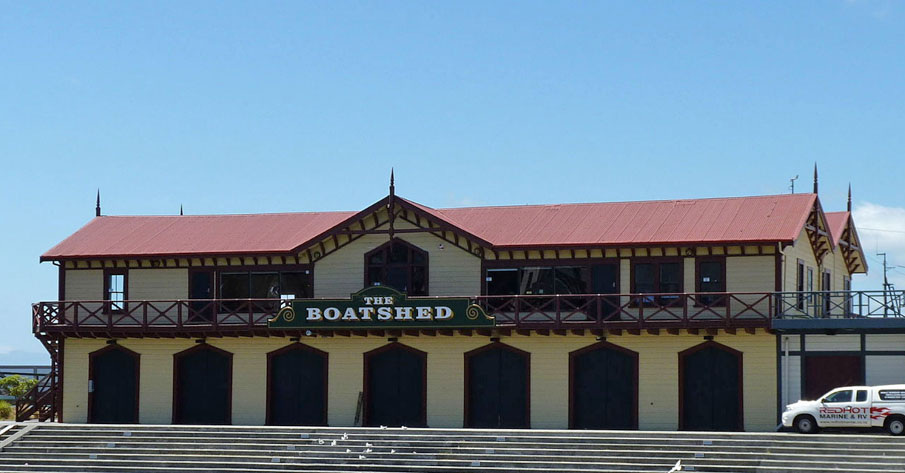
The Star Boating Club Building on Wellington's waterfront was built specifically for the club in 1886, and the club still occupies this building today.
The Star Boating Club was formed in 1866. It was the first rowing club established in Wellington and is one of the oldest sporting clubs in New Zealand. Initially, the club was housed in a shed erected near the site of the Cenotaph, but harbour reclamation and the resulting loss of their waterfront position resulted in the club relocating to another shed in 1874. Further reclamations during 1883 meant that the club needed to move again. This led to the construction of the Star Boating Club Building.
The Star Boating Club Building was purpose built for the club. It was designed by architect William Chatfield, himself a club member. Given that the club's previous boatsheds had been affected by harbour reclamations, the new building was built on skids so that it could be relocated easily. It was erected in 1886 and was originally sited on Customhouse Quay on land which was reclaimed, this project being paid for by club members. The building was constructed by W. Fitzgerald and E.Connal, and the two storey design provided space for storing boats on the ground floor and social areas upstairs.
Only three years later, in 1889, it became necessary to move the clubrooms due to ongoing harbour reclamations. The building was moved by steam engine to the site on Jervois Quay it then occupied for 100 years. It is possibly the only building in New Zealand relocated in this way.
The club was once possibly the largest athletic club in the Southern Hemisphere, boasting 390 members prior to World War One. Founded by H.F. Logan, J.C. Boddington and R. Kirton, among others, the Star Boating Club has had a number of prominent members, including Olympic athlete George Cooke and former Governor General and recipient of the VC, Lord Freyberg. Over time the clubrooms have also been associated with many organisations other than the Star Boating Club. In 1945, the exterior of the eastern end of the building was slightly damaged by fire, and the clubrooms were renovated the same year. In 1965, the building was renovated in time for the Star Boating Club's centennial celebrations.
The building has also played an important part in the history of the Downstage Theatre, New Zealand's longest running professional theatre, who occupied the clubrooms between 1969 and 1973. During that time modifications were made to the upper storey of the building, while the rowing club continued to operate from the ground floor. During Downstage's time in the building performers included many of New Zealand's most successful actors. The motivation to rent the building to Downstage was to raise funds in order to build new clubrooms, as the prospect of demolishing the building and relocating the club had been discussed by the Council and the club for some time. In the end, the club lobbied against relocation and instead undertook renovations to the clubhouse in order to meet council requirements.
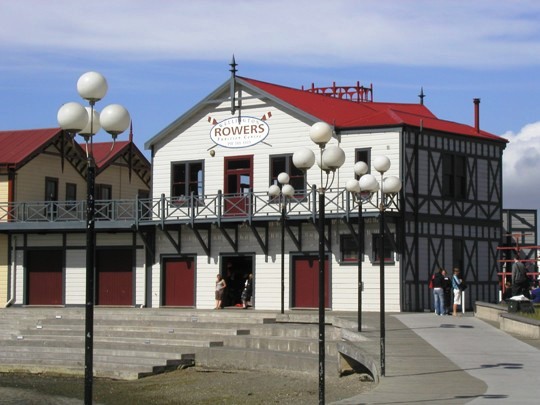
However, in 1989 the building was relocated for a second time as part of the redevelopment of Wellington's waterfront, and was extensively refurbished, including replacing the skids with a new foundation. The Wellington Rowing Club building was also relocated, maintaining the close relationship between the buildings and clubs themselves. The Star Boating Club Building has since been used as an events venue and as such it has had a significant association with cultural life in Wellington. Events held there have included the 1992 Fringe Festival, the 1993 Gay and Lesbian Devotion Festival, and the International Festival of the Arts in 1994 and 1996. It also continues to be a popular venue for weddings, conferences and other functions. Now on its third site, the building retains its original purpose as the clubrooms for the Star Boating Club. The club continues to attract rowers and has close links with secondary school rowing.
The Star Boating club building was specifically designed by the eminent architect William Chatfield to facilitate its relocation, responding to the ongoing reclamation of Wellington's waterfront. As such it is of architectural and technological significance. The historical significance of the building is also high, given its continuous association with the Star Boating Club, one of the oldest rowing and sporting clubs in New Zealand. This distinctive building contributes greatly to the streetscape and, along with the neighbouring Wellington Rowing Club building occupies a prominent place on the waterfront. The building has had a significant historical association with New Zealand's longest running professional theatre, Downstage. The Star Boating Club Building also possesses strong social value as it has hosted a number of community groups and clubs, as well as high profile events such as the International Festival of Arts.