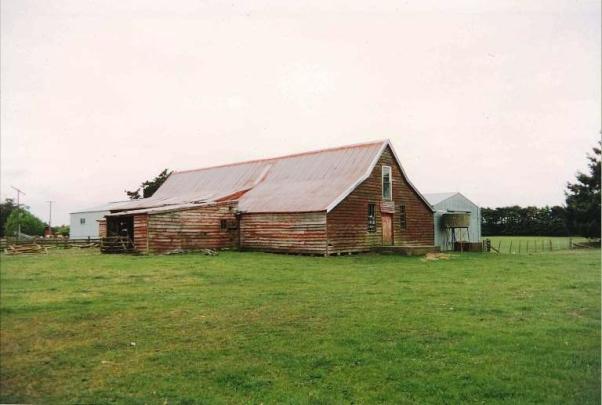
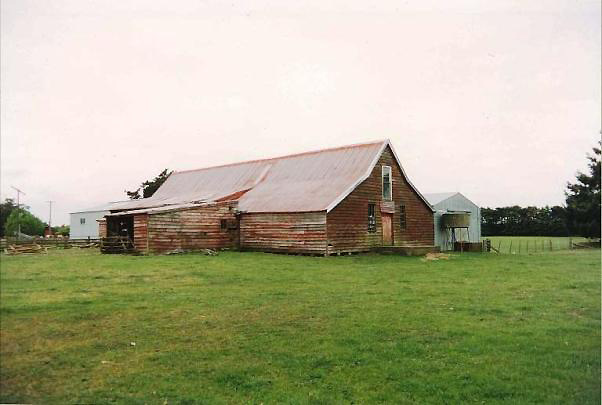
Built in the mid-1850s, the Coldstream Woolshed at 30 Stevens Road, Coldstream, south of Ashburton, is one of New Zealand’s oldest surviving farm buildings. It tells stories of an early Canterbury sheep run established by William Scott and Ernest Gray and it has ongoing, deep connections with generations of the Studholme family – the owners of Coldstream Estate since 1867 – as well as farm workers and the broader community. Coldstream Woolshed has aesthetic, archaeological, architectural, cultural, historical and social significance.
The wider area where the property is situated, just north-east of the Rangitata River, had long been a mahinga kai. At Kai-Whareatua in the Rangitata River mouth area, there was an abundance of ducks, shags, swans, fish, eels, and freshwater crayfish (kōura). Fed by springs, a cold stream previously known as Pakihau-kuku/Pakikaukuku/Pukiakuku – said to allude to the freshwater mussels found there – flowed slowly through wetlands within an area that was later to become the settlements of Coldstream and Lowcliffe. Weka and wild pig were also in abundance there. When the first Pākehā settled at Coldstream, they recorded finding small piles of moa stones near the stream, as well as numerous broken moa bones scattered over a wide area. The land had tī kōuka and kōwhai trees, matagouri and mānuka, but mostly it was covered in tussock and native broom. Wetland areas along the coast were dense with flax, rushes and toetoe. Through colonial settlement, this large area transformed into pastoral and arable land.
Runs 453 and 454 (Coldstream Station) were taken up in 1854 by William Scott and Ernest Gray on around 55,000 acres of mainly flat land sloping down to the coast. Like other early farmers in New Zealand, they invested in sheep for the bales of wool they could ship to England and they soon built an 18-stand woolshed.
The timber woolshed is rectangular in plan, with a steeply pitched roof flaring out to a lesser pitch at the sides. The main structure of the woolshed is built from pit-sawn Kahikatea, cut from Scott and Gray’s block at Peel Forest (the pit from which the timber was laboriously sawn is understood to remain extant). The pit saw marks are evident in the woolshed’s large posts. The original roof covering was Australian hardwood shingles, later covered over by corrugated iron. Part of the roof is raised along the shearing boards, which had provision for 18 blade shearers – the steeply pitched roof at one time had a loft for storing wool. The woolshed had little storage for sheep – there was a single catching pen for every two shearers or enough night pens for 300 sheep – as was a common Australian practice at the time.
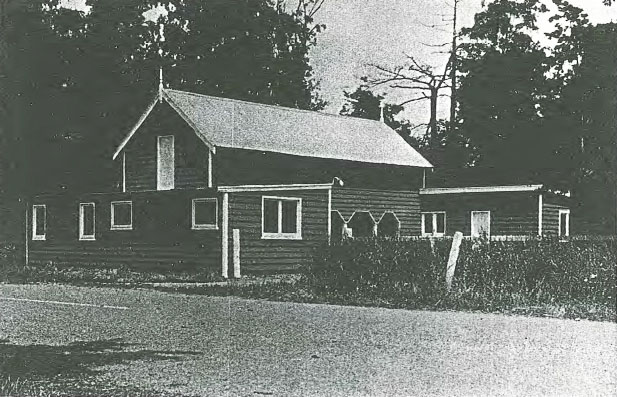
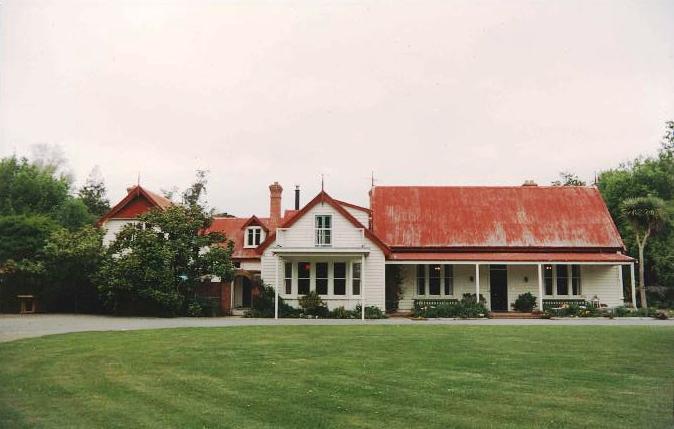
In 1867, John and Michael Studholme, early colonial settlers with a wide property portfolio, bought the Coldstream Station and in 1868 they appointed C.H. Dowding as manager. By 1875, Dowding was running 26,000 sheep, along with 4,000 acres of cereal crops. In 1878 John and Michael dissolved their partnership, with Michael focusing on Te Waimate Station, and John taking Coldstream and other South Island runs. John Studholme was an early promoter and founding director of the Canterbury Frozen Meat Company. Eventually mechanical shearing was introduced. A Warwick spirit engine ran the grinder and a Lister engine ran the shearing plants. The woolshed was utilised for social functions, including festivities such as ‘Harvest Homes’ and balls after shearing – the woolshed was lit by kerosene lamps, dressing rooms were staged in the fleece-baling cubicles, and live music was played for locals all around. Regular church services were held in the woolshed’s wool room prior to 1901, after which time they were held in ‘the hall’ of John Studholme junior’s (Jack’s) new homestead. In the 1970s a new large shed addition was added to the north-east corner of the old one.
The wider area where the property is situated, just north-east of the Rangitata River, had long been a mahinga kai. At Kai-Whareatua in the Rangitata River mouth area, there was an abundance of ducks, shags, swans, fish, eels, and freshwater crayfish (kōura). Fed by springs, a cold stream previously known as Pakihau-kuku/Pakikaukuku/Pukiakuku – said to allude to the freshwater mussels found there – flowed slowly through wetlands within an area that was later to become the settlements of Coldstream and Lowcliffe. Weka and wild pig were also in abundance there. When the first Pākehā settled at Coldstream, they recorded finding small piles of moa stones near the stream, as well as numerous broken moa bones scattered over a wide area. The land had tī kōuka and kōwhai trees, matagouri and mānuka, but mostly it was covered in tussock and native broom. Wetland areas along the coast were dense with flax, rushes and toetoe. Through colonial settlement, this large area transformed into pastoral and arable land.
Runs 453 and 454 (Coldstream Station) were taken up in 1854 by William Scott and Ernest Gray on around 55,000 acres of mainly flat land sloping down to the coast. Like other early farmers in New Zealand, they invested in sheep for the bales of wool they could ship to England and they soon built an 18-stand woolshed.
The timber woolshed is rectangular in plan, with a steeply pitched roof flaring out to a lesser pitch at the sides. The main structure of the woolshed is built from pit-sawn Kahikatea, cut from Scott and Gray’s block at Peel Forest (the pit from which the timber was laboriously sawn is understood to remain extant). The pit saw marks are evident in the woolshed’s large posts. The original roof covering was Australian hardwood shingles, later covered over by corrugated iron. Part of the roof is raised along the shearing boards, which had provision for 18 blade shearers – the steeply pitched roof at one time had a loft for storing wool. The woolshed had little storage for sheep – there was a single catching pen for every two shearers or enough night pens for 300 sheep – as was a common Australian practice at the time.
In 1867, John and Michael Studholme, early colonial settlers with a wide property portfolio, bought the Coldstream Station and in 1868 they appointed C.H. Dowding as manager. By 1875, Dowding was running 26,000 sheep, along with 4,000 acres of cereal crops. In 1878 John and Michael dissolved their partnership, with Michael focusing on Te Waimate Station, and John taking Coldstream and other South Island runs. John Studholme was an early promoter and founding director of the Canterbury Frozen Meat Company. Eventually mechanical shearing was introduced. A Warwick spirit engine ran the grinder and a Lister engine ran the shearing plants. The woolshed was utilised for social functions, including festivities such as ‘Harvest Homes’ and balls after shearing – the woolshed was lit by kerosene lamps, dressing rooms were staged in the fleece-baling cubicles, and live music was played for locals all around. Regular church services were held in the woolshed’s wool room prior to 1901, after which time they were held in ‘the hall’ of John Studholme junior’s (Jack’s) new homestead. In the 1970s a new large shed addition was added to the north-east corner of the old one.