

The Waitaki area is traditionally associated with the Kāhui-tipua, Te Rapuwai, Waitaha and Kāti Māmoe peoples. The Waitaki River was an ara tawhito (traditional travel route) for Kāi Tahu into the interior of Te Wai Pounamu and there are many kāika nohoka (seasonal settlements) and kāika mahika kai (food gathering sites) along the river. The land around the Waitaki River mouth shows evidence of extensive settlement, while Moeraki was one of the early cradles of knowledge for Waitaha and Kāti Māmoe histories. Key coastal settlements were located at Moeraki, Shag Point, Waikouaiti, and Huriawa (the Karitane Peninsula). These areas later became sites of shore stations with the arrival of early European whalers and sealers in these areas in the 1830s. By the late 1840s the shore whaling stations had overfished the whales.
Kakanui is a small township with very fertile soils used for market gardens and there was early mining of brown coal along the base of the Kakanui mountains. A port was built in 1870 with the hope that Kakanui might become a large trading port and the areas main employer, the New Zealand Meat Preserving Company, was established this year. In 1869 a public meeting of Kakanui settlers was held in the local store where the decision was made to build a church. The south of Kakanui was chosen as the most suitable place and R.A. Lawson, architect was employed to draw up plans and specifications.
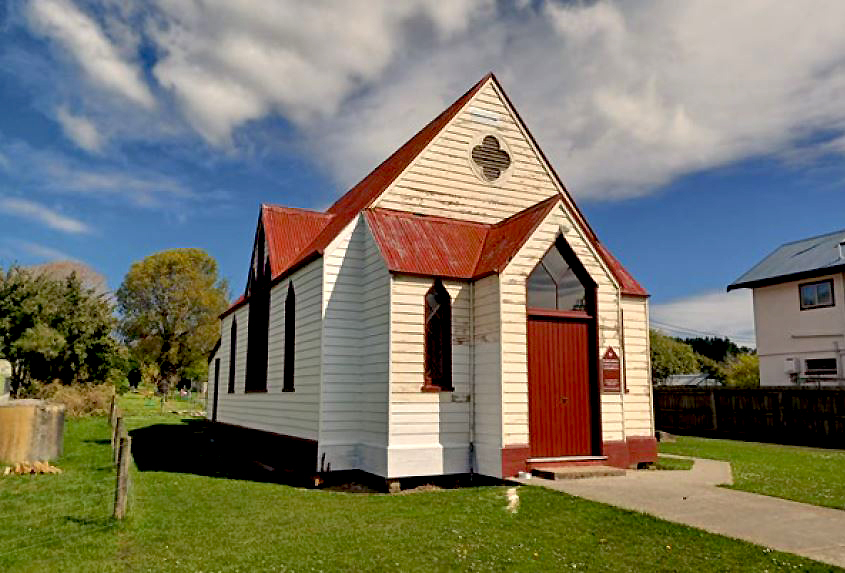
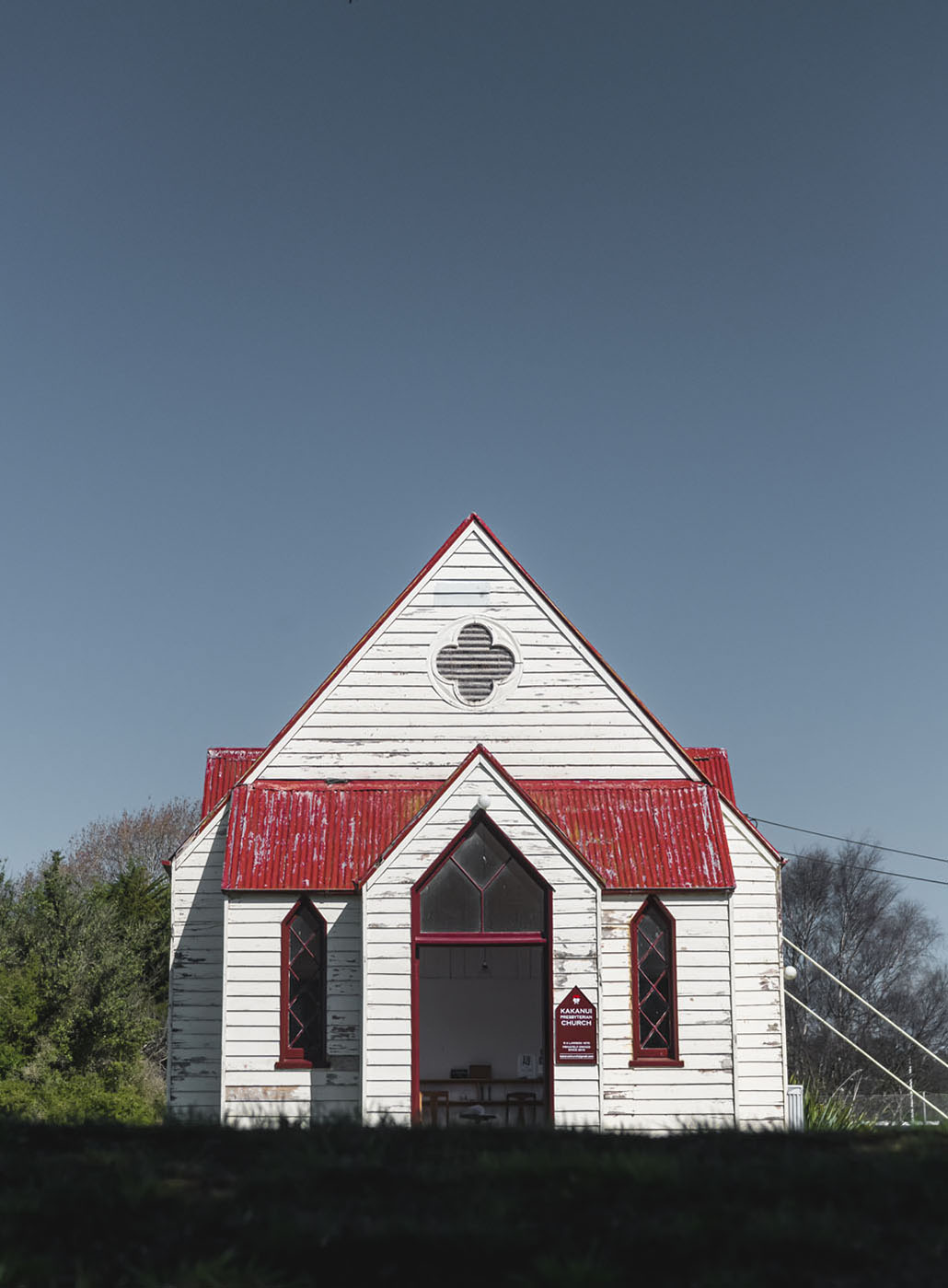
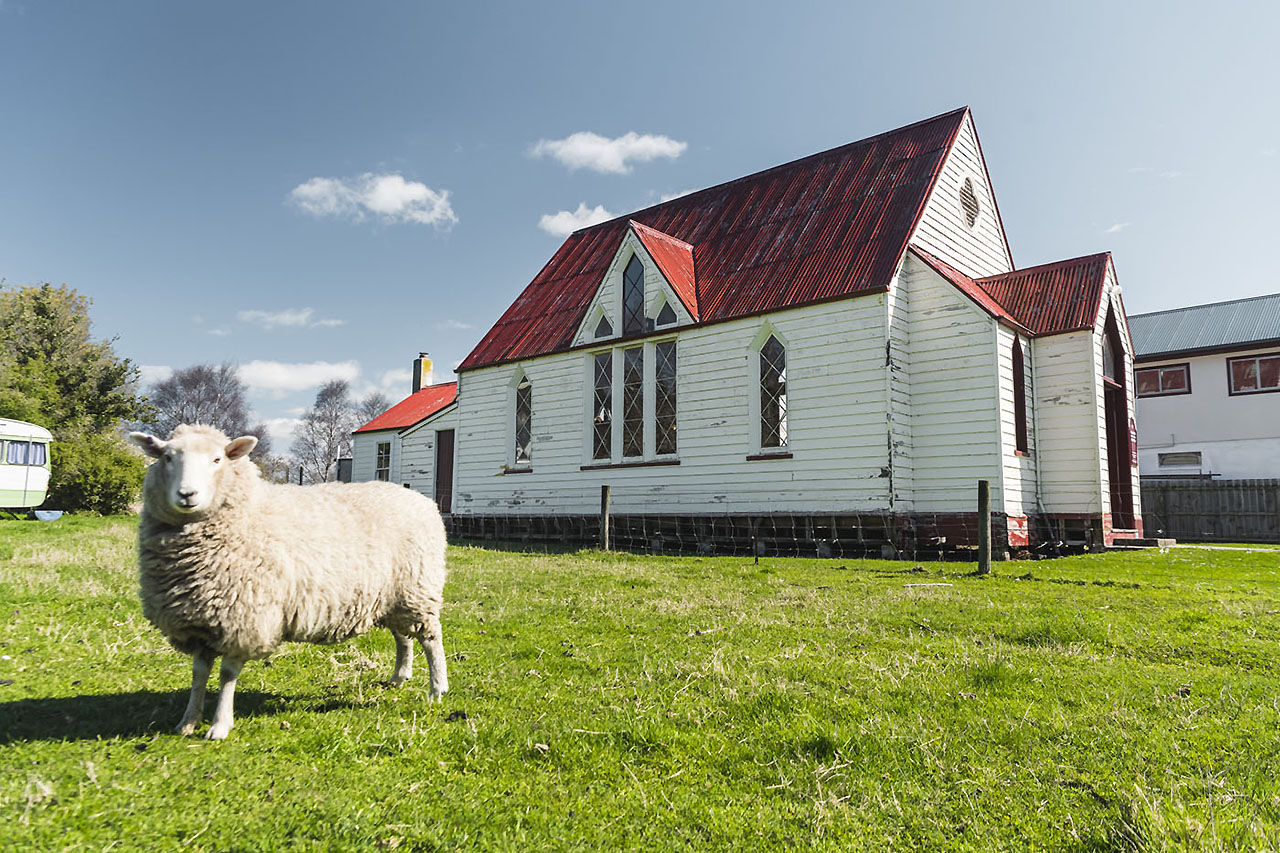
The small north-facing Gothic-styled church is constructed of timber, clad in weatherboard, with a corrugated iron roof (originally a shingle roof). Over the decades it has had supporting stays added in 1884, an iron roof added in 1890 with additions of outbuildings - the Sunday School in 1933 and the Workers Hut added in 1955. A major alteration was the removal of the bell tower in 1959.
After the Kakanui port idea was abandoned in 1886 and Kakanui’s commerce declined after the railway was built inland the township of Kakanui had declined by the early 1900s. The small population and the decline of the Presbyterian Church goers in the late twentieth century saw the Church struggling with maintenance and costs associated with the Kakanui Church building.
The Kakanui Church has played a prominent role in the social life of the Kakanui community throughout its history. It has been the focus for important religious and social milestones for the community from 18th March 1870 through to the final service held there 10 November 2019 following its sale to private owners. Between 2020 and 2025, extensive restoration work was undertaken by the new owners to preserve this well-maintained example of a small Carpenter Gothic Lawson church. The floors and interior ceilings were cleaned, and all rotten wooden boards have been repaired or replaced. The interior has been repainted and the removal of the carpet from the pulpit has revealed the original linoleum. The outbuildings, including the Workers Hut and Sunday School, have also undergone similar renovations, with restoration efforts still ongoing. The church continues to be a community hub hosting functions such as weddings, concerts and social meetings since 2019.
List Entry Information
Status
Listed
List Entry Status
Historic Place Category 1
Access
Private/No Public Access
List Number
1905
Date Entered
26th June 2025
Date of Effect
18th July 2025
City/District Council
Waitaki District
Region
Otago Region
Extent of List Entry
Extent includes the land described as Lot 2 Blk 1 DP 12 (RT OT237/240), Otago Land District and the building known as Kakanui Presbyterian Church (former) thereon, and the following chattels, an ambo, crucifix, organ, bible reading board, cabinet (Refer to map in Section 1.3 of the List entry report for further information).
Legal description
Lot 2 Blk 1 DP 12 (RT OT237/240), Otago Land District
Status
Listed
List Entry Status
Historic Place Category 1
Access
Private/No Public Access
List Number
1905
Date Entered
26th June 2025
Date of Effect
18th July 2025
City/District Council
Waitaki District
Region
Otago Region
Extent of List Entry
Extent includes the land described as Lot 2 Blk 1 DP 12 (RT OT237/240), Otago Land District and the building known as Kakanui Presbyterian Church (former) thereon, and the following chattels, an ambo, crucifix, organ, bible reading board, cabinet (Refer to map in Section 1.3 of the List entry report for further information).
Legal description
Lot 2 Blk 1 DP 12 (RT OT237/240), Otago Land District
Why is this place significant?
Cultural Significance
Social Significance or Value The Kakanui Church (Former) has an outstanding and special social significance with the local community and has been bringing the small village of Kakanui together since 1870. The continuing value of the church within this small rural community, despite the lessening of church influence during the latter half of the twentieth century, has met an ongoing need within Kakanui for a dedicated community space. The significant community fundraising efforts for the renovation and restoration of the Church and a local petition to save the Church before its sale demonstrates the sense of importance the place holds for the community. Under new ownership, people have been welcomed in to see the restoration and visitors have regularly shared their memories and stories. Local music performances and community space for markets, weddings and meetings have meant the space continues to serve a vital cultural role in the community. The former Kakanui Presbyterian Church is a prominent landmark within the Kakanui community, reflecting the cultural significance of religion, in the Waitaki region. For many years it played a special and vital role in the spiritual life and support of small communities like Kakanui. This enduring community connection was evident at the Church’s final service, where a standing-room-only congregation gathered to mark the occasion.
Historic Significance
Historical Significance or Value The former Kakanui Presbyterian Church holds outstanding historical significance, reflecting the central role of religion - particularly Presbyterianism in the Kakanui and wider Otago community. The development of the church reflects the period of settlement consolidation, when the Presbyterian Church established permanent places of worship. Since its construction it has housed the Presbyterian Congregation and Sunday School classes and been a focus of important religious and social milestones through its wealth of community events. It has provided a place for the Presbyterian community to come together, and many have fond memories related to the Church which have been shared with the new owners and collected as a part of the community memory. Social events for small rural communities in the nineteenth and twentieth centuries centred on churches, and Kakanui Church was one of the first buildings to be built enabling this community spirit. Today, Kakanui Church remains the only sizeable building in the area dating back to the nineteenth century pioneer era, making it a rare and valuable link to the region’s early history.
Physical Significance
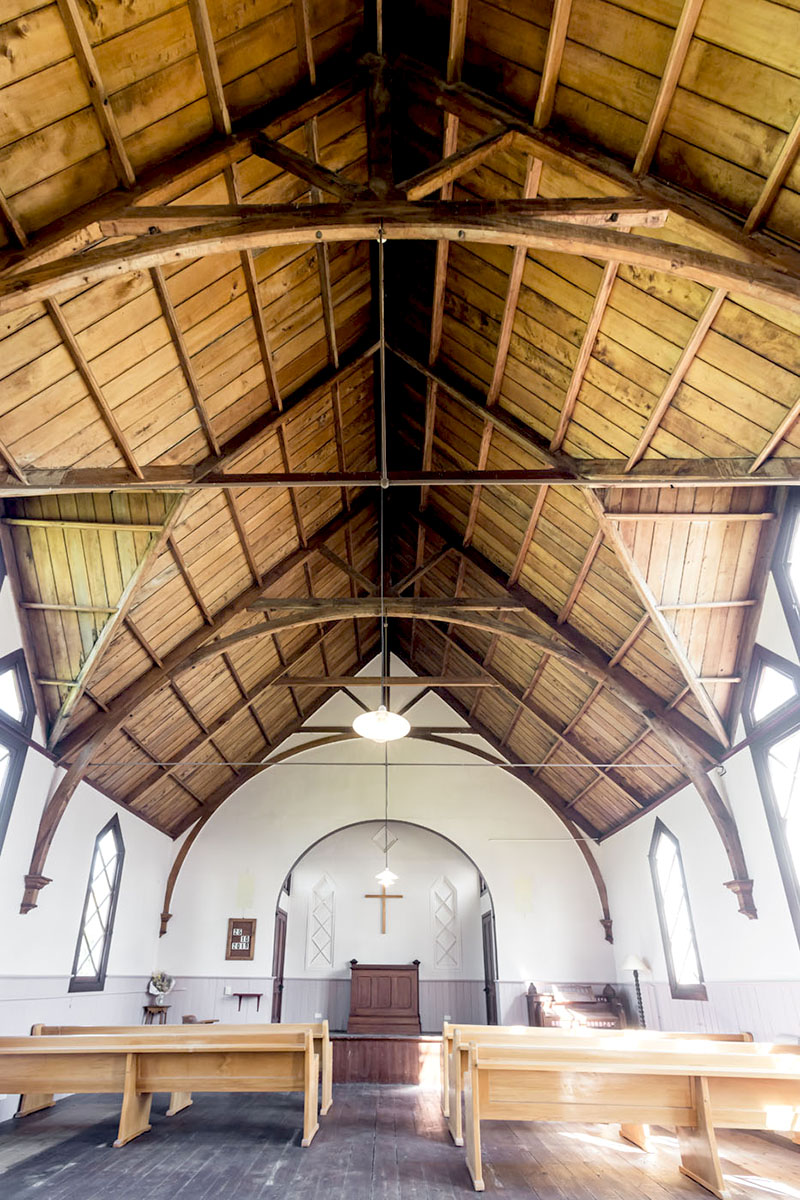
Aesthetic Significance or Value Kakanui Church stands out aesthetically for its striking yet simple timber form, prominently positioned within the Kakanui Township. Designed in the Gothic (Carpenter Gothic) style for which Robert Lawson was renowned, the church embodies a refined elegance through its clean lines and carefully proportioned structure. Inside, the interplay of light and texture creates an inviting and atmospheric space. Sunlight streaming in through the lancet windows casts a soft glow on the timber interior, enhancing its rich warmth and natural grain. This ever-changing light creates a soothing and contemplative ambiance, reinforcing the church’s long-standing role as a place of reflection and gathering. Architectural Significance or Value Kakanui Presbyterian Church (Former) holds outstanding architectural significance as a rare example of a wooden church designed by prominent Dunedin architect Robert Arthur Lawson. Celebrated for his early buildings in Otago, Lawson was particularly influential for church buildings. This church is a representative example of a modest Presbyterian church designed in Gothic style. Of the many timber Presbyterian churches designed by Lawson, only two remain: Gore Presbyterian Church (List No. 2530) and Kakanui Church. Kakanui Church is the oldest and best-preserved, and least modified, making it a rare and valuable example of New Zealand’s ecclesiastic architectural heritage.
Why is this place Category 1 / Category 2?
Detail Of Assessed Criteria
This place was assessed against the criteria set out in section 66(3) of the Heritage New Zealand Pouhere Taonga Act 2014 and found to qualify as a Category 1 historic place under the following criteria; a, b, c, e, f, h, and j. (a) The extent to which the place reflects important or representative aspects of New Zealand history. The Kakanui Church is of special historical significance with its direct ties to the early European agricultural settlement to the Kakanui area, the development of the Presbyterian Church and the architect R.A. Lawson. The development of a community of worship in Kakanui is a representative aspect of New Zealand history which illustrates the importance of the Presbyterian Church in this area, and particularly the Otago/Southland synod. It represents the period of development in the Presbyterian Church which saw the consolidation of communities. Its subsequent closure and sale for adaption to a new purpose is also representative of the decline of organised religion at the close of the twentieth century. (b) The association of the place with events, persons, or ideas of importance in New Zealand history. The Kakanui Presbyterian Church (Former) is associated with a nationally significant Dunedin architect Robert Arthur Lawson. Robert Lawson became a preeminent Victorian architect – more renowned today than in his own time. Lawson, through his church links, was employed by the Presbyterian Church as architect for the Kakanui Church and was known for his work for the Presbyterian Church in Otago in particular. (c) The potential of the place to provide knowledge of New Zealand history. Kakanui Church includes fabric that offer valuable insight into the early development into the early development of agricultural settlements and Presbyterianism in Otago. The use of Baltic pine and locally available resources – such as using packing cases for doors, provides knowledge of how early places of worship were constructed and valued. (e) The community association with, or public esteem for the place The church played an outstanding and special role in the social life of the Kakanui community throughout its history. It was the focus for the most important religious and social milestones for the Presbyterian and wider community, such as baptisms, weddings and funerals from 1870 through to the final service held there 10 November 2019 following its sale to private owners. Testament to the building’s central role within Kakanui was the significant community attempt to fundraise for the renovation and restoration of the Church by locals from the community and a local petition to save the Church garnered great response from the locals and wider community alike. (f) The potential of the place for public education Kakanui Church is still within its original setting and has been little altered from its original design with a high level of authenticity. It demonstrates the early Presbyterian Church history in New Zealand particularly in smaller communities. It has the potential to teach the public about a small rural settler community who rallied to build a church and how the community became established around it. The church enabled a school to run as well as becoming a hub and meeting place for many community events. The site itself has had continuous use as a church for 149 years and longer as a place that brings the community together. (h) The symbolic or commemorative value of the place Kakanui Church was designed for commemoration and worship by the Presbyterian Otago/Southland synod and has outstanding significance in New Zealand history. As it is little altered from its original plan from 1870 it symbolises and has special association with the early establishment and importance of religion in a rural settlement and reflects the period of consolidation of settlement and the building of permanent places of worship by the Presbyterian Church. (j) The importance of identifying rare types of historic places R.A. Lawson-designed timber churches were once spread across the lower South Island, with the first being built in Waikouaiti in 1863. From 1865 Lawson used a similar style for his small timber churches across Otago and Southland. Today only two survive: Kakanui Church and East Gore Church, making Kakanui Church a very rare example of Lawson’s work. Of the two, Kakanui Church is the best preserved. Summary of Significance Values This place has been assessed for and found to possess outstanding aesthetic, architectural, historical, and social significance. This place qualifies as an outstanding example of a small timber designed church along with its association to the preeminent architect R.A. Lawson. The church is representative of the huge importance of the Presbyterian Church on communities and its subsequent decline as part of New Zealand’s historic and cultural heritage. The importance of religion, and particularly of the Presbyterian Church in the Kakanui and Otago community is shown in this rare example of a timber construction Gothic style church in New Zealand. The church has outstanding social significance as a place of worship for nearly 150 years and the church maintains strong social significance as a place important to the community. Its restoration and listing have been widely supported within the community and the building is still regularly used today.
Why is this place significant?
Cultural Significance
Social Significance or Value The Kakanui Church (Former) has an outstanding and special social significance with the local community and has been bringing the small village of Kakanui together since 1870. The continuing value of the church within this small rural community, despite the lessening of church influence during the latter half of the twentieth century, has met an ongoing need within Kakanui for a dedicated community space. The significant community fundraising efforts for the renovation and restoration of the Church and a local petition to save the Church before its sale demonstrates the sense of importance the place holds for the community. Under new ownership, people have been welcomed in to see the restoration and visitors have regularly shared their memories and stories. Local music performances and community space for markets, weddings and meetings have meant the space continues to serve a vital cultural role in the community. The former Kakanui Presbyterian Church is a prominent landmark within the Kakanui community, reflecting the cultural significance of religion, in the Waitaki region. For many years it played a special and vital role in the spiritual life and support of small communities like Kakanui. This enduring community connection was evident at the Church’s final service, where a standing-room-only congregation gathered to mark the occasion.
Historic Significance
Historical Significance or Value The former Kakanui Presbyterian Church holds outstanding historical significance, reflecting the central role of religion - particularly Presbyterianism in the Kakanui and wider Otago community. The development of the church reflects the period of settlement consolidation, when the Presbyterian Church established permanent places of worship. Since its construction it has housed the Presbyterian Congregation and Sunday School classes and been a focus of important religious and social milestones through its wealth of community events. It has provided a place for the Presbyterian community to come together, and many have fond memories related to the Church which have been shared with the new owners and collected as a part of the community memory. Social events for small rural communities in the nineteenth and twentieth centuries centred on churches, and Kakanui Church was one of the first buildings to be built enabling this community spirit. Today, Kakanui Church remains the only sizeable building in the area dating back to the nineteenth century pioneer era, making it a rare and valuable link to the region’s early history.
Physical Significance
Aesthetic Significance or Value Kakanui Church stands out aesthetically for its striking yet simple timber form, prominently positioned within the Kakanui Township. Designed in the Gothic (Carpenter Gothic) style for which Robert Lawson was renowned, the church embodies a refined elegance through its clean lines and carefully proportioned structure. Inside, the interplay of light and texture creates an inviting and atmospheric space. Sunlight streaming in through the lancet windows casts a soft glow on the timber interior, enhancing its rich warmth and natural grain. This ever-changing light creates a soothing and contemplative ambiance, reinforcing the church’s long-standing role as a place of reflection and gathering. Architectural Significance or Value Kakanui Presbyterian Church (Former) holds outstanding architectural significance as a rare example of a wooden church designed by prominent Dunedin architect Robert Arthur Lawson. Celebrated for his early buildings in Otago, Lawson was particularly influential for church buildings. This church is a representative example of a modest Presbyterian church designed in Gothic style. Of the many timber Presbyterian churches designed by Lawson, only two remain: Gore Presbyterian Church (List No. 2530) and Kakanui Church. Kakanui Church is the oldest and best-preserved, and least modified, making it a rare and valuable example of New Zealand’s ecclesiastic architectural heritage.
Why is this place Category 1 / Category 2?
Detail Of Assessed Criteria
This place was assessed against the criteria set out in section 66(3) of the Heritage New Zealand Pouhere Taonga Act 2014 and found to qualify as a Category 1 historic place under the following criteria; a, b, c, e, f, h, and j. (a) The extent to which the place reflects important or representative aspects of New Zealand history. The Kakanui Church is of special historical significance with its direct ties to the early European agricultural settlement to the Kakanui area, the development of the Presbyterian Church and the architect R.A. Lawson. The development of a community of worship in Kakanui is a representative aspect of New Zealand history which illustrates the importance of the Presbyterian Church in this area, and particularly the Otago/Southland synod. It represents the period of development in the Presbyterian Church which saw the consolidation of communities. Its subsequent closure and sale for adaption to a new purpose is also representative of the decline of organised religion at the close of the twentieth century. (b) The association of the place with events, persons, or ideas of importance in New Zealand history. The Kakanui Presbyterian Church (Former) is associated with a nationally significant Dunedin architect Robert Arthur Lawson. Robert Lawson became a preeminent Victorian architect – more renowned today than in his own time. Lawson, through his church links, was employed by the Presbyterian Church as architect for the Kakanui Church and was known for his work for the Presbyterian Church in Otago in particular. (c) The potential of the place to provide knowledge of New Zealand history. Kakanui Church includes fabric that offer valuable insight into the early development into the early development of agricultural settlements and Presbyterianism in Otago. The use of Baltic pine and locally available resources – such as using packing cases for doors, provides knowledge of how early places of worship were constructed and valued. (e) The community association with, or public esteem for the place The church played an outstanding and special role in the social life of the Kakanui community throughout its history. It was the focus for the most important religious and social milestones for the Presbyterian and wider community, such as baptisms, weddings and funerals from 1870 through to the final service held there 10 November 2019 following its sale to private owners. Testament to the building’s central role within Kakanui was the significant community attempt to fundraise for the renovation and restoration of the Church by locals from the community and a local petition to save the Church garnered great response from the locals and wider community alike. (f) The potential of the place for public education Kakanui Church is still within its original setting and has been little altered from its original design with a high level of authenticity. It demonstrates the early Presbyterian Church history in New Zealand particularly in smaller communities. It has the potential to teach the public about a small rural settler community who rallied to build a church and how the community became established around it. The church enabled a school to run as well as becoming a hub and meeting place for many community events. The site itself has had continuous use as a church for 149 years and longer as a place that brings the community together. (h) The symbolic or commemorative value of the place Kakanui Church was designed for commemoration and worship by the Presbyterian Otago/Southland synod and has outstanding significance in New Zealand history. As it is little altered from its original plan from 1870 it symbolises and has special association with the early establishment and importance of religion in a rural settlement and reflects the period of consolidation of settlement and the building of permanent places of worship by the Presbyterian Church. (j) The importance of identifying rare types of historic places R.A. Lawson-designed timber churches were once spread across the lower South Island, with the first being built in Waikouaiti in 1863. From 1865 Lawson used a similar style for his small timber churches across Otago and Southland. Today only two survive: Kakanui Church and East Gore Church, making Kakanui Church a very rare example of Lawson’s work. Of the two, Kakanui Church is the best preserved. Summary of Significance Values This place has been assessed for and found to possess outstanding aesthetic, architectural, historical, and social significance. This place qualifies as an outstanding example of a small timber designed church along with its association to the preeminent architect R.A. Lawson. The church is representative of the huge importance of the Presbyterian Church on communities and its subsequent decline as part of New Zealand’s historic and cultural heritage. The importance of religion, and particularly of the Presbyterian Church in the Kakanui and Otago community is shown in this rare example of a timber construction Gothic style church in New Zealand. The church has outstanding social significance as a place of worship for nearly 150 years and the church maintains strong social significance as a place important to the community. Its restoration and listing have been widely supported within the community and the building is still regularly used today.
Construction Professional
Name
Wright and Hislop
Type
Builder
Biography
Name
Michael Simpson
Type
Builder
Biography
Name
Lawson, Robert Arthur
Type
Architect
Biography
Born in Scotland, Lawson (1833-1902) began his professional career in Perth. At the age of 25 he moved to Melbourne and was engaged in goldmining and journalism before resuming architectural practice. In 1862 Lawson sailed for Dunedin, where his sketch plans had won the competition for the design of First Church. This was built 1867-73. Lawson went on to become one of the most important architects in New Zealand. First Church is regarded as his masterpiece and one of the finest nineteenth century churches in New Zealand. He was also responsible for the design of the Trinity Church (now Fortune Theatre), Dunedin (1869-70), the East Taieri Presbyterian Church (1870), and Knox Church, Dunedin (1874). He designed Park's School (1864) and the ANZ Bank (originally Union Bank, 1874). In Oamaru he designed the Bank of Otago (later National Bank building, 1870) and the adjoining Bank of New South Wales (now Forrester Gallery, 1881). See also: Ledgerwood, Norman, 2013. 'R.A. Lawson: Victorian Architect of Dunedin'. Historic Cemeteries Conservation NZ.
Construction Details
Start Year
1870
Type
Original Construction
Start Year
1874
Type
Refurbishment/renovation
Description
Church building painted
Start Year
1884
Type
Addition
Description
Supporting stayed added
Start Year
1890
Type
Addition
Description
Iron roof replaced painted shingles
Start Year
1930
Type
Modification
Description
Stables removed
Start Year
1933
Type
Addition
Description
Sunday School built at rear of Church
Start Year
1935
Type
Addition
Description
Pews installed
Start Year
1936
Type
Refurbishment/renovation
Description
Exterior painted, fibrous plaster on interior walls
Start Year
1955
Type
Addition
Description
Huts purchased for use as an additional Sunday School building
Start Year
1959
Type
Modification
Description
Bell tower removed
Start Year
1988
Type
Refurbishment/renovation
Description
Painting and repairs
Start Year
1997
Type
Refurbishment/renovation
Description
Painting
Start Year
2019
Finish Year
2024
Type
Refurbishment/renovation
Description
Floors, windows, timber boards, hut, ceiling, roof, Sunday School repaired and renovated
Construction Materials
Timber (Baltic pine); Corrugated iron; Kauri (for repairs)
Construction Professional
Name
Wright and Hislop
Type
Builder
Biography
Name
Michael Simpson
Type
Builder
Biography
Name
Lawson, Robert Arthur
Type
Architect
Biography
Born in Scotland, Lawson (1833-1902) began his professional career in Perth. At the age of 25 he moved to Melbourne and was engaged in goldmining and journalism before resuming architectural practice. In 1862 Lawson sailed for Dunedin, where his sketch plans had won the competition for the design of First Church. This was built 1867-73. Lawson went on to become one of the most important architects in New Zealand. First Church is regarded as his masterpiece and one of the finest nineteenth century churches in New Zealand. He was also responsible for the design of the Trinity Church (now Fortune Theatre), Dunedin (1869-70), the East Taieri Presbyterian Church (1870), and Knox Church, Dunedin (1874). He designed Park's School (1864) and the ANZ Bank (originally Union Bank, 1874). In Oamaru he designed the Bank of Otago (later National Bank building, 1870) and the adjoining Bank of New South Wales (now Forrester Gallery, 1881). See also: Ledgerwood, Norman, 2013. 'R.A. Lawson: Victorian Architect of Dunedin'. Historic Cemeteries Conservation NZ.
Construction Details
Start Year
1870
Type
Original Construction
Start Year
1874
Type
Refurbishment/renovation
Description
Church building painted
Start Year
1884
Type
Addition
Description
Supporting stayed added
Start Year
1890
Type
Addition
Description
Iron roof replaced painted shingles
Start Year
1930
Type
Modification
Description
Stables removed
Start Year
1933
Type
Addition
Description
Sunday School built at rear of Church
Start Year
1935
Type
Addition
Description
Pews installed
Start Year
1936
Type
Refurbishment/renovation
Description
Exterior painted, fibrous plaster on interior walls
Start Year
1955
Type
Addition
Description
Huts purchased for use as an additional Sunday School building
Start Year
1959
Type
Modification
Description
Bell tower removed
Start Year
1988
Type
Refurbishment/renovation
Description
Painting and repairs
Start Year
1997
Type
Refurbishment/renovation
Description
Painting
Start Year
2019
Finish Year
2024
Type
Refurbishment/renovation
Description
Floors, windows, timber boards, hut, ceiling, roof, Sunday School repaired and renovated
Construction Materials
Timber (Baltic pine); Corrugated iron; Kauri (for repairs)
Early history The Waitaki area is traditionally associated with the Kāhui-tipua, Te Rapuwai, Waitaha and Kāti Māmoe peoples. The Waitaki River was an ara tawhito (traditional travel route) for Kāi Tahu into the interior of Te Wai Pounamu and there are many kāika nohoaka (seasonal settlements) and kāika mahika kai (food gathering sites) along the river. The land around the Waitaki River mouth shows evidence of extensive settlement, while Moeraki was one of the early cradles of knowledge for Waitaha and Kāti Māmoe histories. Pukehopai is the traditional Māori name for Taipo – a hill situated near the junction of the Kākaunui (Kakanui River) and Waiareka Creek. Pukehopai was an ancestor on the Ārai-te-uru waka that capsized off the coastline near Matakaea (Shag Point). After capsizing, many of the passengers went ashore to explore the land, however they needed to be back at the waka before daylight. Most did not make it, including Pukehopai, and they were transformed into many of the well-known landmarks of Te Waipounamu. Key coastal settlements were located at Moeraki, Shag Point, Waikouaiti, and Huriawa (the Karitane Peninsula). These places continue to have significance for the many descendants of those early tūpuna who still live in the region. The historic presence of Māori on the land is shown through a range of archaeological sites from middens, ovens and urupā, to rock art. There are multiple recorded archaeological sites in the area from Kakanui to Moeraki along the coast, but none at or near the site of the Church. The Takiroa Historic Area (List No.7769), Maerewhenua Historic Area (List No.7770), Awamoko Rock Art Site (List No.5670) are some of the sites that are listed on the southern boundary of the Waitaki. Kāi Tahu named the area in the lee of the cape, Te Oha-a Maru or the place of Maru, making use of the extensive resources of the area. The Kākaunui River flows in an easterly direction where it meets the Te Tai-o-Ārai-te-uru (Otago coastline). The awa was recorded in 1879 as a kāinga mahinga kai, where weka tuna, tutu and kōarearea were gathered. The first European settlers in the area were whalers and sealers who arrived in the 1830s to establish shore stations. They were a tough and rough lot of men who often intermarried or bore children with Māori women. By the late 1840s the shore whaling stations had overfished the whales and the Māori population with whom the whalers had intermarried had been depleted by disease. On 7 November 1848 European government Land Purchase Agent Walter Mantell visited Kakanui, where he marked out 75 acres and recorded the Māori population as only twelve people. However, in 1853 this reserve was abolished and an equivalent area of land added to the Moeraki Reserve. It was largely to these reserves that Māori shifted following the Crown purchase of Otago land from Ngāi Tahu and the commencement of European incursion and settlement.” Settlement Kakanui as its now known, is a small township with very fertile soils that have been home to successful market gardens split on two sides of the river. Te Runanga o Moeraki have said the name "Kakaunui" had local and historic significance for Ngai Tahu and Kākaunui is the correct spelling for the Kākaunui River. This likely led to the towns name referring to swimming in the river. After the controversial 1848 sale of Canterbury, commonly known as the Kemp’s Deed which extended from Kaiapoi in the North to south of the Molieneaux River (Mata-au mouth), Ngai Tahu were slowly forces out of their mahinga kai and nohoanga as European miners and settlers arrived. There was early mining of brown coal along the base of the Kakanui mountains and limestone and gold found “on the Kakanui near Moeraki” in the early 1860s. Kakanui became mainly run hold land with a few European settlers leasing land before 1860 and in 1861 the land was surveyed for closer settlement. A Crown Grant was granted in 1869 and in 1870 the township was surveyed and divided up into sections by John Bathgate. The area continues to be a good agricultural area for growing oats, potatoes and tomatoes. A port was built in 1870 with the hope that Kakanui might become a large trading port. The NZ Meat Preserving Company was established in 1870 which was important to the trade and export of New Zealand Meat to the overseas markets. In 1870 there were few settlers who were scattered around the area but owning to the opening of the Meat Preserving Company, Kakanui became more established with the works employing between 60 and 70 hands in 1872. Flax Works were also established on the banks of the river. A reporter who visited in 1870 noted the two houses of worship erected by the Presbyterians and the Wesleyans - “The Presbyterian Church is a really pretty little edifice, built of wood, in the usual good taste of Mr Lawson’s designs”. He also noted it was much larger than the Wesleyan Chapel and was quite a feature on the landscape. Even as quickly as the next year Kakanui was reported as “a busy hive of industry, giving promise of vigorous growth”. However the port was abandoned in 1886 after a storm destroyed the harbour and Kakanui’s commerce declined after the railway was built inland, through nearby Maheno. By the early 1900s Kakanui had a population of 370 and the area was described in 1905 as consisting of “a post and telephone office, a public school, fellmongery and meat preserving works, and a hotel.” Holiday homes began to be built in the 1920s and Kakanui in the twenty first century has become a very popular holiday destination with holiday rentals attracting holiday makers, surfers and white-baiters. The Presbyterian Church in Otago The Presbyterian Church arrived in New Zealand with settlers from Scotland, rather than missionaries and were members of the Free Church of Scotland. Presbyterian emphasizes community and democracy. A schism had occurred in 1843 with many of the Scottish Church leaders leaving the Church of Scotland after arguing that congregations, not the state or landlords, should appoint ministers which was later termed the ‘Disruption’. The Free Church was established from this conflict which in turn saw many of these people migrating to New Zealand with the hub of the Free Church in New Zealand being established in Dunedin. Dunedin was founded in 1848 by Thomas Burns and William Cargill as a Free Church settlement – then became a city. While most New Zealand Presbyterians were Free Church adherents, differences emerged during attempts to create a national church. When the first general assembly of regional presbyteries (courts) was held in 1862, the Otago and Southland presbyteries did not join. The independent southern settlers established their own Presbyterian Church with the Otago and Southland Synod established in 1866 as the ruling body. This split Presbyterians into a northern church above the Waitaki River and a southern church below it. Kakanui Church was established within the Otago and Southland Synod. The church’s reforming ideals meant it often provided social services and was involved in social causes. A new church for Kakanui “It has stood beside the river for 141 years, one of R.A. Lawson's humbler creations: a small, austerely Presbyterian thing with not a hint of stained-glass or other indulgence.” The first Presbyterian service was held in the Kakanui area in a woodshed of local, Mr E McGlashan in 1858. A local church was wanted as the roads were too bad for people to travel to nearby Ōtepopo. In 1869 a public meeting of Kakanui settlers was held in Mr Cruickshank’s store on 15 September where the decision was made to build a church. The south of Kakanui was chosen as the most suitable place and a section was purchased for £15 (today $2, 038) and R.A. Lawson, architect was employed to draw up plans and specifications for a fee of £20 ($2, 717). The contractors were Wright and Hislop for a tender of £353 ($49, 525).” At a later date the church was offered the section east of the church and six horse stables were built on it. The timber for the Church was unloaded at the river mouth at Kakanui and carried up to the section that had been set aside. R.A. Lawson was one of New Zealand’s pre-eminent architects. Lawson arrived in Dunedin in 1862, where his sketch plans had won the competition for the design of Dunedin’s First Church (built 1867-73). Lawson went on to become one of the most important architects in New Zealand and did more to shape the architectural face of Victorian Dunedin than any other architect. First Church is regarded as his masterpiece and one of the finest nineteenth century churches in New Zealand. He was also responsible for the design of the Trinity Church (now Fortune Theatre), Dunedin (1869-70), the East Taieri Presbyterian Church (1870), and Knox Church, Dunedin (1874). He designed Park's School (1864) and the ANZ Bank (originally Union Bank, 1874). In the area of North Otago, Lawson also designed other Presbyterian churches including Hampden Presbyterian Church (List No. 3249), Palmerston Presbyterian Church (built 1865) and Manse (built 1871) and the west wing of the Ōtepopo (Herbert) Presbyterian Church (List No. 3249). While Lawson specialised in larger ecclesiastical and commercial buildings, he also designed smaller ecclesiastical and residential buildings throughout his career. This church is a representative example of a modest Presbyterian church designed in Gothic style. This was one of 30 churches that Lawsons built between 1863 and 1870s during a busy period of his career. Lawson’s first church project was in 1863 and from 1865 Lawson used a similar style for his small timber churches across Otago and Southland tailoring them to what the community wanted. Many of these have been replaced with brick churches, sometimes designed by Lawson again. His connections with the Presbyterian Church would have led to relationships with many of the Otago settlers who were in the Otago region. Clad in weatherboards, with a shingle roof, the Kakanui Church was built within 3 months to accommodate 200 people and the first service was held on 20 March 1870. The Church was opened by Rev A.B. Todd of Oamaru and the first minister was Rev John Riley from 1864 to 1881. The original Bible carries the inscription “This Holy Bible was presented to the Rev. J. Riley for the use of the Kakanui Church when first opened in March 1870 by William Cruickshank and James Matheson. Date of Presentation 18th March 1870”. On the next evening a soiree was held and was very successful. On its first anniversary, another well-attended soiree was held, serviced with tea and cake, and a review of finances with the news that £200 ($30, 408) had been raised ‘for ecclesiastical purposes’. Annual soirees on or around the anniversary became a regular and an anticipated event and the Church became a significant and essential centre for many Church and wider community events. In its first years the school, lacking a building of its own, used the building for teaching until 1873 (with up to 53 children), and local businesses and community members gave money of support to finance the church loan. Other groups ran events at the church and in 1929 the Kakanui Branch of the Presbyterian Women’s Missionary Union was formed which furthered the work of the Church in the community and further afield. It is these important connections with the Kakanui community that the Kakanui Church holds a special place within the township. The Church's Gothic-styling is representative of Lawson's churches and is a significant element in his design history which included other Presbyterian churches in the North Otago area. The Carpenter Gothic characteristics of the design that were often applied to small rural timber churches are apparent with the pitched roof with gables and lancet windows. The supporting stays were provided in 1884 after some strong winds threatened the building and in 1890 a corrugated iron roof replaced the painted shingles. In the twentieth century, the Church underwent repairs and renovations with repairs undertaken in 1906 and the stable was removed in 1930. The Church was painted and had fibrous plaster added to the interior walls, as well as new seats in 1936. The most significant change to the original design was the addition of the Sunday School in 1933 to the rear of the Church and the removal of the bell tower in 1959. Sunday School was held regularly from the inception of the church and was popular within the community in the early twentieth century, so much so that in 1933 a dedicated Bible Class hall building was built attached to the main church. Later the school changed to ‘Thursday School’ to enable the children of market gardeners in the community to receive religious instruction on a Thursday to allow their families to attend fresh vegetable markets to sell their produce on a Sunday. In 1955 another building was purchased for the increasing Sunday School numbers and a single man’s hut was purchased from the local convent and one from the Roadways. Local community group, the Kakanui branch of the Brownies (younger section of Girl Guides) used one of the working man’s huts to the east side of the main building as their den. A period of decline Over the years the number of parishioners decreased, and the church was used irregularly for services from 2010. New Zealand began trending towards secularism from the 1960s and the three main Protestant churches were all facing declining numbers in the latter half of the twentieth century. Despite this the Kakanui Church was a well-loved community landmark, and locals made every attempt to save it. The formation of the ‘Friends of the Kakanui Church’ group undertook fundraising to help restore the building for nine years. However, the Presbyterian synod was unable to guarantee that the church would not be sold and the Friends of the Kakanui Church group felt that it was not appropriate to spend the money only to see it sold. Many within the community were worried that the sale of the building would see it either extensively changed or left to deteriorate to such an extent that it would eventually become derelict and lead to collapse. Such was the importance within the community the locals organised a ‘petition of support’ based at the local store and was well supported with many locals adding their own personal thoughts to it or their good wishes for the restoration project that lies ahead. Michael Simpson and Anna Miles purchased the property in 2019 and see themselves as caretakers of the buildings. Members of the community expressed relief when the building was sold to private owners who intend to restore the church without making significant changes to the external design and structure of the prominent community landmark. The final service and de-consecration was held on Sunday 10 November 2019 and the service was led by Reverend Rose Luxford of Ōamaru. Symbols of the church were removed, “as we remove these symbols from this place, we acknowledge the importance they have played in the life of this church and acknowledge their ongoing importance in our other places of worship in the parish” and the Church was deconsecrated. Rev. Rose Luxford said, "It's been a long and winding road to get to where we are today. And it hasn't always been easy. There's not been regular worship in this place for, I think, about 10 years. Numbers have declined. People have moved. New patterns of worship have emerged. It's been a difficult decision to come to the point that we are at today. We come to a new season in the life of this place - a time of endings, and also a time of beginnings." Community support for the new owners and their restoration plans are expressed in the comments left in the Visitors Book since 2019 from the local community and wider afield. “Fond memories of Sunday School and nativity plays at Christmas” “Lived in Maheno but love Kakanui and worshipped in the Church many times” “Welcome to our community…Lovely to think you have such a vision for this special place” “Welcome to our beloved Kakanui. Bless out for loving and saving our Church” The new owners are lovingly restoring the Church building as a passion project with a view to maintain it as a venue that can continue as a community space. The importance to the community is displayed in the many people who come and visit and tell their stories and the importance of the church in their lives. The Church is seeing in a new chapter of its history as a community hub and the remaining Hut has been converted to a bedroom and the Sunday School has been renovated and utilised as a kitchen, living and dining area. Since 2020 the Church has been regularly used for market days, weddings and live music events as the Church undergoes its renovations. The couple also plan to reinstate the bell tower back on the church. The restoration is regularly documented on social media sharing the work undertaken with the community and the general public.
Early history The Waitaki area is traditionally associated with the Kāhui-tipua, Te Rapuwai, Waitaha and Kāti Māmoe peoples. The Waitaki River was an ara tawhito (traditional travel route) for Kāi Tahu into the interior of Te Wai Pounamu and there are many kāika nohoaka (seasonal settlements) and kāika mahika kai (food gathering sites) along the river. The land around the Waitaki River mouth shows evidence of extensive settlement, while Moeraki was one of the early cradles of knowledge for Waitaha and Kāti Māmoe histories. Pukehopai is the traditional Māori name for Taipo – a hill situated near the junction of the Kākaunui (Kakanui River) and Waiareka Creek. Pukehopai was an ancestor on the Ārai-te-uru waka that capsized off the coastline near Matakaea (Shag Point). After capsizing, many of the passengers went ashore to explore the land, however they needed to be back at the waka before daylight. Most did not make it, including Pukehopai, and they were transformed into many of the well-known landmarks of Te Waipounamu. Key coastal settlements were located at Moeraki, Shag Point, Waikouaiti, and Huriawa (the Karitane Peninsula). These places continue to have significance for the many descendants of those early tūpuna who still live in the region. The historic presence of Māori on the land is shown through a range of archaeological sites from middens, ovens and urupā, to rock art. There are multiple recorded archaeological sites in the area from Kakanui to Moeraki along the coast, but none at or near the site of the Church. The Takiroa Historic Area (List No.7769), Maerewhenua Historic Area (List No.7770), Awamoko Rock Art Site (List No.5670) are some of the sites that are listed on the southern boundary of the Waitaki. Kāi Tahu named the area in the lee of the cape, Te Oha-a Maru or the place of Maru, making use of the extensive resources of the area. The Kākaunui River flows in an easterly direction where it meets the Te Tai-o-Ārai-te-uru (Otago coastline). The awa was recorded in 1879 as a kāinga mahinga kai, where weka tuna, tutu and kōarearea were gathered. The first European settlers in the area were whalers and sealers who arrived in the 1830s to establish shore stations. They were a tough and rough lot of men who often intermarried or bore children with Māori women. By the late 1840s the shore whaling stations had overfished the whales and the Māori population with whom the whalers had intermarried had been depleted by disease. On 7 November 1848 European government Land Purchase Agent Walter Mantell visited Kakanui, where he marked out 75 acres and recorded the Māori population as only twelve people. However, in 1853 this reserve was abolished and an equivalent area of land added to the Moeraki Reserve. It was largely to these reserves that Māori shifted following the Crown purchase of Otago land from Ngāi Tahu and the commencement of European incursion and settlement.” Settlement Kakanui as its now known, is a small township with very fertile soils that have been home to successful market gardens split on two sides of the river. Te Runanga o Moeraki have said the name "Kakaunui" had local and historic significance for Ngai Tahu and Kākaunui is the correct spelling for the Kākaunui River. This likely led to the towns name referring to swimming in the river. After the controversial 1848 sale of Canterbury, commonly known as the Kemp’s Deed which extended from Kaiapoi in the North to south of the Molieneaux River (Mata-au mouth), Ngai Tahu were slowly forces out of their mahinga kai and nohoanga as European miners and settlers arrived. There was early mining of brown coal along the base of the Kakanui mountains and limestone and gold found “on the Kakanui near Moeraki” in the early 1860s. Kakanui became mainly run hold land with a few European settlers leasing land before 1860 and in 1861 the land was surveyed for closer settlement. A Crown Grant was granted in 1869 and in 1870 the township was surveyed and divided up into sections by John Bathgate. The area continues to be a good agricultural area for growing oats, potatoes and tomatoes. A port was built in 1870 with the hope that Kakanui might become a large trading port. The NZ Meat Preserving Company was established in 1870 which was important to the trade and export of New Zealand Meat to the overseas markets. In 1870 there were few settlers who were scattered around the area but owning to the opening of the Meat Preserving Company, Kakanui became more established with the works employing between 60 and 70 hands in 1872. Flax Works were also established on the banks of the river. A reporter who visited in 1870 noted the two houses of worship erected by the Presbyterians and the Wesleyans - “The Presbyterian Church is a really pretty little edifice, built of wood, in the usual good taste of Mr Lawson’s designs”. He also noted it was much larger than the Wesleyan Chapel and was quite a feature on the landscape. Even as quickly as the next year Kakanui was reported as “a busy hive of industry, giving promise of vigorous growth”. However the port was abandoned in 1886 after a storm destroyed the harbour and Kakanui’s commerce declined after the railway was built inland, through nearby Maheno. By the early 1900s Kakanui had a population of 370 and the area was described in 1905 as consisting of “a post and telephone office, a public school, fellmongery and meat preserving works, and a hotel.” Holiday homes began to be built in the 1920s and Kakanui in the twenty first century has become a very popular holiday destination with holiday rentals attracting holiday makers, surfers and white-baiters. The Presbyterian Church in Otago The Presbyterian Church arrived in New Zealand with settlers from Scotland, rather than missionaries and were members of the Free Church of Scotland. Presbyterian emphasizes community and democracy. A schism had occurred in 1843 with many of the Scottish Church leaders leaving the Church of Scotland after arguing that congregations, not the state or landlords, should appoint ministers which was later termed the ‘Disruption’. The Free Church was established from this conflict which in turn saw many of these people migrating to New Zealand with the hub of the Free Church in New Zealand being established in Dunedin. Dunedin was founded in 1848 by Thomas Burns and William Cargill as a Free Church settlement – then became a city. While most New Zealand Presbyterians were Free Church adherents, differences emerged during attempts to create a national church. When the first general assembly of regional presbyteries (courts) was held in 1862, the Otago and Southland presbyteries did not join. The independent southern settlers established their own Presbyterian Church with the Otago and Southland Synod established in 1866 as the ruling body. This split Presbyterians into a northern church above the Waitaki River and a southern church below it. Kakanui Church was established within the Otago and Southland Synod. The church’s reforming ideals meant it often provided social services and was involved in social causes. A new church for Kakanui “It has stood beside the river for 141 years, one of R.A. Lawson's humbler creations: a small, austerely Presbyterian thing with not a hint of stained-glass or other indulgence.” The first Presbyterian service was held in the Kakanui area in a woodshed of local, Mr E McGlashan in 1858. A local church was wanted as the roads were too bad for people to travel to nearby Ōtepopo. In 1869 a public meeting of Kakanui settlers was held in Mr Cruickshank’s store on 15 September where the decision was made to build a church. The south of Kakanui was chosen as the most suitable place and a section was purchased for £15 (today $2, 038) and R.A. Lawson, architect was employed to draw up plans and specifications for a fee of £20 ($2, 717). The contractors were Wright and Hislop for a tender of £353 ($49, 525).” At a later date the church was offered the section east of the church and six horse stables were built on it. The timber for the Church was unloaded at the river mouth at Kakanui and carried up to the section that had been set aside. R.A. Lawson was one of New Zealand’s pre-eminent architects. Lawson arrived in Dunedin in 1862, where his sketch plans had won the competition for the design of Dunedin’s First Church (built 1867-73). Lawson went on to become one of the most important architects in New Zealand and did more to shape the architectural face of Victorian Dunedin than any other architect. First Church is regarded as his masterpiece and one of the finest nineteenth century churches in New Zealand. He was also responsible for the design of the Trinity Church (now Fortune Theatre), Dunedin (1869-70), the East Taieri Presbyterian Church (1870), and Knox Church, Dunedin (1874). He designed Park's School (1864) and the ANZ Bank (originally Union Bank, 1874). In the area of North Otago, Lawson also designed other Presbyterian churches including Hampden Presbyterian Church (List No. 3249), Palmerston Presbyterian Church (built 1865) and Manse (built 1871) and the west wing of the Ōtepopo (Herbert) Presbyterian Church (List No. 3249). While Lawson specialised in larger ecclesiastical and commercial buildings, he also designed smaller ecclesiastical and residential buildings throughout his career. This church is a representative example of a modest Presbyterian church designed in Gothic style. This was one of 30 churches that Lawsons built between 1863 and 1870s during a busy period of his career. Lawson’s first church project was in 1863 and from 1865 Lawson used a similar style for his small timber churches across Otago and Southland tailoring them to what the community wanted. Many of these have been replaced with brick churches, sometimes designed by Lawson again. His connections with the Presbyterian Church would have led to relationships with many of the Otago settlers who were in the Otago region. Clad in weatherboards, with a shingle roof, the Kakanui Church was built within 3 months to accommodate 200 people and the first service was held on 20 March 1870. The Church was opened by Rev A.B. Todd of Oamaru and the first minister was Rev John Riley from 1864 to 1881. The original Bible carries the inscription “This Holy Bible was presented to the Rev. J. Riley for the use of the Kakanui Church when first opened in March 1870 by William Cruickshank and James Matheson. Date of Presentation 18th March 1870”. On the next evening a soiree was held and was very successful. On its first anniversary, another well-attended soiree was held, serviced with tea and cake, and a review of finances with the news that £200 ($30, 408) had been raised ‘for ecclesiastical purposes’. Annual soirees on or around the anniversary became a regular and an anticipated event and the Church became a significant and essential centre for many Church and wider community events. In its first years the school, lacking a building of its own, used the building for teaching until 1873 (with up to 53 children), and local businesses and community members gave money of support to finance the church loan. Other groups ran events at the church and in 1929 the Kakanui Branch of the Presbyterian Women’s Missionary Union was formed which furthered the work of the Church in the community and further afield. It is these important connections with the Kakanui community that the Kakanui Church holds a special place within the township. The Church's Gothic-styling is representative of Lawson's churches and is a significant element in his design history which included other Presbyterian churches in the North Otago area. The Carpenter Gothic characteristics of the design that were often applied to small rural timber churches are apparent with the pitched roof with gables and lancet windows. The supporting stays were provided in 1884 after some strong winds threatened the building and in 1890 a corrugated iron roof replaced the painted shingles. In the twentieth century, the Church underwent repairs and renovations with repairs undertaken in 1906 and the stable was removed in 1930. The Church was painted and had fibrous plaster added to the interior walls, as well as new seats in 1936. The most significant change to the original design was the addition of the Sunday School in 1933 to the rear of the Church and the removal of the bell tower in 1959. Sunday School was held regularly from the inception of the church and was popular within the community in the early twentieth century, so much so that in 1933 a dedicated Bible Class hall building was built attached to the main church. Later the school changed to ‘Thursday School’ to enable the children of market gardeners in the community to receive religious instruction on a Thursday to allow their families to attend fresh vegetable markets to sell their produce on a Sunday. In 1955 another building was purchased for the increasing Sunday School numbers and a single man’s hut was purchased from the local convent and one from the Roadways. Local community group, the Kakanui branch of the Brownies (younger section of Girl Guides) used one of the working man’s huts to the east side of the main building as their den. A period of decline Over the years the number of parishioners decreased, and the church was used irregularly for services from 2010. New Zealand began trending towards secularism from the 1960s and the three main Protestant churches were all facing declining numbers in the latter half of the twentieth century. Despite this the Kakanui Church was a well-loved community landmark, and locals made every attempt to save it. The formation of the ‘Friends of the Kakanui Church’ group undertook fundraising to help restore the building for nine years. However, the Presbyterian synod was unable to guarantee that the church would not be sold and the Friends of the Kakanui Church group felt that it was not appropriate to spend the money only to see it sold. Many within the community were worried that the sale of the building would see it either extensively changed or left to deteriorate to such an extent that it would eventually become derelict and lead to collapse. Such was the importance within the community the locals organised a ‘petition of support’ based at the local store and was well supported with many locals adding their own personal thoughts to it or their good wishes for the restoration project that lies ahead. Michael Simpson and Anna Miles purchased the property in 2019 and see themselves as caretakers of the buildings. Members of the community expressed relief when the building was sold to private owners who intend to restore the church without making significant changes to the external design and structure of the prominent community landmark. The final service and de-consecration was held on Sunday 10 November 2019 and the service was led by Reverend Rose Luxford of Ōamaru. Symbols of the church were removed, “as we remove these symbols from this place, we acknowledge the importance they have played in the life of this church and acknowledge their ongoing importance in our other places of worship in the parish” and the Church was deconsecrated. Rev. Rose Luxford said, "It's been a long and winding road to get to where we are today. And it hasn't always been easy. There's not been regular worship in this place for, I think, about 10 years. Numbers have declined. People have moved. New patterns of worship have emerged. It's been a difficult decision to come to the point that we are at today. We come to a new season in the life of this place - a time of endings, and also a time of beginnings." Community support for the new owners and their restoration plans are expressed in the comments left in the Visitors Book since 2019 from the local community and wider afield. “Fond memories of Sunday School and nativity plays at Christmas” “Lived in Maheno but love Kakanui and worshipped in the Church many times” “Welcome to our community…Lovely to think you have such a vision for this special place” “Welcome to our beloved Kakanui. Bless out for loving and saving our Church” The new owners are lovingly restoring the Church building as a passion project with a view to maintain it as a venue that can continue as a community space. The importance to the community is displayed in the many people who come and visit and tell their stories and the importance of the church in their lives. The Church is seeing in a new chapter of its history as a community hub and the remaining Hut has been converted to a bedroom and the Sunday School has been renovated and utilised as a kitchen, living and dining area. Since 2020 the Church has been regularly used for market days, weddings and live music events as the Church undergoes its renovations. The couple also plan to reinstate the bell tower back on the church. The restoration is regularly documented on social media sharing the work undertaken with the community and the general public.
The Kakanui Church is a small north facing Gothic-styled church designed by Robert Lawson in 1870. It is situated on the south side of the Kakanui River in North Otago and is a prominent landmark there. The Church is constructed of timber, clad in weatherboard, with a corrugated iron roof. The Kakanui design exemplifies what Jonathan Mane-Wheoki identifies as the ‘vestigial stump of chancel and transept’. Behind the pulpit, in effect chancel, is the transept cross arm with doors exiting from either side. The nave is simple but meaningfully adorned with its gable windows. There is little decoration, and the windows are plain glass. The timber floor is Baltic pine. On the wall high above the porch and entrance is a quatrefoil vent with wooden louvres. The original bell tower was removed in 1959. The projecting entrance way is aligned symmetrically between two lancet windows with a diamond pattern in the mullions – ten panes of glass. Most of the glass is original. A step leads up into a projecting entrance way with a pitched roof, double doors form a lancet window shape, the upper part is formed of glass in three panes, one diamond sitting in two polygons. The mullions are separated into three panes. Double wooden doors lead into a small narthex (2 meters wide), directly opposite is a recessed arch (50 millimetres deep) clad in vertical tongue and groove timbers. The rest of the room and ceiling is horizontal tongue and groove. Either side of the arch are doors leading into the nave. These doorways are wider than usual with the twentieth century veneer recently removed revealing they have been constructed from nineteenth century packing crates. The central space of the church, the nave, is currently clear of permanently attached pews. Originally the pews (4 m) ran the width of the nave with passages on either side from the entrance doors. On the pulpit an ambo stands which possibly dates from the original Church. The railings and posts of the altar have been removed. The carpet has recently been pulled up revealing a floor in covered in linoleum (possible date 1890s). Two lancet windows are extant and have been painted over and there is a small diamond window situated above the crucifix which was once the back wall of the church before the Sunday School was built on the rear of the building. The bible readings board (now used to display the date) is on the wall. To either side of the chancel are two small rooms and above the entrance to each are three small lancet windows. The easterly room off the chancel was originally the same footprint as the opposite side. This was extended sometime in the 1930s at the time of other renovations, given the age and type of timber in the subfloor, and the re-use of existing timber. The window is only a single fixed sash of two panes, but in the proportion of a double sash window, which perhaps hints at construction being at the time of the Sunday School with its double sashes. The exterior door is original to the building. The room was conventionally always used as a vestry, according to former parishioners. There is also evidence of this with a corner shelf having a cut out for ablutions wash bowl. The easterly room has steps down and a door leading out to concrete steps. The external door opens out and is constructed using vertical boards. The westerly room is a small cupboard clad in vertical tongue and groove boards and a small lancet window without glazing bars sits in the western wall. The interior of the chapel has vertical tongue and groove wainscoting with a dado rail. The dado rail extends up between the window frames and sits level with the base of the glass in the windows. Between the dado rail and the wooden ceiling, the walls are painted white (which were plastered in the 1930s). The wainscoting and dado rail extend up into the chancel. The north wall with entrance doors in the north-western and north-eastern corners, has a central recessed archway (50 millimetres deep) and the wall around it is clad in diagonal tongue and groove boards painted white, three coat hooks appear at each end near the entrance. The east and west walls of the nave have a central gable within which a triptych of lancet windows sit. The top portion of the windows are separated from the lower by a horizontal mullion. A tall central window of 19 panes flanked by windows with 13 panes, all with the distinctive diamond pattern. Some of the easterly windows (lites and glazing bars) have been replaced. This grouping is flanked by two lancet windows following the same pattern of decoration. The ceiling of the sanctuary is of raw boards, with 4 wooden arches and there is timber missing at the north end covered in iron where the bell tower was removed. Many years of deferred maintenance has meant deterioration to windows, weatherboards, subfloor framing, paint, and roof structure when it was put up for sale in 2019. Currently the owners are in the process of restoring this building, preserving as much original material as possible. Work undertaken in the last five years has included floors and interior ceiling have been cleaned; all subfloor framing that was rotten or damaged has been repaired and/or replaced, the rotten elements to window frames and facings have been repaired with salvaged Kauri and several sills were totally lost to rot, and were replaced with Kauri or Matai, depending on dimensions and availability of appropriate recycled materials. Many of the weatherboards have been repaired and replaced with doors being stripped back to original. Leaking roof valley flashings have been replaced where necessary, along with associated repair of rotten timber in the ceiling. The interior has been painted and carpet removed from the pulpit revealing original linoleum. Downpipes have been repaired, and the right side of the church has been jacked up to rectify slumping caused by the leaking downpipes. The Church site contains several structures: the church and Sunday school, a worker’s hut, and external toilet. Sunday School Building The Bible Class Hall as it was originally known, or Sunday School building was built in 1933 at the rear of the Church. It is timber and corrugated iron construction with rusticated weatherboards and was designed to complement the existing church. The windows in the chancel have been painted over which are visible from the attic of the Sunday School building. The roof is of a shallower pitch that the church. The south side has an exterior Oamaru stone chimney. The entrance is through a door on the western side of the building adjacent to the cupboard off the chancel. The doorway is protected by a hood with curved brackets. The eastern and western elevations have a pair of double sash windows which have been recently repaired. The top pane is a grid of four clear panes, the bottom panes are also a grid but in fingerprint glass, presumably to provide privacy. The interior is clad in varnished tongue and groove boards and in the southern wall there is a deco style Ōamaru stone fireplace surround. The lino floor covering appears to be original. Workers hut A small workers hut (2 meters by 3 meters) sits towards the rear of the site on the western boundary. This was one of three similar buildings with the other two removed from the site. The remaining hut has been renovated into a sleeping space in 2020 and has been recarpeted and painted inside. The hut is of rusticated weatherboards painted white and corrugated iron, painted Nelson red. The pitch of the roof is the same as the church. There is a small window centred in the north side of the building. The owners have been told the working men’s hut did originally house a caretaker. Comparative Analysis Gore Presbyterian Church (Former), GORE – List No 2530, Historic Place Category 2 The Gore Presbyterian Church also designed by R.A. Lawson, was built in 1880-81 and served its congregation until its closure in 1995. This simple timber church is significant as one of Lawson’s few surviving timber churches. It is historically significant as the hub of the Presbyterian congregation in Gore for over 115 years and has significant community connection. Its reincarnation as a print making studio for the town’s significant art scene gives the building cultural significance as well as maintaining a purpose of a community centre. This Church has more additions and alterations than Kakanui Church. Pukehiki Church, PUKEHIKI - (Presbyterian) List No 7326, Historic Place Category 2 The significance of the church is representative demonstrating the importance that early European colonists attached to the construction of churches, even in isolated rural communities, for their parishioners. The church was built in 1867-68 to serve the growing number of residents settling in the Pukehiki area and to be an important community centre and it was the centre of parish life until after World War II. The church, like Kakanui Church, has a very long history of use, being the second oldest, continuously used and basically unaltered Presbyterian church in Otago. This church has strong community support and has recently been restored. It is also associated with a prominent person - Otago's colourful Provincial Superintendent, James Macandrew. The church is designed in the Early English Lancet style - simple and austere, with a plain and relatively undistinguished interior.
The Kakanui Church is a small north facing Gothic-styled church designed by Robert Lawson in 1870. It is situated on the south side of the Kakanui River in North Otago and is a prominent landmark there. The Church is constructed of timber, clad in weatherboard, with a corrugated iron roof. The Kakanui design exemplifies what Jonathan Mane-Wheoki identifies as the ‘vestigial stump of chancel and transept’. Behind the pulpit, in effect chancel, is the transept cross arm with doors exiting from either side. The nave is simple but meaningfully adorned with its gable windows. There is little decoration, and the windows are plain glass. The timber floor is Baltic pine. On the wall high above the porch and entrance is a quatrefoil vent with wooden louvres. The original bell tower was removed in 1959. The projecting entrance way is aligned symmetrically between two lancet windows with a diamond pattern in the mullions – ten panes of glass. Most of the glass is original. A step leads up into a projecting entrance way with a pitched roof, double doors form a lancet window shape, the upper part is formed of glass in three panes, one diamond sitting in two polygons. The mullions are separated into three panes. Double wooden doors lead into a small narthex (2 meters wide), directly opposite is a recessed arch (50 millimetres deep) clad in vertical tongue and groove timbers. The rest of the room and ceiling is horizontal tongue and groove. Either side of the arch are doors leading into the nave. These doorways are wider than usual with the twentieth century veneer recently removed revealing they have been constructed from nineteenth century packing crates. The central space of the church, the nave, is currently clear of permanently attached pews. Originally the pews (4 m) ran the width of the nave with passages on either side from the entrance doors. On the pulpit an ambo stands which possibly dates from the original Church. The railings and posts of the altar have been removed. The carpet has recently been pulled up revealing a floor in covered in linoleum (possible date 1890s). Two lancet windows are extant and have been painted over and there is a small diamond window situated above the crucifix which was once the back wall of the church before the Sunday School was built on the rear of the building. The bible readings board (now used to display the date) is on the wall. To either side of the chancel are two small rooms and above the entrance to each are three small lancet windows. The easterly room off the chancel was originally the same footprint as the opposite side. This was extended sometime in the 1930s at the time of other renovations, given the age and type of timber in the subfloor, and the re-use of existing timber. The window is only a single fixed sash of two panes, but in the proportion of a double sash window, which perhaps hints at construction being at the time of the Sunday School with its double sashes. The exterior door is original to the building. The room was conventionally always used as a vestry, according to former parishioners. There is also evidence of this with a corner shelf having a cut out for ablutions wash bowl. The easterly room has steps down and a door leading out to concrete steps. The external door opens out and is constructed using vertical boards. The westerly room is a small cupboard clad in vertical tongue and groove boards and a small lancet window without glazing bars sits in the western wall. The interior of the chapel has vertical tongue and groove wainscoting with a dado rail. The dado rail extends up between the window frames and sits level with the base of the glass in the windows. Between the dado rail and the wooden ceiling, the walls are painted white (which were plastered in the 1930s). The wainscoting and dado rail extend up into the chancel. The north wall with entrance doors in the north-western and north-eastern corners, has a central recessed archway (50 millimetres deep) and the wall around it is clad in diagonal tongue and groove boards painted white, three coat hooks appear at each end near the entrance. The east and west walls of the nave have a central gable within which a triptych of lancet windows sit. The top portion of the windows are separated from the lower by a horizontal mullion. A tall central window of 19 panes flanked by windows with 13 panes, all with the distinctive diamond pattern. Some of the easterly windows (lites and glazing bars) have been replaced. This grouping is flanked by two lancet windows following the same pattern of decoration. The ceiling of the sanctuary is of raw boards, with 4 wooden arches and there is timber missing at the north end covered in iron where the bell tower was removed. Many years of deferred maintenance has meant deterioration to windows, weatherboards, subfloor framing, paint, and roof structure when it was put up for sale in 2019. Currently the owners are in the process of restoring this building, preserving as much original material as possible. Work undertaken in the last five years has included floors and interior ceiling have been cleaned; all subfloor framing that was rotten or damaged has been repaired and/or replaced, the rotten elements to window frames and facings have been repaired with salvaged Kauri and several sills were totally lost to rot, and were replaced with Kauri or Matai, depending on dimensions and availability of appropriate recycled materials. Many of the weatherboards have been repaired and replaced with doors being stripped back to original. Leaking roof valley flashings have been replaced where necessary, along with associated repair of rotten timber in the ceiling. The interior has been painted and carpet removed from the pulpit revealing original linoleum. Downpipes have been repaired, and the right side of the church has been jacked up to rectify slumping caused by the leaking downpipes. The Church site contains several structures: the church and Sunday school, a worker’s hut, and external toilet. Sunday School Building The Bible Class Hall as it was originally known, or Sunday School building was built in 1933 at the rear of the Church. It is timber and corrugated iron construction with rusticated weatherboards and was designed to complement the existing church. The windows in the chancel have been painted over which are visible from the attic of the Sunday School building. The roof is of a shallower pitch that the church. The south side has an exterior Oamaru stone chimney. The entrance is through a door on the western side of the building adjacent to the cupboard off the chancel. The doorway is protected by a hood with curved brackets. The eastern and western elevations have a pair of double sash windows which have been recently repaired. The top pane is a grid of four clear panes, the bottom panes are also a grid but in fingerprint glass, presumably to provide privacy. The interior is clad in varnished tongue and groove boards and in the southern wall there is a deco style Ōamaru stone fireplace surround. The lino floor covering appears to be original. Workers hut A small workers hut (2 meters by 3 meters) sits towards the rear of the site on the western boundary. This was one of three similar buildings with the other two removed from the site. The remaining hut has been renovated into a sleeping space in 2020 and has been recarpeted and painted inside. The hut is of rusticated weatherboards painted white and corrugated iron, painted Nelson red. The pitch of the roof is the same as the church. There is a small window centred in the north side of the building. The owners have been told the working men’s hut did originally house a caretaker. Comparative Analysis Gore Presbyterian Church (Former), GORE – List No 2530, Historic Place Category 2 The Gore Presbyterian Church also designed by R.A. Lawson, was built in 1880-81 and served its congregation until its closure in 1995. This simple timber church is significant as one of Lawson’s few surviving timber churches. It is historically significant as the hub of the Presbyterian congregation in Gore for over 115 years and has significant community connection. Its reincarnation as a print making studio for the town’s significant art scene gives the building cultural significance as well as maintaining a purpose of a community centre. This Church has more additions and alterations than Kakanui Church. Pukehiki Church, PUKEHIKI - (Presbyterian) List No 7326, Historic Place Category 2 The significance of the church is representative demonstrating the importance that early European colonists attached to the construction of churches, even in isolated rural communities, for their parishioners. The church was built in 1867-68 to serve the growing number of residents settling in the Pukehiki area and to be an important community centre and it was the centre of parish life until after World War II. The church, like Kakanui Church, has a very long history of use, being the second oldest, continuously used and basically unaltered Presbyterian church in Otago. This church has strong community support and has recently been restored. It is also associated with a prominent person - Otago's colourful Provincial Superintendent, James Macandrew. The church is designed in the Early English Lancet style - simple and austere, with a plain and relatively undistinguished interior.
Historical and Associated Iwi / Hapū / Whānau
Completion Date
2nd April 2025
Report Written By
Alison Breese
Information Sources
Knight, 1993
Hardwicke Knight, Church Building in Otago, Dunedin, 1993.
McDonald, 1998
McDonald, K.C., History of North Otago for Centennial Period 1840 to 1940. Oamaru, Oamaru Mail Co, 1940; repr. 1998
Ledgerwood (2013)
Norman Ledgerwood, R.A. Lawson: Victorian Architect of Dunedin, Historic Cemeteries Conservation Trust of New Zealand, Dunedin, 2013
Heritage New Zealand Pouhere Taonga File
36007-806
Fyfe, 1969
Fyfe, ML, 1870-1970 Kakanui School Centenary with the History of the District, Kakanui, 1969.
‘Historical Happening...Kakanui Church', 2008
‘Historical Happenings and Memories of the Kakanui Presbyterian Church’ Booklet, 13 July 2008.
De Maine, 2012
De Maine, Dorothy, Divided by a River – A history of Kakanui, Kakanui, 2012.
DNZB - 'Lawson, Robert Arthur',
Mane-Wheoki, Jonathan, 'Lawson, Robert Arthur', Dictionary of New Zealand Biography, Te Ara - the Encyclopedia of New Zealand, https://teara.govt.nz/en/biographies/2l5/lawson-robert-arthur (accessed 12 November 2024).
‘Otepopo Presbyterian Church Souvenir 1865-1915’
‘Otepopo Presbyterian Church Souvenir 1865-1915’, MS-2721/028, Hocken Uare Taoka o Hākena Collections.
McLean, 1980
McLean, G.J., Kakanui Harbour: a short history of a minor 19th century port, New Zealand Marine News, 1980.
Scotter, 1978
Scotter, W.H., Run, Estate and Farm: a history of the Kakanui and Waireka Valleys, North Otago, Christchurch, 1978.
Other Information
A fully referenced copy of the Listing Report is available upon request from the Southern Area Office of Heritage New Zealand Pouhere Taonga Disclaimer Please note that entry on the New Zealand Heritage List/Rārangi Kōrero identifies only the heritage values of the property concerned and should not be construed as advice on the state of the property, or as a comment of its soundness or safety, including in regard to earthquake risk, safety in the event of fire, or insanitary conditions. Archaeological sites are protected by the Heritage New Zealand Pouhere Taonga Act 2014, regardless of whether they are entered on the New Zealand Heritage List/Rārangi Kōrero or not. Archaeological sites include ‘places associated with pre-1900 human activity, where there may be evidence relating to the history of New Zealand’. This List entry report should not be read as a statement on whether or not the archaeological provisions of the Act apply to the property (s) concerned. Please contact your local Heritage New Zealand office for archaeological advice.
Historical and Associated Iwi / Hapū / Whānau
Completion Date
2nd April 2025
Report Written By
Alison Breese
Information Sources
Knight, 1993
Hardwicke Knight, Church Building in Otago, Dunedin, 1993.
McDonald, 1998
McDonald, K.C., History of North Otago for Centennial Period 1840 to 1940. Oamaru, Oamaru Mail Co, 1940; repr. 1998
Ledgerwood (2013)
Norman Ledgerwood, R.A. Lawson: Victorian Architect of Dunedin, Historic Cemeteries Conservation Trust of New Zealand, Dunedin, 2013
Heritage New Zealand Pouhere Taonga File
36007-806
Fyfe, 1969
Fyfe, ML, 1870-1970 Kakanui School Centenary with the History of the District, Kakanui, 1969.
‘Historical Happening...Kakanui Church', 2008
‘Historical Happenings and Memories of the Kakanui Presbyterian Church’ Booklet, 13 July 2008.
De Maine, 2012
De Maine, Dorothy, Divided by a River – A history of Kakanui, Kakanui, 2012.
DNZB - 'Lawson, Robert Arthur',
Mane-Wheoki, Jonathan, 'Lawson, Robert Arthur', Dictionary of New Zealand Biography, Te Ara - the Encyclopedia of New Zealand, https://teara.govt.nz/en/biographies/2l5/lawson-robert-arthur (accessed 12 November 2024).
‘Otepopo Presbyterian Church Souvenir 1865-1915’
‘Otepopo Presbyterian Church Souvenir 1865-1915’, MS-2721/028, Hocken Uare Taoka o Hākena Collections.
McLean, 1980
McLean, G.J., Kakanui Harbour: a short history of a minor 19th century port, New Zealand Marine News, 1980.
Scotter, 1978
Scotter, W.H., Run, Estate and Farm: a history of the Kakanui and Waireka Valleys, North Otago, Christchurch, 1978.
Other Information
A fully referenced copy of the Listing Report is available upon request from the Southern Area Office of Heritage New Zealand Pouhere Taonga Disclaimer Please note that entry on the New Zealand Heritage List/Rārangi Kōrero identifies only the heritage values of the property concerned and should not be construed as advice on the state of the property, or as a comment of its soundness or safety, including in regard to earthquake risk, safety in the event of fire, or insanitary conditions. Archaeological sites are protected by the Heritage New Zealand Pouhere Taonga Act 2014, regardless of whether they are entered on the New Zealand Heritage List/Rārangi Kōrero or not. Archaeological sites include ‘places associated with pre-1900 human activity, where there may be evidence relating to the history of New Zealand’. This List entry report should not be read as a statement on whether or not the archaeological provisions of the Act apply to the property (s) concerned. Please contact your local Heritage New Zealand office for archaeological advice.
Current Usages
Uses: Civic Facilities
Specific Usage: Community centre
Former Usages
General Usage: Religion
Specific Usage: Church
General Usage: Religion
Specific Usage: Church Hall/Sunday School
General Usage: Religion
Specific Usage: Churchyard
Web Links
description: Final service at 149-year-old church, ODT 11 Nov 2019
url: https://www.odt.co.nz/regions/north-otago/final-service-149-year-old-church
description: Disappointment church to be sold, ODT 21 May 2019
url: https://www.odt.co.nz/regions/north-otago/disappointment-church-be-sold
description: Couple loves heritage, Oamaru Mail, 8 Nov 2019
url: https://www.oamarumail.co.nz/community/couple-loves-heritage/
description: Hope church will be restored, ODT, 3 Aug 2019
url: https://www.odt.co.nz/regions/north-otago/hope-church-will-be-restored
Current Usages
Uses: Civic Facilities
Specific Usage: Community centre
Former Usages
General Usage: Religion
Specific Usage: Church
General Usage: Religion
Specific Usage: Church Hall/Sunday School
General Usage: Religion
Specific Usage: Churchyard
Web Links
description: Final service at 149-year-old church, ODT 11 Nov 2019
url: https://www.odt.co.nz/regions/north-otago/final-service-149-year-old-church
description: Disappointment church to be sold, ODT 21 May 2019
url: https://www.odt.co.nz/regions/north-otago/disappointment-church-be-sold
description: Couple loves heritage, Oamaru Mail, 8 Nov 2019
url: https://www.oamarumail.co.nz/community/couple-loves-heritage/
description: Hope church will be restored, ODT, 3 Aug 2019
url: https://www.odt.co.nz/regions/north-otago/hope-church-will-be-restored
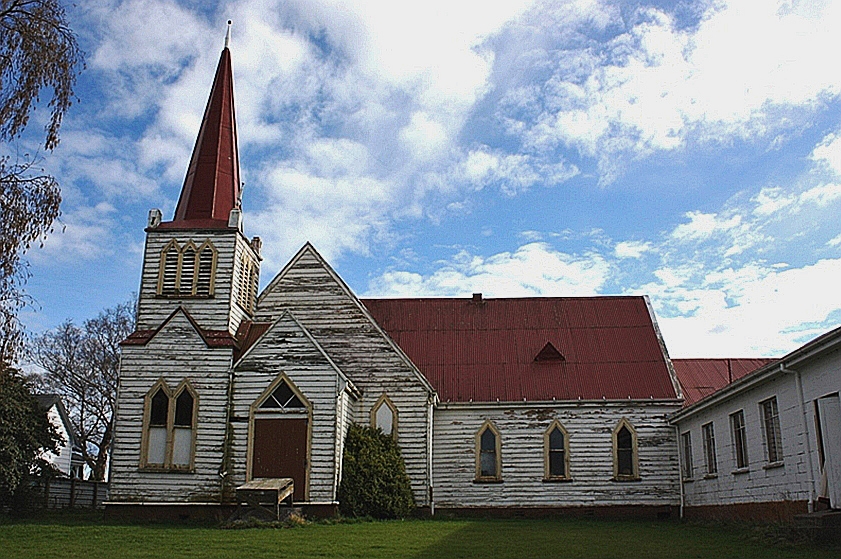
Sign up to hear more
Get the latest heritage news, features and events delivered
straight to your inbox.
