

The woolshed was the largest and most characteristic of New Zealand farm buildings. This was where sheep were kept under cover prior to shearing; where the shearing took place; and where the fleeces were sorted, baled, and stored until transport was available to take the clip to the main towns. Woolsheds varied in size from relatively small to huge structures with as many as 48 stands. The most common constructional material was timber or corrugated iron. Until the 1890s, shearing was a laborious process carried out by hand, using blade shears. From 1889 mechanically powered machines began to take over, to be succeeded in the twentieth century by electrically driven shears.
Arowhenua Station was the second run taken up in South Canterbury. Originally consisting of 31,000 acres, it was taken up by Major Alfred Hornbrook in 1853, and managed by his brother William for 10 years. The 20 stand station woolshed is thought to have been constructed as early as 1853 but was certainly there by 1854. In 1857, as there were no suitable buildings in the area, the woolshed was the site of the first Anglican service in South Canterbury. This was conducted by Bishop Harper, who also conducted a service there in 1859.
In 1863 the station was sold to Alfred Cox, then in 1878 to J. T. Ford and Co, from whom it was taken over in 1883 by the Bank of New Zealand. The bank's estate company assumed control in 1890, subdividing the station in 1897. The homestead block containing the woolshed was drawn in ballot by Robert McCallum, who in turn sold the block to John Lyon in 1919. Mrs Lyon, a family member, still owns and lives on the property, but the land is leased to an adjoining farmer. Use of the woolshed ceased during the 1980s.
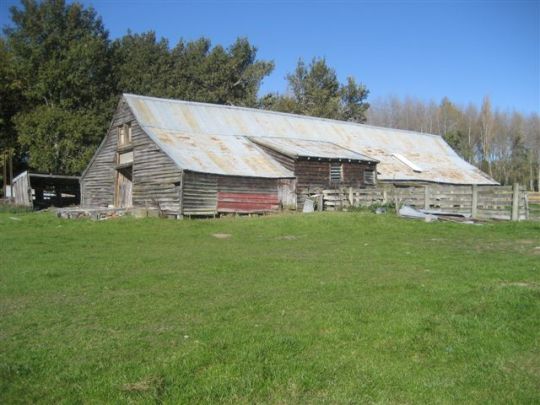
A 'dignified, weathered old building' (Wilson: 1991, p 22), the Arowhenua woolshed is one of the oldest woolsheds in the country, and may well also be the oldest remaining woolshed. Other venerable wooden woolsheds in South Canterbury include that at Anamo (1854), near Mt. Somers in Mid-Canterbury; Te Waimate (1856) in South Canterbury; and Coldstream (1856) at Rangitata Mouth.
List Entry Information
Status
Listed
List Entry Status
Historic Place Category 2
Access
Private/No Public Access
List Number
1953
Date Entered
25th June 2004
Date of Effect
25th June 2004
City/District Council
Timaru District
Region
Canterbury Region
Extent of List Entry
Extent includes part of the land described as Lot 1 DP 23188 (RT CB3D/1239), Canterbury Land District, and the structure known as Arowhenua Station Woolshed thereon, and its fittings and fixtures.
Legal description
Lot 1 DP 23188 (RT CB3D/1239), Canterbury Land District
Location Description
Arowhenua is located near Temuka.
Status
Listed
List Entry Status
Historic Place Category 2
Access
Private/No Public Access
List Number
1953
Date Entered
25th June 2004
Date of Effect
25th June 2004
City/District Council
Timaru District
Region
Canterbury Region
Extent of List Entry
Extent includes part of the land described as Lot 1 DP 23188 (RT CB3D/1239), Canterbury Land District, and the structure known as Arowhenua Station Woolshed thereon, and its fittings and fixtures.
Legal description
Lot 1 DP 23188 (RT CB3D/1239), Canterbury Land District
Location Description
Arowhenua is located near Temuka.
Why is this place significant?
Cultural Significance
It is significant in terms of social history because Bishop Harper, on his first visit to South Canterbury in 1857, preached to local Europeans from the woolshed's loading platform.
Historic Significance
Historical Significance or Value The Arowhenua Woolshed, dating from 1853 or 4, has historical significance as one of the earliest extant woolsheds in New Zealand.
Physical Significance
Its construction from pitsawn black pine and hand made nails with a kauri shingled roof (since covered with corrugated iron) make it important technologically.
Why is this place Category 1 / Category 2?
Detail Of Assessed Criteria
(a) it represents the beginnings of pastoralism, an industry which has been integral to New Zealand's economy and identity. Built in 1853-4 and in use until the 1980s it is one of the earliest woolsheds in the South Island and also one of the oldest in New Zealand. (b) It has associations with Bishop Harper, first Bishop of the Canterbury Diocese, and his early ministry in South Canterbury. In 1857 he held his first service here at the woolshed for local European residents of the district. (g) The woolshed's design is an archetype of what became the typical form of a New Zealand woolshed. (i) It dates from an early period of New Zealand's settlement and is one of the earliest remaining examples of a woolshed, which has become an iconic building in the New Zealand landscape. (k) The woolshed forms part of an historical complex with the adjacent cow byre (Cat. II)
Why is this place significant?
Cultural Significance
It is significant in terms of social history because Bishop Harper, on his first visit to South Canterbury in 1857, preached to local Europeans from the woolshed's loading platform.
Historic Significance
Historical Significance or Value The Arowhenua Woolshed, dating from 1853 or 4, has historical significance as one of the earliest extant woolsheds in New Zealand.
Physical Significance
Its construction from pitsawn black pine and hand made nails with a kauri shingled roof (since covered with corrugated iron) make it important technologically.
Why is this place Category 1 / Category 2?
Detail Of Assessed Criteria
(a) it represents the beginnings of pastoralism, an industry which has been integral to New Zealand's economy and identity. Built in 1853-4 and in use until the 1980s it is one of the earliest woolsheds in the South Island and also one of the oldest in New Zealand. (b) It has associations with Bishop Harper, first Bishop of the Canterbury Diocese, and his early ministry in South Canterbury. In 1857 he held his first service here at the woolshed for local European residents of the district. (g) The woolshed's design is an archetype of what became the typical form of a New Zealand woolshed. (i) It dates from an early period of New Zealand's settlement and is one of the earliest remaining examples of a woolshed, which has become an iconic building in the New Zealand landscape. (k) The woolshed forms part of an historical complex with the adjacent cow byre (Cat. II)
Construction Professional
Name
Hornbrook
Type
Builder
Biography
No biography is currently available for this construction professional
Construction Details
Start Year
1854
Type
Original Construction
Type
Modification
Description
Raising of section of roof for installation of machine stands.
Period
1900s
Construction Materials
Timber with an iron roof.
Construction Professional
Name
Hornbrook
Type
Builder
Biography
No biography is currently available for this construction professional
Construction Details
Start Year
1854
Type
Original Construction
Type
Modification
Description
Raising of section of roof for installation of machine stands.
Period
1900s
Construction Materials
Timber with an iron roof.
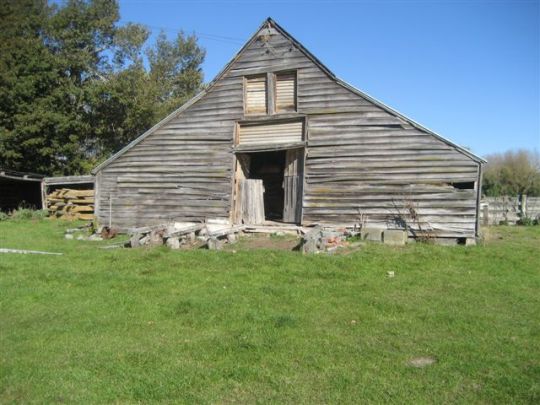
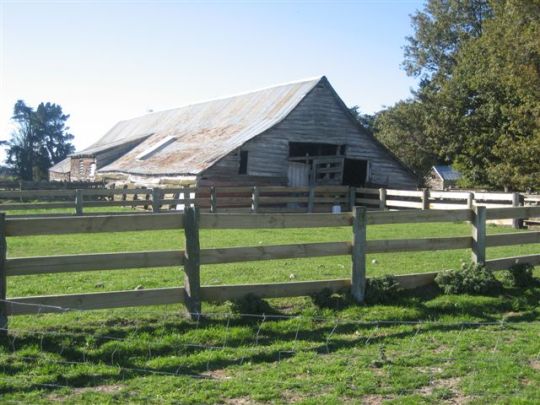
A long low (90 x 36 ft) woolshed originally accommodating twenty blade shearers; constructed of unpainted black pine pit-sawn on the property, and hand-made nails. The steeply pitched shingle roof is now covered with iron. At one end of the building is a sarked wool-processing room, with a low loading platform in a wide doorway. Part of the roof on the north-west side has been raised to allow for two machine shearing stands. The building has never been painted and the timbers have weathered to a silver-grey colour.
A long low (90 x 36 ft) woolshed originally accommodating twenty blade shearers; constructed of unpainted black pine pit-sawn on the property, and hand-made nails. The steeply pitched shingle roof is now covered with iron. At one end of the building is a sarked wool-processing room, with a low loading platform in a wide doorway. Part of the roof on the north-west side has been raised to allow for two machine shearing stands. The building has never been painted and the timbers have weathered to a silver-grey colour.
Historical and Associated Iwi / Hapū / Whānau
Completion Date
2nd September 2004
Report Written By
Pam Wilson
Information Sources
Wilson, 1991
John Wilson, The Canterbury Provincial Council Buildings, Christchurch, 1991
Thornton, 1986
Geoffrey Thornton, The New Zealand Heritage of Farm Buildings, Auckland, 1986
Thornton, 1982
Geoffrey G. Thornton, New Zealand's Industrial Heritage, A.H. & A.W. Reed, Wellington, 1982
Other Information
A fully referenced version of this report is available from the NZHPT Southern Region Office. Please note that entry on the New Zealand Heritage List/Rarangi Korero identifies only the heritage values of the property concerned, and should not be construed as advice on the state of the property, or as a comment of its soundness or safety, including in regard to earthquake risk, safety in the event of fire, or insanitary conditions.
Historical and Associated Iwi / Hapū / Whānau
Completion Date
2nd September 2004
Report Written By
Pam Wilson
Information Sources
Wilson, 1991
John Wilson, The Canterbury Provincial Council Buildings, Christchurch, 1991
Thornton, 1986
Geoffrey Thornton, The New Zealand Heritage of Farm Buildings, Auckland, 1986
Thornton, 1982
Geoffrey G. Thornton, New Zealand's Industrial Heritage, A.H. & A.W. Reed, Wellington, 1982
Other Information
A fully referenced version of this report is available from the NZHPT Southern Region Office. Please note that entry on the New Zealand Heritage List/Rarangi Korero identifies only the heritage values of the property concerned, and should not be construed as advice on the state of the property, or as a comment of its soundness or safety, including in regard to earthquake risk, safety in the event of fire, or insanitary conditions.
Current Usages
Uses: Agriculture
Specific Usage: Woolshed/Shearing Shed
Former Usages
General Usage: Agriculture
Specific Usage: Woolshed/Shearing Shed
Current Usages
Uses: Agriculture
Specific Usage: Woolshed/Shearing Shed
Former Usages
General Usage: Agriculture
Specific Usage: Woolshed/Shearing Shed
Location
Sign up to hear more
Get the latest heritage news, features and events delivered
straight to your inbox.
