

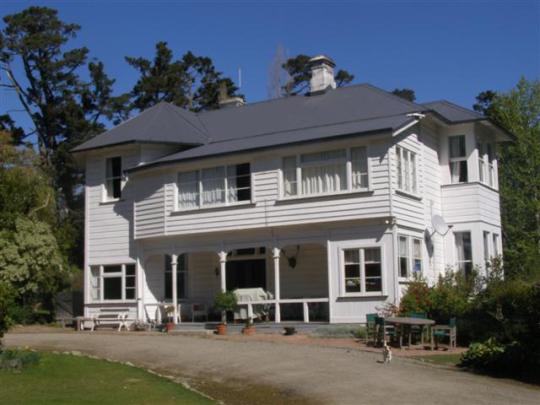
Te Rūnanga o Arowhenua, Te Rūnanga o Waihao and Te Rūnanga o Moeraki share an interest in Te Manahuna/Mackenzie District. They are connected to ngā maunga, awa, roto, whenua (mountains, rivers, lakes, land) and to their tūpuna who walked these lands, and who left their mark in the place names, camp sites and tradition of mahinga kai. Run No. 164, established on an open stony flat east of the Opawa River, was taken up by colonial settler Croft Marsack in 1857. By circa 1860 it was run by George Matson (and later his brother, Alfred), originally from Mountnessing in Essex, England. Also in the 1860s and 1870s Thomas Spencer was involved as a manager or runholder at Mt Nessing. Robert Rutherford purchased Mt Nessing Station in 1878 and for a time from 1879 was joined in partnership by his brother, Edmund Rutherford. In 1891 Robert Rutherford sold the struggling Mt Nessing Station to the mortgager. In 1899, Edgar Jones purchased the property and, with the farming situation much improved, in the early years of the twentieth century built a new two-storeyed house which is the third and now only surviving Mt Nessing Station Homestead (List No. 3143). The ornate timber Mt Nessing Homestead Entrance Gate and Picket Fence is thought to have been built either during Rutherford’s time, after 1878, or during Jones’ time, between 1899 and 1913.
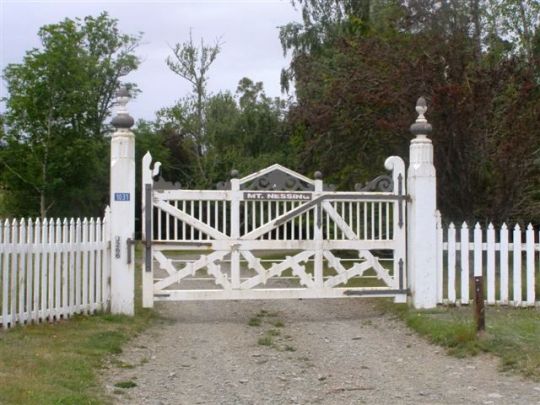
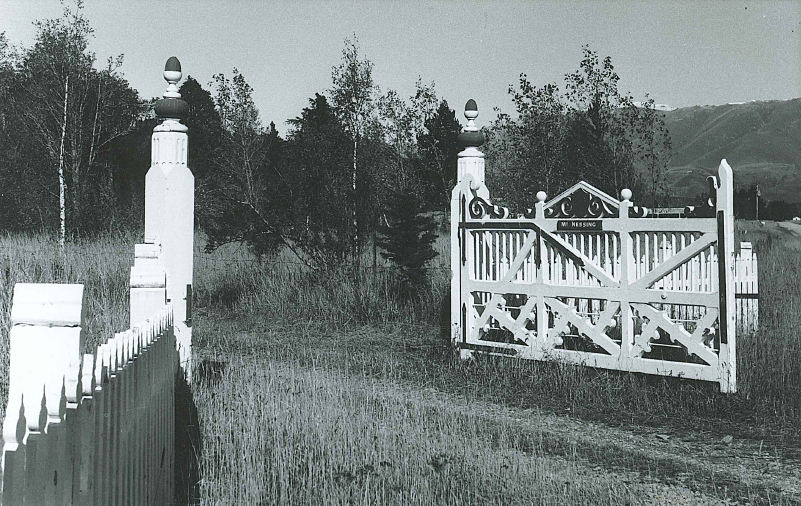
Located in a rural farm setting, at the east side of Mt Nessing Road, the gate provides access to a sweeping drive leading to the Mt Nessing Homestead, which sits some 350 metres to the south. The gate is approximately three metres in length and angles slightly away from the road. The part of the picket fence to its west is around four metres in length and continues at roughly the same angle as the gate, while the 15-metre-long picket fence on the other side of the gate splays northward, creating a wide V-shaped plan for the structure overall. The materials are white-painted timber, with grey wrought iron hinges. Flanked by heavy gate posts topped with acorn-shaped finials, the ornate swing gate has spur detailing on diagonal timbers at the lower level, plain stick-style uprights above, topped with a pedimented centre containing a plain shield, and flanking scroll decoration. A sign with the words ‘MT NESSING’ in black paint spans the centre of the gate. With its elaborate style, the gate is difficult to date with certainty. One unverified suggestion is that the gate may have been built in Sydney in the mid-nineteenth century from oak timbers salvaged from a shipwreck in Sydney harbour, and then erected after Robert Rutherford took over Mt Nessing Station. Decorative timber features may also be seen on New Zealand-made gates or villas spanning decades in the later nineteenth and early twentieth centuries, including in a Kauri Timber Company Ltd catalogue of 1906. Future analysis of original materials may provide more conclusive evidence of the gate’s date and origin.
In his Autobiography of an Early Settler in New Zealand, Jones wrote how ‘after the importation of motor cars, we used to invite any owner of cars for a motor run once a year to Mt Nessing…’. This began a motoring tradition that has continued for well over 100 years, with the cars driving through the Mt Nessing Homestead Entrance Gate and Picket Fence to access the homestead grounds. In 1913, Jones sold Mt Nessing to the government under the Land Settlement Act. The station was broken up by way of ballot at that time, thus creating the Mt Nessing district. The Mt Nessing Homestead block of 8,740 acres went to Miss Jessie Guthrie in 1913. Guthrie sold to Bruce Gillies in 1916. James Renton briefly owned the property before selling to Mary Simpson in 1920, thus beginning a long and ongoing period of ownership by the Simpson family. The current owners, James and Katie Simpson, took over as owners of Mt Nessing Station in 2011. In 2020, through a heritage grant from Mackenzie District Council, repairs were carried out to the Mt Nessing Homestead Entrance Gate and Picket Fence to replace the pickets and acorns, repair a broken metal latch and repaint the Mt Nessing sign.


List Entry Information
Status
Listed
List Entry Status
Historic Place Category 2
Access
Private/No Public Access
List Number
1964
Date Entered
23rd June 1983
Date of Effect
23rd June 1983
City/District Council
Mackenzie District
Region
Canterbury Region
Extent of List Entry
Extent includes part of the land described as Sec 13 Mt Nessing Settlement (RT CB32F/483), Canterbury Land District and the structure known as Mt Nessing Homestead Entrance Gate and Picket Fence thereon. Refer to the extent map tabled at the Rārangi Kōrero meeting on 8 June 2017.
Legal description
Sec 13 Mt Nessing Settlement (RT CB32F/483), Canterbury Land District
Status
Listed
List Entry Status
Historic Place Category 2
Access
Private/No Public Access
List Number
1964
Date Entered
23rd June 1983
Date of Effect
23rd June 1983
City/District Council
Mackenzie District
Region
Canterbury Region
Extent of List Entry
Extent includes part of the land described as Sec 13 Mt Nessing Settlement (RT CB32F/483), Canterbury Land District and the structure known as Mt Nessing Homestead Entrance Gate and Picket Fence thereon. Refer to the extent map tabled at the Rārangi Kōrero meeting on 8 June 2017.
Legal description
Sec 13 Mt Nessing Settlement (RT CB32F/483), Canterbury Land District
Construction Details
Type
Original Construction
Description
Gate and picket fence constructed
Period
Late nineteenth century or early twentieth century
Type
Refurbishment/renovation
Description
Gate refurbished
Period
1980s
Start Year
2020
Type
Restoration
Description
Repairs and repainting (pickets and acorns replaced)
Construction Details
Type
Original Construction
Description
Gate and picket fence constructed
Period
Late nineteenth century or early twentieth century
Type
Refurbishment/renovation
Description
Gate refurbished
Period
1980s
Start Year
2020
Type
Restoration
Description
Repairs and repainting (pickets and acorns replaced)
Historical and Associated Iwi / Hapū / Whānau
Completion Date
3rd August 2026
Report Written By
Robyn Burgess
Information Sources
Holm, 1992
J. Holm, Nothing But Grass and Wind: The Rutherfords of Canterbury, Christchurch, 1992 [Hazard Press]
Pinney, 1971
R Pinney, Early South Canterbury Runs, Wellington, 1971
Holm, 1994
Holm, Janet, ‘Enduring Walls’, Historic Places, May 1994, pp. 24-26
Jones, 1933
Jones, Edgar, Autobiography of an Early Settler in New Zealand, 1933 (1996 edition)
Vance, 1965
Vance, William, High Endeavour, 1965
Other Information
A fully referenced copy of the Upgrade Report is available upon request from the Southern Regional Office of Heritage New Zealand Pouhere Taonga. Disclaimer Please note that entry on the New Zealand Heritage List/Rārangi Kōrero identifies only the heritage values of the property concerned, and should not be construed as advice on the state of the property, or as a comment of its soundness or safety, including in regard to earthquake risk, safety in the event of fire, or insanitary conditions. Archaeological sites are protected by the Heritage New Zealand Pouhere Taonga Act 2014, regardless of whether they are entered on the New Zealand Heritage List/Rārangi Kōrero or not. Archaeological sites include ‘places associated with pre-1900 human activity, where there may be evidence relating to the history of New Zealand’. This List entry report should not be read as a statement on whether or not the archaeological provisions of the Act apply to the property(s) concerned. Please contact your local Heritage New Zealand office for archaeological advice.
Historical and Associated Iwi / Hapū / Whānau
Completion Date
3rd August 2026
Report Written By
Robyn Burgess
Information Sources
Holm, 1992
J. Holm, Nothing But Grass and Wind: The Rutherfords of Canterbury, Christchurch, 1992 [Hazard Press]
Pinney, 1971
R Pinney, Early South Canterbury Runs, Wellington, 1971
Holm, 1994
Holm, Janet, ‘Enduring Walls’, Historic Places, May 1994, pp. 24-26
Jones, 1933
Jones, Edgar, Autobiography of an Early Settler in New Zealand, 1933 (1996 edition)
Vance, 1965
Vance, William, High Endeavour, 1965
Other Information
A fully referenced copy of the Upgrade Report is available upon request from the Southern Regional Office of Heritage New Zealand Pouhere Taonga. Disclaimer Please note that entry on the New Zealand Heritage List/Rārangi Kōrero identifies only the heritage values of the property concerned, and should not be construed as advice on the state of the property, or as a comment of its soundness or safety, including in regard to earthquake risk, safety in the event of fire, or insanitary conditions. Archaeological sites are protected by the Heritage New Zealand Pouhere Taonga Act 2014, regardless of whether they are entered on the New Zealand Heritage List/Rārangi Kōrero or not. Archaeological sites include ‘places associated with pre-1900 human activity, where there may be evidence relating to the history of New Zealand’. This List entry report should not be read as a statement on whether or not the archaeological provisions of the Act apply to the property(s) concerned. Please contact your local Heritage New Zealand office for archaeological advice.
Current Usages
Uses: Accommodation
Specific Usage: Gate
Uses: Accommodation
Specific Usage: Wall/Fence
Current Usages
Uses: Accommodation
Specific Usage: Gate
Uses: Accommodation
Specific Usage: Wall/Fence
Sign up to hear more
Get the latest heritage news, features and events delivered
straight to your inbox.
