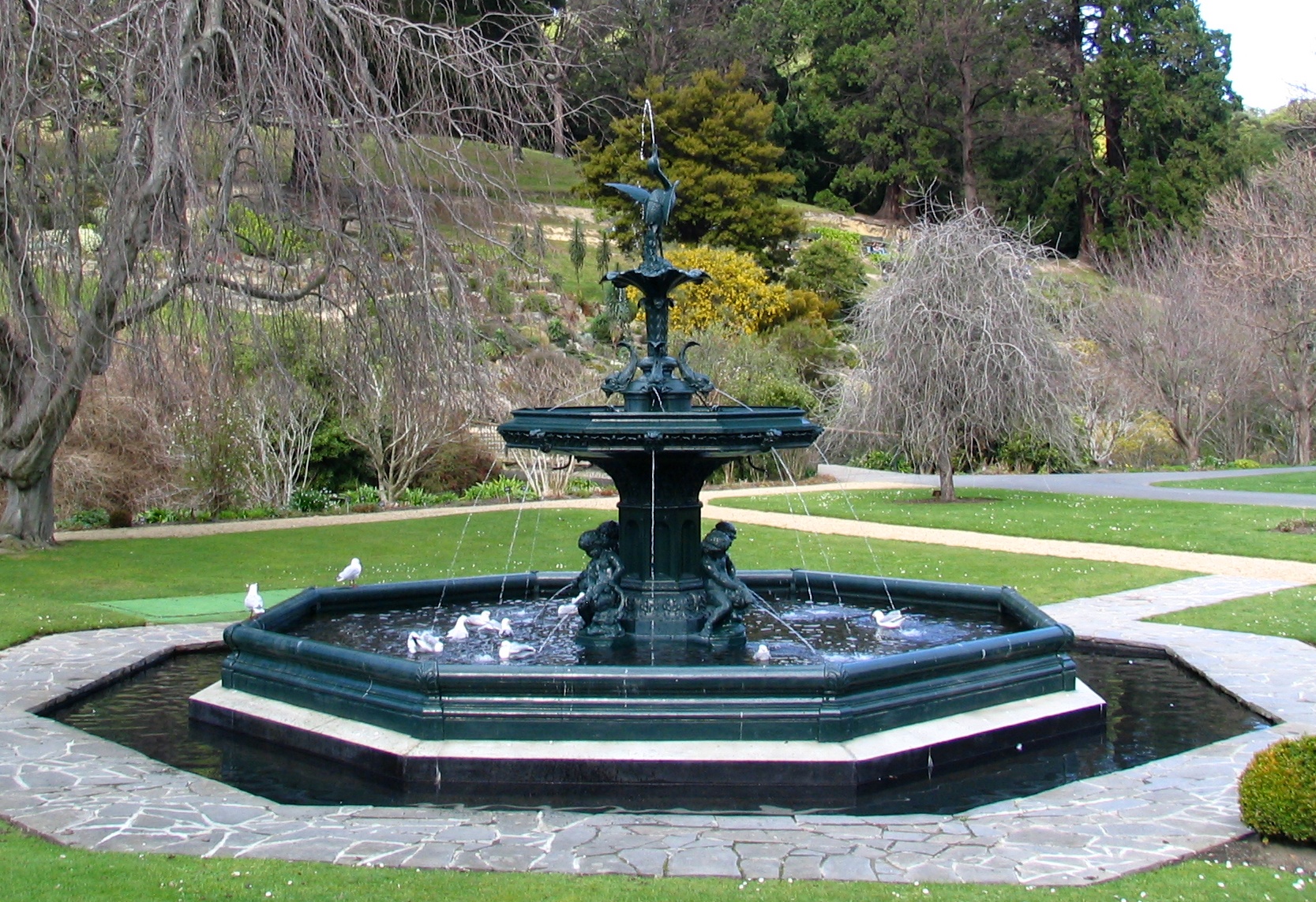
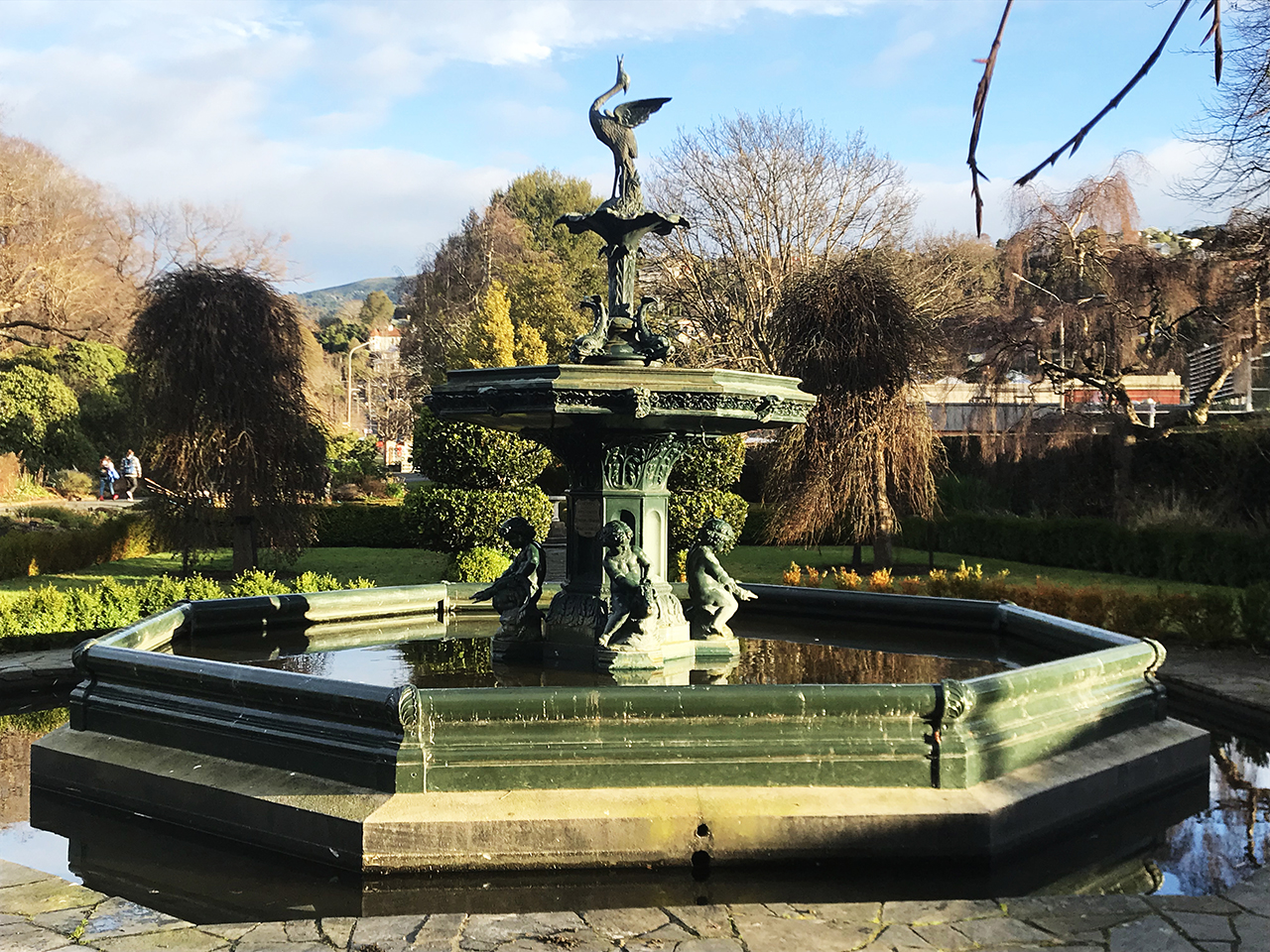
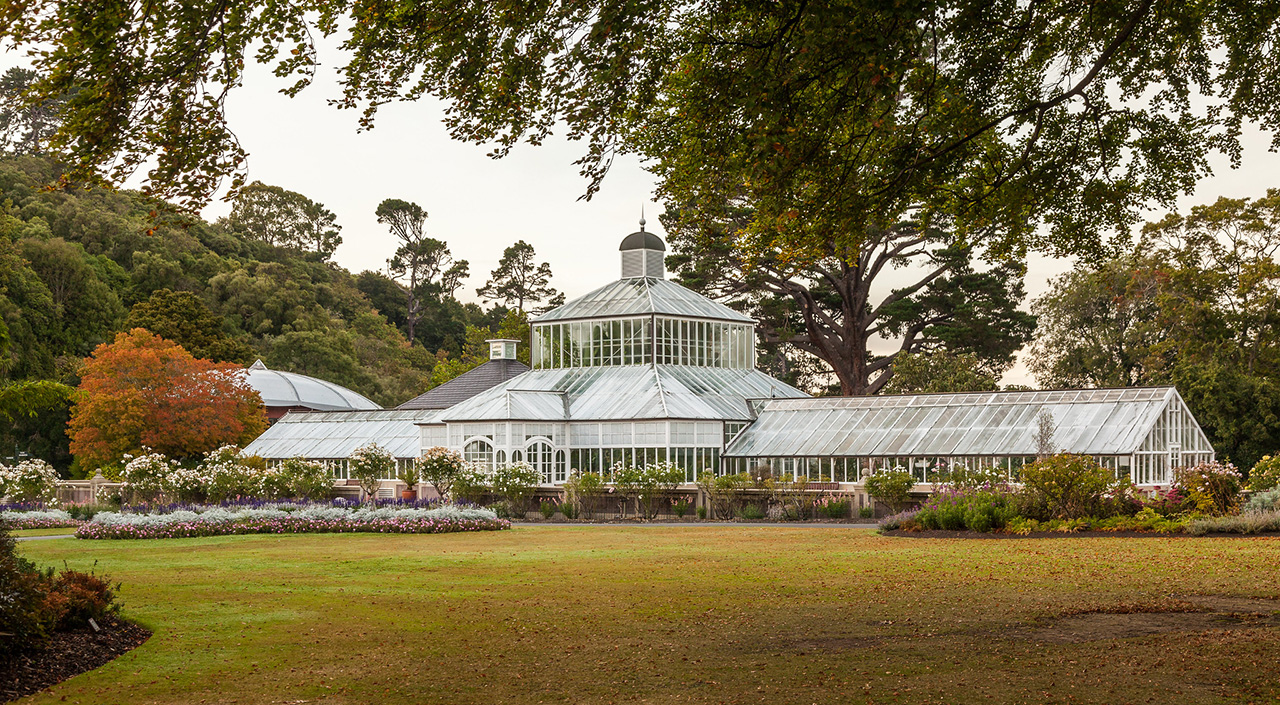
Described as ‘one of Dunedin’s art treasures’, the Wolf Harris fountain dates to 1889 and is situated on the flat at the northern end of the picturesque Botanic Garden near the Water of Leith. The Garden is bounded by Great King Street North, Cumberland Street, Ōpoho Road, and Lovelock Avenue. The fountain has historic and aesthetic significance.
Both iwi history and archaeological evidence show Māori occupation in the Ōtākou / Otago region since the 12th century. Today, Kāi Tahu mana whenua is recognised over a large part of Te Wai Pounamu. Kāti Māmoe and Waitaha shared occupation are always acknowledged. The hapū Kai Te Pahi, Kāti Moki, and Kāti Taoka still maintain their presence and responsibility as kaitiaki in this region. While there were no permanent settlements around the Botanic Garden, place names indicate the area was known to Māori. Ōwheo / Water of Leith was named for Kāti Mamoe chief Wheo and his kāik was located a block south of the confluence of Ōwheo and Puke Hau Kea / Lindsay Creek. The wooded ridge that extends northwards towards Ōpoho to the East of Leith Street was known as Te Mana Kapakapa a Tiki.
The mouth of the Tōitu stream, where the current Exchange is, entered an area of tidal flats at the head of Otago Harbour and was site of the Kāi Tahu and Ngāti Mamoe Tauraka Waka (List No.9774). After the arrival of the first Scottish immigrants in 1848 settlement began in the area. Over several years, Ngā Moana e Rua / Bell Hill was reduced, and the tidal flats reclaimed. This included the area which came to be known as the Triangle near Dunedin’s earliest railway site which was declared a public reserve in 1885. The reserve was unkempt for years, a poor impression for visitors arriving at the new Dunedin railway station (List No. 59). This, and the forthcoming South Seas Exhibition, prompted the Dunedin and Suburban Reserves Conservation Society (RCS) to improve it. Wolf Harris (1833-1926), a founding member of Dunedin’s Jewish community, local businessman and philanthropist, commissioned a fountain in 1889 for an estimated £1000 ($203,023) for the site.
The fountain was described from a tracing received in 1889 by Mr A. Bathgate, the honorary secretary of the RCS,
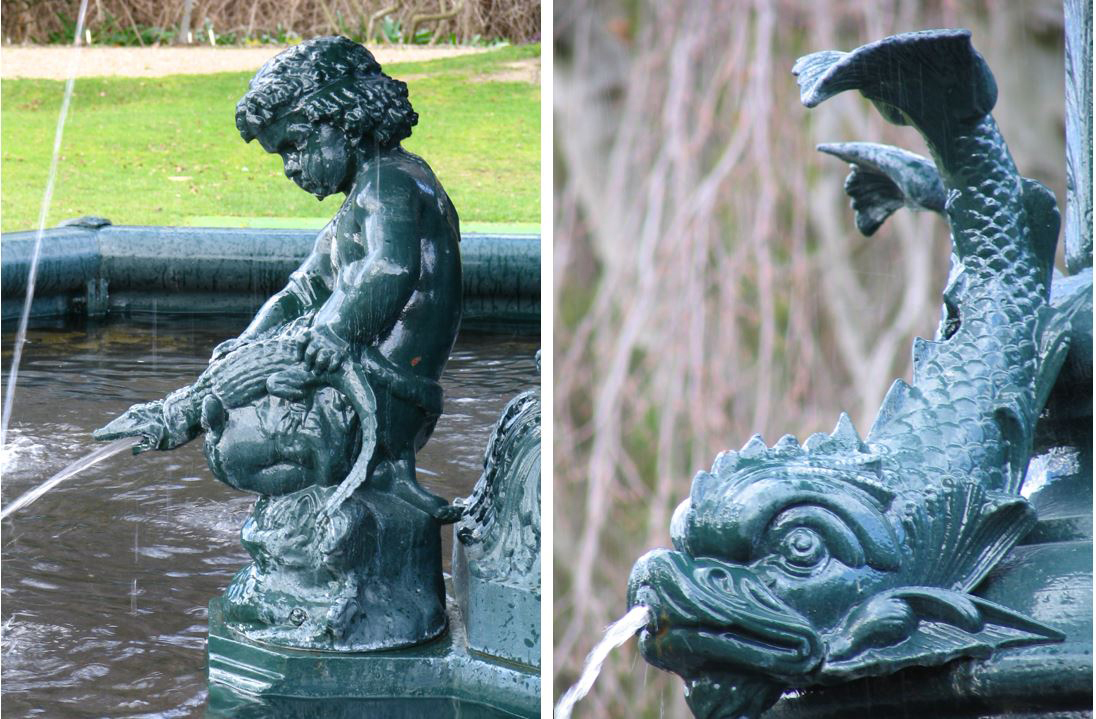
‘An exceedingly handsome fountain, 14ft high (4.3 m), the lower basin being 20ft (6 m) in diameter, from which rises a pillar bearing an upper basin 8ft in diameter (m). Round the base of this pillar are figures of four children, each holding a large lizard on his knee, and from the mouths of which will flow a jet of water … Round the upper basin there are eight heads, from which the water of the upper basin escapes into the lower. From the upper basin there rises a pillar of conventional leaves, forming a small basin, from the irregular edge of which the water drips. Round the base of this small pillar there are four dolphins, while the whole is surmounted by the figure of a stork ...’
Installation of the fountain and fencing was completed in January 1890 and the official handover from the RCA to Council occurred on 28 May 1890.
In 1894 Harris visited Dunedin from London and was so delighted to see the improvements to the Triangle that he offered to pay for the cleaning and painting of the fountain and fencing. After the installation of the Queen Victoria monument (List No. 2206) in 1904, the Triangle was renamed, Queen’s Garden. A proposal to move the fountain to the Botanic Garden was made in 1921 to make way for the Cenotaph (List No. 2221). Harris complied and donated £100 ($8,946) for maintenance. Before it was reassembled, the Exhibition Company requested it for the duration of the New Zealand and South Seas Exhibition. This was agreed and the fountain was stored until it was erected in the ‘grand court’ in 1925. Following the close of the Exhibition in 1926, it was finally moved to the lawn of the Shakespeare Garden near the Leith. David Tannock, (1873-1952) the Superintendent of Reserves, arranged for an interpretive plaque to be installed on the fountain. In 1988 the fountain was described as, ‘beautiful and terribly neglected’. By 1994 it required extensive restoration which was cofounded by Dunedin City Council and the Dunedin Amenities Society (DAS) for $23,000 ($39,218). In 2009 the fountain received a $36,000 ($43,605) upgrade funded by the DAS and the Harris family. Today the fountain remains a beloved feature of the Botanic Garden.
Both iwi history and archaeological evidence show Māori occupation in the Ōtākou / Otago region since the 12th century. Today, Kāi Tahu mana whenua is recognised over a large part of Te Wai Pounamu. Kāti Māmoe and Waitaha shared occupation are always acknowledged. The hapū Kai Te Pahi, Kāti Moki, and Kāti Taoka still maintain their presence and responsibility as kaitiaki in this region. While there were no permanent settlements around the Botanic Garden, place names indicate the area was known to Māori. Ōwheo / Water of Leith was named for Kāti Mamoe chief Wheo and his kāik was located a block south of the confluence of Ōwheo and Puke Hau Kea / Lindsay Creek. The wooded ridge that extends northwards towards Ōpoho to the East of Leith Street was known as Te Mana Kapakapa a Tiki.
The mouth of the Tōitu stream, where the current Exchange is, entered an area of tidal flats at the head of Otago Harbour and was site of the Kāi Tahu and Ngāti Mamoe Tauraka Waka (List No.9774). After the arrival of the first Scottish immigrants in 1848 settlement began in the area. Over several years, Ngā Moana e Rua / Bell Hill was reduced, and the tidal flats reclaimed. This included the area which came to be known as the Triangle near Dunedin’s earliest railway site which was declared a public reserve in 1885. The reserve was unkempt for years, a poor impression for visitors arriving at the new Dunedin railway station (List No. 59). This, and the forthcoming South Seas Exhibition, prompted the Dunedin and Suburban Reserves Conservation Society (RCS) to improve it. Wolf Harris (1833-1926), a founding member of Dunedin’s Jewish community, local businessman and philanthropist, commissioned a fountain in 1889 for an estimated £1000 ($203,023) for the site.
The fountain was described from a tracing received in 1889 by Mr A. Bathgate, the honorary secretary of the RCS,
‘An exceedingly handsome fountain, 14ft high (4.3 m), the lower basin being 20ft (6 m) in diameter, from which rises a pillar bearing an upper basin 8ft in diameter (m). Round the base of this pillar are figures of four children, each holding a large lizard on his knee, and from the mouths of which will flow a jet of water … Round the upper basin there are eight heads, from which the water of the upper basin escapes into the lower. From the upper basin there rises a pillar of conventional leaves, forming a small basin, from the irregular edge of which the water drips. Round the base of this small pillar there are four dolphins, while the whole is surmounted by the figure of a stork ...’
Installation of the fountain and fencing was completed in January 1890 and the official handover from the RCA to Council occurred on 28 May 1890.
In 1894 Harris visited Dunedin from London and was so delighted to see the improvements to the Triangle that he offered to pay for the cleaning and painting of the fountain and fencing. After the installation of the Queen Victoria monument (List No. 2206) in 1904, the Triangle was renamed, Queen’s Garden. A proposal to move the fountain to the Botanic Garden was made in 1921 to make way for the Cenotaph (List No. 2221). Harris complied and donated £100 ($8,946) for maintenance. Before it was reassembled, the Exhibition Company requested it for the duration of the New Zealand and South Seas Exhibition. This was agreed and the fountain was stored until it was erected in the ‘grand court’ in 1925. Following the close of the Exhibition in 1926, it was finally moved to the lawn of the Shakespeare Garden near the Leith. David Tannock, (1873-1952) the Superintendent of Reserves, arranged for an interpretive plaque to be installed on the fountain. In 1988 the fountain was described as, ‘beautiful and terribly neglected’. By 1994 it required extensive restoration which was cofounded by Dunedin City Council and the Dunedin Amenities Society (DAS) for $23,000 ($39,218). In 2009 the fountain received a $36,000 ($43,605) upgrade funded by the DAS and the Harris family. Today the fountain remains a beloved feature of the Botanic Garden.