

The Ōtākaro/Avon River, named after the tipuna, ‘Tākaro’, is the iconic spring-fed river that flows through Ōtautahi/Christchurch and was an important part of the interconnected network of traditional travel routes. With mid-nineteenth century colonisation by the Canterbury Association, the city of Christchurch was established, the settlers bringing with them ideas of laws and administration that reflected British traditions. Colonial women upturned voting traditions, however, when they worked together and with sympathetic men in Parliament, to successfully petition for women’s suffrage in 1893. As such, New Zealand became the first country in the world where women gained the right to vote in national elections. To mark 100 years since this internationally significant social change in the status of women’s full citizenship being recognised, commemorations were planned for 1993 throughout the country. One key project was to establish the Kate Sheppard National Memorial to Women’s Suffrage, which involved considerable input from many individuals and committees, including for design ideas, historical advice and fundraising. Christchurch was chosen as the desired location for the memorial, being the home of Kate Sheppard and many of her supporters during the crucial years of the suffrage campaign. The Kate Sheppard Memorial Committee, made up of prominent women active in the community, gave clear direction regarding the memorial’s bas-relief design and materials, stipulating the deepest relief should be for Kate Sheppard, who should be in a recognisable likeness and positioned in a commanding and inspirational stance. After a limited competition, South Canterbury-based sculptor, Margriet Windhausen was chosen to create the Kate Sheppard National Memorial to Women’s Suffrage.
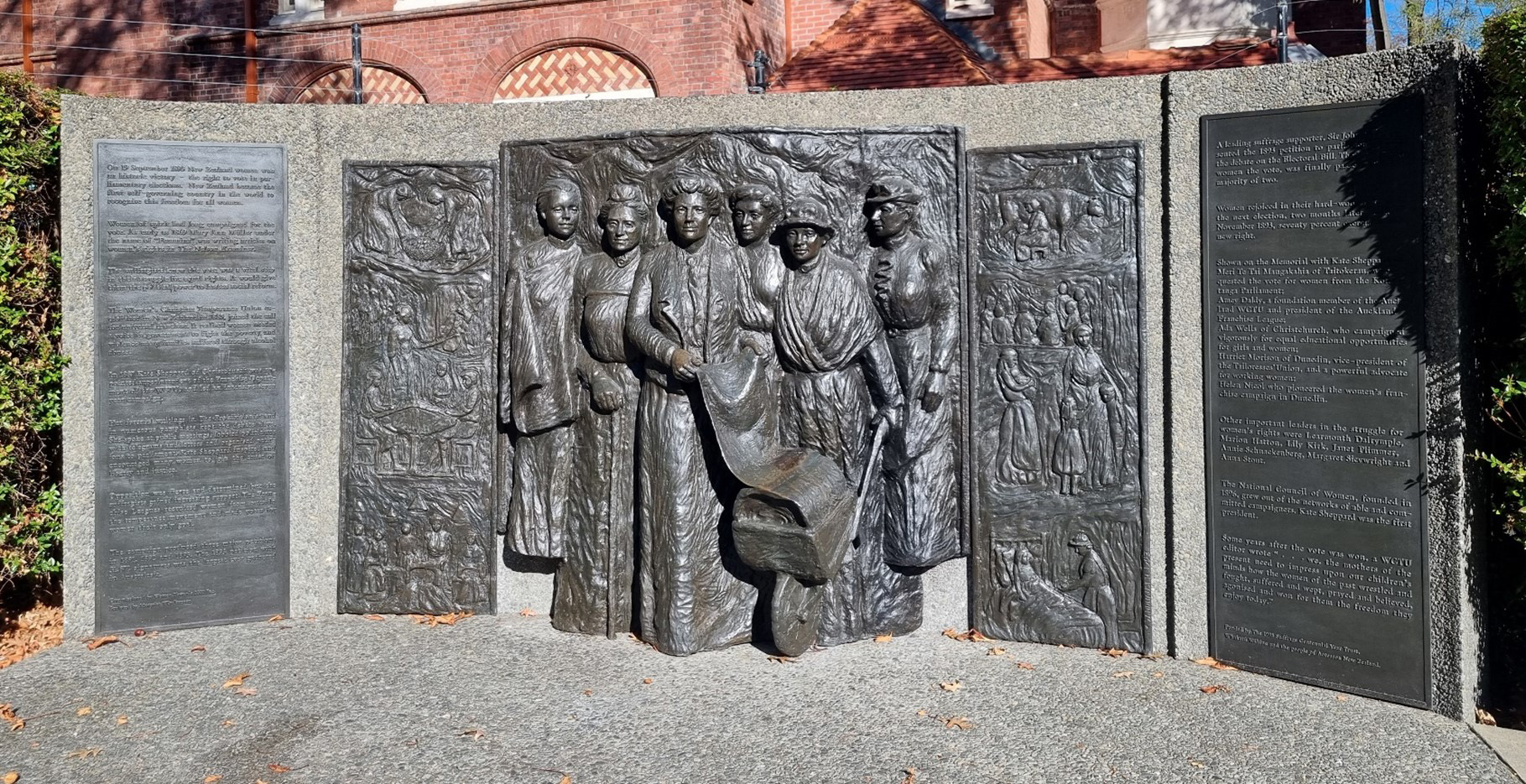
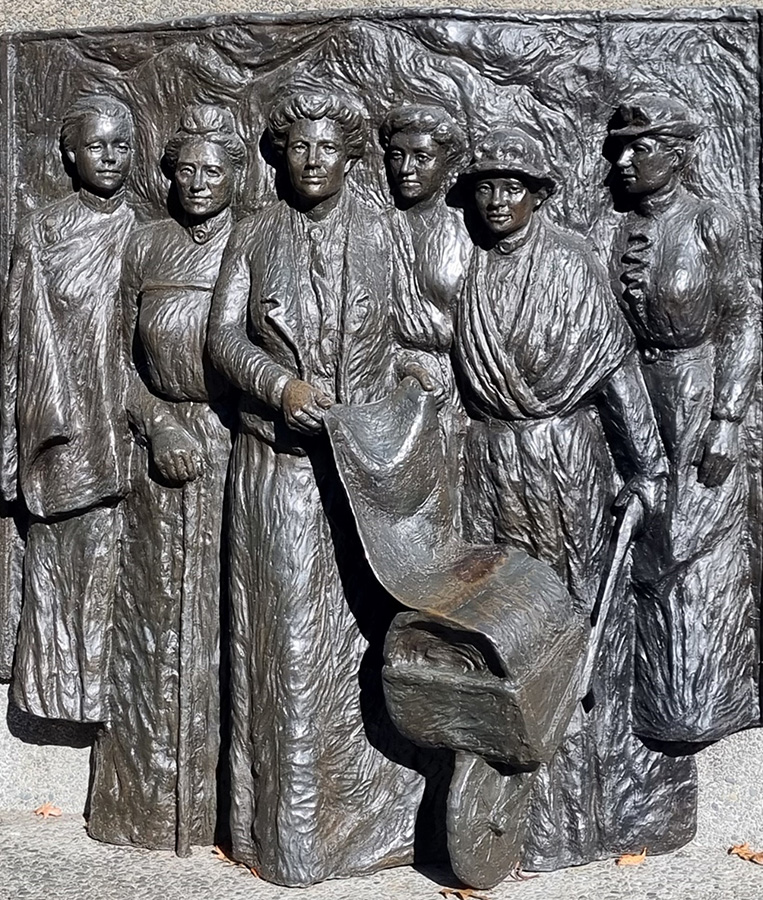
Set on a five metre long curved wall of exposed aggregate, at the centre of the memorial is a bronze relief sculpture, 3.3 metres in length and 2.1 metres in height, depicting six life-size figures in high relief with two side panels in primitive style bas-relief portraying women’s traditional roles. The outer panels contain detailed text outlining the history of the suffrage movement in New Zealand and the names of important leaders in the struggle for women’s rights. The figure at the centre, Kate Sheppard, is represented holding the suffrage petition which is resting in a small wheelbarrow. As text panels explain, the women flanking Kate Sheppard in life-sized deep reliefs represent Meri Te Tai Mangakāhia, draped in a korowai, Amey Daldy, Ada Wells, Harriet Morison and Helen Nicol.
Apart from a couple of years when central Christchurch was effectively closed as a result of the Canterbury Earthquakes of 2010-2011, the Kate Sheppard National Memorial to Women’s Suffrage has been a place of gathering and reflection, especially at Suffrage Day, 19 September, each year.
List Entry Information
Status
Listed
List Entry Status
Historic Place Category 1
Access
Able to Visit
List Number
2290
Date Entered
20th February 2025
Date of Effect
12th March 2025
City/District Council
Christchurch City
Region
Canterbury Region
Extent of List Entry
Extent includes part of the land described as Reserve – Lawns Ornamental Gardens and Ornamental Buildings (Sec 7(1) Christchurch City (Reserves) Empowering Act 1971) and the structure known as the Kate Sheppard National Memorial to Women’s Suffrage thereon. Plantings are not included in the extent. (See the extent map in section 1 of the listing report)
Legal description
Reserve - Lawns Ornamental Gardens and Ornamental Buildings (Sec 7(1) Christchurch City (Reserves) Empowering Act 1971), Canterbury Land District
Location Description
Located behind the Municipal Chambers which is on the corner of 159 Oxford Terrace and Worcester Street, CHRISTCHURCH
Status
Listed
List Entry Status
Historic Place Category 1
Access
Able to Visit
List Number
2290
Date Entered
20th February 2025
Date of Effect
12th March 2025
City/District Council
Christchurch City
Region
Canterbury Region
Extent of List Entry
Extent includes part of the land described as Reserve – Lawns Ornamental Gardens and Ornamental Buildings (Sec 7(1) Christchurch City (Reserves) Empowering Act 1971) and the structure known as the Kate Sheppard National Memorial to Women’s Suffrage thereon. Plantings are not included in the extent. (See the extent map in section 1 of the listing report)
Legal description
Reserve - Lawns Ornamental Gardens and Ornamental Buildings (Sec 7(1) Christchurch City (Reserves) Empowering Act 1971), Canterbury Land District
Location Description
Located behind the Municipal Chambers which is on the corner of 159 Oxford Terrace and Worcester Street, CHRISTCHURCH
Why is this place significant?
Cultural Significance
Social Significance or Value The Kate Sheppard National Memorial to Women’s Suffrage has social significance. It provides an opportunity for people to form bonds and celebrate not only Kate Sheppard, an outstanding heroic figure in the history of New Zealand, but others responsible for this significant social change. Consultation and research conducted in the early 1990s by the history arm of the memorial committee was revelatory and empowering, bringing to light half-forgotten histories and enabling further insight about connections. Dame Whina Cooper’s interest in Meri Te Tai Mangakāhia’s inclusion in the memorial is just one example of strong bonds between contemporary activist women with the historical figures. The conception, design, fundraising and unveiling of the memorial in 1993 brought large numbers of people together. The process of collecting names of subscribers contributing funds for the memorial, held now within the memorial as an unseen deposit, was likened at the time to the collection of petition signatures some 100 years earlier. The collective effort was socially significant. The memorial continues to be a place where connections are made – people meet there, deliberately or coincidentally – and its pleasant riverside location provides a space for contemplation. Apart from a few years when the Christchurch Central Business District was closed following the Canterbury Earthquakes, the memorial has been the yearly gathering place for those celebrating the anniversary of Women’s Suffrage on 19 September each year. Cultural Significance or Value Kate Sheppard National Memorial to Women’s Suffrage has cultural significance. It is a place valued by a wide range of New Zealanders – including, not least, feminists, social reformers and educators – and is where these groups can see their values and world views expressed, especially as it is in public ownership and easily accessible. The place celebrates the value of women’s work and the mammoth effort by women, and their male supporters, in demonstrating that women - making up half the adult population – should be entitled to vote to have a say in political decision-making that affected the whole country. Part of our cultural identity is that New Zealand is recognised globally as the first country in the world to achieve this. This notion of democracy and equal rights underlies our cultural beliefs as a nation, even if, in all reality, there is still a way to go. It is, as the Governor General, Dame Catherine Tizard, said when she unveiled the Kate Sheppard National Memorial to Women’s Suffrage in 1993, a physical reminder of the need to keep making progress towards goals of women’s welfare. Kate Sheppard herself is part of New Zealand’s cultural identity and the prominence given to her in the memorial is deliberate. Just as other figures depicted and named on the memorial demonstrate the teamwork of the nineteenth century, the establishment of the memorial itself was the result of considerable teamwork leading up to the Centennial Suffrage Celebrations in 1993. Groups such as Canterbury Women Towards 2000, the Kate Sheppard Memorial Trust Committees, and the National Council of Women in New Zealand were instrumental in the establishment of the memorial and input was provided by a range of organisations, including the Māori Women’s Welfare League. These groups, working together, is a characteristic of New Zealand’s volunteer culture. Fundraising efforts, locally and nationally, reflect deep community involvement, and the 1993 inclusion of the subscriber names being put together in the memorial’s capsule deposit, is a deliberate association with the collective effort of the petition signing 100 years earlier. The Kate Sheppard National Memorial to Women’s Suffrage, as a public place and site of gathering, continues to allow reflection on cultural development, change and renewal. Those portrayed on the memorial reflect the diversity among New Zealand women: young and old; North to South (Northland, Auckland, Christchurch, Dunedin); working class and middle class; professional, unionist and home workers; urban and rural; Māori and Pākehā. As such, women can come to the memorial and be inspired to find among these campaigners for justice someone like themselves. The memorial’s democratic design approaches make the sculpture available to young, old and those with mobility and vision limitations. For Ngāi Tūāhuriri and for the descendants of Meri Te Tai Mangakāhia, the memorial is a maumahara, a memorial to wāhine toa who successfully helped shape the end of both Māori and Pākehā women’s suffrage in Aotearoa New Zealand’s colonial history.
Historic Significance
Historical Significance or Value The Kate Sheppard National Memorial to Women’s Suffrage has historical significance. The history of the memorial’s inception, design by committee, choice of site, and extensive and inclusive fundraising tells a story of the collective effort and nationwide celebration of the 1993 Women’s Suffrage Centenary. A product of the late twentieth century, it tells the story of a momentous event in history 100 years earlier, whereby New Zealand became the first country in the world where women were granted the right to vote in national parliamentary elections. Historical research was carried out in the early 1990s, and organisations consulted to determine the main figures to be depicted and others to be mentioned in the extensive text on the memorial. Historically, numerous parties played significant roles in the campaign for women’s franchise and the memorial committee’s research and consultation as part of the selection process attempted to reflect this. The women selected for inclusion in the memorial demonstrate the diversity of the parties involved. The Women’s Christian Temperance Union’s Kate Sheppard was identified as being at the helm of a determined campaign to win parliamentary franchise for the women of New Zealand, one of the founders and leaders in the National Council of Women and a respected figure in the international women’s movement. Sheppard’s prominence was brought to the fore nationally at the time of the Centenary celebrations and the memorial emphasises her historical importance through her central, more prominent placing in the memorial as well as in its name. The inclusion of Meri Te Tai Mangakāhia recognises the historical differences for Māori women in the 1890s, who were effectively involved in two suffrage movements at the same time – they supported the W.C.T.U. and Franchise Leagues in seeking the right to vote in the House of Representatives and they also sought the right to vote and to stand as members of Te Kotahitanga, the Māori Parliament. Active campaigner, Ada Wells, was involved in founding (in 1892) the Canterbury Women’s Institute, which was also pivotal in the suffrage campaign. The depictions of Amey Daldy, Harriet Morison and Helen Nicol, and the mention of Marion Hatton in the text, provides recognition of the Women’s Franchise League, as a ‘purpose-built’ franchise organisation established in 1892, working closely with the franchise arm of the W.C.T.U. in its critical role in garnering so many signatures for the monster petition. The siting of the Kate Sheppard National Memorial to Women’s Suffrage, on a public reserve with a long history of civic use, around five metres behind the brick former Municipal Chambers and facing the former Canterbury Provincial Council Buildings, has some poignancy. The first colonial timber building on the Municipal Chambers site had been the Land Office or Survey Office, built in the early 1850s, housing the Registrar of Deeds to record Canterbury land transactions and ownership. Established throughout the colony, Land Offices were associated with Pākehā land acquisition through colonial settlement, something which had a dramatic negative impact on Māori and one of the reasons why Māori women sought to become active in the political sphere. Kate Sheppard and her husband Walter would have been directly associated with this area in the city, especially the timber municipal buildings and its 1886 brick replacement. Ada Wells, one of the women on the memorial, entered this brick building as the first woman member of the Christchurch City Council in 1917. In 1921 Elizabeth McCombs entered this same municipal building to begin a 12-year term on the Christchurch City Council, subsequently becoming, in 1933, New Zealand’s first woman Member of Parliament. It was a deliberate decision that the 1993 Kate Sheppard National Memorial to Women’s Suffrage be placed beside the former Municipal Chambers yet looking directly across to the Canterbury Provincial Council Buildings, which had direct association with the National Council of Women. After the successful suffrage campaign of 1893, the next step forward for New Zealand women’s political involvement had taken place when the National Council of Women held its first meeting at the Canterbury Provincial Council Buildings in 1896. Amongst many other matters, Kate Sheppard and others in the National Council of Women were active in lobbying for municipal franchise once parliamentary franchise was achieved. The memorial has characteristics that enhance the understanding of and provide insight into, and chance for reflection on, what it was like for New Zealand women at the time when it was made, the early 1990s, and what had and had not been achieved in that 100 years since the vote for women was won. Great strides had been made through the women’s liberation movement of the 1960s, 1970s and 1980s but struggles, tensions and inequalities continued. Those involved at the unveiling event gave a sense of some of the gains made. For example, the memorial was unveiled by New Zealand’s first female governor-general, Dame Catherine Tizard. Key speakers included Vicki Buck, the first female mayor of Christchurch, and Jenny Shipley, Minister of the mid-1980s-created Ministry for Women’s Affairs, who’d provided support for the memorial.
Physical Significance
Aesthetic Significance or Value The Kate Sheppard National Memorial to Women’s Suffrage has aesthetic significance. It is a representational piece of art that not only tells a story but, in accordance with the artist’s intention, radiates an energy in a timeless way and therefore speaks to a wide audience. Rather than being a piece of untouchable fine art, it elicits a response encouraging one to come close, read the text and view the depictions, even touch the features of the key figures at the centre. These figures, depicted life-size or near life-size, stand at ground level rather than being on a pedestal, meaning they are approachable, connecting to the viewers. The sculptor identified this connection was important, deliberately using a play with light and dark to give a spirit and energy to reach the viewer. It is the visual and tactile appeal, together with the knowledge that it imparts about the significance of women’s suffrage, that brings about a heightened emotional response from many. Te Whakaoranga, the Kate Sheppard Memorial Enhancement Project, established in the early 2020s to ensure the place be appropriately cared for and enhanced, is an example of a wider emotional connection to the memorial.
Why is this place Category 1 / Category 2?
Detail Of Assessed Criteria
Created through considerable team effort and poignantly sited, in a publicly accessible central Christchurch space, Margriet Windhausen’s Kate Sheppard National Memorial to Women’s Suffrage is of special heritage significance. Part of the broader story of the New Zealand Women’s Movement, with a connection to the influential National Council of Women of New Zealand and the Māori Women’s Welfare League, it reflects a time of revelation and celebration, 100 years on from when New Zealand women famously became the first in the world to be granted the right to vote in national elections. As well as Kate Sheppard at the centre, the inclusion of other nineteenth century champions, such as Meri Te Tai Mangakāhia as a key advocate for Māori women being given a political voice, and Helen Nicol from the Women’s Franchise League, provides an opportunity for understanding how instrumental a range of individuals and organisations were for the successful suffrage outcome. The place continues to be a place of reflection on the importance of women’s issues today. This place was assessed against the criteria set out in section 66(3) of the Heritage New Zealand Pouhere Taonga Act 2014 and found to qualify as a Category 1 historic place under the following criteria: a, b, d, e, f, h, and j. (a) The extent to which the place reflects important or representative aspects of New Zealand history. The Kate Sheppard National Memorial to Women’s Suffrage sheds light on important aspects of nineteenth century New Zealand history – restrictions on women in colonial New Zealand, inequity for Māori through settlers’ land acquisition, the eventual achievement of all women gaining the right to vote in national elections in 1893 and Māori women’s right to stand and vote in Te Kotahitanga in 1897. Through a late twentieth century lens, the memorial reflects the nationwide centennial celebrations largely led and supported by women. Created in the early 1990s, the memorial and its unveiling event reflects a time in New Zealand’s history where women were seeking to write and celebrate Herstory – history from a women’s perspective, rather than the patriarchal History – and take more control over all kinds of matters. As a milestone, the suffrage centenary reflects a time of rediscovery and critical thinking about women’s position as it stood in late twentieth century New Zealand. (b) The association of the place with events, persons, or ideas of importance in New Zealand history. The Kate Sheppard National Memorial to Women’s Suffrage is associated with events, persons and ideas of importance in New Zealand. Looking back to the milestone event of 19 September 1893, when New Zealand women were granted the vote following an incredible campaign, by numerous women and men, fronted by Kate Sheppard, and to the nationwide celebrations 100 years later in September 1993. Sheppard is seen as one of the country’s most notable persons, as indicated by her image being featured on the New Zealand ten-dollar bank note. While the memorial was created many years after Kate Sheppard’s death, the reserve where it is sited is a place that she would have been familiar with, located beside the city’s municipal buildings and near to the Canterbury Provincial Council Buildings, one of the meeting points for the National Council of Women. Importantly, the memorial also demonstrates that other people were instrumental in the movement. As well as the six women depicted at the centre, the names of other key players are included in the text. There has been criticism in recent years that Kate Sheppard’s role at the helm of the movement has been overstated because she did not work alone and the actions of others, including outside of the W.C.T.U., have been downplayed. Even though Kate Sheppard is at the forefront, including in its name, this memorial includes and acknowledges other key figures such as Harriet Morison of the Tailoresses Union, Helen Nicol and Marion Hatton who were instrumental in the Women’s Franchise League, earlier spirited women such as Mary Ann Müller, and parliamentarian Sir John Hall, one of the many males who championed women’s suffrage. In particular, the inclusion of Meri Te Tai Mangakāhia in the memorial provides the opportunity to reflect a much broader story of aspects of the impacts of colonial settlement on Māori. While Māori women and Pākehā women shared similar concerns in late nineteenth century New Zealand, especially in relation to concerns of family and the harms of alcohol, their situations differed. Many Māori women saw their prior rights eroding under colonial rule. Land issues were a key problem and Māori women were vocal, alongside their men, including in the Native Lands Court, raising concerns that so much of their lands and resources going into colonial settler ownership. When Te Kotahitanga, the Māori Parliament, was established in 1892, Māori women were involved and able to speak from its inception. Meri Te Tai Mangakāhia brought forward a motion to Te Kotahitanga that women be allowed to vote and stand in the Māori Parliament in 1893 but deferral of the motion meant this wasn’t put in place until 1897. By this time, all women – Māori and Pākehā – had been granted the right to vote in national elections from September 1893. Themes depicted in the bas-relief panels of the memorial reflect some of the typical work of women – working the land, educating, harvesting, factory sewing, farming, caring for families and nursing – relevant not just for the nineteenth century when the franchise campaign was underway but applicable and worthy of recognition today as a valid contribution to society. When New Zealand men were away serving in the military during the two World Wars of the twentieth century, women took over men’s role in their absence, some working on farms as ‘Land Girls’, others in factories, not unlike the primitive bas-relief images in the memorial. (d) The importance of the place to tangata whenua With respect to the Kate Sheppard National Memorial to Women’s Suffrage, Te Rūnanga o Ngāi Tūahuriri acknowledges the significance of the women depicted, their achievements as leaders and as representatives of the Suffrage movement in New Zealand. At the 130-year celebration for women receiving the vote, on Suffrage Day, 19 September 2023, Tania Wati of Ngāi Tūāhuriri and Te Rūnanga o Ngāi Tahu spoke of the wāhine who signed Te Tiriti o Waitangi and how Māori women were later excluded from decision-making. As a matter of usual practice, Te Rūnanga o Ngāi Tūāhuriri also notes the multiple sites of significance in the vicinity. The stories of these sites have been elevated since the Canterbury Earthquakes of 2010-2011, articulated in the Grand Narratives publication (edited by Te Maire Tau) and made visible through Matapopore’s (the mana whenua voice in the post-quakes Christchurch recovery) Māori urban design and interpretation. For example, Whāriki, weaving designs adapted using stone pavers, set along a pathway through Te Papa Ōtākaro – the Avon River Precinct – provide a symbolic welcome for visitors and are part of an effort to ensure mana whenua Ngāi Tūāhuriri identity visibility in the rebuilt city. One of the Whāriki – Huinga Hau Pīpī – sits on Worcester Street directly outside the former Municipal Chambers and represents the stages of whaikōrero, including acknowledgment of Canterbury waterways and Cathedral Square. The memorial also has special significance to descendants of Meri Te Tai Mangakāhia, who is a key figure depicted. When Meri Te Tai Mangakāhia stood before Te Kotahitanga Paremata in May 1893, urging that women should not only be allowed to vote but also to sit in the Māori parliament as members, this was a pivotal moment for all wāhine Māori. It was one of many steps Meri took in a tireless effort to elevate the visibility of Māori women in politics and a commitment to the wellbeing of Māori women and their whanau. In honouring Meri’s legacy, as at 2023-2024, her descendants are developing a resource about their tupuna to drive forward a whānau-led resource to share more of her story. They see the Kate Sheppard National Memorial to Women’s Suffrage as one of the places that celebrate Meri’s values and vision. (e) The community association with, or public esteem for the place The Kate Sheppard National Memorial to Women’s Suffrage is important because of community attachment to the place. While the arts community’s esteem for the place is mixed, there is considerable broader association with groups interested in history and women’s rights, who regard it as a place that matters to them. As historian Gavin McLean wrote in his History of New Zealand in 100 Places, ‘Here, as resolutely as Iron Curtain icons, suffragists Sheppard, Amey Daldy, Meri Te Tai Mangakāhia, Ada Wells, Harriet Morison and Helen Nicol step fearlessly into the future, behind their electoral petition’. The community would experience a sense of loss if the association or place was lost, as evidenced by the establishment of Te Whakaoranga Trust, the Kate Sheppard Memorial Enhancement Project group, who are active to ensure appropriate promotion, care and enhancement of the site. Supporters of sculptor, Margriet Windhausen, especially including South Canterbury arts and rural communities, continue to have a close association with the place and have been active in seeking heritage recognition for the memorial. (f) The potential of the place for public education The memorial conveys information about a significant aspect of New Zealand history and can be interpreted or understood by people without specialist knowledge. It is publicly accessible and visible, and the text associated with the sculpted figures provides a clear and detailed explanation of what it is about. (h) The symbolic or commemorative value of the place The Kate Sheppard National Memorial to Women’s Suffrage has high commemorative value, as a centennial memorial produced to celebrate the achievement of women's suffrage in New Zealand. It encourages people to recall some of the key figures involved in campaigning for women’s right to vote, while unashamedly putting Kate Sheppard in the most prominent position – both figuratively and in the name of this national memorial. The sculpture was designed for commemoration and is widely recognised for its association with the 1993 suffrage centennial celebrations. (j) The importance of identifying rare types of historic places While the Kate Sheppard National Memorial to Women’s Suffrage is not the only memorial to Kate Sheppard or to Women’s Suffrage, it has rarity in the intention for it to be recognised as a national memorial. Even though government conferral of that status appears to have been overlooked following a cabinet reshuffle after the November 1993 elections, the Kate Sheppard National Memorial to Women’s Suffrage is named and widely considered a memorial of national importance. When compared to other national memorials in New Zealand, the Kate Sheppard National Memorial to Women’s Suffrage appears to be the only one depicting historical female figures and the only one depicting both Māori and Pākehā historical figures together. As of 2024, with the exception of the empire-symbolising Queen Victoria statue in Victoria Square, the Kate Sheppard National Memorial to Women’s Suffrage is the only public statue in Christchurch commemorating historical female figures. The others commemorate male figures such as Captain Cook, John Robert Godley, and former superintendents Fitzgerald, Moorhouse and Rolleston.
Why is this place significant?
Cultural Significance
Social Significance or Value The Kate Sheppard National Memorial to Women’s Suffrage has social significance. It provides an opportunity for people to form bonds and celebrate not only Kate Sheppard, an outstanding heroic figure in the history of New Zealand, but others responsible for this significant social change. Consultation and research conducted in the early 1990s by the history arm of the memorial committee was revelatory and empowering, bringing to light half-forgotten histories and enabling further insight about connections. Dame Whina Cooper’s interest in Meri Te Tai Mangakāhia’s inclusion in the memorial is just one example of strong bonds between contemporary activist women with the historical figures. The conception, design, fundraising and unveiling of the memorial in 1993 brought large numbers of people together. The process of collecting names of subscribers contributing funds for the memorial, held now within the memorial as an unseen deposit, was likened at the time to the collection of petition signatures some 100 years earlier. The collective effort was socially significant. The memorial continues to be a place where connections are made – people meet there, deliberately or coincidentally – and its pleasant riverside location provides a space for contemplation. Apart from a few years when the Christchurch Central Business District was closed following the Canterbury Earthquakes, the memorial has been the yearly gathering place for those celebrating the anniversary of Women’s Suffrage on 19 September each year. Cultural Significance or Value Kate Sheppard National Memorial to Women’s Suffrage has cultural significance. It is a place valued by a wide range of New Zealanders – including, not least, feminists, social reformers and educators – and is where these groups can see their values and world views expressed, especially as it is in public ownership and easily accessible. The place celebrates the value of women’s work and the mammoth effort by women, and their male supporters, in demonstrating that women - making up half the adult population – should be entitled to vote to have a say in political decision-making that affected the whole country. Part of our cultural identity is that New Zealand is recognised globally as the first country in the world to achieve this. This notion of democracy and equal rights underlies our cultural beliefs as a nation, even if, in all reality, there is still a way to go. It is, as the Governor General, Dame Catherine Tizard, said when she unveiled the Kate Sheppard National Memorial to Women’s Suffrage in 1993, a physical reminder of the need to keep making progress towards goals of women’s welfare. Kate Sheppard herself is part of New Zealand’s cultural identity and the prominence given to her in the memorial is deliberate. Just as other figures depicted and named on the memorial demonstrate the teamwork of the nineteenth century, the establishment of the memorial itself was the result of considerable teamwork leading up to the Centennial Suffrage Celebrations in 1993. Groups such as Canterbury Women Towards 2000, the Kate Sheppard Memorial Trust Committees, and the National Council of Women in New Zealand were instrumental in the establishment of the memorial and input was provided by a range of organisations, including the Māori Women’s Welfare League. These groups, working together, is a characteristic of New Zealand’s volunteer culture. Fundraising efforts, locally and nationally, reflect deep community involvement, and the 1993 inclusion of the subscriber names being put together in the memorial’s capsule deposit, is a deliberate association with the collective effort of the petition signing 100 years earlier. The Kate Sheppard National Memorial to Women’s Suffrage, as a public place and site of gathering, continues to allow reflection on cultural development, change and renewal. Those portrayed on the memorial reflect the diversity among New Zealand women: young and old; North to South (Northland, Auckland, Christchurch, Dunedin); working class and middle class; professional, unionist and home workers; urban and rural; Māori and Pākehā. As such, women can come to the memorial and be inspired to find among these campaigners for justice someone like themselves. The memorial’s democratic design approaches make the sculpture available to young, old and those with mobility and vision limitations. For Ngāi Tūāhuriri and for the descendants of Meri Te Tai Mangakāhia, the memorial is a maumahara, a memorial to wāhine toa who successfully helped shape the end of both Māori and Pākehā women’s suffrage in Aotearoa New Zealand’s colonial history.
Historic Significance
Historical Significance or Value The Kate Sheppard National Memorial to Women’s Suffrage has historical significance. The history of the memorial’s inception, design by committee, choice of site, and extensive and inclusive fundraising tells a story of the collective effort and nationwide celebration of the 1993 Women’s Suffrage Centenary. A product of the late twentieth century, it tells the story of a momentous event in history 100 years earlier, whereby New Zealand became the first country in the world where women were granted the right to vote in national parliamentary elections. Historical research was carried out in the early 1990s, and organisations consulted to determine the main figures to be depicted and others to be mentioned in the extensive text on the memorial. Historically, numerous parties played significant roles in the campaign for women’s franchise and the memorial committee’s research and consultation as part of the selection process attempted to reflect this. The women selected for inclusion in the memorial demonstrate the diversity of the parties involved. The Women’s Christian Temperance Union’s Kate Sheppard was identified as being at the helm of a determined campaign to win parliamentary franchise for the women of New Zealand, one of the founders and leaders in the National Council of Women and a respected figure in the international women’s movement. Sheppard’s prominence was brought to the fore nationally at the time of the Centenary celebrations and the memorial emphasises her historical importance through her central, more prominent placing in the memorial as well as in its name. The inclusion of Meri Te Tai Mangakāhia recognises the historical differences for Māori women in the 1890s, who were effectively involved in two suffrage movements at the same time – they supported the W.C.T.U. and Franchise Leagues in seeking the right to vote in the House of Representatives and they also sought the right to vote and to stand as members of Te Kotahitanga, the Māori Parliament. Active campaigner, Ada Wells, was involved in founding (in 1892) the Canterbury Women’s Institute, which was also pivotal in the suffrage campaign. The depictions of Amey Daldy, Harriet Morison and Helen Nicol, and the mention of Marion Hatton in the text, provides recognition of the Women’s Franchise League, as a ‘purpose-built’ franchise organisation established in 1892, working closely with the franchise arm of the W.C.T.U. in its critical role in garnering so many signatures for the monster petition. The siting of the Kate Sheppard National Memorial to Women’s Suffrage, on a public reserve with a long history of civic use, around five metres behind the brick former Municipal Chambers and facing the former Canterbury Provincial Council Buildings, has some poignancy. The first colonial timber building on the Municipal Chambers site had been the Land Office or Survey Office, built in the early 1850s, housing the Registrar of Deeds to record Canterbury land transactions and ownership. Established throughout the colony, Land Offices were associated with Pākehā land acquisition through colonial settlement, something which had a dramatic negative impact on Māori and one of the reasons why Māori women sought to become active in the political sphere. Kate Sheppard and her husband Walter would have been directly associated with this area in the city, especially the timber municipal buildings and its 1886 brick replacement. Ada Wells, one of the women on the memorial, entered this brick building as the first woman member of the Christchurch City Council in 1917. In 1921 Elizabeth McCombs entered this same municipal building to begin a 12-year term on the Christchurch City Council, subsequently becoming, in 1933, New Zealand’s first woman Member of Parliament. It was a deliberate decision that the 1993 Kate Sheppard National Memorial to Women’s Suffrage be placed beside the former Municipal Chambers yet looking directly across to the Canterbury Provincial Council Buildings, which had direct association with the National Council of Women. After the successful suffrage campaign of 1893, the next step forward for New Zealand women’s political involvement had taken place when the National Council of Women held its first meeting at the Canterbury Provincial Council Buildings in 1896. Amongst many other matters, Kate Sheppard and others in the National Council of Women were active in lobbying for municipal franchise once parliamentary franchise was achieved. The memorial has characteristics that enhance the understanding of and provide insight into, and chance for reflection on, what it was like for New Zealand women at the time when it was made, the early 1990s, and what had and had not been achieved in that 100 years since the vote for women was won. Great strides had been made through the women’s liberation movement of the 1960s, 1970s and 1980s but struggles, tensions and inequalities continued. Those involved at the unveiling event gave a sense of some of the gains made. For example, the memorial was unveiled by New Zealand’s first female governor-general, Dame Catherine Tizard. Key speakers included Vicki Buck, the first female mayor of Christchurch, and Jenny Shipley, Minister of the mid-1980s-created Ministry for Women’s Affairs, who’d provided support for the memorial.
Physical Significance
Aesthetic Significance or Value The Kate Sheppard National Memorial to Women’s Suffrage has aesthetic significance. It is a representational piece of art that not only tells a story but, in accordance with the artist’s intention, radiates an energy in a timeless way and therefore speaks to a wide audience. Rather than being a piece of untouchable fine art, it elicits a response encouraging one to come close, read the text and view the depictions, even touch the features of the key figures at the centre. These figures, depicted life-size or near life-size, stand at ground level rather than being on a pedestal, meaning they are approachable, connecting to the viewers. The sculptor identified this connection was important, deliberately using a play with light and dark to give a spirit and energy to reach the viewer. It is the visual and tactile appeal, together with the knowledge that it imparts about the significance of women’s suffrage, that brings about a heightened emotional response from many. Te Whakaoranga, the Kate Sheppard Memorial Enhancement Project, established in the early 2020s to ensure the place be appropriately cared for and enhanced, is an example of a wider emotional connection to the memorial.
Why is this place Category 1 / Category 2?
Detail Of Assessed Criteria
Created through considerable team effort and poignantly sited, in a publicly accessible central Christchurch space, Margriet Windhausen’s Kate Sheppard National Memorial to Women’s Suffrage is of special heritage significance. Part of the broader story of the New Zealand Women’s Movement, with a connection to the influential National Council of Women of New Zealand and the Māori Women’s Welfare League, it reflects a time of revelation and celebration, 100 years on from when New Zealand women famously became the first in the world to be granted the right to vote in national elections. As well as Kate Sheppard at the centre, the inclusion of other nineteenth century champions, such as Meri Te Tai Mangakāhia as a key advocate for Māori women being given a political voice, and Helen Nicol from the Women’s Franchise League, provides an opportunity for understanding how instrumental a range of individuals and organisations were for the successful suffrage outcome. The place continues to be a place of reflection on the importance of women’s issues today. This place was assessed against the criteria set out in section 66(3) of the Heritage New Zealand Pouhere Taonga Act 2014 and found to qualify as a Category 1 historic place under the following criteria: a, b, d, e, f, h, and j. (a) The extent to which the place reflects important or representative aspects of New Zealand history. The Kate Sheppard National Memorial to Women’s Suffrage sheds light on important aspects of nineteenth century New Zealand history – restrictions on women in colonial New Zealand, inequity for Māori through settlers’ land acquisition, the eventual achievement of all women gaining the right to vote in national elections in 1893 and Māori women’s right to stand and vote in Te Kotahitanga in 1897. Through a late twentieth century lens, the memorial reflects the nationwide centennial celebrations largely led and supported by women. Created in the early 1990s, the memorial and its unveiling event reflects a time in New Zealand’s history where women were seeking to write and celebrate Herstory – history from a women’s perspective, rather than the patriarchal History – and take more control over all kinds of matters. As a milestone, the suffrage centenary reflects a time of rediscovery and critical thinking about women’s position as it stood in late twentieth century New Zealand. (b) The association of the place with events, persons, or ideas of importance in New Zealand history. The Kate Sheppard National Memorial to Women’s Suffrage is associated with events, persons and ideas of importance in New Zealand. Looking back to the milestone event of 19 September 1893, when New Zealand women were granted the vote following an incredible campaign, by numerous women and men, fronted by Kate Sheppard, and to the nationwide celebrations 100 years later in September 1993. Sheppard is seen as one of the country’s most notable persons, as indicated by her image being featured on the New Zealand ten-dollar bank note. While the memorial was created many years after Kate Sheppard’s death, the reserve where it is sited is a place that she would have been familiar with, located beside the city’s municipal buildings and near to the Canterbury Provincial Council Buildings, one of the meeting points for the National Council of Women. Importantly, the memorial also demonstrates that other people were instrumental in the movement. As well as the six women depicted at the centre, the names of other key players are included in the text. There has been criticism in recent years that Kate Sheppard’s role at the helm of the movement has been overstated because she did not work alone and the actions of others, including outside of the W.C.T.U., have been downplayed. Even though Kate Sheppard is at the forefront, including in its name, this memorial includes and acknowledges other key figures such as Harriet Morison of the Tailoresses Union, Helen Nicol and Marion Hatton who were instrumental in the Women’s Franchise League, earlier spirited women such as Mary Ann Müller, and parliamentarian Sir John Hall, one of the many males who championed women’s suffrage. In particular, the inclusion of Meri Te Tai Mangakāhia in the memorial provides the opportunity to reflect a much broader story of aspects of the impacts of colonial settlement on Māori. While Māori women and Pākehā women shared similar concerns in late nineteenth century New Zealand, especially in relation to concerns of family and the harms of alcohol, their situations differed. Many Māori women saw their prior rights eroding under colonial rule. Land issues were a key problem and Māori women were vocal, alongside their men, including in the Native Lands Court, raising concerns that so much of their lands and resources going into colonial settler ownership. When Te Kotahitanga, the Māori Parliament, was established in 1892, Māori women were involved and able to speak from its inception. Meri Te Tai Mangakāhia brought forward a motion to Te Kotahitanga that women be allowed to vote and stand in the Māori Parliament in 1893 but deferral of the motion meant this wasn’t put in place until 1897. By this time, all women – Māori and Pākehā – had been granted the right to vote in national elections from September 1893. Themes depicted in the bas-relief panels of the memorial reflect some of the typical work of women – working the land, educating, harvesting, factory sewing, farming, caring for families and nursing – relevant not just for the nineteenth century when the franchise campaign was underway but applicable and worthy of recognition today as a valid contribution to society. When New Zealand men were away serving in the military during the two World Wars of the twentieth century, women took over men’s role in their absence, some working on farms as ‘Land Girls’, others in factories, not unlike the primitive bas-relief images in the memorial. (d) The importance of the place to tangata whenua With respect to the Kate Sheppard National Memorial to Women’s Suffrage, Te Rūnanga o Ngāi Tūahuriri acknowledges the significance of the women depicted, their achievements as leaders and as representatives of the Suffrage movement in New Zealand. At the 130-year celebration for women receiving the vote, on Suffrage Day, 19 September 2023, Tania Wati of Ngāi Tūāhuriri and Te Rūnanga o Ngāi Tahu spoke of the wāhine who signed Te Tiriti o Waitangi and how Māori women were later excluded from decision-making. As a matter of usual practice, Te Rūnanga o Ngāi Tūāhuriri also notes the multiple sites of significance in the vicinity. The stories of these sites have been elevated since the Canterbury Earthquakes of 2010-2011, articulated in the Grand Narratives publication (edited by Te Maire Tau) and made visible through Matapopore’s (the mana whenua voice in the post-quakes Christchurch recovery) Māori urban design and interpretation. For example, Whāriki, weaving designs adapted using stone pavers, set along a pathway through Te Papa Ōtākaro – the Avon River Precinct – provide a symbolic welcome for visitors and are part of an effort to ensure mana whenua Ngāi Tūāhuriri identity visibility in the rebuilt city. One of the Whāriki – Huinga Hau Pīpī – sits on Worcester Street directly outside the former Municipal Chambers and represents the stages of whaikōrero, including acknowledgment of Canterbury waterways and Cathedral Square. The memorial also has special significance to descendants of Meri Te Tai Mangakāhia, who is a key figure depicted. When Meri Te Tai Mangakāhia stood before Te Kotahitanga Paremata in May 1893, urging that women should not only be allowed to vote but also to sit in the Māori parliament as members, this was a pivotal moment for all wāhine Māori. It was one of many steps Meri took in a tireless effort to elevate the visibility of Māori women in politics and a commitment to the wellbeing of Māori women and their whanau. In honouring Meri’s legacy, as at 2023-2024, her descendants are developing a resource about their tupuna to drive forward a whānau-led resource to share more of her story. They see the Kate Sheppard National Memorial to Women’s Suffrage as one of the places that celebrate Meri’s values and vision. (e) The community association with, or public esteem for the place The Kate Sheppard National Memorial to Women’s Suffrage is important because of community attachment to the place. While the arts community’s esteem for the place is mixed, there is considerable broader association with groups interested in history and women’s rights, who regard it as a place that matters to them. As historian Gavin McLean wrote in his History of New Zealand in 100 Places, ‘Here, as resolutely as Iron Curtain icons, suffragists Sheppard, Amey Daldy, Meri Te Tai Mangakāhia, Ada Wells, Harriet Morison and Helen Nicol step fearlessly into the future, behind their electoral petition’. The community would experience a sense of loss if the association or place was lost, as evidenced by the establishment of Te Whakaoranga Trust, the Kate Sheppard Memorial Enhancement Project group, who are active to ensure appropriate promotion, care and enhancement of the site. Supporters of sculptor, Margriet Windhausen, especially including South Canterbury arts and rural communities, continue to have a close association with the place and have been active in seeking heritage recognition for the memorial. (f) The potential of the place for public education The memorial conveys information about a significant aspect of New Zealand history and can be interpreted or understood by people without specialist knowledge. It is publicly accessible and visible, and the text associated with the sculpted figures provides a clear and detailed explanation of what it is about. (h) The symbolic or commemorative value of the place The Kate Sheppard National Memorial to Women’s Suffrage has high commemorative value, as a centennial memorial produced to celebrate the achievement of women's suffrage in New Zealand. It encourages people to recall some of the key figures involved in campaigning for women’s right to vote, while unashamedly putting Kate Sheppard in the most prominent position – both figuratively and in the name of this national memorial. The sculpture was designed for commemoration and is widely recognised for its association with the 1993 suffrage centennial celebrations. (j) The importance of identifying rare types of historic places While the Kate Sheppard National Memorial to Women’s Suffrage is not the only memorial to Kate Sheppard or to Women’s Suffrage, it has rarity in the intention for it to be recognised as a national memorial. Even though government conferral of that status appears to have been overlooked following a cabinet reshuffle after the November 1993 elections, the Kate Sheppard National Memorial to Women’s Suffrage is named and widely considered a memorial of national importance. When compared to other national memorials in New Zealand, the Kate Sheppard National Memorial to Women’s Suffrage appears to be the only one depicting historical female figures and the only one depicting both Māori and Pākehā historical figures together. As of 2024, with the exception of the empire-symbolising Queen Victoria statue in Victoria Square, the Kate Sheppard National Memorial to Women’s Suffrage is the only public statue in Christchurch commemorating historical female figures. The others commemorate male figures such as Captain Cook, John Robert Godley, and former superintendents Fitzgerald, Moorhouse and Rolleston.
Construction Professional
Name
Margriet Windhausen
Type
Sculptor
Biography
Construction Details
Start Year
1991
Type
Designed
Description
Competition
Start Year
1992
Finish Year
1993
Type
Original Construction
Description
Memorial
Construction Materials
Bronze, concrete
Construction Professional
Name
Margriet Windhausen
Type
Sculptor
Biography
Construction Details
Start Year
1991
Type
Designed
Description
Competition
Start Year
1992
Finish Year
1993
Type
Original Construction
Description
Memorial
Construction Materials
Bronze, concrete
Early History Ōtautahi (now Christchurch city) has always been a food gathering space for Māori. Its water, including wetlands, and rich soils meant an abundance of birds and fish gathered in seasonal rounds by Waitaha, Ngāti Māmoe and Ngāi Tahu’. The Ōtākaro/Avon River is named after the tipuna, ‘Tākaro’. It is the iconic spring-fed river that flows through Christchurch into Te Ihutai (the Avon-Heathcote Estuary) and was an important part of the interconnected network of traditional travel routes, particularly as an access route through the swampy marshlands of Christchurch. The mouth of the Ōtākaro was a permanent mahinga kai, and the river supported numerous kāinga mahinga kai, with foods gathered including tuna (eel), inaka (whitebait), kōkopu (native trout), kanakana (lamprey), waikōura (freshwater crayfish), waikākahi (freshwater mussel), tuere (blind eel), and pātiki (flounders). A variety of birds were also harvested on the river, including pūtakitaki (paradise ducks), pārera (grey duck), raipo (New Zealand scaup), tataa (brown duck), and pāteke (teal). On the banks of the rivers, plant-based foods such as aruhe (bracken fernroot) and kāuru (root of the tī kōuka) were also gathered. Around the area now known as Victoria Square, which from the mid-nineteenth century became a marketplace for Ngāi Tūāhuriri to trade with early settlers, was Pūāri, an ancient pā site that extended widely along by the Ōtākaro. Acting as a mahinga kai outpost for the large Kaiapoi Pā, Pūāri potentially encompassed the general area around where the Kate Sheppard National Memorial was later erected. The land, though, appears much different from pre-colonial times, since early settlers drained the wetlands and cut vegetation to create the new city of Christchurch. Colonial Settlement The brothers William and John Deans were the first permanent Pākehā pioneers to settle on the Canterbury Plains, at Riccarton (Putaringamotu) in 1843 and they gave the river Ōtākaro the new name of Avon River, after an Avon River in their homeland of Ayrshire, Scotland. From the late 1840s, a programme of systematic colonial settlement was established by the Canterbury Association, led by John Robert Godley and Edward Gibbon Wakefield. Founded on the principles of the Church of England, the Canterbury Colony’s chief city was to be Christchurch. From 1849-1850 the Canterbury Association surveyed the town of Christchurch, with an Anglican Cathedral to be built at the physical heart, and rural sections outside of the town boundary. Much of the city was built on a wetlands site. Roads, commercial buildings, houses, churches, schools and hotels were quickly built. By 1851 a Land Office building was constructed right beside the Avon River, on the corner of Oxford Terrace and Worcester Street. Managed by the local Registrar of Deeds, who was located in this building, the deeds system of the nineteenth century was the main way property ownership was recorded in New Zealand before the land titles system. The Christchurch Land Office Building, also known as the Survey Office, was added to in 1858, and photographed by Alfred Barker in 1860. The Christchurch Land Office building was further added to, in a piecemeal manner, so that by the early 1880s the building, known as municipal buildings, included various civic offices, including Christchurch City Council chambers and, until 1881, the Resident Magistrate’s Court. The timber building was sold in parts in January that year to clear the site so that new brick municipal buildings could be constructed. A report of the auction day sale in January 1893 reported that Mr W. R. Parker secured the Council Chamber, Surveyor's office, and Mayor's room, the public office, and committee room for £37, Mr Scrimshaw bought the Town’s Clerk’s office for £II, and various bidders secured fire-grates, mantelpieces and other fittings for a total of just over £9. The new brick Municipal Buildings were built in 1886, in an elaborate Queen Anne style, to the designs of architect, Samuel Hurst Seager. The floor plans of this two and three storeyed building show the Public Office, where anyone could visit, at the ground floor centre of the northern rear of the building. Women’s Suffrage Movement Throughout the nineteenth century the position of women in New Zealand and their role in society gradually underwent change, as they increasingly united to voice their need for a greater degree of equality in both public and private life. As early as 1843 Alfred Saunders and William Fox advocated for ‘Women Suffrage’ and from 1869 Mary Ann Müller, publishing under the pen name ‘Femmina’, put out a public appeal for women to be given the vote. In 1877 politician Dr James Willis moved in Parliament ‘that the same political rights and privileges should be granted to women as to men’ and in 1881 he introduced a Women’s Franchise Bill. Despite some support in the house, these early efforts were unsuccessful, in part because it was argued that women themselves did not want the vote. Women needed to agitate to prove they were serious. Women’s Christian Temperance Union (W.C.T.U.) A prohibitionist organisation, the Women’s Christian Temperance Union (W.C.T.U.) was pivotal in the push to demonstrate women’s wish to vote. At the beginning of 1887 Kate Sheppard was elected the W.C.T.U.’s Superintendent for Franchise and Legislation, a national and local position, and the following year, 1888, she wrote her first one page leaflet, Ten Reasons Why the Women of New Zealand Should Vote. Gentle but persuasive, well-organised and highly influential, Kate was at the helm of the suffrage movement during these crucial years. She did not work alone, of course, and there were many women of considerable ability throughout the country who devoted time and energy to gaining new members, public support for their objectives and taking practical steps to achieve their aims. Christchurch and Canterbury were particularly fortunate in the calibre of their W.C.T.U. members and supporters, notably Emma Packe, Isabel May, Ada Wells and William and Jennie Smith (later Lovell-Smith, who used their printery for pamphlet production). Politicians Alfred Saunders and Sir John Hall played major political and advisory roles, also supporting two unsuccessful petitions requesting franchise organised by the W.C.T.U. in 1887. In 1893 the campaign to gather signatures all around the country became more organised. The Women’s Franchise League, formed in 1892, focused on collecting signatures for the suffrage petitions, making sure women of all classes were canvassed, and reaching out to country districts. The League was especially influential in Dunedin, where Marion Hatton was the League’s first chair, as well as in Auckland, Napier and Whanganui. In Otago, the record 7,088 signatures gathered was attributed to the harmonious working of the local W.C.T.U. superintendent with Marion Hatton of the Dunedin Franchise League. Other suffrage movement leaders active throughout the country included Anna Stout of Wellington, Margaret Sievwright of Gisborne, Annie Schnackenburg of Auckland, and Ada Wells and Wilhelmina Sheriff Bain, both from Christchurch. The labour involved in collecting the petition signatures was immense and meant, in many cases, trudging from door to door in intervals between household duties. As the signed pages came in, from her Christchurch home, Kate Sheppard compiled them for dispatch to Wellington. The Appendix to the Journals of the House of Representatives 1893 shows that there was a total of 13 petitions that made up the monster petition – by far the largest was that of ‘Mary J. Carpenter and 25,519 Others’, 270 metres long, which was the one pasted and sent through from Kate Sheppard on 13 July 1893 – she reported that she was expecting at least another 1500 more signatures to be forwarded that week, anticipating that Sir John Hall would hand them over. When Sir John Hall presented the 13 separate petitions to the House of Representatives on 11 August 1893, he noted that they contained the signatures of 31,872 women, almost a quarter of the voting age European female population. The ‘monster’ petition was indeed impressive, by far the largest petition presented to any Parliament in Australasia to that date, and the Electoral Bill allowing women’s suffrage was passed by the House of Representatives and then by the Legislative Council. The assent was signed by the Governor, Lord Glasgow, on 19 September 1893. Excitement at the victory was clear, as Kate Sheppard wrote: ‘The news is being flashed far and wide, and before our Earth has revolved on its axis every civilised community within the reach of the electric wires will have received the tidings that civic freedom has been granted to the women of New Zealand.’ Māori Women and the Vote Māori were early and active petitioners. This included many Māori women who, throughout the nineteenth century and especially in the 1890s, used petitioning to publicise issues of relevance to them and to engage in political debate and discourse. It is not known how many Māori women signed the 1893 suffrage petition, but it is known they were enthusiastic voters in the national elections that took place in late 1893. In the 1890s, Māori women were effectively involved in two suffrage movements at the same time – they supported the W.C.T.U. in seeking the right to vote in the House of Representatives and they also lobbied for the right to vote and to stand as members of Te Kotahitanga, the Māori Parliament. Although Māori women encountered increasing restrictions from a male-dominated Pākehā society, after the passing of the Native Land Act in 1865, they attempted to use legal remedies to retain or confirm their interest in iwi lands. As the Government worked to provide for a growing number of settlers, in the early 1890s legislation was passed which put increasing pressure on Māori to sell their land. One of the ways Māori women responded was by seeking their traditional independent voice in politics they wanted to be heard and vote in Te Kotahitanga, the Māori Parliament. Te Kotahitanga Modelled on the New Zealand Parliament, Te Kotahitanga was established by Māori in 1892 with the aim to achieve protection of tribal rights under the Treaty of Waitangi. Te Kotahitanga had a large membership. In 1893, nearly 22,000 men and women were members and by 1895 the number had risen to 35,000. Māori women played an active role in the work of Te Kotahitanga. In contrast to the New Zealand Parliament, where no women could speak, Māori women could speak in the Māori Parliament. The draft Te Kotahitanga constitution did not recognise they could vote or stand as members, however. In May 1893, Meri Mangakāhia of Te Rarawa put a motion, on behalf of women, seeking the right for women to vote and stand as members of Te Kotahitanga. Māori women, she reminded the men, knew how to manage land and owned land. However, the constitution of Te Kotahitanga was finalised before the motion could be further considered. Instead, women formed Ngā Komiti Wāhine, a national network of tribally based Māori women’s committees and their work was reported and discussed at the national meetings of Te Kotahitanga. Finally, in 1897, four years after Meri’s motion had first been introduced, Te Kotahitanga constitution was amended to enable Māori women to vote and stand as a member in Te Kotahitanga. The following year, in 1898, Meri and another politically influential Māori woman, Niniwa Heremaia, started a column, Te Reiri Karamu (‘the Ladies Column’) in Te Tiupiri (The Jubilee), where they encouraged Māori women to correspond with each other. Both Meri and Niniwa were considered ‘wāhine puroto’ in that they sought equality of rights for Māori women both in Māori and non-Māori contexts. No doubt, there would have been tensions arising from differing points of view, including between Māori women and Pākehā women as well as between Māori women and Māori men. For example, like Pākehā women, Māori women had representatives in the house who were supporters of women’s franchise – such as Eparaima Te Mutu Kapa, Member for Northern Māori and member of Te Kotahitanga - as well as Māori who opposed giving franchise to women. After the Suffrage Win Once New Zealand women were universally granted the right to vote, there was still much work to do. In April 1896, a convention of women’s organisations, promoted by the Canterbury Women’s Institute, was held in Christchurch’s Provincial Council Chamber, with delegates including women from all over the country from women’s institutes, women’s political leagues, southern cross league, W.C.T.U. and franchise leagues. The first time in history that enfranchised women had gathered together on affairs of the State, the convention declared themselves the National Council of Women of New Zealand. Kate Sheppard was elected as its first president, and office-holders being other suffrage movement leaders - Anna Stout, Wellington, Marion Hatton of Dunedin, Margaret Sievwright of Gisborne, Annie Schnackenburg of Auckland, and Ada Wells and Wilhelmina Sheriff Bain, both from Christchurch. Through the National Council of Women and societies such as women’s institutes, women continued to seek economic, political and social reforms. They were especially interested in education, health, pensions, housing, prisoner reform, protection of children, support for disabled women, and municipal affairs. With respect to the latter, the National Council of Women, lobbied for local government reform, with their president Kate Sheppard saying in 1899 that ‘all arguments which obtained in favor (sic) of the parliamentary franchise should obtain also in the municipal franchise. The citizens of any community had a right to have a voice in self-government.’ One Hundred Years On – Women’s Suffrage Celebrations 1993 In June 1990, 44 women, representing many women’s groups and organisations attended a meeting called by the National Council of Women to discuss the upcoming centenary of New Zealand women being the first in the world to vote in their country’s parliamentary elections. What emerged was considerable energy, enthusiasm and ideas, and a strong belief that 1993 should be a focus of activity, stocktaking and celebration for women in all parts of the country. A steering group lobbied hard to persuade the Government to fund the 1993 celebrations, a protracted process given the change of Government, from Labour to National, in October 1990. The 1993 New Zealand Women’s Suffrage Centenary Foundation circulated its first newsletter in March 1991. They sought advice from the Māori Women’s Welfare League Inc., who was keen that the 1993 centenary programmes should ensure full participation so that no sector group felt alienated. It was agreed the title for the centennial would be ‘Women’s Suffrage Whakatū Wāhine’. Māori Women’s Welfare League Inc. The Māori Women’s Welfare League held its first inaugural conference in September 1951. In 1993, also the International Year of the World’s Indigenous People, the Māori Women’s Welfare League felt that, since New Zealand women were the first women of the world to vote, it follows that Māori women were the first indigenous race to win suffrage and therefore are pioneers of Indigenous Women’s Suffrage. It was suggested, therefore, that it would be appropriate for Māori women to lead the world in the Centenary year of Women’s Suffrage by hosting a United Nations sponsored Indigenous Women’s Conference on the rights and voting rights of women. This happened 3-7 February 1993 in Christchurch. Leading up to 1993, the Māori Women’s Welfare League worked with regional Māori radio stations to record thoughts, fears and aspirations of contemporary Māori women of all ages. The League also urged gathering of information with a Māori perspective about the relevance of the vote to Māori women – a book was to be commissioned examining the influence of Suffrage on Māori women, their rights in pre-European times and their rights and influence through to the 1990s. This was Tania Rei’s Māori Women and the Vote (1993). The way Māori women organised at a national level to deal with issues of importance to them and their communities was and is important and their involvement in the suffrage movements is an important part of their story. The early 1990s was not a time without tension, however, and concern was expressed by Māori women about their identity being ‘back-seated’ in the Pākehā women’s liberation movement. 1993 Celebrations 1993 was promoted throughout New Zealand as a year of celebration for, and recognition of, the centenary of women’s suffrage. There were conferences and exhibitions on women’s history, women’s arts festivals and sporting events and a spotlight was put on New Zealand’s achievements for women, such as equal pay, equal opportunity, health, education, childcare, care of the aged and matrimonial property, all the while recognising there were still inequities. A new variety of white camellia, a symbol of women’s suffrage, was created and named after Kate Sheppard. Material was generated for use in schools and throughout the community. Projects included a book and television documentary series on the history of New Zealand women since they won the vote called ‘Standing in the Sunshine’, as well as a book on women Members of Parliament and an encyclopedia of women’s organisations. A key project planned for 1993 was the development of a national memorial to women’s suffrage. Suffrage Memorial As early as 1989, a Christchurch group, Women Towards 2000 Inc. raised the matter that there should be a permanent memorial to commemorate the centennial of women's suffrage in New Zealand. It was felt that Christchurch, ‘the city from where the suffrage movement sprang’ was appropriate, with Kate Sheppard at its forefront but also acknowledging others active in the movement. The Kate Sheppard Memorial Appeal Committee was established. They saw the memorial as being ‘a commemoration, not only of the courageous women of the 1890s, but of women who have contributed to our social, political and economic advancement since this time’. The Committee developed a full action timetable in the two years leading up to the September 1993 event. They sought advice from others, including the Robert McDougall Art Gallery about which sculptors may be interested in submitting a design, Christchurch City Council to work out an appropriate site, and the Māori Women’s Welfare League to ensure Māori representation in the memorial content. The site The Christchurch City Council Parks and Reserves Manager was the Council’s Commissioner on the Kate Sheppard Memorial Trust project. The Council offered a choice of four sites, one being in the Cashel Street mall, near the former Shades Arcade, fronting the Bridge of Remembrance. After these were all viewed and discussed, the riverbank reserve between Worcester Street and Gloucester Street bounded by Oxford Terrace and Ōtākaro/Avon River, known as ‘Noah’s riverbank’ site, beside the former Municipal Chambers, was chosen in 1991 as most appropriate. A new memorial here would comply with legislation for the piece of land, the Christchurch City (Reserves) Empowering Act 1971, since the land was ‘for the purposes of lawns, ornamental gardens and ornamental buildings’. The Parks unit was keen to see that shady reserve upgraded and they were excited at the prospect of a new monument. Even within the parcel of land by the Avon River, the exact positioning took some time before it was finalised. Design Concept The Kate Sheppard Memorial Committee came up with a clear concept from which selected sculptors were invited to submit a design: ‘The memorial is to be in the form of a bas-relief, preferably in warm patina bronze on a pink stone or brick memorial wall … The bas-relief may be in the form of one large panel, or several distinct panels, either flush, or at different levels as the sculptor desires and the committee approves. The memorial will be sited on an official Christchurch City Walk route. Next door to the old Municipal Chambers on the corner of Worcester St and Oxford Terrace and over the road from Noah’s Hotel, it will be the principal feature of an area used by Canterbury garden clubs for outdoor displays. It will be a definite architectural feature in a small platform on the Avon River bank. The visual character and detailing will be in sympathy with the Victorian flavour of the Municipal Chambers. It is seen as an attraction for both locals and tourists and a place of pilgrimage for those interested in women’s history and their vital contribution to our country. The sculptor’s input is welcomed also as to modifications to the design of the memorial wall and courtyard. There will be no additional payments, however, for this aspect of the commission. The design should not be as a frieze with the same levels of relief for all figures. There should be deeper relief and a focal position for Kate Sheppard whose importance in the fight for women’s suffrage cannot be exaggerated … Her stance should be commanding and inspirational. Please aim for a reasonable likeness.’ The Committee did not wish to dictate details of the bas-relief but provided suggestions, such as Kate Sheppard with other women (some recognisable) advancing the steps of Old Parliament Building with the 1893 petition, as well as showing women of that late nineteenth century period carrying out tasks such as ‘baking, washing dishes, feeding babies, gardening, harvesting, working in factories, driving horses and waggons, nursing, teaching, playing with children.’ These were the women for whom Kate Sheppard and others were agitating. The bas-relief was to be identified as ‘KATE SHEPPARD MEMORIAL TO WOMEN’S SUFFRAGE, 1893’. The Kate Sheppard Memorial Committee sought professional expertise and advice, and the following decisions were made: 1. The artist had to be resident in New Zealand 2. The original idea of a statue changed to that of a bas-relief because of the wider representation that would give. Kate was the leader, but many other women worked with her through the W.C.T.U. network and there were key men in Parliament who supported the vote for women 3. It must be representational – the figures recognisable 4. On the advice of the professionals, it was decided to invite sculptors who were known to have the knowledge and ability - five women and two men were invited. A selection panel consisting of Neil Roberts (Robert McDougall Art Gallery), Craig Oliver (Christchurch City Council Parks and Recreation), Pat Unger (Arts Critic and Painter), David Buist (Christchurch City Council), Graham Gorton (Southern Regional Arts Council), Judith Hay (Kate Sheppard Memorial Appeal Committee Patron) and Barbara Stewart (Kate Sheppard Memorial Appeal Committee) considered the prepared drawings of the artists and chose two finalists. The finalists, Margriet Windhausen and Roderick Burgess, were then asked to provide models of the bas-relief for the final selection. Selection of Windhausen and Controversy over the artistic merits of the memorial The selection committee’s final choice was for Windhausen to be the memorial’s sculptor. However, by March 1992, concern was being expressed about the artistic merit of the memorial and the suitability of the proposed site. Windhausen’s sketch of the proposed work attracted criticism, including from Robert McDougall Art Gallery curator, Neil Roberts, and Court Theatre set designer, Tony Geddes. Roberts, who’d been co-opted as an advisor for the selection committee, voiced his concern that, although Windhausen was a trained and competent sculptor, she’d done nothing to show she had sufficient imagination and creative flair. It appears the sketch of the proposed memorial used in fundraising material had provoked alarm in some arts quarters. Hasty reassurances were given regarding the artistic merit of the work and qualifications and competence of the sculptor to complete a work that would enhance the city. In response to the accusation that they were ‘anti-male’, the selection committee retorted that, despite some pressure to choose a woman, the final decision was in fact based on merit, and the committee opted for Windhausen ‘because she focused on the actual bas-relief panels’. Around this time, an Art in Public Places Committee was formed, to ensure works were of a high standard, were not a safety hazard or offensive. Windhausen spent several months considering the form her work would take before making a start in January 1992. Striving to evoke feelings of strength and compassion, she wanted the figures to look timeless, without too much emphasis on dress. Members of the Kate Sheppard National Memorial Appeal Committee were delighted when they visited Windhausen’s Maungati studio to view early stages of the bas-relief. Effort could now be more focused on fundraising. Raising Funds While there was some funding for the memorial through central and local government (Christchurch City Council), there was an important role for charitable trusts and private donations in fundraising. Fundraising events were already taking place by late 1991, with a gala luncheon at Mona Vale, a party at Court Theatre and a Christmas raffle drawn on Canterbury Television. A Bikathon was held in February 1992. The campaign ramped up in mid-1992, with an appeal brochure inviting New Zealanders to subscribe and ‘take their place in history … with their names recorded on the Kate Sheppard National Memorial Time Capsule Scroll’, recalling the petition of 100 years earlier. Fundraising was so successful that not only did it cover the cost for sculptor, construction and letter panels, which totalled just over $180,000, but there was sufficient extra raised to establish a Kate Sheppard Memorial Award. Main Memorial Figures Research was undertaken and historians were canvassed to inform the sculptor who and how figures ought to be represented. After lengthy consideration, the decision was made to have six women depicted, with the text expanding on their roles and identifying other key figures in the suffrage movement. The figures finally agreed upon, by committee, for depiction in the memorial were: Meri [Te Tai] Mangakāhia, of Taitokerau who requested the vote for women from Te Kotahitanga, the Māori Parliament; Amey Daldy, a foundation member of the Auckland W.C.T.U. and president of the Auckland Franchise League; Kate Sheppard, of Christchurch, leader of the suffrage campaign; Ada Wells, of Christchurch, who campaigned vigorously for equal educational opportunities for girls and women; Harriet Morison, of Dunedin, vice president of the Tailoresses’ Union and a powerful advocate for working women; Helen Nicol, who pioneered the women’s franchise campaign in Dunedin. Other key figures, not depicted but mentioned in the text, include Learmonth Dalrymple, Marion Hatton, Lily Kirk, Janet Plimmer, Annie Schnackenberg, Margaret Sievwright and Anna Stout. Dr Claudia Orange, who at this time in the early 1990s was chief editor for the Dictionary of New Zealand Biography, had put forward the name of Meri Mangakāhia for inclusion as a key figure in the memorial. On learning that Meri had been selected, well-known activist leader, Dame Whina Cooper phoned the memorial committee’s Māori Women’s Welfare League representative, Elizabeth Cunningham, to press the importance of Meri’s connections to Panguru. While she’d lived in various North Island places, Meri Te Tai Mangakāhia (1868-1920) is understood to have been born near, and died at, Panguru, the same Hokianga place that Dame Whina Cooper was closely connected. Suffrage Day Activities, 19 September 1993 On 19 September 1993, a range of celebrations were held throughout New Zealand to mark 100 years since women were first granted the right to vote. In Christchurch, commemorative activities began with a dawn walk over the Bridle Path from Lyttelton (summonsed by Māori women calling a traditional karanga, the physical ascent of the walk representing the continuing struggle to gain true equality for women). A visit to Kate Sheppard’s grave at Addington Cemetery was at 10am, an Ecumenical Service was held at 11.15am in Christchurch Cathedral, followed by the unveiling ceremony of the Kate Sheppard National Memorial at 12.30pm. The unveiling was a major event, attended by up to 3,000 members of the public. Speakers were Vicki Buck, Mayor of Christchurch, Mary McGiven, Chairwoman of Women Towards 2000 Inc., The Hon. Jenny Shipley, Minister of Women’s Affairs, Her Excellency Mary Robinson, President of Ireland, and Her Excellency the Governor General, Dame Catherine Tizard. After the Governor General unveiled the memorial, doves were released, and choirs sang. A street party was then held along Worcester Boulevard between Cambridge Terrace and Rolleston Avenue, and the street was lined with craft and food stalls and displays commemorating the event. Many people from South Canterbury, including those close to Windhausen and who’d been involved with fundraising, such the Elworthy family from Craigmore Station, attended the unveiling event. The Suffrage Centennial was a time of rediscovery and reassessment of New Zealand women’s history and their present. In a speech taking stock at end of 1993, the Governor General, Dame Catherine Tizard, noted that the Suffrage Centennial Year Trust’s responsibilities were successfully achieved – the first being to promote the centennial throughout New Zealand and the second being to allocate $5.3 million of funding to projects which promoted women’s social, political, economic and cultural development; recognised and encourage diverse their diverse cultural identities; increase awareness of women’s contribution in New Zealand society. Certainly, there was ‘a re-energising and refocusing by women on women’s issues and a heightened perception of women’s aspirations by the wider community – including decision makers in the private and public sectors’. She pointed out that, sadly, the centennial had seen vilification. Not only were prominent feminists subject to personal attacks and their work denigrated, she said, but there was criticism that the celebrations were a waste of money, an elitist middle-class extravagance, as if women’s achievements were not worthy of recognition. On the other hand, there was concern that not enough had been done to address inequalities and social issues, that funding was insufficient or that allocation for projects had not been fair. In looking forward, Tizard considered how the rediscovery of ‘Kate Sheppard and Company’, from a century earlier, might help guide what it would look if the women’s movement were ‘to succeed’, stating: ‘On the way to achieving equal status for men and women, we need to see and acknowledge the women and men in our society live in parallel cultures. Women’s and men’s cultures almost touch, but not quite – we are headed in roughly the same direction, but there is and has always been distance between us. This is obvious in Māori society, but not well understood in the Pākehā world.’ National Memorial Status The idea of the Kate Sheppard Memorial being considered a national memorial was a secondary thought, introduced around a year after planning and works were already under way. While the name change – Kate Sheppard National Memorial to Women’s Suffrage (Kate Sheppard National Memorial) – was easy enough to incorporate into correspondence and fundraising material, and the sculptor’s contract was varied to allow for national in its name, the organisers wrote that they were ‘very conscious that this will be the first national memorial to women and we want to be sure that the importance of its status as such will be recognised in perpetuity [and not have] … its status diminished by the political whims of future Councils’. There were numerous communications, especially with Department of Internal Affairs and the Ministry of Women’s Affairs about the matter. On 15 October 1993, a month after the unveiling, Graeme Lee, Minister of Internal Affairs wrote that he would take steps to request Cabinet approval for the national status of the memorial following the General Election that was to take place in November that year. While the National Party remained in power following those November 1993 elections, Minister Lee was no longer Minister of Internal Affairs. In an apparent oversight, the step of Cabinet formally conferring national status for the Kate Sheppard National Memorial never took place. Continued Relevance The Kate Sheppard National Memorial to Women’s Suffrage provides a place for New Zealanders to continue to take stock of where we are at with issues of gender equality and social justice. It continues to be the point of gathering to celebrate Suffrage Day each year on 19 September. The National Council of Women of New Zealand Ōtautahi/Christchurch Branch holds the annual Suffrage Day celebrations at this memorial each year, gathering at 12pm to hear from a range of speakers who they invite to celebrate with them. Speakers can include Ministers of the Crown, Members of Parliament, the Mayor of Christchurch and Christchurch City Council members, representatives from tangata whenua, Te Rūnanga o Ngāi Tūāhuriri, and women who represent a variety of other women’s organisations. This well-attended annual event is considered very important to the National Council of Women of New Zealand as they strive to uphold the values of Kate Sheppard and her colleagues by advocating for, and supporting, women and girls in the community. The event is always well attended by Cantabrians and often includes young women from local high schools. In the early 2020s, Te Whakaoranga Kate Sheppard Memorial Enhancement Project was established by a group of women, acting in voluntary capacity, to enhance the site and encourage further visitation and appreciation. The National Council of Women Ōtautahi/Christchurch Branch is working with Te Whakaoranga Trust with the aim of ensuring that the site is extended and improved so that is becomes a more visible and well-known memorial.
Early History Ōtautahi (now Christchurch city) has always been a food gathering space for Māori. Its water, including wetlands, and rich soils meant an abundance of birds and fish gathered in seasonal rounds by Waitaha, Ngāti Māmoe and Ngāi Tahu’. The Ōtākaro/Avon River is named after the tipuna, ‘Tākaro’. It is the iconic spring-fed river that flows through Christchurch into Te Ihutai (the Avon-Heathcote Estuary) and was an important part of the interconnected network of traditional travel routes, particularly as an access route through the swampy marshlands of Christchurch. The mouth of the Ōtākaro was a permanent mahinga kai, and the river supported numerous kāinga mahinga kai, with foods gathered including tuna (eel), inaka (whitebait), kōkopu (native trout), kanakana (lamprey), waikōura (freshwater crayfish), waikākahi (freshwater mussel), tuere (blind eel), and pātiki (flounders). A variety of birds were also harvested on the river, including pūtakitaki (paradise ducks), pārera (grey duck), raipo (New Zealand scaup), tataa (brown duck), and pāteke (teal). On the banks of the rivers, plant-based foods such as aruhe (bracken fernroot) and kāuru (root of the tī kōuka) were also gathered. Around the area now known as Victoria Square, which from the mid-nineteenth century became a marketplace for Ngāi Tūāhuriri to trade with early settlers, was Pūāri, an ancient pā site that extended widely along by the Ōtākaro. Acting as a mahinga kai outpost for the large Kaiapoi Pā, Pūāri potentially encompassed the general area around where the Kate Sheppard National Memorial was later erected. The land, though, appears much different from pre-colonial times, since early settlers drained the wetlands and cut vegetation to create the new city of Christchurch. Colonial Settlement The brothers William and John Deans were the first permanent Pākehā pioneers to settle on the Canterbury Plains, at Riccarton (Putaringamotu) in 1843 and they gave the river Ōtākaro the new name of Avon River, after an Avon River in their homeland of Ayrshire, Scotland. From the late 1840s, a programme of systematic colonial settlement was established by the Canterbury Association, led by John Robert Godley and Edward Gibbon Wakefield. Founded on the principles of the Church of England, the Canterbury Colony’s chief city was to be Christchurch. From 1849-1850 the Canterbury Association surveyed the town of Christchurch, with an Anglican Cathedral to be built at the physical heart, and rural sections outside of the town boundary. Much of the city was built on a wetlands site. Roads, commercial buildings, houses, churches, schools and hotels were quickly built. By 1851 a Land Office building was constructed right beside the Avon River, on the corner of Oxford Terrace and Worcester Street. Managed by the local Registrar of Deeds, who was located in this building, the deeds system of the nineteenth century was the main way property ownership was recorded in New Zealand before the land titles system. The Christchurch Land Office Building, also known as the Survey Office, was added to in 1858, and photographed by Alfred Barker in 1860. The Christchurch Land Office building was further added to, in a piecemeal manner, so that by the early 1880s the building, known as municipal buildings, included various civic offices, including Christchurch City Council chambers and, until 1881, the Resident Magistrate’s Court. The timber building was sold in parts in January that year to clear the site so that new brick municipal buildings could be constructed. A report of the auction day sale in January 1893 reported that Mr W. R. Parker secured the Council Chamber, Surveyor's office, and Mayor's room, the public office, and committee room for £37, Mr Scrimshaw bought the Town’s Clerk’s office for £II, and various bidders secured fire-grates, mantelpieces and other fittings for a total of just over £9. The new brick Municipal Buildings were built in 1886, in an elaborate Queen Anne style, to the designs of architect, Samuel Hurst Seager. The floor plans of this two and three storeyed building show the Public Office, where anyone could visit, at the ground floor centre of the northern rear of the building. Women’s Suffrage Movement Throughout the nineteenth century the position of women in New Zealand and their role in society gradually underwent change, as they increasingly united to voice their need for a greater degree of equality in both public and private life. As early as 1843 Alfred Saunders and William Fox advocated for ‘Women Suffrage’ and from 1869 Mary Ann Müller, publishing under the pen name ‘Femmina’, put out a public appeal for women to be given the vote. In 1877 politician Dr James Willis moved in Parliament ‘that the same political rights and privileges should be granted to women as to men’ and in 1881 he introduced a Women’s Franchise Bill. Despite some support in the house, these early efforts were unsuccessful, in part because it was argued that women themselves did not want the vote. Women needed to agitate to prove they were serious. Women’s Christian Temperance Union (W.C.T.U.) A prohibitionist organisation, the Women’s Christian Temperance Union (W.C.T.U.) was pivotal in the push to demonstrate women’s wish to vote. At the beginning of 1887 Kate Sheppard was elected the W.C.T.U.’s Superintendent for Franchise and Legislation, a national and local position, and the following year, 1888, she wrote her first one page leaflet, Ten Reasons Why the Women of New Zealand Should Vote. Gentle but persuasive, well-organised and highly influential, Kate was at the helm of the suffrage movement during these crucial years. She did not work alone, of course, and there were many women of considerable ability throughout the country who devoted time and energy to gaining new members, public support for their objectives and taking practical steps to achieve their aims. Christchurch and Canterbury were particularly fortunate in the calibre of their W.C.T.U. members and supporters, notably Emma Packe, Isabel May, Ada Wells and William and Jennie Smith (later Lovell-Smith, who used their printery for pamphlet production). Politicians Alfred Saunders and Sir John Hall played major political and advisory roles, also supporting two unsuccessful petitions requesting franchise organised by the W.C.T.U. in 1887. In 1893 the campaign to gather signatures all around the country became more organised. The Women’s Franchise League, formed in 1892, focused on collecting signatures for the suffrage petitions, making sure women of all classes were canvassed, and reaching out to country districts. The League was especially influential in Dunedin, where Marion Hatton was the League’s first chair, as well as in Auckland, Napier and Whanganui. In Otago, the record 7,088 signatures gathered was attributed to the harmonious working of the local W.C.T.U. superintendent with Marion Hatton of the Dunedin Franchise League. Other suffrage movement leaders active throughout the country included Anna Stout of Wellington, Margaret Sievwright of Gisborne, Annie Schnackenburg of Auckland, and Ada Wells and Wilhelmina Sheriff Bain, both from Christchurch. The labour involved in collecting the petition signatures was immense and meant, in many cases, trudging from door to door in intervals between household duties. As the signed pages came in, from her Christchurch home, Kate Sheppard compiled them for dispatch to Wellington. The Appendix to the Journals of the House of Representatives 1893 shows that there was a total of 13 petitions that made up the monster petition – by far the largest was that of ‘Mary J. Carpenter and 25,519 Others’, 270 metres long, which was the one pasted and sent through from Kate Sheppard on 13 July 1893 – she reported that she was expecting at least another 1500 more signatures to be forwarded that week, anticipating that Sir John Hall would hand them over. When Sir John Hall presented the 13 separate petitions to the House of Representatives on 11 August 1893, he noted that they contained the signatures of 31,872 women, almost a quarter of the voting age European female population. The ‘monster’ petition was indeed impressive, by far the largest petition presented to any Parliament in Australasia to that date, and the Electoral Bill allowing women’s suffrage was passed by the House of Representatives and then by the Legislative Council. The assent was signed by the Governor, Lord Glasgow, on 19 September 1893. Excitement at the victory was clear, as Kate Sheppard wrote: ‘The news is being flashed far and wide, and before our Earth has revolved on its axis every civilised community within the reach of the electric wires will have received the tidings that civic freedom has been granted to the women of New Zealand.’ Māori Women and the Vote Māori were early and active petitioners. This included many Māori women who, throughout the nineteenth century and especially in the 1890s, used petitioning to publicise issues of relevance to them and to engage in political debate and discourse. It is not known how many Māori women signed the 1893 suffrage petition, but it is known they were enthusiastic voters in the national elections that took place in late 1893. In the 1890s, Māori women were effectively involved in two suffrage movements at the same time – they supported the W.C.T.U. in seeking the right to vote in the House of Representatives and they also lobbied for the right to vote and to stand as members of Te Kotahitanga, the Māori Parliament. Although Māori women encountered increasing restrictions from a male-dominated Pākehā society, after the passing of the Native Land Act in 1865, they attempted to use legal remedies to retain or confirm their interest in iwi lands. As the Government worked to provide for a growing number of settlers, in the early 1890s legislation was passed which put increasing pressure on Māori to sell their land. One of the ways Māori women responded was by seeking their traditional independent voice in politics they wanted to be heard and vote in Te Kotahitanga, the Māori Parliament. Te Kotahitanga Modelled on the New Zealand Parliament, Te Kotahitanga was established by Māori in 1892 with the aim to achieve protection of tribal rights under the Treaty of Waitangi. Te Kotahitanga had a large membership. In 1893, nearly 22,000 men and women were members and by 1895 the number had risen to 35,000. Māori women played an active role in the work of Te Kotahitanga. In contrast to the New Zealand Parliament, where no women could speak, Māori women could speak in the Māori Parliament. The draft Te Kotahitanga constitution did not recognise they could vote or stand as members, however. In May 1893, Meri Mangakāhia of Te Rarawa put a motion, on behalf of women, seeking the right for women to vote and stand as members of Te Kotahitanga. Māori women, she reminded the men, knew how to manage land and owned land. However, the constitution of Te Kotahitanga was finalised before the motion could be further considered. Instead, women formed Ngā Komiti Wāhine, a national network of tribally based Māori women’s committees and their work was reported and discussed at the national meetings of Te Kotahitanga. Finally, in 1897, four years after Meri’s motion had first been introduced, Te Kotahitanga constitution was amended to enable Māori women to vote and stand as a member in Te Kotahitanga. The following year, in 1898, Meri and another politically influential Māori woman, Niniwa Heremaia, started a column, Te Reiri Karamu (‘the Ladies Column’) in Te Tiupiri (The Jubilee), where they encouraged Māori women to correspond with each other. Both Meri and Niniwa were considered ‘wāhine puroto’ in that they sought equality of rights for Māori women both in Māori and non-Māori contexts. No doubt, there would have been tensions arising from differing points of view, including between Māori women and Pākehā women as well as between Māori women and Māori men. For example, like Pākehā women, Māori women had representatives in the house who were supporters of women’s franchise – such as Eparaima Te Mutu Kapa, Member for Northern Māori and member of Te Kotahitanga - as well as Māori who opposed giving franchise to women. After the Suffrage Win Once New Zealand women were universally granted the right to vote, there was still much work to do. In April 1896, a convention of women’s organisations, promoted by the Canterbury Women’s Institute, was held in Christchurch’s Provincial Council Chamber, with delegates including women from all over the country from women’s institutes, women’s political leagues, southern cross league, W.C.T.U. and franchise leagues. The first time in history that enfranchised women had gathered together on affairs of the State, the convention declared themselves the National Council of Women of New Zealand. Kate Sheppard was elected as its first president, and office-holders being other suffrage movement leaders - Anna Stout, Wellington, Marion Hatton of Dunedin, Margaret Sievwright of Gisborne, Annie Schnackenburg of Auckland, and Ada Wells and Wilhelmina Sheriff Bain, both from Christchurch. Through the National Council of Women and societies such as women’s institutes, women continued to seek economic, political and social reforms. They were especially interested in education, health, pensions, housing, prisoner reform, protection of children, support for disabled women, and municipal affairs. With respect to the latter, the National Council of Women, lobbied for local government reform, with their president Kate Sheppard saying in 1899 that ‘all arguments which obtained in favor (sic) of the parliamentary franchise should obtain also in the municipal franchise. The citizens of any community had a right to have a voice in self-government.’ One Hundred Years On – Women’s Suffrage Celebrations 1993 In June 1990, 44 women, representing many women’s groups and organisations attended a meeting called by the National Council of Women to discuss the upcoming centenary of New Zealand women being the first in the world to vote in their country’s parliamentary elections. What emerged was considerable energy, enthusiasm and ideas, and a strong belief that 1993 should be a focus of activity, stocktaking and celebration for women in all parts of the country. A steering group lobbied hard to persuade the Government to fund the 1993 celebrations, a protracted process given the change of Government, from Labour to National, in October 1990. The 1993 New Zealand Women’s Suffrage Centenary Foundation circulated its first newsletter in March 1991. They sought advice from the Māori Women’s Welfare League Inc., who was keen that the 1993 centenary programmes should ensure full participation so that no sector group felt alienated. It was agreed the title for the centennial would be ‘Women’s Suffrage Whakatū Wāhine’. Māori Women’s Welfare League Inc. The Māori Women’s Welfare League held its first inaugural conference in September 1951. In 1993, also the International Year of the World’s Indigenous People, the Māori Women’s Welfare League felt that, since New Zealand women were the first women of the world to vote, it follows that Māori women were the first indigenous race to win suffrage and therefore are pioneers of Indigenous Women’s Suffrage. It was suggested, therefore, that it would be appropriate for Māori women to lead the world in the Centenary year of Women’s Suffrage by hosting a United Nations sponsored Indigenous Women’s Conference on the rights and voting rights of women. This happened 3-7 February 1993 in Christchurch. Leading up to 1993, the Māori Women’s Welfare League worked with regional Māori radio stations to record thoughts, fears and aspirations of contemporary Māori women of all ages. The League also urged gathering of information with a Māori perspective about the relevance of the vote to Māori women – a book was to be commissioned examining the influence of Suffrage on Māori women, their rights in pre-European times and their rights and influence through to the 1990s. This was Tania Rei’s Māori Women and the Vote (1993). The way Māori women organised at a national level to deal with issues of importance to them and their communities was and is important and their involvement in the suffrage movements is an important part of their story. The early 1990s was not a time without tension, however, and concern was expressed by Māori women about their identity being ‘back-seated’ in the Pākehā women’s liberation movement. 1993 Celebrations 1993 was promoted throughout New Zealand as a year of celebration for, and recognition of, the centenary of women’s suffrage. There were conferences and exhibitions on women’s history, women’s arts festivals and sporting events and a spotlight was put on New Zealand’s achievements for women, such as equal pay, equal opportunity, health, education, childcare, care of the aged and matrimonial property, all the while recognising there were still inequities. A new variety of white camellia, a symbol of women’s suffrage, was created and named after Kate Sheppard. Material was generated for use in schools and throughout the community. Projects included a book and television documentary series on the history of New Zealand women since they won the vote called ‘Standing in the Sunshine’, as well as a book on women Members of Parliament and an encyclopedia of women’s organisations. A key project planned for 1993 was the development of a national memorial to women’s suffrage. Suffrage Memorial As early as 1989, a Christchurch group, Women Towards 2000 Inc. raised the matter that there should be a permanent memorial to commemorate the centennial of women's suffrage in New Zealand. It was felt that Christchurch, ‘the city from where the suffrage movement sprang’ was appropriate, with Kate Sheppard at its forefront but also acknowledging others active in the movement. The Kate Sheppard Memorial Appeal Committee was established. They saw the memorial as being ‘a commemoration, not only of the courageous women of the 1890s, but of women who have contributed to our social, political and economic advancement since this time’. The Committee developed a full action timetable in the two years leading up to the September 1993 event. They sought advice from others, including the Robert McDougall Art Gallery about which sculptors may be interested in submitting a design, Christchurch City Council to work out an appropriate site, and the Māori Women’s Welfare League to ensure Māori representation in the memorial content. The site The Christchurch City Council Parks and Reserves Manager was the Council’s Commissioner on the Kate Sheppard Memorial Trust project. The Council offered a choice of four sites, one being in the Cashel Street mall, near the former Shades Arcade, fronting the Bridge of Remembrance. After these were all viewed and discussed, the riverbank reserve between Worcester Street and Gloucester Street bounded by Oxford Terrace and Ōtākaro/Avon River, known as ‘Noah’s riverbank’ site, beside the former Municipal Chambers, was chosen in 1991 as most appropriate. A new memorial here would comply with legislation for the piece of land, the Christchurch City (Reserves) Empowering Act 1971, since the land was ‘for the purposes of lawns, ornamental gardens and ornamental buildings’. The Parks unit was keen to see that shady reserve upgraded and they were excited at the prospect of a new monument. Even within the parcel of land by the Avon River, the exact positioning took some time before it was finalised. Design Concept The Kate Sheppard Memorial Committee came up with a clear concept from which selected sculptors were invited to submit a design: ‘The memorial is to be in the form of a bas-relief, preferably in warm patina bronze on a pink stone or brick memorial wall … The bas-relief may be in the form of one large panel, or several distinct panels, either flush, or at different levels as the sculptor desires and the committee approves. The memorial will be sited on an official Christchurch City Walk route. Next door to the old Municipal Chambers on the corner of Worcester St and Oxford Terrace and over the road from Noah’s Hotel, it will be the principal feature of an area used by Canterbury garden clubs for outdoor displays. It will be a definite architectural feature in a small platform on the Avon River bank. The visual character and detailing will be in sympathy with the Victorian flavour of the Municipal Chambers. It is seen as an attraction for both locals and tourists and a place of pilgrimage for those interested in women’s history and their vital contribution to our country. The sculptor’s input is welcomed also as to modifications to the design of the memorial wall and courtyard. There will be no additional payments, however, for this aspect of the commission. The design should not be as a frieze with the same levels of relief for all figures. There should be deeper relief and a focal position for Kate Sheppard whose importance in the fight for women’s suffrage cannot be exaggerated … Her stance should be commanding and inspirational. Please aim for a reasonable likeness.’ The Committee did not wish to dictate details of the bas-relief but provided suggestions, such as Kate Sheppard with other women (some recognisable) advancing the steps of Old Parliament Building with the 1893 petition, as well as showing women of that late nineteenth century period carrying out tasks such as ‘baking, washing dishes, feeding babies, gardening, harvesting, working in factories, driving horses and waggons, nursing, teaching, playing with children.’ These were the women for whom Kate Sheppard and others were agitating. The bas-relief was to be identified as ‘KATE SHEPPARD MEMORIAL TO WOMEN’S SUFFRAGE, 1893’. The Kate Sheppard Memorial Committee sought professional expertise and advice, and the following decisions were made: 1. The artist had to be resident in New Zealand 2. The original idea of a statue changed to that of a bas-relief because of the wider representation that would give. Kate was the leader, but many other women worked with her through the W.C.T.U. network and there were key men in Parliament who supported the vote for women 3. It must be representational – the figures recognisable 4. On the advice of the professionals, it was decided to invite sculptors who were known to have the knowledge and ability - five women and two men were invited. A selection panel consisting of Neil Roberts (Robert McDougall Art Gallery), Craig Oliver (Christchurch City Council Parks and Recreation), Pat Unger (Arts Critic and Painter), David Buist (Christchurch City Council), Graham Gorton (Southern Regional Arts Council), Judith Hay (Kate Sheppard Memorial Appeal Committee Patron) and Barbara Stewart (Kate Sheppard Memorial Appeal Committee) considered the prepared drawings of the artists and chose two finalists. The finalists, Margriet Windhausen and Roderick Burgess, were then asked to provide models of the bas-relief for the final selection. Selection of Windhausen and Controversy over the artistic merits of the memorial The selection committee’s final choice was for Windhausen to be the memorial’s sculptor. However, by March 1992, concern was being expressed about the artistic merit of the memorial and the suitability of the proposed site. Windhausen’s sketch of the proposed work attracted criticism, including from Robert McDougall Art Gallery curator, Neil Roberts, and Court Theatre set designer, Tony Geddes. Roberts, who’d been co-opted as an advisor for the selection committee, voiced his concern that, although Windhausen was a trained and competent sculptor, she’d done nothing to show she had sufficient imagination and creative flair. It appears the sketch of the proposed memorial used in fundraising material had provoked alarm in some arts quarters. Hasty reassurances were given regarding the artistic merit of the work and qualifications and competence of the sculptor to complete a work that would enhance the city. In response to the accusation that they were ‘anti-male’, the selection committee retorted that, despite some pressure to choose a woman, the final decision was in fact based on merit, and the committee opted for Windhausen ‘because she focused on the actual bas-relief panels’. Around this time, an Art in Public Places Committee was formed, to ensure works were of a high standard, were not a safety hazard or offensive. Windhausen spent several months considering the form her work would take before making a start in January 1992. Striving to evoke feelings of strength and compassion, she wanted the figures to look timeless, without too much emphasis on dress. Members of the Kate Sheppard National Memorial Appeal Committee were delighted when they visited Windhausen’s Maungati studio to view early stages of the bas-relief. Effort could now be more focused on fundraising. Raising Funds While there was some funding for the memorial through central and local government (Christchurch City Council), there was an important role for charitable trusts and private donations in fundraising. Fundraising events were already taking place by late 1991, with a gala luncheon at Mona Vale, a party at Court Theatre and a Christmas raffle drawn on Canterbury Television. A Bikathon was held in February 1992. The campaign ramped up in mid-1992, with an appeal brochure inviting New Zealanders to subscribe and ‘take their place in history … with their names recorded on the Kate Sheppard National Memorial Time Capsule Scroll’, recalling the petition of 100 years earlier. Fundraising was so successful that not only did it cover the cost for sculptor, construction and letter panels, which totalled just over $180,000, but there was sufficient extra raised to establish a Kate Sheppard Memorial Award. Main Memorial Figures Research was undertaken and historians were canvassed to inform the sculptor who and how figures ought to be represented. After lengthy consideration, the decision was made to have six women depicted, with the text expanding on their roles and identifying other key figures in the suffrage movement. The figures finally agreed upon, by committee, for depiction in the memorial were: Meri [Te Tai] Mangakāhia, of Taitokerau who requested the vote for women from Te Kotahitanga, the Māori Parliament; Amey Daldy, a foundation member of the Auckland W.C.T.U. and president of the Auckland Franchise League; Kate Sheppard, of Christchurch, leader of the suffrage campaign; Ada Wells, of Christchurch, who campaigned vigorously for equal educational opportunities for girls and women; Harriet Morison, of Dunedin, vice president of the Tailoresses’ Union and a powerful advocate for working women; Helen Nicol, who pioneered the women’s franchise campaign in Dunedin. Other key figures, not depicted but mentioned in the text, include Learmonth Dalrymple, Marion Hatton, Lily Kirk, Janet Plimmer, Annie Schnackenberg, Margaret Sievwright and Anna Stout. Dr Claudia Orange, who at this time in the early 1990s was chief editor for the Dictionary of New Zealand Biography, had put forward the name of Meri Mangakāhia for inclusion as a key figure in the memorial. On learning that Meri had been selected, well-known activist leader, Dame Whina Cooper phoned the memorial committee’s Māori Women’s Welfare League representative, Elizabeth Cunningham, to press the importance of Meri’s connections to Panguru. While she’d lived in various North Island places, Meri Te Tai Mangakāhia (1868-1920) is understood to have been born near, and died at, Panguru, the same Hokianga place that Dame Whina Cooper was closely connected. Suffrage Day Activities, 19 September 1993 On 19 September 1993, a range of celebrations were held throughout New Zealand to mark 100 years since women were first granted the right to vote. In Christchurch, commemorative activities began with a dawn walk over the Bridle Path from Lyttelton (summonsed by Māori women calling a traditional karanga, the physical ascent of the walk representing the continuing struggle to gain true equality for women). A visit to Kate Sheppard’s grave at Addington Cemetery was at 10am, an Ecumenical Service was held at 11.15am in Christchurch Cathedral, followed by the unveiling ceremony of the Kate Sheppard National Memorial at 12.30pm. The unveiling was a major event, attended by up to 3,000 members of the public. Speakers were Vicki Buck, Mayor of Christchurch, Mary McGiven, Chairwoman of Women Towards 2000 Inc., The Hon. Jenny Shipley, Minister of Women’s Affairs, Her Excellency Mary Robinson, President of Ireland, and Her Excellency the Governor General, Dame Catherine Tizard. After the Governor General unveiled the memorial, doves were released, and choirs sang. A street party was then held along Worcester Boulevard between Cambridge Terrace and Rolleston Avenue, and the street was lined with craft and food stalls and displays commemorating the event. Many people from South Canterbury, including those close to Windhausen and who’d been involved with fundraising, such the Elworthy family from Craigmore Station, attended the unveiling event. The Suffrage Centennial was a time of rediscovery and reassessment of New Zealand women’s history and their present. In a speech taking stock at end of 1993, the Governor General, Dame Catherine Tizard, noted that the Suffrage Centennial Year Trust’s responsibilities were successfully achieved – the first being to promote the centennial throughout New Zealand and the second being to allocate $5.3 million of funding to projects which promoted women’s social, political, economic and cultural development; recognised and encourage diverse their diverse cultural identities; increase awareness of women’s contribution in New Zealand society. Certainly, there was ‘a re-energising and refocusing by women on women’s issues and a heightened perception of women’s aspirations by the wider community – including decision makers in the private and public sectors’. She pointed out that, sadly, the centennial had seen vilification. Not only were prominent feminists subject to personal attacks and their work denigrated, she said, but there was criticism that the celebrations were a waste of money, an elitist middle-class extravagance, as if women’s achievements were not worthy of recognition. On the other hand, there was concern that not enough had been done to address inequalities and social issues, that funding was insufficient or that allocation for projects had not been fair. In looking forward, Tizard considered how the rediscovery of ‘Kate Sheppard and Company’, from a century earlier, might help guide what it would look if the women’s movement were ‘to succeed’, stating: ‘On the way to achieving equal status for men and women, we need to see and acknowledge the women and men in our society live in parallel cultures. Women’s and men’s cultures almost touch, but not quite – we are headed in roughly the same direction, but there is and has always been distance between us. This is obvious in Māori society, but not well understood in the Pākehā world.’ National Memorial Status The idea of the Kate Sheppard Memorial being considered a national memorial was a secondary thought, introduced around a year after planning and works were already under way. While the name change – Kate Sheppard National Memorial to Women’s Suffrage (Kate Sheppard National Memorial) – was easy enough to incorporate into correspondence and fundraising material, and the sculptor’s contract was varied to allow for national in its name, the organisers wrote that they were ‘very conscious that this will be the first national memorial to women and we want to be sure that the importance of its status as such will be recognised in perpetuity [and not have] … its status diminished by the political whims of future Councils’. There were numerous communications, especially with Department of Internal Affairs and the Ministry of Women’s Affairs about the matter. On 15 October 1993, a month after the unveiling, Graeme Lee, Minister of Internal Affairs wrote that he would take steps to request Cabinet approval for the national status of the memorial following the General Election that was to take place in November that year. While the National Party remained in power following those November 1993 elections, Minister Lee was no longer Minister of Internal Affairs. In an apparent oversight, the step of Cabinet formally conferring national status for the Kate Sheppard National Memorial never took place. Continued Relevance The Kate Sheppard National Memorial to Women’s Suffrage provides a place for New Zealanders to continue to take stock of where we are at with issues of gender equality and social justice. It continues to be the point of gathering to celebrate Suffrage Day each year on 19 September. The National Council of Women of New Zealand Ōtautahi/Christchurch Branch holds the annual Suffrage Day celebrations at this memorial each year, gathering at 12pm to hear from a range of speakers who they invite to celebrate with them. Speakers can include Ministers of the Crown, Members of Parliament, the Mayor of Christchurch and Christchurch City Council members, representatives from tangata whenua, Te Rūnanga o Ngāi Tūāhuriri, and women who represent a variety of other women’s organisations. This well-attended annual event is considered very important to the National Council of Women of New Zealand as they strive to uphold the values of Kate Sheppard and her colleagues by advocating for, and supporting, women and girls in the community. The event is always well attended by Cantabrians and often includes young women from local high schools. In the early 2020s, Te Whakaoranga Kate Sheppard Memorial Enhancement Project was established by a group of women, acting in voluntary capacity, to enhance the site and encourage further visitation and appreciation. The National Council of Women Ōtautahi/Christchurch Branch is working with Te Whakaoranga Trust with the aim of ensuring that the site is extended and improved so that is becomes a more visible and well-known memorial.
Current Description The Kate Sheppard National Memorial to Women’s Suffrage stands in a landscaped area on Oxford Terrace beside the Ōtākaro/Avon River and at the rear of the large brick Municipal Chambers (Former) which fronts Worcester Street. At the time of writing (January 2025), abelia bushes, trimmed to the height of the sculpture, extend at either side and at the rear of the memorial. In the wider surrounding area are other plantings, including camelia bushes, as well as several commemorative plaques (Land Office memorial (1950), International Year of the Volunteers plaque (2001) and a plaque commemorating the 105th anniversary of Zonta International ‘Building a Better World for Women and Girls’). The Kate Sheppard National Memorial to Women’s Suffrage is made of several components. It includes a slightly curved wall, approximately five metres long, and curved low step/base, 2.5 metres deep, both made of the exposed aggregate concrete. At the north end of the step a bronze plaque has been set which reads ‘The Kate Sheppard National Memorial to Women’s Suffrage, Unveiled by Her Excellency Dame Catherine Tizard G.C.M.G., D.B.E., Governor General of New Zealand on September 19th 1993,’ this text being framed by a depiction of a pair of camellias connected by a ribbon, both symbols of the suffrage campaign. Set in the memorial, unseen, is a time capsule (technically, a ‘deposit’), created by George Lucking and containing a record of all donors and some material relevant to women’s lives in 1993. Affixed to the wall, at the centre, is a 3.3 metre long by 2.1 metre high bronze relief sculpture. Six life-size figures are portrayed in high relief with two side panels in bas-relief portraying women’s traditional roles, flanked by bronze text explanatory panels. At the centre, Kate Sheppard, is represented holding the petition which is resting in a short wheelbarrow. It became popular understanding that the petition was so bulky that a wheelbarrow was required to deliver it to the House of Representatives, though the accuracy of this is not certain. The side panels show primitive style depictions of women of the time in typical everyday settings – gathering shellfish, teaching, factory sewing, farming, caring for families and nursing. The text, cast in bronze, book-ends the pictorial triptych sculpture. The left (north-eastern) panel reads: On 19 September 1893 New Zealand women won an historic victory – the right to vote in parliamentary elections. New Zealand became the first self-governing country in the world to recognise this freedom for all women. Women of spirit had long campaigned for the vote. As early as 1869 Mary Ann Müller under the name of “Femmina” was writing articles on women’s rights in The Nelson Examiner. The suffragists knew the vote was a vital step in their struggle for equal rights. It would give them the political power to hasten social reform. The Women’s Christian Temperance Union, established in New Zealand in 1885, joined the call for universal franchise. It realised women needed a voice in government to fight the poverty and violence many families suffered through alcohol abuse. In 1887 Kate Sheppard of Christchurch was appointed superintendent of the Franchise Department of the WCTU, and led an intensive seven year campaign. Her forceful writings in The Prohibitionist and in numerous pamphlets kept the debate alive. She spoke at public meetings, lobbied politicians with telegrams and letters and organised petitions to parliament. Kate Sheppard inspired and encouraged many women to join the cause of liberty and justice. Opposition was fierce and determined but the suffragists gained increasing support. The Franchise Leagues recruited women from outside the temperance movement and made votes for women their only goal. The campaign produced three major petitions in 1891, 1892 and 1893. The 1893 petition with 31, 872 signatures was the largest ever gathered in Australasia. Commissioned by Women Towards 2000 Inc. Sculpted by Margriet Windhausen The right (south-western) panel reads: A leading suffrage supporter, Sir John Hall, presented the 1893 petition to parliament during the debate on the Electoral Bill. The Bill, giving women the vote, was finally passed with a majority of two. Women rejoiced in their hard-won victory. At the next election, two months later on 28 November 1893, seventy percent exercised their new right. Shown on the Memorial with Kate Sheppard are Meri Te Tai Mangakahia of Taitokerau, who requested the vote for women from the Kotahitanga Parliament; Amey Daldy, a foundation member of the Auckland WCTU and president of the Auckland Franchise League; Ada Wells of Christchurch, who campaigned vigorously for equal educational opportunities for girls and women; Harriet Morison of Dunedin, vice-president of the Tailoresses’ Union, and a powerful advocate for working women; Helen Nicol who pioneered the women’s franchise campaign in Dunedin. Other important leaders in the struggle for women’s rights were Learmonth Dalrymple, Marion Hatton, Lily Kirk, Janet Plimmer, Annie Schnackenberg, Margaret Sievwright and Anna Stout. The National Council of Women, founded in 1896, grew out of the networks of able and committed campaigners. Kate Sheppard was the first president. Some years after the vote was won, a WCTU editor wrote “. . . we, the mothers of the present need to impress upon our children’s minds how the women of the past wrestled and fought, suffered and wept, prayed and believed, agonised and won for them the freedom they enjoy today”. Funded by The 1993 Suffrage Centennial Year Trust, Whakatū Wāhine and the people of Aotearoa New Zealand. Creating the Memorial Windhausen utilised the lost wax procedure for casting the bronze, a technique which gives a very fine rendering of detail. She first sculpted the work with clay, from which she made a polyester resin mould, which was filled with wax to become the positive impression. The impression was then cut into pieces for casting into bronze at a foundry in Invercargill. After casting, these were then welded together, cleaned and sandblasted. She said of the six main figures at the centre, ‘I wanted the faces and the stance of the figures to be timeless for I believe it’s important these women should be able to speak to us today as contemporary women. I did not want them locked in time. They both look out at the audience and beyond into the future’. At the suggestion of the Fine Arts Department of Canterbury University, Brian High was commissioned to make a film of Windhausen producing the work. Windhausen explains in the video how she worked with her fingers, leaving a mark on the clay like a brush stroke, to create an energy and bring the figure alive. For the sculptor, the way the different planes come together, a play with light and dark, rather than the expression on the faces, that gives the spirit and the energy to reach the viewer. As a portraitist, Windhausen believes a face is not by accident, rather it is all part of the character of the head. For the memorial, Windhausen used some 2-D images to build up a 3-D sculpture to come up with a type of face for the women. There were quite a few images of Kate Sheppard to work from but fewer for the other women. A copy of a rare image of Meri Te Tai Mangakāhia, a hand coloured black and white photograph, was supplied and, at the suggestion of Elizabeth Cunningham, the korowai was included to differentiate her from the others. While there were no models, as such, for the figure of Helen Nicol, Nicol’s great granddaughter happened to be Windhausen’s student at Roncalli College, and the sculptor was able to observe her features and facial expressions to help build up a sense of the women from the past. Apart from its casting into bronze at a foundry, Windhausen produced the Kate Sheppard National Memorial to Women’s Suffrage entirely at her rural South Canterbury historic Maungati property, at the back of Craigmore Station. Margriet Windhausen Margriet Windhausen is Dutch-born and a fourth-generation artist in the Windhausen family. Windhausen and her artist husband, Paul van den Bergh, migrated to New Zealand with their family in 1976. They settled first in Gisborne but moved to Timaru, Hamilton, Invercargill and back to near Timaru (Maungati) in 1987, where they set up their art studios. Both were art teachers. In 2015 they moved to Lower Hutt. Windhausen has exhibited widely, especially throughout the first and second decades of the twenty-first century. Some of her other sculptures include: - Land Girls, Maungati, 2022 - Captain Hamilton, Civic Square, 2013 - Major General Sir Andrew H. Russell, Civic Square, Hastings, 2015 - Portrait of Lord Elworthy, Timaru, 1990 - Bob Fitzsimmons, Boxer, Timaru, 1987 - The Farming Family, Hamilton, 1990 - Jack Lovelock, 1936 Olympic Champion, Timaru, 2002 - The Face of Peace, Caroline Bay, Timaru, 2008 - Abel Tasman Memorial Ships, Te Papa, Wellington, 1992 - Tuatara, Queen’s Park, Invercargill, 2000 (is this bronze?) - Weka, Invercargill, 2006 - Wings, Craigmore, Maungati, 2006 Comparative Analysis Suffrage themed memorials in New Zealand The Kate Sheppard National Memorial to Women’s Suffrage shares historical association with other suffrage-themed memorials. The Suffrage Centennial Year of 1993 saw hundreds of memorials established or recognised, appearing in a variety of forms, including remembrance gardens, parks, trees, works of art, sculptures, wall hangings, murals, painting, plaques and buildings. A guide to such places was published as The Suffrage Trail by Jill Pierce in 1993. A particularly notable public memorial created in 1993 in Auckland is the colourful tiled mural making up the Auckland Women’s Suffrage Memorial – it was entered on the New Zealand Heritage List as a Category 1 historic place (List No. 9567) in 2022. Other suffrage memorials have since been created. For example, the Puketāpapa Women’s Suffrage Memorial in Rose Park, Three Kings, Auckland, commemorating local women who campaigned for women’s suffrage, was unveiled in 2013, marking the 120th anniversary of enfranchisement. Some memorials to individual suffragists have been erected including a stone monument to mark the birthplace of Meri Te Tai Mangakāhia in Hokianga, created in 1993, and Margaret Home Sievwright Memorial, Gisborne, which was entered on the New Zealand Heritage List as a Category 2 historic place in 1984 (List No. 3536) and which was created in 1906, the first memorial to a suffragist in New Zealand. Memorialising Women New Zealand has a number of memorial statues depicting specific women, including: New Zealand’s first woman registered as a doctor, Margaret Cruickshank, Waimate, 1923; the aviator, Jean Batten, Auckland, 1989; Invercargill’s Southern Sting netball team, 1998-2007, Dame Whina Cooper, Panguru, 2020; and Dame Hilda Ross, cabinet minister and founder of children’s health camps, Hamilton, 2020. These and many other memorials to individuals, pioneering women and symbolic figures appear in a digital story Memorialising Women in NZ compiled by Digital NZ – URL: https://digitalnz.org/stories/5dca38d911943200090b3abc. Memorials specialist, Professor Jacky Bowring of Lincoln University, observes that, for public memorial statues that are of a specific person, the majority are males. In Christchurch, for example, there at least six memorial statues of males – Captain Cook, Captain Scott, James Fitzgerald, John Robert Godley, William Moorhouse and William Rolleston – while only two memorials are of women, one of those being Queen Victoria (representing the Empire) and the other is the Kate Sheppard National Memorial to Women’s Suffrage. Generally, the males are presented upright, high on a plinth and with some abbreviated information about the person. The Kate Sheppard National Memorial to Women’s Suffrage, on the other hand, is at ground level, the main figures are near-life size (whereas in the male statues, the men are often larger than life-size or their heads, at least, are bigger), and there is a bas-relief showing women in their activities as well as very detailed text explaining about the memorial and the people in it. The Kate Sheppard National Memorial to Women’s Suffrage is accessible, in that people can and do come and touch (especially the faces and hands of the women portrayed), but it is also somewhat tucked out of the way, behind the large Municipal Chambers. The style of the Kate Sheppard National Memorial to Women’s Suffrage was discussed as part of Neil Plimmer’s Ovenden Lecture at the New Zealand National Portrait Gallery on 30 November 2021, ‘Portraiture in 3D’. Plimmer commented that while portraiture reliefs have a very long history and have been widely used overseas, they are not common in New Zealand. An exception is the Kate Sheppard National Memorial, with its six portraits of women significant in the fight for the vote, and which Plimmer commends, stating: ‘It strikes me as a quality artwork, if conservative in a sense, with clear representation of the features of the subjects, and a convincing way of commemorating a collective effort. It could well provide an inspiration for other memorials and artworks, to be executed in this form’. National Memorials in New Zealand Decisions on establishing national memorials are made by the New Zealand government. As of 2024, the Ministry for Culture and Heritage is responsible for 12 national memorials in New Zealand, namely Atatürk Memorial, Wellington; Canterbury Earthquake National Memorial, Christchurch; Coates Memorial Church, Matakohe; Cook Monument, Thames; Fraser Memorial, Karori Cemetery, and Peter Fraser Statue, Wellington; Holyoake Memorial, Wellington; Kirk Memorial, Waimate; Massey Memorial, Wellington; Pukeahu National War Memorial Park, Wellington; Savage Memorial, Auckland; Seddon Memorial, Wellington; Tangiwai Memorial, Karori Cemetery, Wellington. Also in the care of Ministry for Culture and Heritage are another eight national memorials located overseas. The Abel Tasman National Monument is a national memorial under the care of Department of Conservation. While the Kate Sheppard National Memorial to Women’s Suffrage, under the care of the Christchurch City Council, is a national memorial in name, no record of government conferral of that status has been found. This appears to be an oversight, as there was clear intention for this to happen following the 1993 unveiling of the memorial. When compared to other national memorials in New Zealand, the Kate Sheppard National Memorial to Women’s Suffrage appears to be the only one depicting historical female figures and the only one depicting both Māori and Pākehā historical figures together. A locality for Women and Sculpture The wider area around Christchurch’s Kate Sheppard National Memorial to Women’s Suffrage does have other sculptures either of, or by, women. Just to the south of the memorial, situated high up on the main south façade of the 1880s brick former Municipal Chambers, are two terracotta female figures – representing ‘Industry’ and ‘Concord’ – made by the English sculptor, George Frampton. Looking back at this façade and standing on a tall plinth on a grassy reserve near the Worcester Street bridge, is the marble statue of Captain Robert Falcon Scott, sculpted by Scott’s widow, Kathleen, and unveiled in 1917. These sculptures, including Margriet Windhausen’s Kate Sheppard National Memorial to Women’s Suffrage, each represent effort. Frampton’s terracotta statues show that industriousness and co-operation are needed for harmony in municipal affairs, Kathleen Scott’s sculpture of her Antarctic explorer husband represents the valour of men confronting a hostile physical world, and Windhausen’s Kate Sheppard National Memorial to Women’s Suffrage represents the tenacity of women tackling an inhospitable social system.
Current Description The Kate Sheppard National Memorial to Women’s Suffrage stands in a landscaped area on Oxford Terrace beside the Ōtākaro/Avon River and at the rear of the large brick Municipal Chambers (Former) which fronts Worcester Street. At the time of writing (January 2025), abelia bushes, trimmed to the height of the sculpture, extend at either side and at the rear of the memorial. In the wider surrounding area are other plantings, including camelia bushes, as well as several commemorative plaques (Land Office memorial (1950), International Year of the Volunteers plaque (2001) and a plaque commemorating the 105th anniversary of Zonta International ‘Building a Better World for Women and Girls’). The Kate Sheppard National Memorial to Women’s Suffrage is made of several components. It includes a slightly curved wall, approximately five metres long, and curved low step/base, 2.5 metres deep, both made of the exposed aggregate concrete. At the north end of the step a bronze plaque has been set which reads ‘The Kate Sheppard National Memorial to Women’s Suffrage, Unveiled by Her Excellency Dame Catherine Tizard G.C.M.G., D.B.E., Governor General of New Zealand on September 19th 1993,’ this text being framed by a depiction of a pair of camellias connected by a ribbon, both symbols of the suffrage campaign. Set in the memorial, unseen, is a time capsule (technically, a ‘deposit’), created by George Lucking and containing a record of all donors and some material relevant to women’s lives in 1993. Affixed to the wall, at the centre, is a 3.3 metre long by 2.1 metre high bronze relief sculpture. Six life-size figures are portrayed in high relief with two side panels in bas-relief portraying women’s traditional roles, flanked by bronze text explanatory panels. At the centre, Kate Sheppard, is represented holding the petition which is resting in a short wheelbarrow. It became popular understanding that the petition was so bulky that a wheelbarrow was required to deliver it to the House of Representatives, though the accuracy of this is not certain. The side panels show primitive style depictions of women of the time in typical everyday settings – gathering shellfish, teaching, factory sewing, farming, caring for families and nursing. The text, cast in bronze, book-ends the pictorial triptych sculpture. The left (north-eastern) panel reads: On 19 September 1893 New Zealand women won an historic victory – the right to vote in parliamentary elections. New Zealand became the first self-governing country in the world to recognise this freedom for all women. Women of spirit had long campaigned for the vote. As early as 1869 Mary Ann Müller under the name of “Femmina” was writing articles on women’s rights in The Nelson Examiner. The suffragists knew the vote was a vital step in their struggle for equal rights. It would give them the political power to hasten social reform. The Women’s Christian Temperance Union, established in New Zealand in 1885, joined the call for universal franchise. It realised women needed a voice in government to fight the poverty and violence many families suffered through alcohol abuse. In 1887 Kate Sheppard of Christchurch was appointed superintendent of the Franchise Department of the WCTU, and led an intensive seven year campaign. Her forceful writings in The Prohibitionist and in numerous pamphlets kept the debate alive. She spoke at public meetings, lobbied politicians with telegrams and letters and organised petitions to parliament. Kate Sheppard inspired and encouraged many women to join the cause of liberty and justice. Opposition was fierce and determined but the suffragists gained increasing support. The Franchise Leagues recruited women from outside the temperance movement and made votes for women their only goal. The campaign produced three major petitions in 1891, 1892 and 1893. The 1893 petition with 31, 872 signatures was the largest ever gathered in Australasia. Commissioned by Women Towards 2000 Inc. Sculpted by Margriet Windhausen The right (south-western) panel reads: A leading suffrage supporter, Sir John Hall, presented the 1893 petition to parliament during the debate on the Electoral Bill. The Bill, giving women the vote, was finally passed with a majority of two. Women rejoiced in their hard-won victory. At the next election, two months later on 28 November 1893, seventy percent exercised their new right. Shown on the Memorial with Kate Sheppard are Meri Te Tai Mangakahia of Taitokerau, who requested the vote for women from the Kotahitanga Parliament; Amey Daldy, a foundation member of the Auckland WCTU and president of the Auckland Franchise League; Ada Wells of Christchurch, who campaigned vigorously for equal educational opportunities for girls and women; Harriet Morison of Dunedin, vice-president of the Tailoresses’ Union, and a powerful advocate for working women; Helen Nicol who pioneered the women’s franchise campaign in Dunedin. Other important leaders in the struggle for women’s rights were Learmonth Dalrymple, Marion Hatton, Lily Kirk, Janet Plimmer, Annie Schnackenberg, Margaret Sievwright and Anna Stout. The National Council of Women, founded in 1896, grew out of the networks of able and committed campaigners. Kate Sheppard was the first president. Some years after the vote was won, a WCTU editor wrote “. . . we, the mothers of the present need to impress upon our children’s minds how the women of the past wrestled and fought, suffered and wept, prayed and believed, agonised and won for them the freedom they enjoy today”. Funded by The 1993 Suffrage Centennial Year Trust, Whakatū Wāhine and the people of Aotearoa New Zealand. Creating the Memorial Windhausen utilised the lost wax procedure for casting the bronze, a technique which gives a very fine rendering of detail. She first sculpted the work with clay, from which she made a polyester resin mould, which was filled with wax to become the positive impression. The impression was then cut into pieces for casting into bronze at a foundry in Invercargill. After casting, these were then welded together, cleaned and sandblasted. She said of the six main figures at the centre, ‘I wanted the faces and the stance of the figures to be timeless for I believe it’s important these women should be able to speak to us today as contemporary women. I did not want them locked in time. They both look out at the audience and beyond into the future’. At the suggestion of the Fine Arts Department of Canterbury University, Brian High was commissioned to make a film of Windhausen producing the work. Windhausen explains in the video how she worked with her fingers, leaving a mark on the clay like a brush stroke, to create an energy and bring the figure alive. For the sculptor, the way the different planes come together, a play with light and dark, rather than the expression on the faces, that gives the spirit and the energy to reach the viewer. As a portraitist, Windhausen believes a face is not by accident, rather it is all part of the character of the head. For the memorial, Windhausen used some 2-D images to build up a 3-D sculpture to come up with a type of face for the women. There were quite a few images of Kate Sheppard to work from but fewer for the other women. A copy of a rare image of Meri Te Tai Mangakāhia, a hand coloured black and white photograph, was supplied and, at the suggestion of Elizabeth Cunningham, the korowai was included to differentiate her from the others. While there were no models, as such, for the figure of Helen Nicol, Nicol’s great granddaughter happened to be Windhausen’s student at Roncalli College, and the sculptor was able to observe her features and facial expressions to help build up a sense of the women from the past. Apart from its casting into bronze at a foundry, Windhausen produced the Kate Sheppard National Memorial to Women’s Suffrage entirely at her rural South Canterbury historic Maungati property, at the back of Craigmore Station. Margriet Windhausen Margriet Windhausen is Dutch-born and a fourth-generation artist in the Windhausen family. Windhausen and her artist husband, Paul van den Bergh, migrated to New Zealand with their family in 1976. They settled first in Gisborne but moved to Timaru, Hamilton, Invercargill and back to near Timaru (Maungati) in 1987, where they set up their art studios. Both were art teachers. In 2015 they moved to Lower Hutt. Windhausen has exhibited widely, especially throughout the first and second decades of the twenty-first century. Some of her other sculptures include: - Land Girls, Maungati, 2022 - Captain Hamilton, Civic Square, 2013 - Major General Sir Andrew H. Russell, Civic Square, Hastings, 2015 - Portrait of Lord Elworthy, Timaru, 1990 - Bob Fitzsimmons, Boxer, Timaru, 1987 - The Farming Family, Hamilton, 1990 - Jack Lovelock, 1936 Olympic Champion, Timaru, 2002 - The Face of Peace, Caroline Bay, Timaru, 2008 - Abel Tasman Memorial Ships, Te Papa, Wellington, 1992 - Tuatara, Queen’s Park, Invercargill, 2000 (is this bronze?) - Weka, Invercargill, 2006 - Wings, Craigmore, Maungati, 2006 Comparative Analysis Suffrage themed memorials in New Zealand The Kate Sheppard National Memorial to Women’s Suffrage shares historical association with other suffrage-themed memorials. The Suffrage Centennial Year of 1993 saw hundreds of memorials established or recognised, appearing in a variety of forms, including remembrance gardens, parks, trees, works of art, sculptures, wall hangings, murals, painting, plaques and buildings. A guide to such places was published as The Suffrage Trail by Jill Pierce in 1993. A particularly notable public memorial created in 1993 in Auckland is the colourful tiled mural making up the Auckland Women’s Suffrage Memorial – it was entered on the New Zealand Heritage List as a Category 1 historic place (List No. 9567) in 2022. Other suffrage memorials have since been created. For example, the Puketāpapa Women’s Suffrage Memorial in Rose Park, Three Kings, Auckland, commemorating local women who campaigned for women’s suffrage, was unveiled in 2013, marking the 120th anniversary of enfranchisement. Some memorials to individual suffragists have been erected including a stone monument to mark the birthplace of Meri Te Tai Mangakāhia in Hokianga, created in 1993, and Margaret Home Sievwright Memorial, Gisborne, which was entered on the New Zealand Heritage List as a Category 2 historic place in 1984 (List No. 3536) and which was created in 1906, the first memorial to a suffragist in New Zealand. Memorialising Women New Zealand has a number of memorial statues depicting specific women, including: New Zealand’s first woman registered as a doctor, Margaret Cruickshank, Waimate, 1923; the aviator, Jean Batten, Auckland, 1989; Invercargill’s Southern Sting netball team, 1998-2007, Dame Whina Cooper, Panguru, 2020; and Dame Hilda Ross, cabinet minister and founder of children’s health camps, Hamilton, 2020. These and many other memorials to individuals, pioneering women and symbolic figures appear in a digital story Memorialising Women in NZ compiled by Digital NZ – URL: https://digitalnz.org/stories/5dca38d911943200090b3abc. Memorials specialist, Professor Jacky Bowring of Lincoln University, observes that, for public memorial statues that are of a specific person, the majority are males. In Christchurch, for example, there at least six memorial statues of males – Captain Cook, Captain Scott, James Fitzgerald, John Robert Godley, William Moorhouse and William Rolleston – while only two memorials are of women, one of those being Queen Victoria (representing the Empire) and the other is the Kate Sheppard National Memorial to Women’s Suffrage. Generally, the males are presented upright, high on a plinth and with some abbreviated information about the person. The Kate Sheppard National Memorial to Women’s Suffrage, on the other hand, is at ground level, the main figures are near-life size (whereas in the male statues, the men are often larger than life-size or their heads, at least, are bigger), and there is a bas-relief showing women in their activities as well as very detailed text explaining about the memorial and the people in it. The Kate Sheppard National Memorial to Women’s Suffrage is accessible, in that people can and do come and touch (especially the faces and hands of the women portrayed), but it is also somewhat tucked out of the way, behind the large Municipal Chambers. The style of the Kate Sheppard National Memorial to Women’s Suffrage was discussed as part of Neil Plimmer’s Ovenden Lecture at the New Zealand National Portrait Gallery on 30 November 2021, ‘Portraiture in 3D’. Plimmer commented that while portraiture reliefs have a very long history and have been widely used overseas, they are not common in New Zealand. An exception is the Kate Sheppard National Memorial, with its six portraits of women significant in the fight for the vote, and which Plimmer commends, stating: ‘It strikes me as a quality artwork, if conservative in a sense, with clear representation of the features of the subjects, and a convincing way of commemorating a collective effort. It could well provide an inspiration for other memorials and artworks, to be executed in this form’. National Memorials in New Zealand Decisions on establishing national memorials are made by the New Zealand government. As of 2024, the Ministry for Culture and Heritage is responsible for 12 national memorials in New Zealand, namely Atatürk Memorial, Wellington; Canterbury Earthquake National Memorial, Christchurch; Coates Memorial Church, Matakohe; Cook Monument, Thames; Fraser Memorial, Karori Cemetery, and Peter Fraser Statue, Wellington; Holyoake Memorial, Wellington; Kirk Memorial, Waimate; Massey Memorial, Wellington; Pukeahu National War Memorial Park, Wellington; Savage Memorial, Auckland; Seddon Memorial, Wellington; Tangiwai Memorial, Karori Cemetery, Wellington. Also in the care of Ministry for Culture and Heritage are another eight national memorials located overseas. The Abel Tasman National Monument is a national memorial under the care of Department of Conservation. While the Kate Sheppard National Memorial to Women’s Suffrage, under the care of the Christchurch City Council, is a national memorial in name, no record of government conferral of that status has been found. This appears to be an oversight, as there was clear intention for this to happen following the 1993 unveiling of the memorial. When compared to other national memorials in New Zealand, the Kate Sheppard National Memorial to Women’s Suffrage appears to be the only one depicting historical female figures and the only one depicting both Māori and Pākehā historical figures together. A locality for Women and Sculpture The wider area around Christchurch’s Kate Sheppard National Memorial to Women’s Suffrage does have other sculptures either of, or by, women. Just to the south of the memorial, situated high up on the main south façade of the 1880s brick former Municipal Chambers, are two terracotta female figures – representing ‘Industry’ and ‘Concord’ – made by the English sculptor, George Frampton. Looking back at this façade and standing on a tall plinth on a grassy reserve near the Worcester Street bridge, is the marble statue of Captain Robert Falcon Scott, sculpted by Scott’s widow, Kathleen, and unveiled in 1917. These sculptures, including Margriet Windhausen’s Kate Sheppard National Memorial to Women’s Suffrage, each represent effort. Frampton’s terracotta statues show that industriousness and co-operation are needed for harmony in municipal affairs, Kathleen Scott’s sculpture of her Antarctic explorer husband represents the valour of men confronting a hostile physical world, and Windhausen’s Kate Sheppard National Memorial to Women’s Suffrage represents the tenacity of women tackling an inhospitable social system.
Historical and Associated Iwi / Hapū / Whānau
Completion Date
29th January 2025
Report Written By
Robyn Burgess
Information Sources
Coney, 1993
Sandra Coney, 'Standing in the Sunshine: A History of New Zealand Women Since they Won the Vote', Auckland, 1993
Rei, 1993
Tania Rei, Māori Women and The Vote, Wellington, 1993
Tau, 2016
Te Maire Tau, Grand Narratives, Canterbury Earthquake Recovery Authority, 2016
Heritage New Zealand Pouhere Taonga File
36007-797
Lovell-Smith, 1993
Lovell-Smith, Margaret, How Women Won the Vote: A Canterbury Perspective, 1993
Martyn, 1993
Martyn, Tamara, The Art of Victory, Pacific Way, Nov. 1993, pp. 41-44
Paterson and Wanhalla, 2017
Paterson, Lachy and Angela Wanhalla, He Reo Wāhine: Māori Women’s Voices from the Nineteenth Century, 2017
Other Information
A fully referenced copy of the listing report is available upon request from the Southern Regional Office of Heritage New Zealand Pouhere Taonga. Disclaimer Please note that entry on the New Zealand Heritage List/Rārangi Kōrero identifies only the heritage values of the property concerned and should not be construed as advice on the state of the property, or as a comment of its soundness or safety, including in regard to earthquake risk, safety in the event of fire, or insanitary conditions. Archaeological sites are protected by the Heritage New Zealand Pouhere Taonga Act 2014, regardless of whether they are entered on the New Zealand Heritage List/Rārangi Kōrero or not. Archaeological sites include ‘places associated with pre-1900 human activity, where there may be evidence relating to the history of New Zealand’. This List entry report should not be read as a statement on whether or not the archaeological provisions of the Act apply to the property (s) concerned. Please contact your local Heritage New Zealand office for archaeological advice.
Historical and Associated Iwi / Hapū / Whānau
Completion Date
29th January 2025
Report Written By
Robyn Burgess
Information Sources
Coney, 1993
Sandra Coney, 'Standing in the Sunshine: A History of New Zealand Women Since they Won the Vote', Auckland, 1993
Rei, 1993
Tania Rei, Māori Women and The Vote, Wellington, 1993
Tau, 2016
Te Maire Tau, Grand Narratives, Canterbury Earthquake Recovery Authority, 2016
Heritage New Zealand Pouhere Taonga File
36007-797
Lovell-Smith, 1993
Lovell-Smith, Margaret, How Women Won the Vote: A Canterbury Perspective, 1993
Martyn, 1993
Martyn, Tamara, The Art of Victory, Pacific Way, Nov. 1993, pp. 41-44
Paterson and Wanhalla, 2017
Paterson, Lachy and Angela Wanhalla, He Reo Wāhine: Māori Women’s Voices from the Nineteenth Century, 2017
Other Information
A fully referenced copy of the listing report is available upon request from the Southern Regional Office of Heritage New Zealand Pouhere Taonga. Disclaimer Please note that entry on the New Zealand Heritage List/Rārangi Kōrero identifies only the heritage values of the property concerned and should not be construed as advice on the state of the property, or as a comment of its soundness or safety, including in regard to earthquake risk, safety in the event of fire, or insanitary conditions. Archaeological sites are protected by the Heritage New Zealand Pouhere Taonga Act 2014, regardless of whether they are entered on the New Zealand Heritage List/Rārangi Kōrero or not. Archaeological sites include ‘places associated with pre-1900 human activity, where there may be evidence relating to the history of New Zealand’. This List entry report should not be read as a statement on whether or not the archaeological provisions of the Act apply to the property (s) concerned. Please contact your local Heritage New Zealand office for archaeological advice.
Current Usages
Uses: Commemoration
Specific Usage: Memorial - Particular person or group
Themes
Women's Suffrage
Web Links
description: Public Art Heritage Aotearoa NZ Register
description: Memorialising Women in NZ - Digital NZ
Current Usages
Uses: Commemoration
Specific Usage: Memorial - Particular person or group
Themes
Women's Suffrage
Web Links
description: Public Art Heritage Aotearoa NZ Register
description: Memorialising Women in NZ - Digital NZ
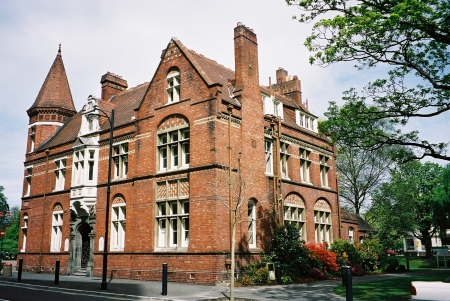
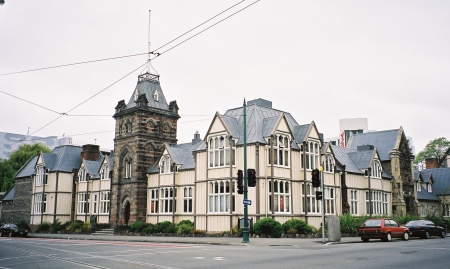
Sign up to hear more
Get the latest heritage news, features and events delivered
straight to your inbox.
