

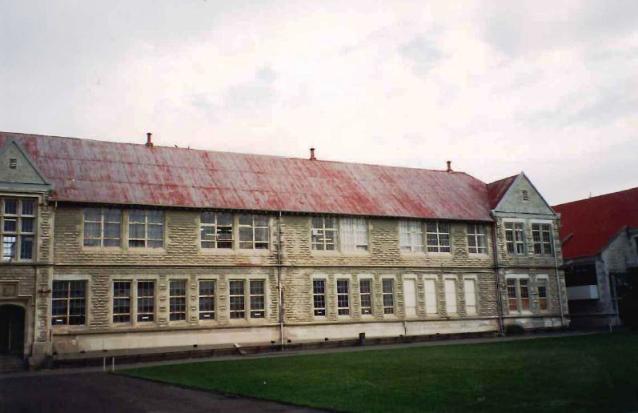
The Junior High School building was the first of two major building projects at the school in the 1920s. In the 1920s, the government was experimenting with reorganizing primary education, introducing an Intermediate/Junior High School system. Junior High Schools had already been set up in Canada, Britain and the United States, and it was hoped that these schools would prepare pupils for secondary school. In 1922, a separate Junior School at Kingsland in Auckland was among the first to open. Oamaru was chosen as an experiment of ‘attached’ junior schools – with Waitaki Girls’ High and Waitaki Boys’ High Junior Schools added to these schools’ existing departments (rather than functioning as independent schools as was the case in larger centres). The Junior High School was a two-storeyed stone building located on the south side of the quadrangle to the rear of the main buildings. Although due to open in February 1925, the Junior High School opening was delayed until April because of a polio epidemic. One hundred and sixty boys in four classes attended on opening day. The building itself was not completed until later in the year. In its final form, the building had two ‘very large class-rooms and a laboratory and store-room, while upstairs were four class-rooms and an apartment that in due course became a special library for the Junior High School.’ The Junior High School was extended in 1936. The Junior High School operated until 1962, when a purpose built intermediate school opened in Oamaru. After this time, the building was incorporated into Waitaki Boys’ High School. In 1996, a new auditorium was added to the former Junior High School
In 2015, the former Junior High School remains one of the significant buildings within historic Waitaki Boys’ High School.
List Entry Information
Status
Listed
List Entry Status
Historic Place Category 2
Access
Private/No Public Access
List Number
2308
Date Entered
2nd July 1982
Date of Effect
2nd July 1982
City/District Council
Waitaki District
Region
Otago Region
Extent of List Entry
The extent includes part of the land described as Pt Sec 15 Blk I Oamaru SD (RT OT237/140), Otago Land District and the building known as the Waitaki Boys Junior High School (Former) thereon. Refer to the extent map tabled at the Heritage New Zealand Board meeting on 30 April 2015.
Legal description
Pt Sec 15 Blk I Oamaru SD (RT OT237/140), Otago Land District
Status
Listed
List Entry Status
Historic Place Category 2
Access
Private/No Public Access
List Number
2308
Date Entered
2nd July 1982
Date of Effect
2nd July 1982
City/District Council
Waitaki District
Region
Otago Region
Extent of List Entry
The extent includes part of the land described as Pt Sec 15 Blk I Oamaru SD (RT OT237/140), Otago Land District and the building known as the Waitaki Boys Junior High School (Former) thereon. Refer to the extent map tabled at the Heritage New Zealand Board meeting on 30 April 2015.
Legal description
Pt Sec 15 Blk I Oamaru SD (RT OT237/140), Otago Land District
Construction Professional
Name
Forrester, John Meggett
Type
Architect
Biography
John Meggett Forrester (1866-1965) grew up in Oamaru where his father Thomas Forrester (1838-1907) was practising as an architect. Having been educated at Oamaru Grammar School, he entered the architectural profession and in 1890 took over his father's practice, Forrester and Lemon, following the death of John Lemon (1828-90). He was responsible for the Oamaru Opera House (1907), the Borough Council building, the World War I Memorial and the Waitaki Boys High School Hall of Memories, all in Oamaru. In 1919 he was joined in partnership by Ivan Steenson and he retired in 1931. Forrester was prominent in Oamaru public life. He was a Justice of the Peace for many years, an Oamaru Borough Councillor (1913-33) and Mayor of Oamaru (1931-33). When he died in 1965 he left a bequest for the establishment of an Art Gallery in North Otago. The Forrester Gallery was opened in 1983 in the former Bank of New South Wales building.
Construction Details
Start Year
1925
Type
Original Construction
Construction Professional
Name
Forrester, John Meggett
Type
Architect
Biography
John Meggett Forrester (1866-1965) grew up in Oamaru where his father Thomas Forrester (1838-1907) was practising as an architect. Having been educated at Oamaru Grammar School, he entered the architectural profession and in 1890 took over his father's practice, Forrester and Lemon, following the death of John Lemon (1828-90). He was responsible for the Oamaru Opera House (1907), the Borough Council building, the World War I Memorial and the Waitaki Boys High School Hall of Memories, all in Oamaru. In 1919 he was joined in partnership by Ivan Steenson and he retired in 1931. Forrester was prominent in Oamaru public life. He was a Justice of the Peace for many years, an Oamaru Borough Councillor (1913-33) and Mayor of Oamaru (1931-33). When he died in 1965 he left a bequest for the establishment of an Art Gallery in North Otago. The Forrester Gallery was opened in 1983 in the former Bank of New South Wales building.
Construction Details
Start Year
1925
Type
Original Construction
Historical and Associated Iwi / Hapū / Whānau
Completion Date
8th April 2015
Report Written By
Heather Bauchop
Information Sources
McCarthy, 2002
Conal McCarthy, Forrester and Lemon of Oamaru, architects, Oamaru, 2002
Tyrrell, 1983
A R Tyrrell, Strong to endure : Waitaki Boys’ High School, 1883-1983, Oamaru, 1983
R. S. Drew (ed)
R. S Drew (ed), A Haul of Memories Waitaki Boys’ High School 125th Anniversary, Waitaki Boys’ High School Old Boys’ Association, Oamaru, 2008
McDonald, 1958
K.C. McDonald, A History of Waitaki Boys’ High School 1883-1958, Whitcombe and Tombs Limited, Christchurch, 1958
Other Information
This place was identified as significant under previous legislation with different information requirements. It remains significant under the current legislation. There is opportunity under our legislation and policies to add to this information. Further information about this place may be available from the Otago/Southland Office of Heritage New Zealand Pouhere Taonga. Please note that entry on the New Zealand Heritage List/Rarangi Korero identifies only the heritage values of the property concerned, and should not be construed as advice on the state of the property, or as a comment of its soundness or safety, including in regard to earthquake risk, safety in the event of fire, or insanitary conditions. A fully referenced upgrade report is available on request from the Otago/Southland Office of Heritage New Zealand
Historical and Associated Iwi / Hapū / Whānau
Completion Date
8th April 2015
Report Written By
Heather Bauchop
Information Sources
McCarthy, 2002
Conal McCarthy, Forrester and Lemon of Oamaru, architects, Oamaru, 2002
Tyrrell, 1983
A R Tyrrell, Strong to endure : Waitaki Boys’ High School, 1883-1983, Oamaru, 1983
R. S. Drew (ed)
R. S Drew (ed), A Haul of Memories Waitaki Boys’ High School 125th Anniversary, Waitaki Boys’ High School Old Boys’ Association, Oamaru, 2008
McDonald, 1958
K.C. McDonald, A History of Waitaki Boys’ High School 1883-1958, Whitcombe and Tombs Limited, Christchurch, 1958
Other Information
This place was identified as significant under previous legislation with different information requirements. It remains significant under the current legislation. There is opportunity under our legislation and policies to add to this information. Further information about this place may be available from the Otago/Southland Office of Heritage New Zealand Pouhere Taonga. Please note that entry on the New Zealand Heritage List/Rarangi Korero identifies only the heritage values of the property concerned, and should not be construed as advice on the state of the property, or as a comment of its soundness or safety, including in regard to earthquake risk, safety in the event of fire, or insanitary conditions. A fully referenced upgrade report is available on request from the Otago/Southland Office of Heritage New Zealand
Current Usages
Uses: Education
Specific Usage: School
Current Usages
Uses: Education
Specific Usage: School
Location
Related listings
Sign up to hear more
Get the latest heritage news, features and events delivered
straight to your inbox.
