DonateMembershipVisit Heritage
  • Tūrangawaewae
    Places
  • Tira Māori
    Māori Heritage
  • Poutairangahia
    Archaeology
  • Rauemi
    Resources
  • Mō Tātou
    About Us
  • New Zealand Heritage List
  • Nominate and submit
  • Explore the List
  • National Historic Landmarks
  • Plaques
  • Rainbow List Project
  • Lost heritage
  • Visit Heritage
  • Our properties
  • Turnbull House Project
  • Collections
  • Shop
  • Tohu Whenua
  • Tira Māori
  • Conserving Māori heritage
  • Marae built heritage
  • Māori heritage on the List
  • Hinemihi—Te Hokinga Mai
  • What is archaeology?
  • Is there a site on my property?
  • What are my legal requirements?
  • Affecting an archaeological site
  • Declaring an archaeological site
  • Archaeology FAQs
  • Archaeology Digital Library
  • Archaeology guidelines and templates
  • Resources
  • Funding
  • Publications
  • Sustainable management guides
  • Disaster recovery
  • Podcasts & digital resources
  • Education Hub
  • Conservation plans
  • About
  • Board
  • Māori Heritage Council
  • Senior Staff
  • Offices
  • Contact us
  • Careers
  • Covenants
  • Fast-track
  • Corporate documents
  • Currently consulting on
  • Our submissions
  • News
  • Covid-19 response
Quick links
Rārangi Kōrero | The List
Explore the List
National Historic Landmarks
Ngā Manawhenua o Aotearoa me ōna Kōrero Tūturu
Quick links
Tapuwae
A Vision for Places of Māori Heritage
Funding for Māori Heritage
Resources
Quick links
Archaeological Authority Portal
Applying for an archaeological authority
Archaeology FAQs
Browse the most frequently asked questions about archaeological authorities and the archaeological process.
Quick links
Quick links
News
News Keep up to date with Heritage New Zealand Pouhere Taonga
Membership
Membership Find out more and sign up today
DonateMembershipVisit Heritage
  • Tūrangawaewae
    Places
  • Tira Māori
    Māori Heritage
  • Poutairangahia
    Archaeology
  • Rauemi
    Resources
  • Mō Tātou
    About Us
  • New Zealand Heritage List
  • Nominate and submit
  • Explore the List
  • National Historic Landmarks
  • Plaques
  • Rainbow List Project
  • Lost heritage
  • Visit Heritage
  • Our properties
  • Turnbull House Project
  • Collections
  • Shop
  • Tohu Whenua
  • Tira Māori
  • Conserving Māori heritage
  • Marae built heritage
  • Māori heritage on the List
  • Hinemihi—Te Hokinga Mai
  • What is archaeology?
  • Is there a site on my property?
  • What are my legal requirements?
  • Affecting an archaeological site
  • Declaring an archaeological site
  • Archaeology FAQs
  • Archaeology Digital Library
  • Archaeology guidelines and templates
  • Resources
  • Funding
  • Publications
  • Sustainable management guides
  • Disaster recovery
  • Podcasts & digital resources
  • Education Hub
  • Conservation plans
  • About
  • Board
  • Māori Heritage Council
  • Senior Staff
  • Offices
  • Contact us
  • Careers
  • Covenants
  • Fast-track
  • Corporate documents
  • Currently consulting on
  • Our submissions
  • News
  • Covid-19 response
Quick links
Rārangi Kōrero | The List
Explore the List
National Historic Landmarks
Ngā Manawhenua o Aotearoa me ōna Kōrero Tūturu
Quick links
Tapuwae
A Vision for Places of Māori Heritage
Funding for Māori Heritage
Resources
Quick links
Archaeological Authority Portal
Applying for an archaeological authority
Archaeology FAQs
Browse the most frequently asked questions about archaeological authorities and the archaeological process.
Quick links
Quick links
News
News Keep up to date with Heritage New Zealand Pouhere Taonga
Membership
Membership Find out more and sign up today
  • Places
  • Nominate and submit
  • National Historic Landmarks
  • Places
  • Nominate and submit
  • National Historic Landmarks
  • Tira Māori
  • Conserving Māori heritage
  • Marae built heritage
  • Tira Māori
  • Conserving Māori heritage
  • Marae built heritage
  • Archaeological authorities
  • Archaeology Digital Library
  • Archaeological authorities
  • Archaeology Digital Library
  • All resources
  • Publications
  • Funding
  • All resources
  • Publications
  • Funding
  • FAQs
  • FAQs
Follow us on:
Places
  • Places
  • Nominate and submit
  • National Historic Landmarks
Tira Māori
  • Tira Māori
  • Conserving Māori heritage
  • Marae built heritage
Archaeology
  • Archaeological authorities
  • Archaeology Digital Library
Resources
  • All resources
  • Publications
  • Funding
FAQs
  • FAQs
Follow us on
HomePrivacyTerms and conditionsAbout this site
© Heritage New Zealand Pouhere Taonga 2026.
 
Masonic Hall (Former)

64 Forth Street and 20 Nith Street, INVERCARGILL

Public

Historic Place Category 2

List No. 2457

Quick links:
List GalleryLocationDetails
Designed by architect Frederick Burwell and opened in 1882, this was the third Masonic Lodge built in Invercargill. The building has historic, architectural and cultural significance.

The Southern Cross Lodge No. 9 was established in 1863, following meetings where Masons from different constitutions met to discuss forming a lodge. This building was the third lodge built in Invercargill, the first being taken over by the Southland Provincial Council in 1866. The lodge continued to meet at the hall, sharing the meeting space with the new owners. As the lodge recovered from the slump of the mid-1860s and numbers began to increase again, they offered to buy back the building but the Provincial Government declined. The lodge built a small timber hall in Nith Street in 1876, which served as a meeting place until the larger Masonic hall, again on Nith Street, was opened in 1882. The Southern Cross and St John’s Lodges built the hall to provide joint premises.

In April 1882, the ceremony to hand over the hall to the brethren of the Masonic Order took place. A long article in the Southland Times detailed the event and described the hall as ‘chastely finished within and without’ and a ‘decided acquisition to the architectural amenities of the town.’ Both the architect and builders were Masons themselves. Burwell’s ‘severe treatment’ of the exterior concealed the ornate interior. The Forth street elevation was ‘relieved by columns and a massive pediment’ bearing the Masonic symbols. The entrance hall extended the width of the building, adjoining which was the ante room, and adjoining that ‘another apartment for probationers’ – both rooms giving access to the hall.

The hall merited a detailed description: ‘On slightly raised platforms along the side walls are placed continuous seats, elegantly upholstered in crimson plush, and of most inviting appearance. In the “East” or Master’s end a dais has been erected, approached by semi-circular steps and provided with the usual Master’s chair and pedestal. The Corinthian, Ionic, and Doric columns forming part of the symbols of the Order terminate in shafts formed as candles. These are provided with gas jets; the effect being novel. The usual seats for officials are incorporated with the other seating; being divided therefrom by massive arms. Round the hall and supported by elegant foliated columns is a handsome entablature supported by trusses. This again over the master’s dais is further enriched by a pediment supported by Corinthian columns. Over this again the roof curves inward, to panels extending across the hall. Light is obtained from a lantern which forms the external finial of a nicely proportioned interior dome, the whole rising 35 feet from the floor. The centre of the floor is laid in an intricate black-and-white pattern with Minton tiles, specially designed by a London firm, and which afford food for curiosity for the uninitiated. Artificial light is obtained from one brilliant gas star occupying the centre of the dome. Two large ventilators, relieved by Masonic emblems occupy the remaining roof panels.’ Open fireplaces provided the heating. To the rear of the hall were the Master’s room, and attached strong-room. Adjoining the Master’s room was an organ and choir-room. The articles emphasised the use of permanent materials – bricks, concrete, plaster and imported slates, and native timbers.

In 1912, additions were made to the rear of the building. The building remained the Masonic Hall until an even grander hall was built on Forth Street in 1926 (List No. 390, Category 1). The lodge transferred the title to The Orange Hall Company Limited in 1924. The Orange Hall Company sold off the rear of the section at this time. The Orange Hall was associated with the Orange Order, a Protestant fraternity with its origins in England and Ireland, established in New Zealand in 1843, and in the South Island in 1870. In later years, the hall housed manufacturing premises, the Southland Country Music Association, and was used as a hall. In 2018, the hall is the premises of E-scape Glass.
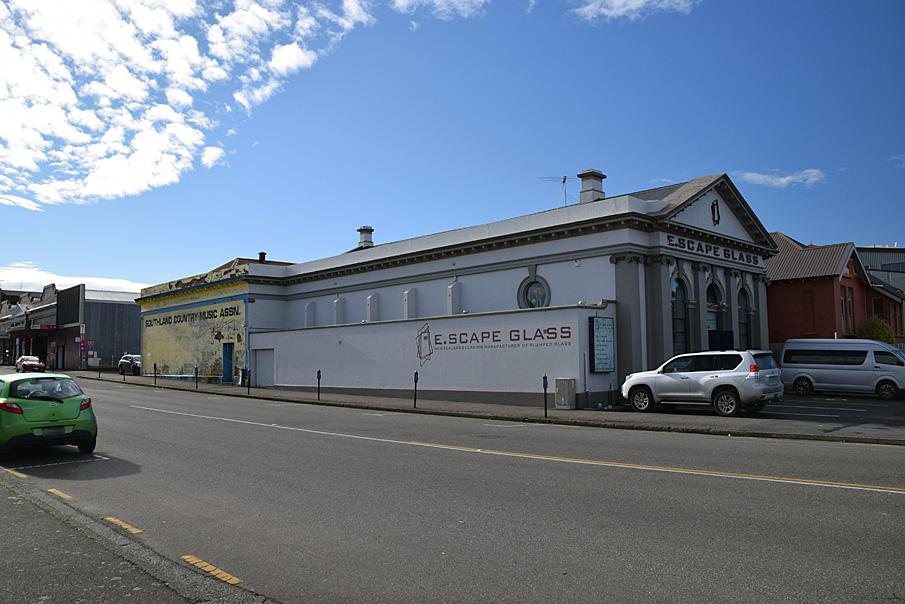
Masonic Hall (Former), Invercargill. Image courtesy of Robin Miller | 26/07/2016 | Robin Miller

List Entry Information

Overview

Status
Listed

List Entry Status
Historic Place Category 2

Access
Able to Visit

List Number
2457

Date Entered
24th November 1983

Date of Effect
24th November 1983

City/District Council
Invercargill City

Region
Southland Region

Extent of List Entry

Extent includes the land described as Lot 1 DP 3807 (RT 468724) and Lots 2-3 DP 3807 (RT SL8D/515), Southland Land District, and the building known as Masonic Hall (Former) thereon.

Legal description

Lot 1 DP 3807 (RT 468724) and Lots 2-3 DP 3807 (RT SL8D/515), Southland Land District

Detailed List Entry

Construction Professional

Name

Burwell, F. W.

Type

Architect

Biography

F.W. Burwell (1846-1915) is noted for designing many buildings in Invercargill, transforming the centre of the town between 1874 and the mid-1880s. Born in Scotland, Burwell served his articles with the architect John Matthews and immigrated to New Zealand in the late 1860s. By 1873, he had established his practice in Queenstown. He moved to Invercargill the following year. Once established there, he began designing elegant two and three-storey buildings in the Renaissance style. He designed almost all the buildings in Dee Street, including the hospital. 'The Crescent' was another notable Invercargill streetscape created by Burwell. In recognition of his work, he was elected a Fellow of the Royal Institute of British Architects in 1880. The depression in the 1880s saw his commissions decline and he moved to Australia in 1887 where he practised in Melbourne, Perth and then Fremantle. He was particularly successful in the last, as Western Australia was in the middle of a building boom, and a number of his commercial buildings in central Fremantle are now classified by the Australian Heritage Commission. Burwell returned to Melbourne in 1910, and died there five years later. (Jonathan Mane-Wheoki, 'Burwell, Frederick William (1846-1915)' in Jane Thomson (ed.), Southern People: a dictionary of Otago Southland biography, Dunedin, 1998, p. 74.)

Name

W. and A. Little

Type

Builder

Biography

William and Adam Little, trading as Messrs Little Brothers, worked in Invercargill in the 1870s and early 1880s. Their work included the Anglican parsonage on Tay Street, Invercargill (1876), the erection of offices for Martin, Maitland and Co. in Esk Street (1877), offices shops and a grain store for McArdell and Co (1880). Their partnership was dissolved in October 1882. Adam Little carried on the business on his own account, working on some large projects including warehousing for Cleave and Ross on Dee Street (1884), the construction of fever wards at Invercargill hospital (1885), a grain store for Dalgety and Company in Gore (1900) and the erection of buildings at the Mataura Freezing Works (1906). Adam Little died in 1921.

Construction Details

Start Year

1881

Finish Year

1882

Type

Original Construction

Construction Materials

Plaster over brick, corrugated iron roof

Reference

Completion Date

22nd January 2018

Report Written By

Heather Bauchop

Information Sources

New Zealand Freemason

NZ Freemason magazine, Issue 2 June 2014

Report Written By

This place was identified as significant under previous legislation with different information requirements. It remains significant under the current legislation. There is opportunity under our legislation and policies to add to this information. Further information about this place may be available from the Otago/Southland Office of Heritage New Zealand Pouhere Taonga. Please note that entry on the New Zealand Heritage List/Rarangi Korero identifies only the heritage values of the property concerned, and should not be construed as advice on the state of the property, or as a comment of its soundness or safety, including in regard to earthquake risk, safety in the event of fire, or insanitary conditions. A fully referenced upgrade report is available on request from the Otago/Southland Area Office of Heritage New Zealand

Further Information

Current Usages

Uses: Trade

Specific Usage: Shop

Former Usages

General Usage:: Civic Facilities

Specific Usage: Hall, Community

General Usage:: Civic Facilities

Specific Usage: Masonic Lodge

Themes

Web Links

Overview

Status

Listed

List Entry Status

Historic Place Category 2

Access

Able to Visit

List Number

2457

Date Entered

24th November 1983

Date of Effect

24th November 1983

City/District Council

Invercargill City

Region

Southland Region

Extent of List Entry

Extent includes the land described as Lot 1 DP 3807 (RT 468724) and Lots 2-3 DP 3807 (RT SL8D/515), Southland Land District, and the building known as Masonic Hall (Former) thereon.

Legal description

Lot 1 DP 3807 (RT 468724) and Lots 2-3 DP 3807 (RT SL8D/515), Southland Land District

Status

Listed

List Entry Status

Historic Place Category 2

Access

Able to Visit

List Number

2457

Date Entered

24th November 1983

Date of Effect

24th November 1983

City/District Council

Invercargill City

Region

Southland Region

Extent of List Entry

Extent includes the land described as Lot 1 DP 3807 (RT 468724) and Lots 2-3 DP 3807 (RT SL8D/515), Southland Land District, and the building known as Masonic Hall (Former) thereon.

Legal description

Lot 1 DP 3807 (RT 468724) and Lots 2-3 DP 3807 (RT SL8D/515), Southland Land District

Construction Information

Construction Professional

Name

Burwell, F. W.

Type

Architect

Biography

F.W. Burwell (1846-1915) is noted for designing many buildings in Invercargill, transforming the centre of the town between 1874 and the mid-1880s. Born in Scotland, Burwell served his articles with the architect John Matthews and immigrated to New Zealand in the late 1860s. By 1873, he had established his practice in Queenstown. He moved to Invercargill the following year. Once established there, he began designing elegant two and three-storey buildings in the Renaissance style. He designed almost all the buildings in Dee Street, including the hospital. 'The Crescent' was another notable Invercargill streetscape created by Burwell. In recognition of his work, he was elected a Fellow of the Royal Institute of British Architects in 1880. The depression in the 1880s saw his commissions decline and he moved to Australia in 1887 where he practised in Melbourne, Perth and then Fremantle. He was particularly successful in the last, as Western Australia was in the middle of a building boom, and a number of his commercial buildings in central Fremantle are now classified by the Australian Heritage Commission. Burwell returned to Melbourne in 1910, and died there five years later. (Jonathan Mane-Wheoki, 'Burwell, Frederick William (1846-1915)' in Jane Thomson (ed.), Southern People: a dictionary of Otago Southland biography, Dunedin, 1998, p. 74.)

Name

W. and A. Little

Type

Builder

Biography

William and Adam Little, trading as Messrs Little Brothers, worked in Invercargill in the 1870s and early 1880s. Their work included the Anglican parsonage on Tay Street, Invercargill (1876), the erection of offices for Martin, Maitland and Co. in Esk Street (1877), offices shops and a grain store for McArdell and Co (1880). Their partnership was dissolved in October 1882. Adam Little carried on the business on his own account, working on some large projects including warehousing for Cleave and Ross on Dee Street (1884), the construction of fever wards at Invercargill hospital (1885), a grain store for Dalgety and Company in Gore (1900) and the erection of buildings at the Mataura Freezing Works (1906). Adam Little died in 1921.

Construction Details

Start Year

1881

Finish Year

1882

Type

Original Construction

Construction Materials

Plaster over brick, corrugated iron roof

Construction Professional

Name

Burwell, F. W.

Type

Architect

Biography

F.W. Burwell (1846-1915) is noted for designing many buildings in Invercargill, transforming the centre of the town between 1874 and the mid-1880s. Born in Scotland, Burwell served his articles with the architect John Matthews and immigrated to New Zealand in the late 1860s. By 1873, he had established his practice in Queenstown. He moved to Invercargill the following year. Once established there, he began designing elegant two and three-storey buildings in the Renaissance style. He designed almost all the buildings in Dee Street, including the hospital. 'The Crescent' was another notable Invercargill streetscape created by Burwell. In recognition of his work, he was elected a Fellow of the Royal Institute of British Architects in 1880. The depression in the 1880s saw his commissions decline and he moved to Australia in 1887 where he practised in Melbourne, Perth and then Fremantle. He was particularly successful in the last, as Western Australia was in the middle of a building boom, and a number of his commercial buildings in central Fremantle are now classified by the Australian Heritage Commission. Burwell returned to Melbourne in 1910, and died there five years later. (Jonathan Mane-Wheoki, 'Burwell, Frederick William (1846-1915)' in Jane Thomson (ed.), Southern People: a dictionary of Otago Southland biography, Dunedin, 1998, p. 74.)

Name

W. and A. Little

Type

Builder

Biography

William and Adam Little, trading as Messrs Little Brothers, worked in Invercargill in the 1870s and early 1880s. Their work included the Anglican parsonage on Tay Street, Invercargill (1876), the erection of offices for Martin, Maitland and Co. in Esk Street (1877), offices shops and a grain store for McArdell and Co (1880). Their partnership was dissolved in October 1882. Adam Little carried on the business on his own account, working on some large projects including warehousing for Cleave and Ross on Dee Street (1884), the construction of fever wards at Invercargill hospital (1885), a grain store for Dalgety and Company in Gore (1900) and the erection of buildings at the Mataura Freezing Works (1906). Adam Little died in 1921.

Construction Details

Start Year

1881

Finish Year

1882

Type

Original Construction

Construction Materials

Plaster over brick, corrugated iron roof

Reference

Historical and Associated Iwi / Hapū / Whānau

Completion Date

22nd January 2018

Report Written By

Heather Bauchop

Information Sources

New Zealand Freemason

NZ Freemason magazine, Issue 2 June 2014

Other Information

This place was identified as significant under previous legislation with different information requirements. It remains significant under the current legislation. There is opportunity under our legislation and policies to add to this information. Further information about this place may be available from the Otago/Southland Office of Heritage New Zealand Pouhere Taonga. Please note that entry on the New Zealand Heritage List/Rarangi Korero identifies only the heritage values of the property concerned, and should not be construed as advice on the state of the property, or as a comment of its soundness or safety, including in regard to earthquake risk, safety in the event of fire, or insanitary conditions. A fully referenced upgrade report is available on request from the Otago/Southland Area Office of Heritage New Zealand

Historical and Associated Iwi / Hapū / Whānau

Completion Date

22nd January 2018

Report Written By

Heather Bauchop

Information Sources

New Zealand Freemason

NZ Freemason magazine, Issue 2 June 2014

Other Information

This place was identified as significant under previous legislation with different information requirements. It remains significant under the current legislation. There is opportunity under our legislation and policies to add to this information. Further information about this place may be available from the Otago/Southland Office of Heritage New Zealand Pouhere Taonga. Please note that entry on the New Zealand Heritage List/Rarangi Korero identifies only the heritage values of the property concerned, and should not be construed as advice on the state of the property, or as a comment of its soundness or safety, including in regard to earthquake risk, safety in the event of fire, or insanitary conditions. A fully referenced upgrade report is available on request from the Otago/Southland Area Office of Heritage New Zealand

Further Information

Current Usages

Uses: Trade

Specific Usage: Shop

Former Usages

General Usage: Civic Facilities

Specific Usage: Hall, Community

General Usage: Civic Facilities

Specific Usage: Masonic Lodge

Current Usages

Uses: Trade

Specific Usage: Shop

Former Usages

General Usage: Civic Facilities

Specific Usage: Hall, Community

General Usage: Civic Facilities

Specific Usage: Masonic Lodge

Location

Loading
Related listings
Masonic Hall (Former), Invercargill. CC BY Licence
Masonic Hall (Former)
Masonic Hall (Former), Invercargill
Masonic Hall (Former)
Masonic Hall (Former), Invercargill
Masonic Hall (Former)
Masonic Hall (Former), Invercargill. CC BY Licence
Masonic Hall (Former)
Stay up to date with Heritage this month