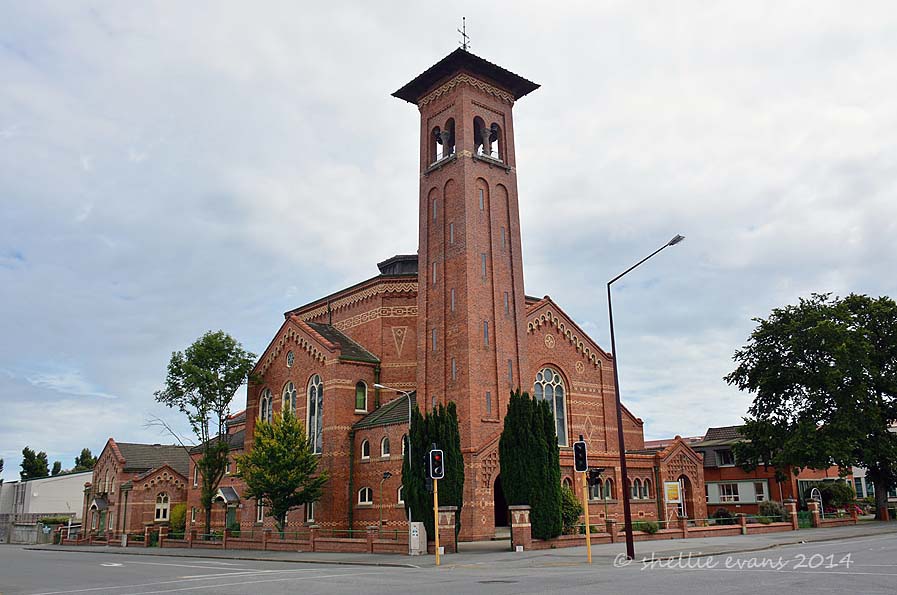
Invercargill’s first Presbyterian service was held in 1856, with the first minister, Reverend A.H. Stobo was inducted on 29 June 1860. The first First Presbyterian Church was opened on 15 March 1863. When it opened, the timber church was the town’s largest building. Stobo lived in a four-roomed cottage opposite the church. From there he moved to a house behind the church, and later another manse next to the church. A building fund was established in 1889 to fund a new church. The Jubilee celebrations in 1910 provided impetus for the building project, and in 1908, on the site of the first building was laid the foundation stone for the new church and associated Sunday School. Once the church debts had been reduced to a manageable level, attention turned to providing a new manse. The existing manse was sold for removal, and in 1929 a site on Tay Street was purchased.
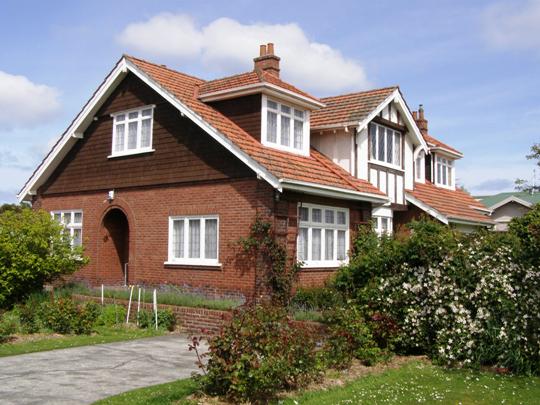
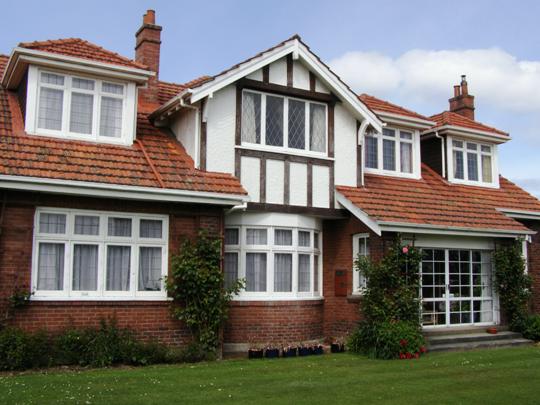
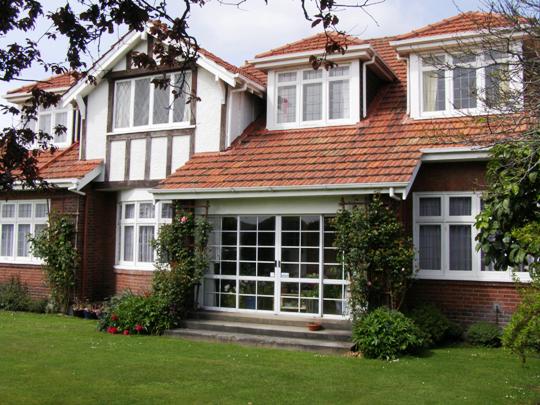
Invercargill Architect Allan C Ford designed the brick and tile manse in an English country style with Tudor decorative elements. The contractor was Olloff Johnston. The manse is a two-storey residence, the lower floor brick, and the upper floor clad in shingles. The manse has a Marseille tile roof. There are two dormer windows on the first floor flanking a projecting gable that extends through both floors. The casement windows have leadlights, and many have toplights. The manse is set on generous grounds, the mature garden adding to its sense of status. In 2018, the house remains the First Church Manse.
List Entry Information
Status
Listed
List Entry Status
Historic Place Category 2
Access
Private/No Public Access
List Number
2462
Date Entered
24th November 1983
Date of Effect
24th November 1983
City/District Council
Invercargill City
Region
Southland Region
Extent of List Entry
Extent includes the land described as Sec 7 Blk LII Town of Invercargill (RT 348211) and Sec 8 Blk LII Town of Invercargill (RT SL125/84), Southland Land District, and the First Church Manse thereon.
Legal description
Sec 7 Blk LII Town of Invercargill (RT 348211) and Sec 8 Blk LII Town of Invercargill (RT SL125/84), Southland Land District
Status
Listed
List Entry Status
Historic Place Category 2
Access
Private/No Public Access
List Number
2462
Date Entered
24th November 1983
Date of Effect
24th November 1983
City/District Council
Invercargill City
Region
Southland Region
Extent of List Entry
Extent includes the land described as Sec 7 Blk LII Town of Invercargill (RT 348211) and Sec 8 Blk LII Town of Invercargill (RT SL125/84), Southland Land District, and the First Church Manse thereon.
Legal description
Sec 7 Blk LII Town of Invercargill (RT 348211) and Sec 8 Blk LII Town of Invercargill (RT SL125/84), Southland Land District
Construction Professional
Name
Ford, A C
Type
Architect
Biography
Allan Ford was born in Dunedin in 1892, and educated at Otago Boy’s High School. He established his Invercargill office in 1920 and was active in Invercargill for fifty years. He died in 1989 at age 97.
Name
O E Johnston
Type
Builder
Biography
Olloff Edward Johnston (1875-1960) was a Southland builder and contractor. After a six year apprenticeship, and then some years as a journeyman, in 1902 he started his business as a carpenter and joiner, and later, as a builder. One of the large buildings he erected as Mr Cawthrone’s (he married Cawthorne’s daughter in 1899) fellmongery at West Plains, and the First Presbyterian Church Manse (1930). He died in Dunedin in 1960.
Construction Details
Start Year
1929
Type
Designed
Start Year
1930
Type
Original Construction
Construction Professional
Name
Ford, A C
Type
Architect
Biography
Allan Ford was born in Dunedin in 1892, and educated at Otago Boy’s High School. He established his Invercargill office in 1920 and was active in Invercargill for fifty years. He died in 1989 at age 97.
Name
O E Johnston
Type
Builder
Biography
Olloff Edward Johnston (1875-1960) was a Southland builder and contractor. After a six year apprenticeship, and then some years as a journeyman, in 1902 he started his business as a carpenter and joiner, and later, as a builder. One of the large buildings he erected as Mr Cawthrone’s (he married Cawthorne’s daughter in 1899) fellmongery at West Plains, and the First Presbyterian Church Manse (1930). He died in Dunedin in 1960.
Construction Details
Start Year
1929
Type
Designed
Start Year
1930
Type
Original Construction
Historical and Associated Iwi / Hapū / Whānau
Completion Date
9th May 2018
Report Written By
Heather Bauchop
Information Sources
Deaker, 1960
A.J. Deaker, Centenary of First Church: The Story of First Presbyterian Church, Invercargill, New Zealand, Invercargill, 1960
First Church Website
http://www.firstchurch.org.nz/
Other Information
This place was identified as significant under previous legislation with different information requirements. It remains significant under the current legislation. There is opportunity under our legislation and policies to add to this information. Further information about this place may be available from the Otago/Southland Office of Heritage New Zealand Pouhere Taonga. Please note that entry on the New Zealand Heritage List/Rarangi Korero identifies only the heritage values of the property concerned, and should not be construed as advice on the state of the property, or as a comment of its soundness or safety, including in regard to earthquake risk, safety in the event of fire, or insanitary conditions. A fully referenced upgrade report is available on request from the Otago/Southland Office of Heritage New Zealand
Historical and Associated Iwi / Hapū / Whānau
Completion Date
9th May 2018
Report Written By
Heather Bauchop
Information Sources
Deaker, 1960
A.J. Deaker, Centenary of First Church: The Story of First Presbyterian Church, Invercargill, New Zealand, Invercargill, 1960
First Church Website
http://www.firstchurch.org.nz/
Other Information
This place was identified as significant under previous legislation with different information requirements. It remains significant under the current legislation. There is opportunity under our legislation and policies to add to this information. Further information about this place may be available from the Otago/Southland Office of Heritage New Zealand Pouhere Taonga. Please note that entry on the New Zealand Heritage List/Rarangi Korero identifies only the heritage values of the property concerned, and should not be construed as advice on the state of the property, or as a comment of its soundness or safety, including in regard to earthquake risk, safety in the event of fire, or insanitary conditions. A fully referenced upgrade report is available on request from the Otago/Southland Office of Heritage New Zealand
Current Usages
Uses: Accommodation
Specific Usage: House
Former Usages
General Usage: Accommodation
Specific Usage: House
General Usage: Religion
Specific Usage: Vicarage/Manse/Presbytery/Rectory
Current Usages
Uses: Accommodation
Specific Usage: House
Former Usages
General Usage: Accommodation
Specific Usage: House
General Usage: Religion
Specific Usage: Vicarage/Manse/Presbytery/Rectory