Invercargill’s first Presbyterian service was held in 1856, with the first minister, Reverend A.H. Stobo, inducted on 29 June 1860. The first First Presbyterian Church was opened on 15 March 1863. The timber church was the town’s largest building when it was opened. Stobo lived in a four-roomed cottage opposite the church. From there he moved to a house behind the church, and later another manse next to the church. A building fund was established in 1889 to fund a new church. The Jubilee celebrations in 1910 provided impetus for the building project, and in 1908, on the site of the first building was laid the foundation stone for the new church and associated Sunday School. Architect (and old Invercargill boy, son of the Deacon of the church, who had returned from overseas study) John Mair invited tenders In January 1911, and having failed to attract an acceptable tender, re-advertised in November 1911.
It was not until 14 months later that the building contract was let to the firm of McKinnon and Hamilton with their tender of £13,883. The old church was sold for removal, and the contractors proceeded with the Sunday School – known as Stobo Hall – which when complete, was used as a temporary church. The Deacon’s Court subsequently accepted a higher contract price with the decision to proceed with a domed roof. The church was officially opened on 10 February 1915. The congregation donated interior fittings including a baptismal font, communion chairs and bells.
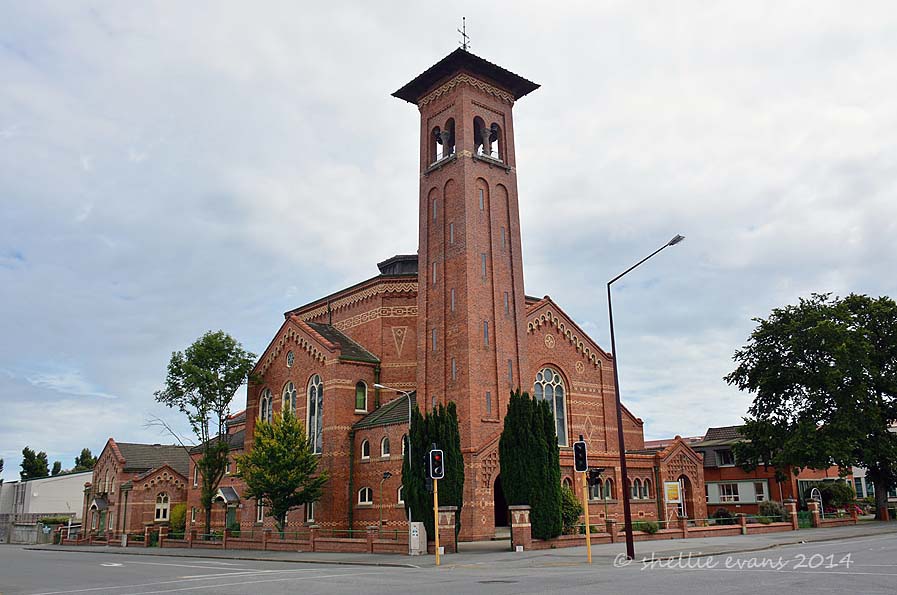
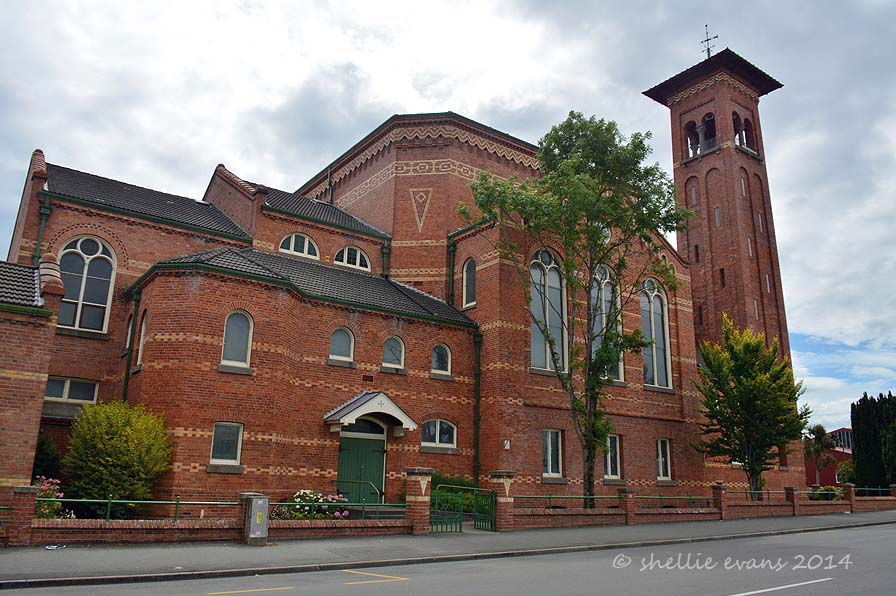
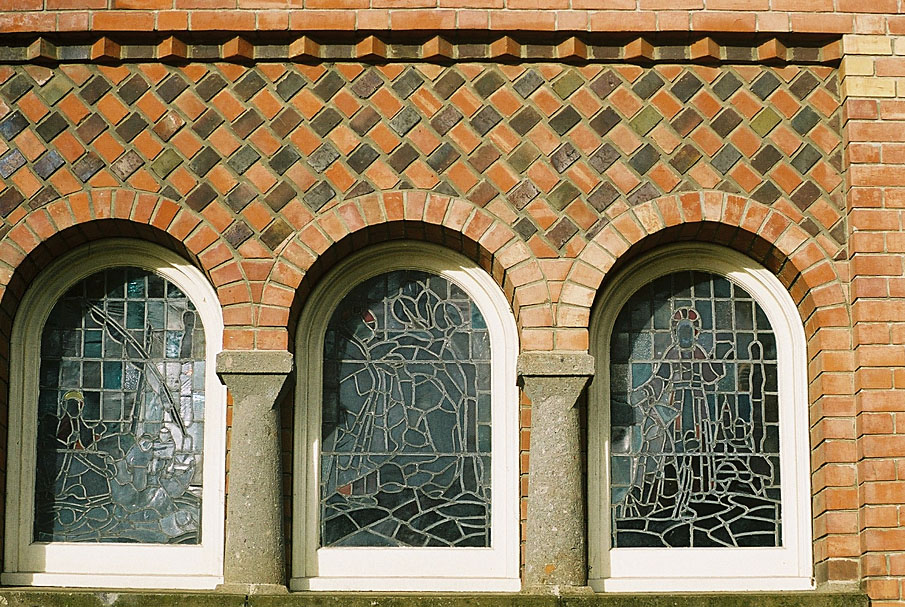
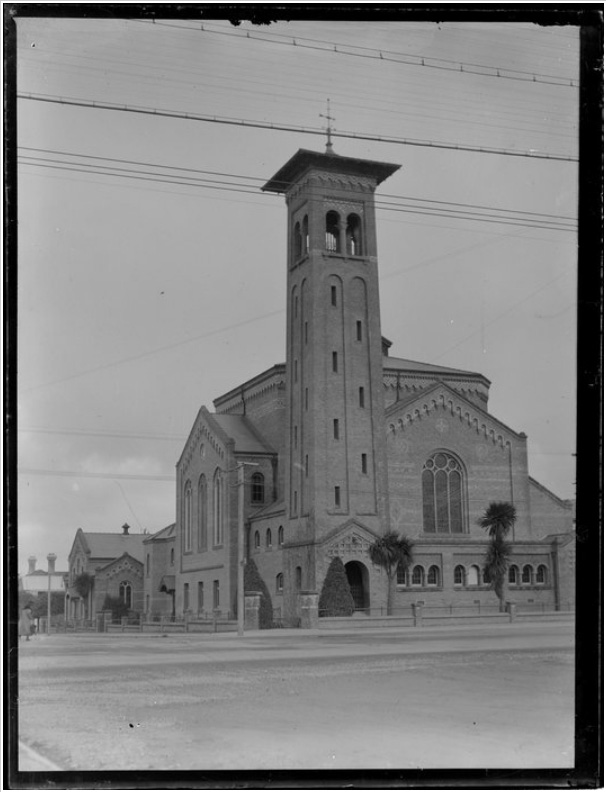
The First Presbyterian Church in Invercargill was Mair’s first major work after commencing practice in Wellington in 1910. Architectural historian Peter Shaw writes ‘First Church, the cornerstone of Mair's reputation as an architect.’ Its ’unusual design’ was received with some scepticism – it had a ‘polygonal plan and unusual positioning of choir, gallery and organ behind the pulpit were wholly unexpected. Its eclectic mixture of Romanesque and Byzantine elements was resisted by members of a Southland congregation unfamiliar with architectural fashion in cities like Boston or Philadelphia. The exterior's intricate decorative brickwork, garish to many contemporary eyes, was in fact a clever practical solution to the unavailability of other building materials.’ The First Presbyterian Church has seen many changes – the interior, including the altar has been altered and remodelled to suit changing worship practices – the first being in the mid-1950s. Its distinctive appearance makes the Church an Invercargill landmark.
List Entry Information
Status
Listed
List Entry Status
Historic Place Category 1
Access
Private/No Public Access
List Number
387
Date Entered
22nd November 1984
Date of Effect
22nd November 1984
City/District Council
Invercargill City
Region
Southland Region
Extent of List Entry
Extent includes part of the land described as Sec 12, and Secs 13-14 Blk XIII Town of Invercargill (RT SL125/107), Southland Land District, and First Presbyterian Church and Stobo Hall thereon. Refer to the extent map tabled at the Rārangi Kōrero Committee meeting on 31 May 2018.
Legal description
Secs 12-14 Blk XIII Town of Invercargill (RT SL125/107), Southland Land District
Status
Listed
List Entry Status
Historic Place Category 1
Access
Private/No Public Access
List Number
387
Date Entered
22nd November 1984
Date of Effect
22nd November 1984
City/District Council
Invercargill City
Region
Southland Region
Extent of List Entry
Extent includes part of the land described as Sec 12, and Secs 13-14 Blk XIII Town of Invercargill (RT SL125/107), Southland Land District, and First Presbyterian Church and Stobo Hall thereon. Refer to the extent map tabled at the Rārangi Kōrero Committee meeting on 31 May 2018.
Legal description
Secs 12-14 Blk XIII Town of Invercargill (RT SL125/107), Southland Land District
Construction Professional
Name
Mair, John Thomas
Type
Architect
Biography
John Thomas Mair (1876-1959) was born in Invercargill and began his career with the New Zealand Railways on the staff of the Office Engineer, George Troup. In 1906 he travelled to the United States of America where he studied architecture at the University of Pennsylvania. He then worked in the office of George B. Post in New York before travelling to England where he was admitted as an Associate of the Royal Institute of British Architects. He became a Fellow in 1940. On his return to New Zealand he entered private practice, one of his first buildings being the Presbyterian First Church, Invercargill (1915), a prominent building of Romanesque character. He then practised in Wellington, carrying out largely domestic commissions. In 1918 he was appointed Inspector of Military Hospitals by the Defence Department, and in 1920 he became architect to the Department of Education. Following the retirement of John Campbell in 1922, Mair was appointed Government Architect, a position which he held until his retirement in 1942. During this period he was responsible for a variety of buildings, including the Courthouse, Hamilton, the Post Office in High Street, Christchurch, Government Life Office and the Departmental Building, both in Wellington, and the Jean Batten Building, Auckland. Such buildings show a departure from tradition, with the emphasis on function, structure and volume as opposed to a stylistic treatment of the building fabric. A Fellow of the New Zealand Institute of Architects, Mair was made a Life Member in 1942. His son John Lindsay Mair also practised as an architect.
Name
Ford Gray & Derbie
Type
Builder
Biography
Ford Gray & Derbie was an Invercargill based architectural practice active around the 1950s. The practice was involved in extensions and additions to All Saints Church and its hall, as well as the Invercargill Club. (NZHPT Registration Report, All Saints Anglican Church and Parish Hall, 16 May 2011).
Name
Sefton, Arthur
Type
Builder
Biography
Arthur Sefton was a bricklayer whose major commission was the First Presbyterian Church of Invercargill. Sefton arrived in New Zealand from Britain in 1909 and settled in Invercargill. He also built the Catholic Convent in Tyne Street, a number of dairy factories, the Nurses' Home and the police station, all in and around Invercargill.
Name
McKinnon and Hamilton
Type
Builder
Biography
John Alexander McKinnon (d. 1937) and John Leitch Hamilton (d. 1927) were Dunedin contractors active in the early and mid-twentieth century. Their major projects include Invercargill’s First Presbyterian Church (1910-1915) and People’s Picture Palace (1914; E.W. Walden, architect). In Dunedin, their projects include the Roberts Building at 99 Stuart Street (1903-1904, J.A. Burnside, architect), school at Fairfax (1909). They won the 1911 contract for erecting the Tapanui Hospital.
Construction Details
Start Year
1912
Type
Addition
Description
Stobo Hall completed and opened
Start Year
1917
Type
Modification
Description
Sanctuary altered, choir gallery modified and new organ installed
Start Year
1953
Type
Refurbishment/renovation
Description
Church and Stobo Hall re-roofed with copper and concrete and metal tiles
Start Year
1957
Type
Reconstruction
Description
Church interior reconstructed and renovated; Hall extended
Start Year
1969
Finish Year
1972
Type
Modification
Description
Stobo Hall altered
Start Year
2015
Type
Damaged
Description
Fire in church
Start Year
2017
Type
Restoration
Description
Church reopens after fire
Start Year
1910
startYearCirca
Finish Year
1915
Type
Original Construction
Description
Foundation stone was laid in 1910. Construction of church itself started c.1913
Start Year
1910
Type
Designed
Start Year
1956
Finish Year
1957
Type
Modification
Description
Interior modified. Chancel added.
Construction Professional
Name
Mair, John Thomas
Type
Architect
Biography
John Thomas Mair (1876-1959) was born in Invercargill and began his career with the New Zealand Railways on the staff of the Office Engineer, George Troup. In 1906 he travelled to the United States of America where he studied architecture at the University of Pennsylvania. He then worked in the office of George B. Post in New York before travelling to England where he was admitted as an Associate of the Royal Institute of British Architects. He became a Fellow in 1940. On his return to New Zealand he entered private practice, one of his first buildings being the Presbyterian First Church, Invercargill (1915), a prominent building of Romanesque character. He then practised in Wellington, carrying out largely domestic commissions. In 1918 he was appointed Inspector of Military Hospitals by the Defence Department, and in 1920 he became architect to the Department of Education. Following the retirement of John Campbell in 1922, Mair was appointed Government Architect, a position which he held until his retirement in 1942. During this period he was responsible for a variety of buildings, including the Courthouse, Hamilton, the Post Office in High Street, Christchurch, Government Life Office and the Departmental Building, both in Wellington, and the Jean Batten Building, Auckland. Such buildings show a departure from tradition, with the emphasis on function, structure and volume as opposed to a stylistic treatment of the building fabric. A Fellow of the New Zealand Institute of Architects, Mair was made a Life Member in 1942. His son John Lindsay Mair also practised as an architect.
Name
Ford Gray & Derbie
Type
Builder
Biography
Ford Gray & Derbie was an Invercargill based architectural practice active around the 1950s. The practice was involved in extensions and additions to All Saints Church and its hall, as well as the Invercargill Club. (NZHPT Registration Report, All Saints Anglican Church and Parish Hall, 16 May 2011).
Name
Sefton, Arthur
Type
Builder
Biography
Arthur Sefton was a bricklayer whose major commission was the First Presbyterian Church of Invercargill. Sefton arrived in New Zealand from Britain in 1909 and settled in Invercargill. He also built the Catholic Convent in Tyne Street, a number of dairy factories, the Nurses' Home and the police station, all in and around Invercargill.
Name
McKinnon and Hamilton
Type
Builder
Biography
John Alexander McKinnon (d. 1937) and John Leitch Hamilton (d. 1927) were Dunedin contractors active in the early and mid-twentieth century. Their major projects include Invercargill’s First Presbyterian Church (1910-1915) and People’s Picture Palace (1914; E.W. Walden, architect). In Dunedin, their projects include the Roberts Building at 99 Stuart Street (1903-1904, J.A. Burnside, architect), school at Fairfax (1909). They won the 1911 contract for erecting the Tapanui Hospital.
Construction Details
Start Year
1912
Type
Addition
Description
Stobo Hall completed and opened
Start Year
1917
Type
Modification
Description
Sanctuary altered, choir gallery modified and new organ installed
Start Year
1953
Type
Refurbishment/renovation
Description
Church and Stobo Hall re-roofed with copper and concrete and metal tiles
Start Year
1957
Type
Reconstruction
Description
Church interior reconstructed and renovated; Hall extended
Start Year
1969
Finish Year
1972
Type
Modification
Description
Stobo Hall altered
Start Year
2015
Type
Damaged
Description
Fire in church
Start Year
2017
Type
Restoration
Description
Church reopens after fire
Start Year
1910
startYearCirca
Finish Year
1915
Type
Original Construction
Description
Foundation stone was laid in 1910. Construction of church itself started c.1913
Start Year
1910
Type
Designed
Start Year
1956
Finish Year
1957
Type
Modification
Description
Interior modified. Chancel added.
Historical and Associated Iwi / Hapū / Whānau
Completion Date
7th May 2018
Report Written By
Heather Bauchop
Information Sources
Baillie, 1985
Wallace W. Baillie (compiler), First Presbyterian Church Invercargill. Historical Notes 1960 - 1985, [Invercargill], 1985
Cowley, 1957
Russell Cowley, First Church of Southland, Invercargill, New Zealand : a descriptive guide, Invercargill, 1957
Deaker, 1960
A.J. Deaker, Centenary of First Church: The Story of First Presbyterian Church, Invercargill, New Zealand, Invercargill, 1960
Holcroft, 1976
M.H. Holcroft, Old Invercargill, Dunedin, 1976
Shaw, 1997 (2003)
Peter Shaw, A History of New Zealand Architecture, Auckland, 1997
Conservation Plan
Conservation Plan
First Church Website
http://www.firstchurch.org.nz/
Other Information
This place was identified as significant under previous legislation with different information requirements. It remains significant under the current legislation. There is opportunity under our legislation and policies to add to this information. Further information about this place may be available from the Otago/Southland Office of Heritage New Zealand Pouhere Taonga. Please note that entry on the New Zealand Heritage List/Rarangi Korero identifies only the heritage values of the property concerned, and should not be construed as advice on the state of the property, or as a comment of its soundness or safety, including in regard to earthquake risk, safety in the event of fire, or insanitary conditions. A fully referenced upgrade report is available on request from the Otago/Southland Area Office of Heritage New Zealand
Historical and Associated Iwi / Hapū / Whānau
Completion Date
7th May 2018
Report Written By
Heather Bauchop
Information Sources
Baillie, 1985
Wallace W. Baillie (compiler), First Presbyterian Church Invercargill. Historical Notes 1960 - 1985, [Invercargill], 1985
Cowley, 1957
Russell Cowley, First Church of Southland, Invercargill, New Zealand : a descriptive guide, Invercargill, 1957
Deaker, 1960
A.J. Deaker, Centenary of First Church: The Story of First Presbyterian Church, Invercargill, New Zealand, Invercargill, 1960
Holcroft, 1976
M.H. Holcroft, Old Invercargill, Dunedin, 1976
Shaw, 1997 (2003)
Peter Shaw, A History of New Zealand Architecture, Auckland, 1997
Conservation Plan
Conservation Plan
First Church Website
http://www.firstchurch.org.nz/
Other Information
This place was identified as significant under previous legislation with different information requirements. It remains significant under the current legislation. There is opportunity under our legislation and policies to add to this information. Further information about this place may be available from the Otago/Southland Office of Heritage New Zealand Pouhere Taonga. Please note that entry on the New Zealand Heritage List/Rarangi Korero identifies only the heritage values of the property concerned, and should not be construed as advice on the state of the property, or as a comment of its soundness or safety, including in regard to earthquake risk, safety in the event of fire, or insanitary conditions. A fully referenced upgrade report is available on request from the Otago/Southland Area Office of Heritage New Zealand
Current Usages
Uses: Religion
Specific Usage: Church
Former Usages
General Usage: Religion
Specific Usage: Church
Web Links
description:
Current Usages
Uses: Religion
Specific Usage: Church
Former Usages
General Usage: Religion
Specific Usage: Church
Web Links
description:
Stay up to date with Heritage this month


