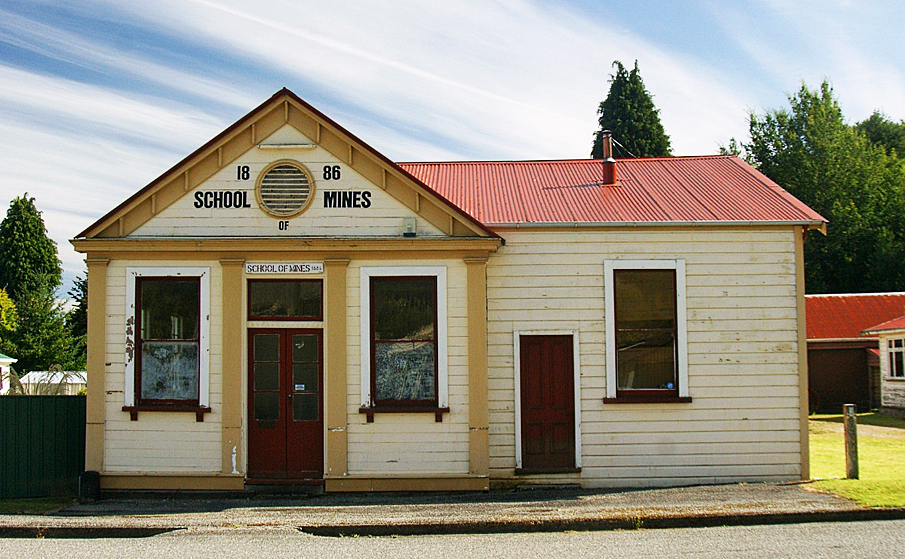
The School offered courses by correspondence and a free identification and assay service for new discoveries of ore. There was also an out-class system with the director lecturing in neighbouring settlements. With the decline of quartz mining in the area in later years the School placed more emphasis on coal-mining. Before its closure in 1970 it had begun to offer assistance to uranium prospectors. The director was the only full-time employee at the School and his wages were subsidised by central government.
List Entry Information
Status
Listed
List Entry Status
Historic Place Category 1
Access
Private/No Public Access
List Number
263
Date Entered
30th August 1990
Date of Effect
30th August 1990
City/District Council
Buller District
Region
West Coast Region
Extent of List Entry
Extent of registration includes the land described as Pt Sec 1342 Town of Reefton (NZ Gazette 1989 p 4870), Nelson Land District, and the building known as School of Mines thereon.
Legal description
Pt Sec 1342 Town of Reefton (NZ Gazette 1989 p 4870), Nelson Land District
Status
Listed
List Entry Status
Historic Place Category 1
Access
Private/No Public Access
List Number
263
Date Entered
30th August 1990
Date of Effect
30th August 1990
City/District Council
Buller District
Region
West Coast Region
Extent of List Entry
Extent of registration includes the land described as Pt Sec 1342 Town of Reefton (NZ Gazette 1989 p 4870), Nelson Land District, and the building known as School of Mines thereon.
Legal description
Pt Sec 1342 Town of Reefton (NZ Gazette 1989 p 4870), Nelson Land District
Why is this place significant?
Historic Significance
Historical Significance or Value The Reefton School of Mines was once the leading school of its kind on the West Coast where it was originally concerned with promoting a more scientific and less speculative approach to quartz goldmining. The school was closely associated with James Gow Black, a foundation professor of Otago University, who opened schools of mines throughout the country after conducting inaugural classes at Reefton and Thames in the mid-1880s. The Reefton school later played an important part in the application of the cyanide process to gold mining.
Physical Significance
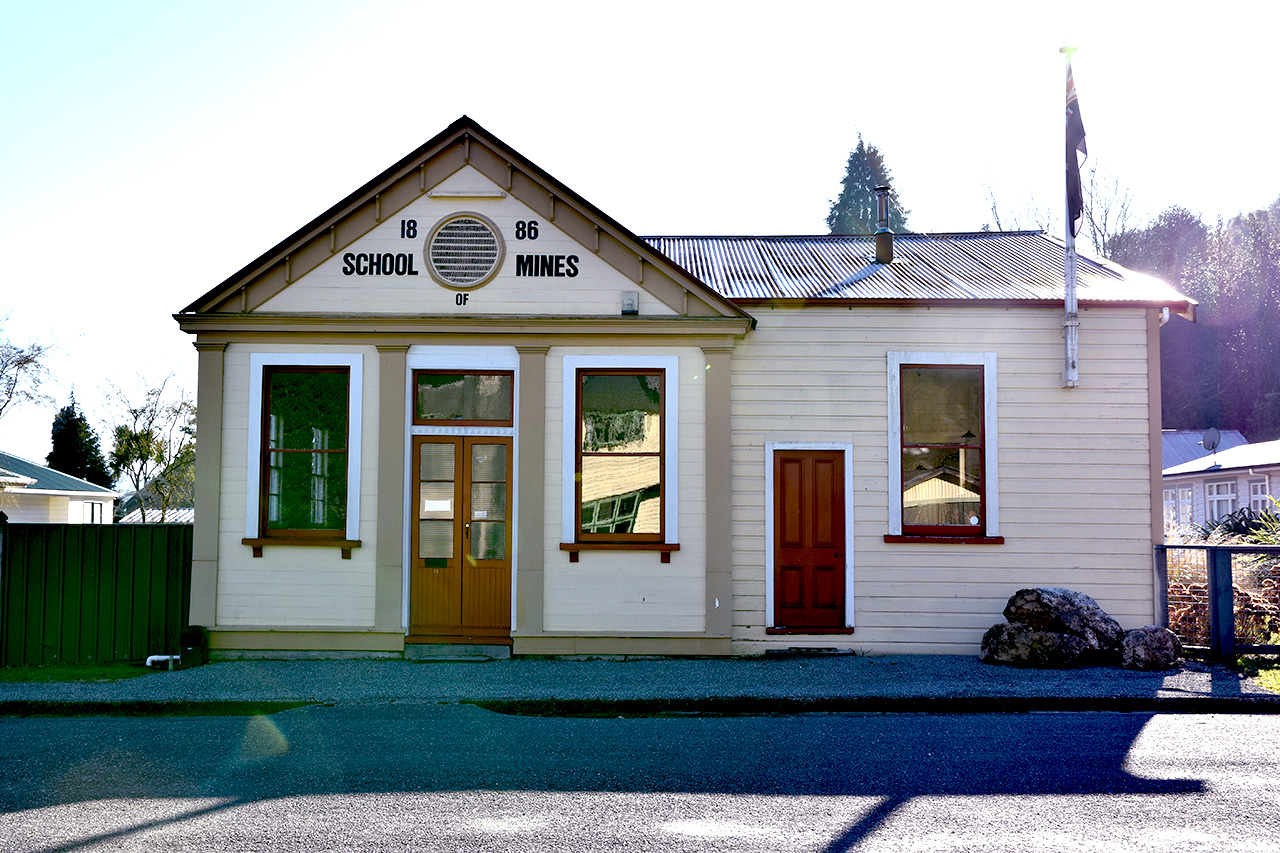
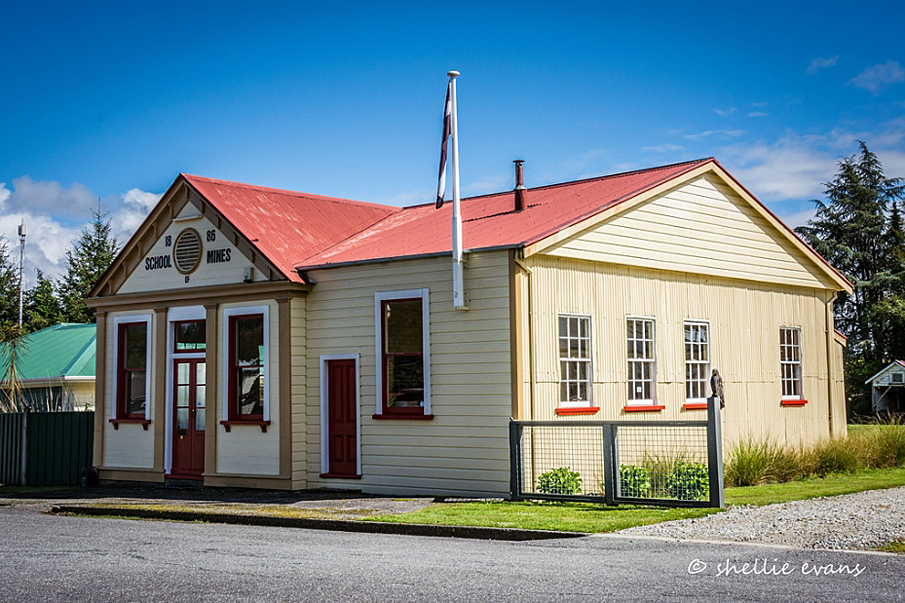
ARCHITECTURAL QUALITY: Whereas the facade of the original wing seeks to evoke an impression of classical symmetry, the rest of the School of Mines building is much more utilitarian in appearance and thus represents a builder's response to the school's need for functional premises which could be erected quickly and economically, and added to without difficulty. TOWNSCAPE/LANDMARK VALUE: The School of Mines building makes an unassuming contribution to the streetscape of Reefton.
Why is this place significant?
Historic Significance
Historical Significance or Value The Reefton School of Mines was once the leading school of its kind on the West Coast where it was originally concerned with promoting a more scientific and less speculative approach to quartz goldmining. The school was closely associated with James Gow Black, a foundation professor of Otago University, who opened schools of mines throughout the country after conducting inaugural classes at Reefton and Thames in the mid-1880s. The Reefton school later played an important part in the application of the cyanide process to gold mining.
Physical Significance
ARCHITECTURAL QUALITY: Whereas the facade of the original wing seeks to evoke an impression of classical symmetry, the rest of the School of Mines building is much more utilitarian in appearance and thus represents a builder's response to the school's need for functional premises which could be erected quickly and economically, and added to without difficulty. TOWNSCAPE/LANDMARK VALUE: The School of Mines building makes an unassuming contribution to the streetscape of Reefton.
Construction Details
Type
Addition
Description
pre 1923 - Addition of crush room, library, toilet and both lean-to structures.
Period
pre-1923
Type
Addition
Description
post 1923 - Addition of meeting room. New roof erected over this room and adjacent library.
Period
post-1923
Start Year
1975
startYearCirca
Type
Modification
Description
Wall dividing meeting room and library partially removed.
Start Year
1887
Type
Original Construction
Construction Materials
Timber and corrugated galvanised iron.
Notable Features
The School of Mines building houses a large collection of minerals which was assembled by the School's directors for the purposes of identification and education. Together with the equipment in the assay and crushing rooms, these minerals provide an insight into the operation of the School and into mining education in New Zealand.
Construction Details
Type
Addition
Description
pre 1923 - Addition of crush room, library, toilet and both lean-to structures.
Period
pre-1923
Type
Addition
Description
post 1923 - Addition of meeting room. New roof erected over this room and adjacent library.
Period
post-1923
Start Year
1975
startYearCirca
Type
Modification
Description
Wall dividing meeting room and library partially removed.
Start Year
1887
Type
Original Construction
Construction Materials
Timber and corrugated galvanised iron.
Notable Features
The School of Mines building houses a large collection of minerals which was assembled by the School's directors for the purposes of identification and education. Together with the equipment in the assay and crushing rooms, these minerals provide an insight into the operation of the School and into mining education in New Zealand.
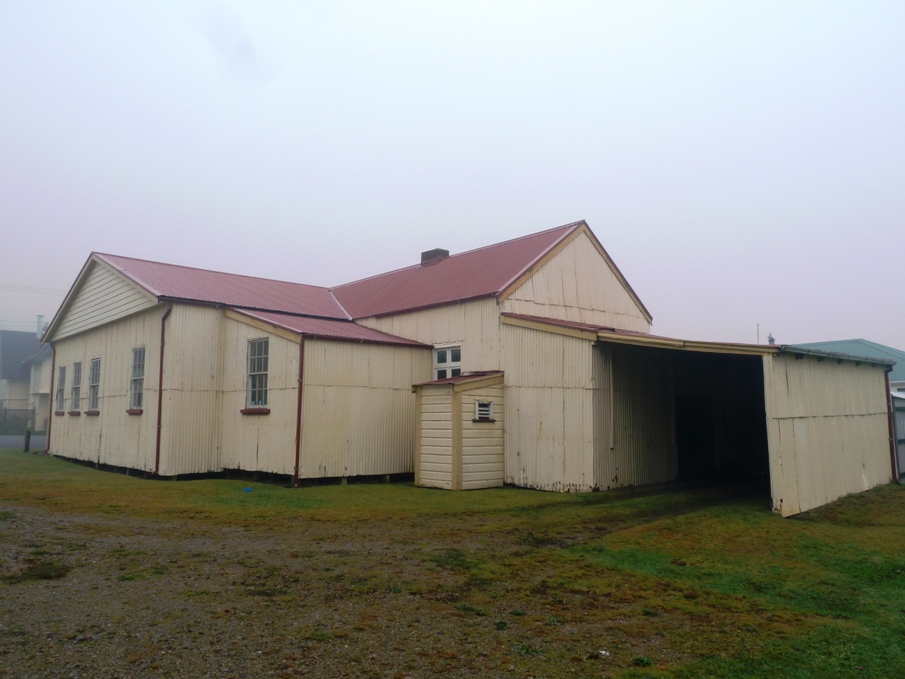
ARCHITECTURAL DESCRIPTION: The School of Mines building has two gabled wings set at right angles to one another with lean-to structures at the rear of both. The older section of the building runs at right angles to Shiel Street and has a gable end as its principal elevation. Clad in flush weatherboards this facade has bracketed eaves, a circular vent within the gable apex and a simple cornice above four pilasters. The latter frame the ends of the facade and the central entrance which is flanked by sash windows with bracketed sills. Double doors with glass insets and a crowning fanlight open into the mineral display room at the front of the building, which in turn opens into the assay room beyond. These rooms constitute the original part of the School of Mines building and have panelled walls with window openings on the eastern wall which were clearly boarded over when the secondary wing was erected. The display room features freestanding and built-in display cases, whilst the assay room has a distilled water maker beside the fireplace which is set within the rear wall. Beside the fireplace is another doorway which opens into the crushing room. This room is unlined, has a concrete floor and houses the School's coke-fired furnaces, crushing and grinding machinery. A lean-to behind the crushing room is divided in two, housing a storeroom and opening into a caravan shelter used by the local St John's Ambulance Brigade. A toilet clad in weatherboards also opens off the crushing room on the eastern side of the building. The secondary gable houses a meeting room, fitted with a pot belly stove, and a library from which opens the director's office housed within the second lean-to. Parallel to the street, this wing is slightly set back from the original wing and has a weatherboard gable. Clad in rusticated weatherboards, the main elevation features a four-panelled door and single sash window but is devoid of any further ornamentation. Six-pane sash windows are set within the side walls of both wings which are clad in vertical corrugated iron, like the roof and rear walls, and the entire structure rests upon wooden piles. MODIFICATIONS: pre 1923 - Addition of crush room, library, toilet and both lean-to structures. post 1923 - Addition of meeting room. New roof erected over this room and adjacent library. c.1975 - Wall dividing meeting room and library partially removed.
ARCHITECTURAL DESCRIPTION: The School of Mines building has two gabled wings set at right angles to one another with lean-to structures at the rear of both. The older section of the building runs at right angles to Shiel Street and has a gable end as its principal elevation. Clad in flush weatherboards this facade has bracketed eaves, a circular vent within the gable apex and a simple cornice above four pilasters. The latter frame the ends of the facade and the central entrance which is flanked by sash windows with bracketed sills. Double doors with glass insets and a crowning fanlight open into the mineral display room at the front of the building, which in turn opens into the assay room beyond. These rooms constitute the original part of the School of Mines building and have panelled walls with window openings on the eastern wall which were clearly boarded over when the secondary wing was erected. The display room features freestanding and built-in display cases, whilst the assay room has a distilled water maker beside the fireplace which is set within the rear wall. Beside the fireplace is another doorway which opens into the crushing room. This room is unlined, has a concrete floor and houses the School's coke-fired furnaces, crushing and grinding machinery. A lean-to behind the crushing room is divided in two, housing a storeroom and opening into a caravan shelter used by the local St John's Ambulance Brigade. A toilet clad in weatherboards also opens off the crushing room on the eastern side of the building. The secondary gable houses a meeting room, fitted with a pot belly stove, and a library from which opens the director's office housed within the second lean-to. Parallel to the street, this wing is slightly set back from the original wing and has a weatherboard gable. Clad in rusticated weatherboards, the main elevation features a four-panelled door and single sash window but is devoid of any further ornamentation. Six-pane sash windows are set within the side walls of both wings which are clad in vertical corrugated iron, like the roof and rear walls, and the entire structure rests upon wooden piles. MODIFICATIONS: pre 1923 - Addition of crush room, library, toilet and both lean-to structures. post 1923 - Addition of meeting room. New roof erected over this room and adjacent library. c.1975 - Wall dividing meeting room and library partially removed.
Historical and Associated Iwi / Hapū / Whānau
Public NZAA Number
L30/68
Information Sources
Cyclopedia of New Zealand, 1906
Cyclopedia Company, Industrial, descriptive, historical, biographical facts, figures, illustrations, Wellington, N.Z, 1897-1908, Vol. 5, Nelson, Marlborough, Westland, 1906
Department of Conservation
Department of Conservation
New Zealand Historic Places Trust (NZHPT)
New Zealand Historic Places Trust
Porter, 1983
Frances Porter (ed), Historic Buildings of Dunedin, South Island, Methuen, Auckland, 1983.
Other Information
This historic place was registered under the Historic Places Act 1980. This report includes the text from the original Building Classification Committee report considered by the NZHPT Board at the time of registration. Please note that entry on the New Zealand Heritage List/Rarangi Korero identifies only the heritage values of the property concerned, and should not be construed as advice on the state of the property, or as a comment of its soundness or safety, including in regard to earthquake risk, safety in the event of fire, or insanitary conditions.
Historical and Associated Iwi / Hapū / Whānau
Public NZAA Number
L30/68
Information Sources
Cyclopedia of New Zealand, 1906
Cyclopedia Company, Industrial, descriptive, historical, biographical facts, figures, illustrations, Wellington, N.Z, 1897-1908, Vol. 5, Nelson, Marlborough, Westland, 1906
Department of Conservation
Department of Conservation
New Zealand Historic Places Trust (NZHPT)
New Zealand Historic Places Trust
Porter, 1983
Frances Porter (ed), Historic Buildings of Dunedin, South Island, Methuen, Auckland, 1983.
Other Information
This historic place was registered under the Historic Places Act 1980. This report includes the text from the original Building Classification Committee report considered by the NZHPT Board at the time of registration. Please note that entry on the New Zealand Heritage List/Rarangi Korero identifies only the heritage values of the property concerned, and should not be construed as advice on the state of the property, or as a comment of its soundness or safety, including in regard to earthquake risk, safety in the event of fire, or insanitary conditions.