Early development of the St Patrick's Cathedral complex
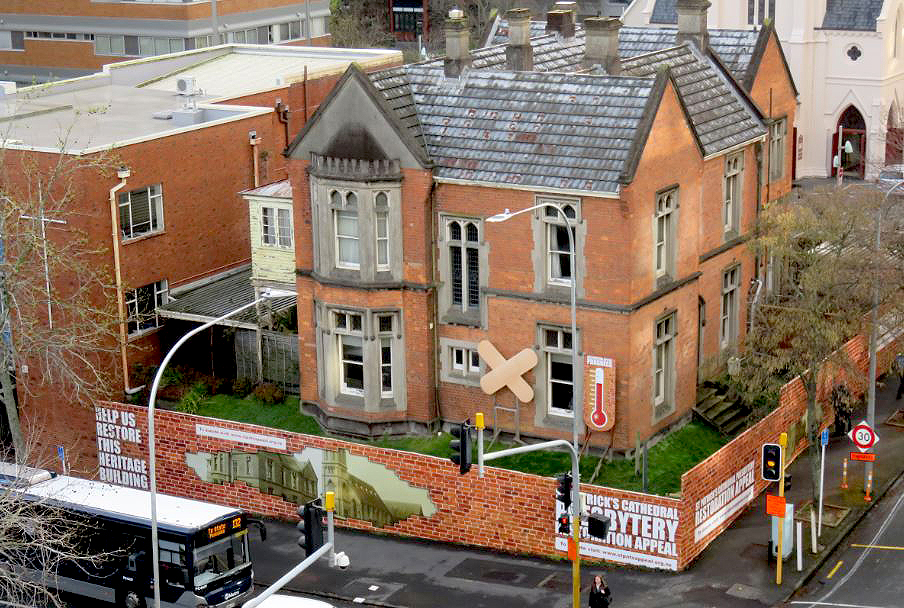
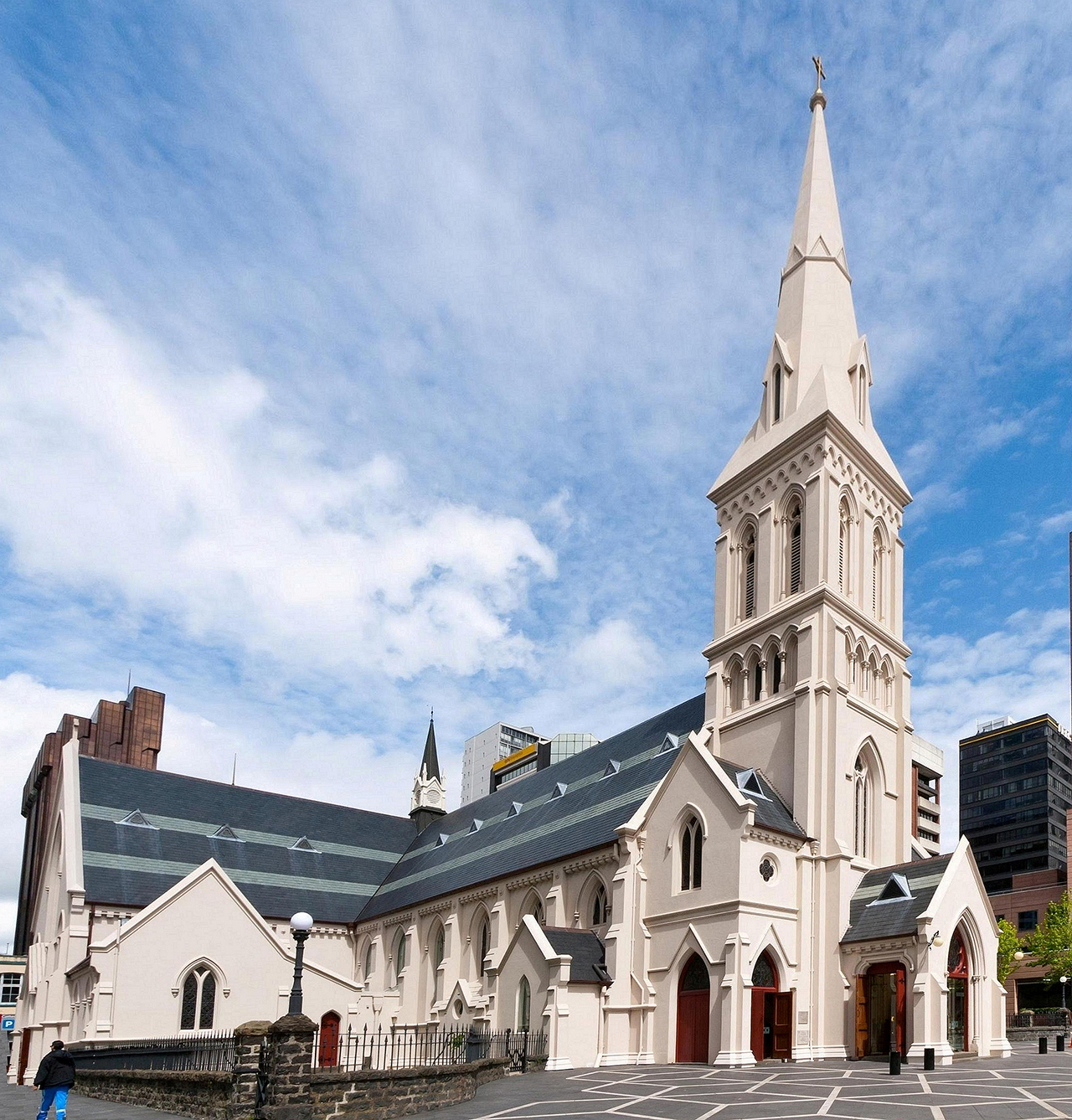
Constructed in 1888, the current presbytery is closely linked with the development of St Patrick's Cathedral and its associated complex of religious structures. Initially established in the 1840s, the complex soon became the spiritual heart of New Zealand's most populous Catholic Diocese. Until the creation of the Waikato Diocese in 1980, the Diocese embraced the northern half of the North Island, also uniquely incorporating an extensive Maori Mission. From its inception, the presbytery was integral to the workings of the Diocese, being involved in the administration of the Diocese, the Cathedral complex and the local parish, as well as housing the Cathedral clergy/parish priests.
The Crown granted part of the land occupied by the complex to Bishop Jean-Baptiste Pompallier (1801-1871) in June 1841. Pompallier was the pre-eminent Catholic clergyman in early colonial New Zealand, and sought to establish a religious base for his faith in the newly-established capital at Auckland. The land occupied part of a ridge in the western part of the settlement, on the opposite side of the town from the principal Anglican buildings on Constitution Hill and in Parnell. The parish of St Patrick's was founded in 1842, and a timber building housing St Patrick's chapel and school was opened on 29 January 1843.
A reference to a 'chapel house, Wyndham Street' in 1842 suggests that a presbytery had also been built by this time. It may have been erected by the Reverend Jean-Baptiste Petit-Jean, who described his house as being 'a small, unfinished, scarcely habitable building'. The presbytery is believed to have been situated immediately to the west of where construction of a stone church (and future Cathedral) was started by March 1846. Consecration in March 1848 of the Church of St Patrick and St Joseph - Auckland's first stone building - broadly coincided with Auckland becoming the Diocesan seat for the Bishop.
Further expansion of the complex subsequently occurred. In April 1850, the presbytery was converted into a convent to house Mother Cecilia Maher and seven Irish Sisters of Mercy who arrived to establish the first religious order of women in New Zealand. The priests and Bishop Pompallier relocated to another house, almost certainly on the site of the present presbytery. Although Pompallier formally purchased the two parcels of land comprising the modern presbytery site in 1852 and 1855, there may have been an arrangement for its ecclesiastical use prior to the legal settlement being recorded. Located on the corner of Hobson and Wyndham Streets, the second presbytery appears to have been a single-storey timber dwelling with a shingle roof. It may be the smart residence with two dormers, verandah and picket fence that occupies a corner site in an 1860s photo of Hobson Street.
Construction of the Present Presbytery
Following the appointment of Bishop John Luck (1840-1896) in 1882, a programme of rebuilding occurred. Substantial new structures were erected including a large Cathedral, which was blessed and opened in March 1885. Less than three years later, a decision was taken to improve the priests' quarters. This ultimately involved replacement of the timber presbytery with an impressive new structure of brick.
In 1879, the presbytery had been described as a single-storey dwelling with three smallish rooms, housing two or three priests who were responsible for three quarters of the Catholics living in the town. The death of Monsignor Henry Fynes in 1887 enabled construction of the new presbytery to be funded from the Fyne's Trust, Fynes having left his estate to the church. Fynes, an Englishman ordained in Sydney in 1845, had come to Auckland in October 1849 and during 1850-1851 held the position of 'Administrator' (parish priest for the cathedral). Fynes is remembered for the model schools he developed staffed by laypeople. During the absence of Bishops Croke and Steins, he was appointed the administrator of the Auckland Diocese for extended periods.
Tenders had initially been called for alterations to the existing presbytery, but even the lowest of the fifteen tenders received exceeded the budget. As ground levels along Hobson Street were being reduced around this time to improve access to the waterfront, it was decided to excavate the site and build a completely new presbytery. The land was excavated but not to street level, leaving the site with a 'gentle eminence' and the old presbytery buildings shifted to another part of the block. As a result of these earthworks it is uncertain how much archaeological material for the period leading up to 1888 may remain, although an old well is said to survive beneath one of the car parking spaces within the northeast corner of the current presbytery site.
The new presbytery was carried out to the design of architects Edward Mahoney & Sons, one of the most prolific and significant Auckland architectural firms of the late nineteenth and early twentieth centuries. It was completed and handed over by the contractor Mr E. J. Matthews by
the second week of October 1888, the year that marked the completion of 50 years of the New Zealand mission of the Catholic Church. The New Zealand Herald noted that,
'The ground floor contains reception, dining and meeting rooms, kitchen and offices, and the upper floor, suites of studies and bedrooms, with bathroom. The upper part of the windows and the whole of the staircase windows are filled with cathedral glass and leadlights'.
The residence, costing £2,000, was declared to be 'comfortable and convenient, and a great improvement on the previous building'. When constructed, the building was a particularly grand and prominent example of a brick residence in the western part of the city centre, which
traditionally contained fewer houses belonging to the wealthier members of society. More modest brick buildings had, however, been erected in Hobson Street from before the mid 1860s, and small clusters of these are recorded as existing along this thoroughfare in the early 1880s.
Architecturally, St Patrick's Presbytery stands as a unique example of the strict Gothic Revival ecclesiastical work of Edward Mahoney & Sons. It is said to be one of the most rigorous examples of ecclesiastical domestic architecture of its type to be erected in Auckland, strictly fulfilling the notions of the influential British architect, Augustus Welby Pugin. Pugin's architectural work and writings advocated the use of medieval Gothic architectural forms, and were important influences on church design and associated ecclesiastical buildings throughout the mid to late nineteenth century.
There were several connections between Pugin and the Catholic authorities operating in Auckland. Pugin had founded the religious complex of St Augustine's at Ramsgate, Kent between 1845 and 1851, a project that is probably the closest representation in architectural terms of Pugin's own philosophy. After Pugin's death, St Augustine's became a Benedictine Monastery. It was from there that Benedictine brothers were sent to assist in the establishment of the Newton Parish in Auckland.
The new presbytery on Wyndham Street was also, for a time, the home of Bishop John Luck prior to completion of Bishop's Palace, Ponsonby in 1894. Luck, the 'Benedictine Bishop', had as a child moved to Ramsgate when his father, Alfred Luck, had bought the home of Augustus Pugin, close to the Church of St Augustine. Alfred Luck had later, at his own expense, built a monastery for the Benedictine community that established itself there in 1856, centred on the Church of St Augustine. On his death, he also left his house and substantial funds to the Benedictine Order. The friendship between Bishop John Luck, 'an energetic builder', with Pugin's son Peter Paul Pugin, led to the firm of Pugin and Pugin being selected as architects for the Bishop's Palace built in New Street, Ponsonby in 1894. It is likely that this connection also influenced the earlier design of St Patrick's Presbytery.
Subsequent Use and Development
From its inception, the presbytery was intended to provide accommodation for clergy serving the Cathedral and to be the centrepiece for the administration of the Auckland Diocese, Cathedral and local parish. For nearly a hundred years after its construction, Diocesan administration from
the presbytery extended as far south as the East Coast parishes around Gisborne and to some of the King Country west of Lake Taupo. It also encompassed an extensive Maori Mission. Clergy based at the presbytery directly served the Cathedral, having responsibilities for
conducting services celebrating special religious events, including ordinations and installation of the bishop. Diocesan priests came annually to renew their vows at the Cathedral. Also, traditionally the Cathedral and presbytery formed a gathering place for priests celebrating St Patrick's Day.
The presbytery further served an extensive inner-city parish, bounded from 1887 by the parishes of Parnell, Newton and Ponsonby. Priests based at the presbytery provided a variety of pastoral care conducting ceremonies linked with important life-cycle events among other matters. Members of the parish and others met with the clergy at the presbytery for preparation for baptism, holy communion, confession/reconciliation, confirmation and marriage. In view of the particular needs of an inner city parish, which encompassed particularly severe social problems during difficult periods such as the Great Depression of the 1930s, work at the presbytery is considered to have provided important training for many young priests.
As the administrative centre of the Diocese, many important meetings were held at the Presbytery. In March 1922, eighteen of Auckland's city and suburban priests met there and unanimously passed resolutions supporting Dr James Liston who faced prosecution in the Supreme Court by William Massey's government for allegedly making seditious utterances at a St Patrick's night address in the Auckland Town Hall. Liston was ultimately acquitted by an all-Protestant jury and went on to become Auckland's longest serving Bishop, eventually being honoured by the Church with the title 'Archbishop'. As the formal administrative centre of the Roman Catholic Bishop, the presbytery was the venue for receiving visits from many of
Auckland's Mayors, acknowledging the place of the Cathedral in the City, the Roman Catholic Bishop as a leading citizen of Auckland, and the contribution of the Cathedral clergy in dealing with the social and spiritual issues of those in the inner city.
Administrators of St Patrick's who were, or who became significant figures in the church include James Hackett (1889-1891) later Dean of the Auckland Diocese's southern district; priest and educationalist Monsignor Patrick O'Reilly (1899-1901); Matthew Brodie (1913-1915), who upon leaving St Patrick's Cathedral became Bishop of Christchurch and the Roman Catholic church's first New Zealand-born bishop; Monsignor Leonard Buxton (1925-1942), whose initiatives included the Roman Catholic publications The Month and Zealandia and who gave Knocknagree
camp at Oratia and the Catholic university-student centre Newman Hall to the Auckland diocese; Monsignor Adrian Curran (1942-1970) who was Vicar General of the diocese for nine years; and Monsignor Brian Arahill (1971-1988) who was the architect of a liturgical programme for the Auckland diocese implementing the ideas of Vatican II locally.
Historically the Administrator of St Patrick's Cathedral was also the manager of New Zealand's oldest-running school, which closed in December 1979. St Patrick's Cathedral School was founded on the Cathedral site in 1843 and later moved to the west side of Hobson Street and in 1927 to nearby Wellington Street. The strong links between the school and the Cathedral clergy were reflected in the pupils' participation in Cathedral liturgies and in the clergy's role as school chaplain, conducting the special services held at the school. Such services were an integral part of education provided in Roman Catholic schools prior to integration of Catholic schools into the state school system. Until the establishment of Te Unga Waka (Meeting of Canoes) in Epsom in the late 1960s much of the Church's Maori mission work centred round St Patrick's Cathedral and St Patrick's School.
An undated inventory, probably compiled some time following Bishop Luck's residence, gives an insight into the way the presbytery was used. It includes references to the Administrator's office and reception room (on the ground floor); the Assistant Priest's reception room (ground floor);
dining room; the Administrator's bedroom and study; Assistant Priest's rooms [bedroom]; visitors' bedroom; and servants' bedrooms. By 1900, the Very Reverend Dean Patrick O'Reilly was the Administrator in charge of St Patrick's Cathedral, assisted by a curate and assistant curate. The Cathedral parish at that time included the majority of the Catholics in the Diocese and the Cathedral was able to provide for 1,100 worshippers. A less detailed inventory completed in 1943 noted that there were: five bedrooms 'properly furnished'; one dining room; one sitting room; one 'smoke room'; two reception rooms; two rooms labelled 'domestics'; and a kitchen.
There appear to have been few alterations to the building for the first 50 years or so of its existence. In 1945 a bedroom addition resulted in the closing in of the Hobson Street end of the verandah. Almost 30 years later more extensive alterations were undertaken, resulting in: the further enclosure of the upper floor verandah; the lowering of ceilings; the provision of bathroom facilities for the housekeeper; and a narrow single-storey addition to the east end of the building. In 1995 alterations were made to enable better separation of the parish office activities from the priests' living area. This occurred after the administrative centre of the Diocese was moved to the Bishop's House in New Street, St Mary's Bay. The presbytery currently houses the priests of St Patrick's parish and the parish office, and provides a venue for meetings associated with the Cathedral restoration project.
Comparative Examples
Nationally, the building is unique as the only purpose-built Roman Catholic cathedral presbytery to survive. Of the other cathedral centres in New Zealand, Dunedin's cathedral presbytery was not purpose-built. Constructed in 1871 for merchant trader George Duncan, the bluestone building was purchased by the Otago Diocese in 1872. Sold by the Church in 1999, the former presbytery is now used for tourist accommodation. The cathedral presbytery in Christchurch occupied a site in Barbadoes Street beside the cathedral, but was demolished over a decade ago. Wellington's cathedral presbytery, a house purchased in the 1930s, was previously a doctor's residence. The earlier Wellington cathedral presbytery has not survived.
Presbyteries of non-cathedral status survive, including those in Auckland at St Benedict's, Newton (circa 1887), St John the Baptist, Parnell (circa 1903) and the Church of the Assumption, Onehunga (circa 1905). Examples nationally include Burnett Street, Ashburton (NZHPT Registration # 1808, Category II historic place); the St Mary's Church Presbytery (NZHPTRegistration # 1532, Category II historic place) recently relocated from Blenheim to Seddon; Pukekaraka Presbytery, Otaki (1897) (NZHPT Registration # 4100, Category II historic place); and the Presbytery at Reed Street, Oamaru (NZHPT Registration # 2297, Category II historic place).
Although there are other places constructed as brick residences in inner-city Auckland that are older and there may be some of later or unknown date that retain residential use, St Patrick's Presbytery is likely to be unusual as a surviving nineteenth-century brick residence within the colonial city centre and as a continually occupied nineteenth-century residence within the same area. Surviving examples of buildings constructed as residences in Auckland's CBD include the original (rear) section of the building at 5 Alten Road (NZHPT Registration # 7398, Category II historic place) built in 1849-1850 as the manse for the first minister of St Andrew's Presbyterian Church. The building currently known as Newman Hall, 18 Waterloo Quadrant was originally a brick residence constructed for merchant David Nathan in 1863 and in the following decades was to become but one of many brick residences in the Princes Street/Lower Symonds Street area, several of which survive. These include Pembridge at 31 Princes Street; Wickford at 26 Princes Street, now part of the University of Auckland Registry; the houses at 12, 14 and 16 Symonds Street constructed in the mid-1880s; those at 25-29 Symonds Street (NZHPT Registration # 568, Category I historic place) probably built in 1897; and two houses at 201-203 Federal Street, constructed in circa 1907. Examples of more humble residential buildings include semi-detached cottages constructed of stone and brick at 30-32 Airedale Street (NZHPT Registration # 7089, Category I historic place).