This historic place was registered under the Historic Places Act 1993. The following text is the original citation considered by the NZHPT Board at the time of registration. Information in square brackets indicate modifications made after the paper was considered by the NZHPT Board.
The Taranaki region is thought to have been settled by Maori around 600-700 years ago. Archaeological evidence suggests that pa were being built in the area, which surrounds Mount Taranaki, as early as the fifteenth century. A number of iwi hold mana whenua in the west coast of the region, including Ngati Tama and Ngati Mutunga, Te Atiawa and Taranaki. The area which would become New Plymouth was initially populated by Nga Mahanga a Tairi of Taranaki, and then Te Atiawa, who affiliate with the waka Tokomaru and are said to descend from the semi-divine origins of ancestor Awanuiarangi, whose people moved south from Northland to the Bay of Plenty and Taranaki. Te Atiawa affiliate with the waka Tokomaru and are said to descend from the semi-divine origins of ancestor Awanuiarangi, whose people moved south from Northland to the Bay of Plenty and Taranaki.
European whalers initially arrived along the Taranaki coast in the first half of the nineteenth century, and generally integrated themselves relatively harmoniously with the local Maori communities. By the early 1840s, a Ngati Te Whiti pa at Ngamotu, called Otaka Pa, was still populated but many other Maori strongholds in the region had been abandoned following attacks by taua from the Waikato a decade earlier, which had prompted a major migration of the remnant Te Atiawa population to Otaki, Wellington and Marlborough. However, increasing numbers of European settlers created a demand for land and the resulting tensions between tangata whenua and colonists had lasting effects on all Taranaki residents.
Organised colonial settlement at Taranaki was first instituted by the Plymouth Company in 1839-1840, who arranged to purchase land from the New Zealand Company for the settlement of immigrants from Devon and Cornwall, although this purchase would be much disputed in the future. The site of the township was chosen and laid out by Chief Surveyor Frederic Carrington in February 1841, and settler ships arrived from England from March 1841 onwards.
By this time the Plymouth Company had fallen into financial difficulties, and was formally merged with the New Zealand Company in May 1841. Settler ships continued to arrive, but disputes around the Crown’s role in transferring land out of Maori ownership, and between tangata whenua over who had the authority to transfer land were already evident, frustrating all involved.
Despite the frustration, settlers continued to arrive with relative frequency in the coming decade, and the Hirst family was among them. Thomas Hirst (1805-83) and his wife Grace (1805-1901) emigrated from Yorkshire with five of their eight children in 1851. The distant colony was seen as a good option for Thomas because it offered a fresh start for the wool merchant [and his family].
[While] Thomas undertook business as a travelling wool merchant, Grace and her daughters also set up a business in New Plymouth. The women’s trading enterprise seems to have been a success and among other goods sold were large stocks of items sourced from Grace’s Bracken relatives back in England. Therefore, the Hirst family soon became financially stable [in their new country] and as well as their first New Plymouth home, [a prefabricated residence they named] Egmont House, they soon also acquired a small Bell Block farm in 1854, which they called Brackenhirst.
The upheavals of the 1860s:
The series of prolonged conflicts during the 1860s are now commonly known as the Taranaki Wars, waged between the Crown and Maori in response to Maori uprising against the enforced alienation of their land, and caused widespread deprivation, suffering and loss of life and land for iwi, resulting in the heavy confiscation of tribal land taken by the Crown under the Land Settlement Act of 1863. 185,000 acres of land within Te Atiawa’s rohe was confiscated. The devastating effects of these actions have since been acknowledged by the Crown through formal apologies and efforts of redress by settlement agreements.
The conflicts also affected the fledgling European settler communities, with many residents of outlying areas abandoning their homes and taking refuge in the urban centre of New Plymouth town, or leaving the region altogether for a time. Complaints from anxious European settlers eventually forced the Government to station troops at New Plymouth, and the site of the former Pukaka pa (Marsland Hill) was transformed into a military stockade and barracks in 1855. As the frequency of battles decreased the British troops were gradually withdrawn, until the last detachment of the 50th regiment left in 1867.
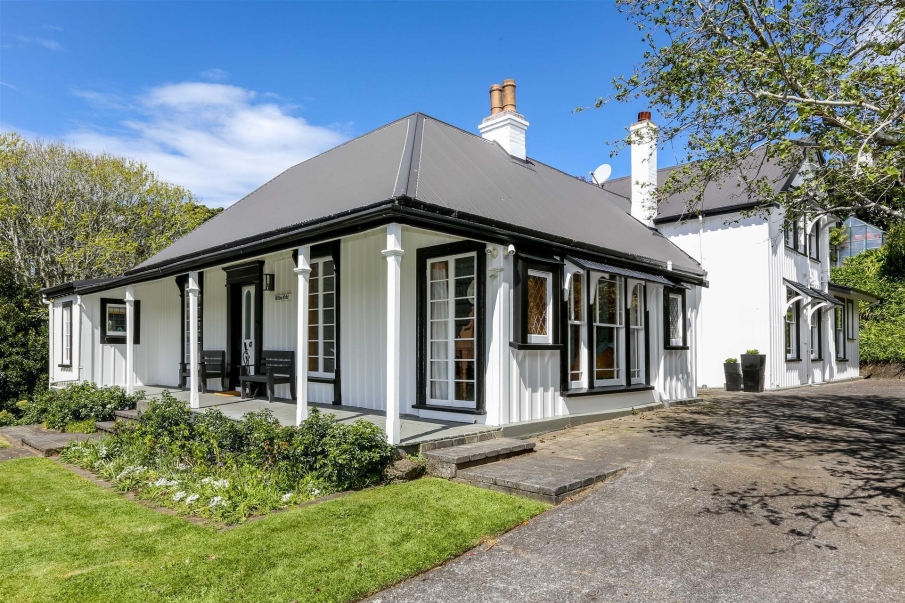
Indeed, the Hirsts were among those who moved back into New Plymouth town in 1860 when martial law was declared. The ongoing uncertainty in region was probably a key motivator for the family to embark on a visit to England in 1861-62. Like other abandoned rural properties, the Hirst’s Brackenhirst property at Bell Block was destroyed by fire as part of the ongoing campaigns of the Taranaki Wars. On their return from England, the family purchased a property closer to central New Plymouth in 1863 and built Willowfield. The house is said to have been named after the Napoleon Willow which was located by a spring towards the boundary of the property. The house was constructed of kauri with a tiled slate roof, and became incrementally surrounded by various outbuildings, including a fowlhouse and greenhouse.
The ‘Hen and Chickens’:
Willowfield soon became the nucleus of a family complex in 1864 when the Hirst’s built a further row of houses at the northern boundary of the property. The Hirst’s property became nicknamed the ‘Hen and Chickens,’ with Thomas and Grace residing in Willowfield (the ‘mother hen’) and providing each of their five children with a cottage to either live in or rent out. The houses were all linked by a private lane (which become known as ‘Petticoat Lane’) that ran behind the back gardens of the ‘chickens’.
The accommodation of their children nearby was not a surprising move considering Grace’s character, and most likely to some extent the insecure atmosphere in Taranaki during the 1860s. Grace reportedly had an indomitable spirit, strong religious convictions, and an inherent belief in the importance of family, which was a reason why it was extremely difficult for her to agree to move to New Zealand in the first place. Indeed, she was the matriarch of the family and for some time her home-base of Willowfield was important to the family. Grace was also known in the wider community for her willingness to, and her ability in, attending pregnant women and nursing the sick, as well as comforting the bereaved. Grace and Thomas were also active in church affairs and after Grace’s death in 1901, the family commissioned a new stone pulpit for St Mary’s Church in New Plymouth, in their honour.
Thomas contributed to the family’s local profile through his business affairs and other roles, such as being a Justice of the Peace. It seems that he
was well-known and respected in New Plymouth society. Like his wife he was heavily involved in church matters and for many years was a church warden at Saint Mary’s Church, as well as being a representative in the Diocesan Synod. Thomas was also involved in public affairs, especially early in his residence in Taranaki when he was a Member of the House of Representatives and also on the Provincial Council.
It was perhaps because of the growth in fortune and family size of Thomas and Grace’s eldest daughter Harriet [Fookes] (1839-1918), that in the 1880s the Fookes family [took up residence in] Willowfield. It has been stated that Thomas and Grace both lived at Willowfield until their deaths. However, when Thomas died the couple were resident at their original New Plymouth home, Egmont House. Indeed, the Fookes’ had legal ownership of Willowfield from the early 1880s, seemingly dating from just after Thomas’ death, as well as retaining one of the ‘chickens’ under Harriet’s name. The other cottages remained divided amongst Grace and Thomas’ other daughters, and as such the Hirst descendants, which numbered 46 grandchildren and 52 great grandchildren upon Grace’s death, retained a connection to Willowfield and the wider Hirst family precinct. It would seem that Grace was living in one of the cottages at the time of her death in 1901.
Harriet Hirst had married Albert Crac[r]oft Fookes (1839?-1916) in 1867, a man said to have been ‘well known throughout Taranaki.’ When the couple were first married Albert was a Waverley store keeper, an occupation he had taken up after serving in the Taranaki Military Settlers during the Taranaki Wars. Subsequently he became a success as a land broker and was involved in projects such as the establishment of the Midh[i]rst Special Settlement. By the 1880s the couple had moved to New Plymouth to live at Willowfield, and Albert continued to run his business from that town. Here he also took an active role in local politics, which built on his role as New Plymouth’s second Mayor, the office he held between 1878 and 1879. Aside from this short term, Albert also remained involved with the Borough Council. Albert was also involved with the New Plymouth Harbour Board, and other commercial interests included the Taranaki Ironsand Company.
The Fookes’ had a sizeable family with five daughters and six sons, one of [whom] became a local medical practitioner, with another a solicitor in Stratford. As such, there were many large family and social occasions hosted at Willowfield, including wedding receptions. Albert and Harriet lived at Willowfield until they died in 1916 and 1918 respectively. Willowfield stayed within the Fookes family until 1958, which meant that descendants of Grace and Thomas Hirst had lived at Willowfield for just under a century.
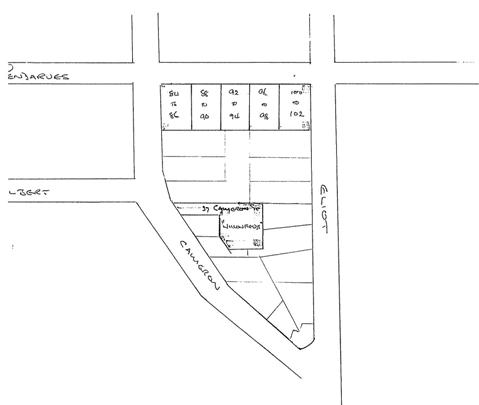
Initially, the ‘Hen and Chickens’ were located in a wedge-shaped section between Pendarves, Eliot, and Cameron Streets - with the section of Pendarves Street that ran in front of the ‘Chickens’ known as York Terrace. However, around the time that Willowfield was sold out of the Fookes family in the mid twentieth century the original land parcel was progressively subdivided, especially along the Cameron Street boundary. Likewise, Willowfield itself was divided into four self-contained flats in the early 1960s. A fire in one of the rear flats in 1976 was fortunately quickly contained from spreading throughout Willowfield, although its kitchen was gutted.
The current owners have owned Willowfield since 1979 and spent the first decade or so catching up on the necessary repairs and deferred maintenance, and removing the flats, therein reinstating Willowfield as a much-loved family home. The house has now been completely relined inside, with the original kauri on scrim linings replaced, and the central rooms have been remodelled to create an open plan kitchen/dining/sunroom space and various living areas. Hand-forged nails have been found during construction work.
The house is regularly the subject of public interest for its historical significance, with various media articles appearing over the years, and visits from school groups doing historical research projects.