

Glendower Station was formed in 1854, when John Milsome Jury (1816-1902) took up 800 acres of land in the Pukengaki range, near Carterton. Jury, born in England, lived an eventful life and settled in New Zealand when he jumped ship in the Bay of Islands in 1835. He married Te Aitu-o-te-rangi (c.1820-1854), a high-born woman of the Ngāti Moe/ Ngāti Muretu hapū of Rangitāne and Ngāti Kahungunu, after meeting her when she was a captive of Te Rauparaha at Kāpiti. Around 1845 Te Aitu claimed ancestral land near Martinborough and the couple farmed on a river island (Te Ureta) that became known as Jury’s Island. When Te Aitu died in 1854, Jury moved further inland and developed Glendower Station. The Crown grant was finally processed in 1866 and by 1917 the station had grown to run 2,200 sheep as well as some cattle. The current Glendower Station Homestead was built in the 1860s; it was John Milsome Jury’s third house on the station.
The Jury family’s long association with sheep farming dates from the 1840s, when John was a witness to some of the Wairarapa’s first land transactions and assisted the region’s earliest pastoral leaseholders with shearing and fencing. Geoffrey Thornton, one of the most eminent historians of New Zealand’s built heritage, considered woolsheds to be ‘the most striking symbol of the New Zealand pastoral landscape.’ The construction date of the Glendower Station Woolshed is unknown, but it was most likely built in the nineteenth century.
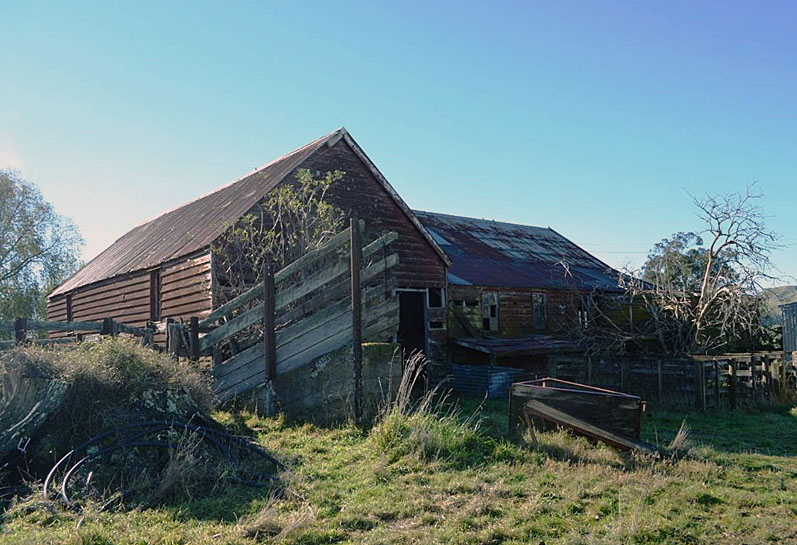
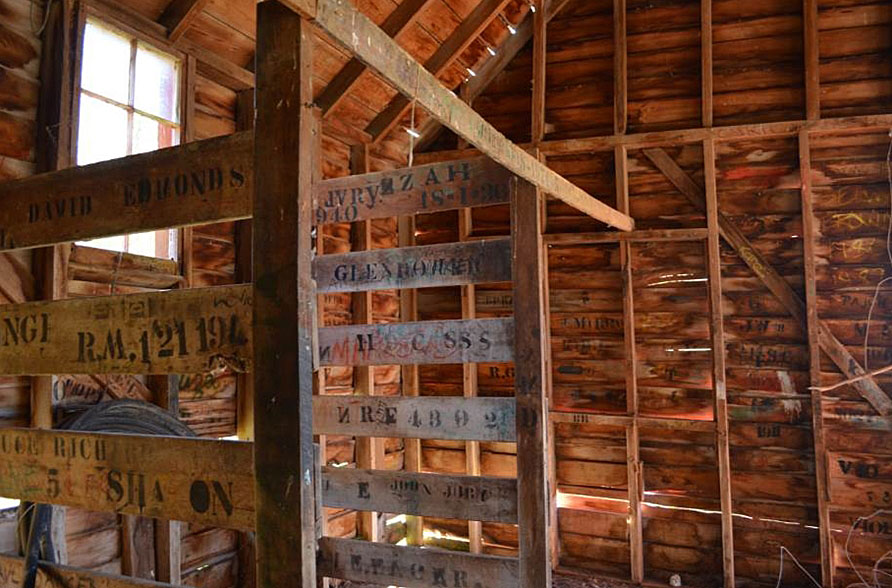
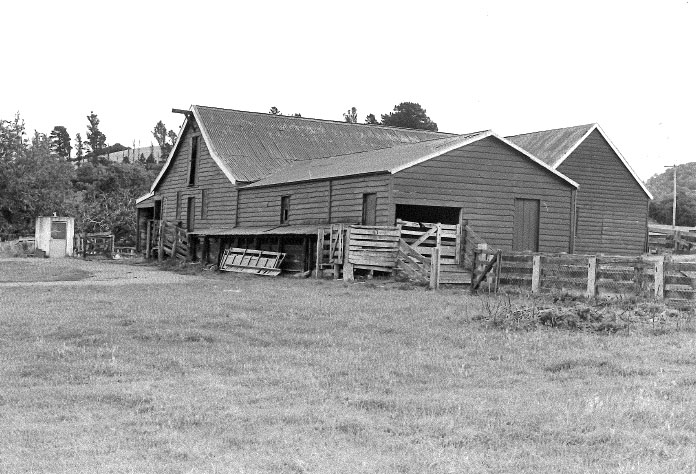
Constructed on the station’s ‘home flats’ near the Ponatahi Road entrance, the woolshed is a U-shaped timber structure with a single-gabled corrugated iron roof. Of three parts, it was likely added to over time. The central part contains the shearing board with stands along the northern and southern walls; porthole chutes allowed the shorn sheep to be passed through to open yards outside. In the centre of the room catching pens with weighted gates gave shearers access to the waiting sheep; above this is a storage loft. The western wing functioned as the wool room, with stalls for sorting and baling the fleeces. The eastern wing contains the covered yards, fed by the open yards outside to the north. The interior is covered with hundreds of wool bale stencils and handwritten signatures of the names of workers, dating from at least 1902, and features many of the district’s longstanding shearing families (for example Jury, Hunt, Nepia, Warren, Haeata). The woolshed is therefore no doubt a trigger for many community memories; certainly it features often in the Jury family’s history.
John Milsome Jury died in 1902. His son Charles Joseph Jury (1850-1916) had taken over the station some time before; by 1904 Charles’ son John Milsome Jury II (known as Paddy) was in charge. Two further generations of Jurys farmed before the homestead was subdivided from the station and sold in 2016. Glendower Woolshed and farm are still in Jury family ownership, although the building ceased being used for shearing in the mid-1990s.
List Entry Information
Status
Listed
List Entry Status
Historic Place Category 2
Access
Private/No Public Access
List Number
2863
Date Entered
23rd June 1983
Date of Effect
23rd June 1983
City/District Council
Carterton District
Region
Wellington Region
Extent of List Entry
Extent includes part of the land described as Lot 2 DP 345357 (RT 185962), Wellington Land District and the building known as Glendower Station Woolshed thereon, and a curtilage acknowledging the yards. Refer to the extent map tabled at the Rārangi Kōrero Committee meeting on 8 March 2018.
Legal description
Lot 2 DP 345357 (RT 185962), Wellington Land District
Status
Listed
List Entry Status
Historic Place Category 2
Access
Private/No Public Access
List Number
2863
Date Entered
23rd June 1983
Date of Effect
23rd June 1983
City/District Council
Carterton District
Region
Wellington Region
Extent of List Entry
Extent includes part of the land described as Lot 2 DP 345357 (RT 185962), Wellington Land District and the building known as Glendower Station Woolshed thereon, and a curtilage acknowledging the yards. Refer to the extent map tabled at the Rārangi Kōrero Committee meeting on 8 March 2018.
Legal description
Lot 2 DP 345357 (RT 185962), Wellington Land District
Historical and Associated Iwi / Hapū / Whānau
Completion Date
23rd November 2017
Report Written By
Blyss Wagstaff
Information Sources
Evening Post
Evening Post, 27 Jun 1919, p.7.
The Story of Glendower
Jury, Olive F., The Story of Glendower, privately published, Ponatahi, 1952, Wairarapa Archives ref 00-296/22
John and Te Aitu Jury: The Jurys of the Wairarapa
Parsons, M.J., John and Te Aitu Jury: The Jurys of the Wairarapa, M.J. Parsons, Christchurch, 1986
The New Zealand Heritage of Farm Buildings
Thornton, Geoffrey G., The New Zealand Heritage of Farm Buildings, Reed Methuen, Auckland, 1986
Other Information
This place was identified as significant under previous legislation with different information requirements. It remains significant under the current legislation. There is opportunity under our legislation and policies to add to this information. Further information about this place may be available from the Central Regional Office of Heritage New Zealand Pouhere Taonga. Please note that entry on the New Zealand Heritage List/Rarangi Korero identifies only the heritage values of the property concerned, and should not be construed as advice on the state of the property, or as a comment of its soundness or safety, including in regard to earthquake risk, safety in the event of fire, or insanitary conditions. A fully referenced upgrade report is available on request from the Central Regional Office of Heritage New Zealand
Historical and Associated Iwi / Hapū / Whānau
Completion Date
23rd November 2017
Report Written By
Blyss Wagstaff
Information Sources
Evening Post
Evening Post, 27 Jun 1919, p.7.
The Story of Glendower
Jury, Olive F., The Story of Glendower, privately published, Ponatahi, 1952, Wairarapa Archives ref 00-296/22
John and Te Aitu Jury: The Jurys of the Wairarapa
Parsons, M.J., John and Te Aitu Jury: The Jurys of the Wairarapa, M.J. Parsons, Christchurch, 1986
The New Zealand Heritage of Farm Buildings
Thornton, Geoffrey G., The New Zealand Heritage of Farm Buildings, Reed Methuen, Auckland, 1986
Other Information
This place was identified as significant under previous legislation with different information requirements. It remains significant under the current legislation. There is opportunity under our legislation and policies to add to this information. Further information about this place may be available from the Central Regional Office of Heritage New Zealand Pouhere Taonga. Please note that entry on the New Zealand Heritage List/Rarangi Korero identifies only the heritage values of the property concerned, and should not be construed as advice on the state of the property, or as a comment of its soundness or safety, including in regard to earthquake risk, safety in the event of fire, or insanitary conditions. A fully referenced upgrade report is available on request from the Central Regional Office of Heritage New Zealand
Former Usages
General Usage: Agriculture
Specific Usage: Woolshed/Shearing Shed
Former Usages
General Usage: Agriculture
Specific Usage: Woolshed/Shearing Shed
Sign up to hear more
Get the latest heritage news, features and events delivered
straight to your inbox.
