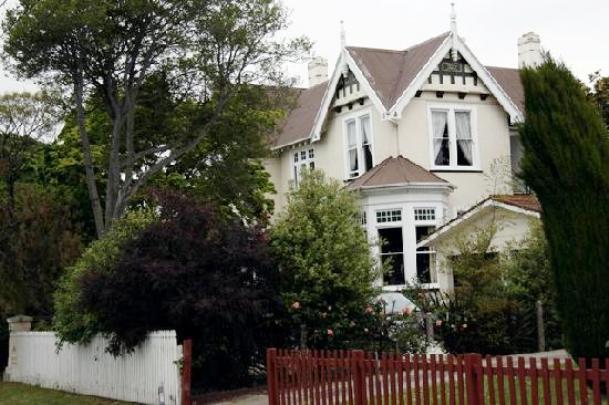
This substantial two-storey timber residence was built in 1901 as the third manse for the St Paul’s Presbyterian Church and was later home to a private maternity hospital. St Paul’s Manse (Former) has historical and architectural significance; designed by Oamaru architect John Megget Forrester, it stands as a reminder of the significance of the Presbyterian Church in early twentieth century Oamaru and of the life of the incumbent minister.
The previous manse, built in 1871, was situated on Humber Street – an inconvenient, noisy, and smoky location close to the main trunk line. In 1899, a new site was needed when the church managers accepted an offer from a businessman to buy the manse and grounds. A building committee was appointed and one of their first tasks was to consider James Meikle’s offer to sell his house and five sections for £350. After several other offers and a reorganising of the committee, the church purchased Meikle’s property at a price of £360. Architect John Megget Forrester was invited to prepare plans for a two storey wooden dwelling. Forrester called for tenders in October 1900.
The plan shows a large residence. The ground floor contained a dining room, drawing room bedroom, kitchen, scullery, pantry, hall, stair and a passage. The ground floor had a large verandah, a covered back porch, as well as a wash house and coal shed. The first floor had five bedrooms, a study, a bathroom, linen closet and a north facing balcony. There were fire places in most rooms. Builder James Sinclair’s tender of £1048 was accepted. Sinclair began work around October 1900. A further tender was accepted for erecting a corrugated iron fence to Reed Street.
Reverend Robert Porter and his family moved in to the manse in 1901. Porter’s health declined in 1914 and he resigned in January 1915. The next minister was Reverend Dr Samuel Hunter who lived there until 1924. Reverend Ivo Bertram was inducted to St Paul’s in February 1924. When Bertram resigned in 1927, the church managers decided to build another manse. The manse was sold to Oamaru jeweller Edward Mills.
Six years later sisters Robina and Elizabeth (and later their sister Jessica) Symington purchased the house and after significant additions and alterations opened their Glen Mavis Maternity Hospital in 1934. They altered the house to make it suitable for hospital activities – they closed in the balcony, put in a fire escape, built two toilets and a sluice room on the landing, converted the southernmost back bedroom into a delivery room, and built a detached room on the southern side to house staff. After the Symington era, Glen Mavis was leased for two years by the Waitaki Hospital Board pending the construction of a maternity ward attached to the hospital. Glen Mavis closed as a maternity home in October 1946.
Jessie Symington and her niece (and children) returned to Glen Mavis in 1946. The house was run as a bed and breakfast for several years and then partly converted into flats. Following Jessie's death, her niece Margaret Anderson remained at Glen Mavis until December 1971. Owners in the 1980s converted the building back to a single residence. In later years, the former manse has been home to Oamaru Creek Bed and Breakfast. In 2015, the house still provides accommodation as Oamaru Creek Bed and Breakfast.
The previous manse, built in 1871, was situated on Humber Street – an inconvenient, noisy, and smoky location close to the main trunk line. In 1899, a new site was needed when the church managers accepted an offer from a businessman to buy the manse and grounds. A building committee was appointed and one of their first tasks was to consider James Meikle’s offer to sell his house and five sections for £350. After several other offers and a reorganising of the committee, the church purchased Meikle’s property at a price of £360. Architect John Megget Forrester was invited to prepare plans for a two storey wooden dwelling. Forrester called for tenders in October 1900.
The plan shows a large residence. The ground floor contained a dining room, drawing room bedroom, kitchen, scullery, pantry, hall, stair and a passage. The ground floor had a large verandah, a covered back porch, as well as a wash house and coal shed. The first floor had five bedrooms, a study, a bathroom, linen closet and a north facing balcony. There were fire places in most rooms. Builder James Sinclair’s tender of £1048 was accepted. Sinclair began work around October 1900. A further tender was accepted for erecting a corrugated iron fence to Reed Street.
Reverend Robert Porter and his family moved in to the manse in 1901. Porter’s health declined in 1914 and he resigned in January 1915. The next minister was Reverend Dr Samuel Hunter who lived there until 1924. Reverend Ivo Bertram was inducted to St Paul’s in February 1924. When Bertram resigned in 1927, the church managers decided to build another manse. The manse was sold to Oamaru jeweller Edward Mills.
Six years later sisters Robina and Elizabeth (and later their sister Jessica) Symington purchased the house and after significant additions and alterations opened their Glen Mavis Maternity Hospital in 1934. They altered the house to make it suitable for hospital activities – they closed in the balcony, put in a fire escape, built two toilets and a sluice room on the landing, converted the southernmost back bedroom into a delivery room, and built a detached room on the southern side to house staff. After the Symington era, Glen Mavis was leased for two years by the Waitaki Hospital Board pending the construction of a maternity ward attached to the hospital. Glen Mavis closed as a maternity home in October 1946.
Jessie Symington and her niece (and children) returned to Glen Mavis in 1946. The house was run as a bed and breakfast for several years and then partly converted into flats. Following Jessie's death, her niece Margaret Anderson remained at Glen Mavis until December 1971. Owners in the 1980s converted the building back to a single residence. In later years, the former manse has been home to Oamaru Creek Bed and Breakfast. In 2015, the house still provides accommodation as Oamaru Creek Bed and Breakfast.