DonateMembershipVisit Heritage
  • Tūrangawaewae
    Places
  • Tira Māori
    Māori Heritage
  • Poutairangahia
    Archaeology
  • Rauemi
    Resources
  • Mō Tātou
    About Us
  • New Zealand Heritage List
  • Nominate and submit
  • Explore the List
  • National Historic Landmarks
  • Plaques
  • Rainbow List Project
  • Lost heritage
  • Visit Heritage
  • Our properties
  • Turnbull House Project
  • Collections
  • Shop
  • Tohu Whenua
  • Tira Māori
  • Conserving Māori heritage
  • Marae built heritage
  • Māori heritage on the List
  • Hinemihi—Te Hokinga Mai
  • What is archaeology?
  • Is there a site on my property?
  • What are my legal requirements?
  • Affecting an archaeological site
  • Declaring an archaeological site
  • Archaeology FAQs
  • Archaeology Digital Library
  • Archaeology guidelines and templates
  • Resources
  • Funding
  • Publications
  • Sustainable management guides
  • Disaster recovery
  • Podcasts & digital resources
  • Education Hub
  • Conservation plans
  • About
  • Board
  • Māori Heritage Council
  • Senior Staff
  • Offices
  • Contact us
  • Careers
  • Covenants
  • Fast-track
  • Corporate documents
  • Currently consulting on
  • Our submissions
  • News
  • Covid-19 response
Quick links
Rārangi Kōrero | The List
Explore the List
National Historic Landmarks
Ngā Manawhenua o Aotearoa me ōna Kōrero Tūturu
Quick links
Tapuwae
A Vision for Places of Māori Heritage
Funding for Māori Heritage
Resources
Quick links
Archaeological Authority Portal
Applying for an archaeological authority
Archaeology FAQs
Browse the most frequently asked questions about archaeological authorities and the archaeological process.
Quick links
Quick links
News
News Keep up to date with Heritage New Zealand Pouhere Taonga
Membership
Membership Find out more and sign up today
DonateMembershipVisit Heritage
  • Tūrangawaewae
    Places
  • Tira Māori
    Māori Heritage
  • Poutairangahia
    Archaeology
  • Rauemi
    Resources
  • Mō Tātou
    About Us
  • New Zealand Heritage List
  • Nominate and submit
  • Explore the List
  • National Historic Landmarks
  • Plaques
  • Rainbow List Project
  • Lost heritage
  • Visit Heritage
  • Our properties
  • Turnbull House Project
  • Collections
  • Shop
  • Tohu Whenua
  • Tira Māori
  • Conserving Māori heritage
  • Marae built heritage
  • Māori heritage on the List
  • Hinemihi—Te Hokinga Mai
  • What is archaeology?
  • Is there a site on my property?
  • What are my legal requirements?
  • Affecting an archaeological site
  • Declaring an archaeological site
  • Archaeology FAQs
  • Archaeology Digital Library
  • Archaeology guidelines and templates
  • Resources
  • Funding
  • Publications
  • Sustainable management guides
  • Disaster recovery
  • Podcasts & digital resources
  • Education Hub
  • Conservation plans
  • About
  • Board
  • Māori Heritage Council
  • Senior Staff
  • Offices
  • Contact us
  • Careers
  • Covenants
  • Fast-track
  • Corporate documents
  • Currently consulting on
  • Our submissions
  • News
  • Covid-19 response
Quick links
Rārangi Kōrero | The List
Explore the List
National Historic Landmarks
Ngā Manawhenua o Aotearoa me ōna Kōrero Tūturu
Quick links
Tapuwae
A Vision for Places of Māori Heritage
Funding for Māori Heritage
Resources
Quick links
Archaeological Authority Portal
Applying for an archaeological authority
Archaeology FAQs
Browse the most frequently asked questions about archaeological authorities and the archaeological process.
Quick links
Quick links
News
News Keep up to date with Heritage New Zealand Pouhere Taonga
Membership
Membership Find out more and sign up today
  • Places
  • Nominate and submit
  • National Historic Landmarks
  • Places
  • Nominate and submit
  • National Historic Landmarks
  • Tira Māori
  • Conserving Māori heritage
  • Marae built heritage
  • Tira Māori
  • Conserving Māori heritage
  • Marae built heritage
  • Archaeological authorities
  • Archaeology Digital Library
  • Archaeological authorities
  • Archaeology Digital Library
  • All resources
  • Publications
  • Funding
  • All resources
  • Publications
  • Funding
  • FAQs
  • FAQs
Follow us on:
Places
  • Places
  • Nominate and submit
  • National Historic Landmarks
Tira Māori
  • Tira Māori
  • Conserving Māori heritage
  • Marae built heritage
Archaeology
  • Archaeological authorities
  • Archaeology Digital Library
Resources
  • All resources
  • Publications
  • Funding
FAQs
  • FAQs
Follow us on
HomePrivacyTerms and conditionsAbout this site
© Heritage New Zealand Pouhere Taonga 2026.
 
Christ's College Memorial Dining Room

33 Rolleston Avenue, CHRISTCHURCH

Private

Historic Place Category 1

List No. 3276

Quick links:
List GalleryLocationDetails
Christ's College began in April 1851, as the Collegiate Grammar School, run from two rooms at the immigration barracks at Lyttelton. The Canterbury Association had planned for such a school before its ships left England, stating that it was to be based on 'the great Grammar Schools of England'. It is not surprising that the Canterbury Association, with their attempts to transpose a cross-section of English society to New Zealand, modelled their first school on the public schools of England with their reputation for turning out an élite ready to administer and defend the British Empire. Christ's College is now the oldest and one of the most prestigious private boys' school in New Zealand.

In 1852 Collegiate Grammar moved to Christchurch and by 1857 was established on its current grounds adjacent to Hagley Park. The buildings of the school were laid out around a quadrangle following the English tradition.

The dining room at Christ's College was designed by Cecil Wood (1878-1947), a noted Christchurch architect, who had a long association with the college. Designed as a memorial to the Old Boys of the college who served in the First World War, it was built in 1925. Of the former pupils and masters of Christ's College who had served in World War I, 44 percent had been killed or injured. Numerous World War I memorials were erected by New Zealand schools, particularly by the large boys' schools. Such memorials were often elaborate and costly structures, with the Christ's College Memorial Dining Room costing more than twice that of the Bridge of Remembrance, one of Christchurch's major World War I memorials.

That the war memorial at Christ's College took the form of a dining hall was due to a 1917 decision by the school board of governors to have a common dining room. It was subsequently decided that this much needed facility would be an appropriate memorial to the dead and wounded. The Old Boys' Association raised £23,000 for the construction of the hall, over eighty percent of the final cost.

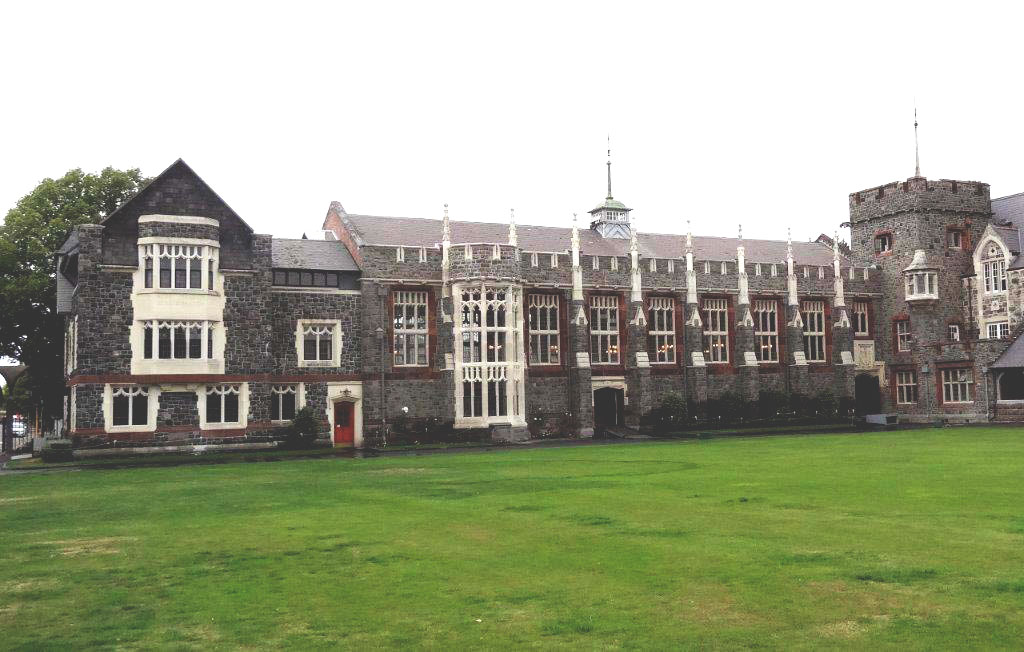
There was some debate over the siting of the hall. Eventually the wishes of the new headmaster, E. C. Crosse, were adopted and the hall was sited on Rolleston Avenue, in order to provide the College with a physical presence on the street. Wood's design for the hall, described as 'one of his finest', established a square tower at the south end of the hall to connect it to the adjacent 1886 block, designed by Benjamin Woolfield Mountfort. An administration wing was housed both within the tower and in a utilitarian three-storeyed block attached to the south end of the hall. The buttresses are a prominent feature of the building and enliven its rectangular bulk, as does the use of white Oamaru and red Redcliff stone facings.

For many years the north wall of the dining hall was plain unornamented brick, as it had always been planned to extend the hall at this end with an office block and gateway. Wood was asked to draw up plans for such an extension during the 1940s but lack of funding meant his proposal was never built. A new block, to house the school's administration offices and boardroom, was eventually built at the north end of the hall in 1986-1988 to a design by Sir Miles Warren.

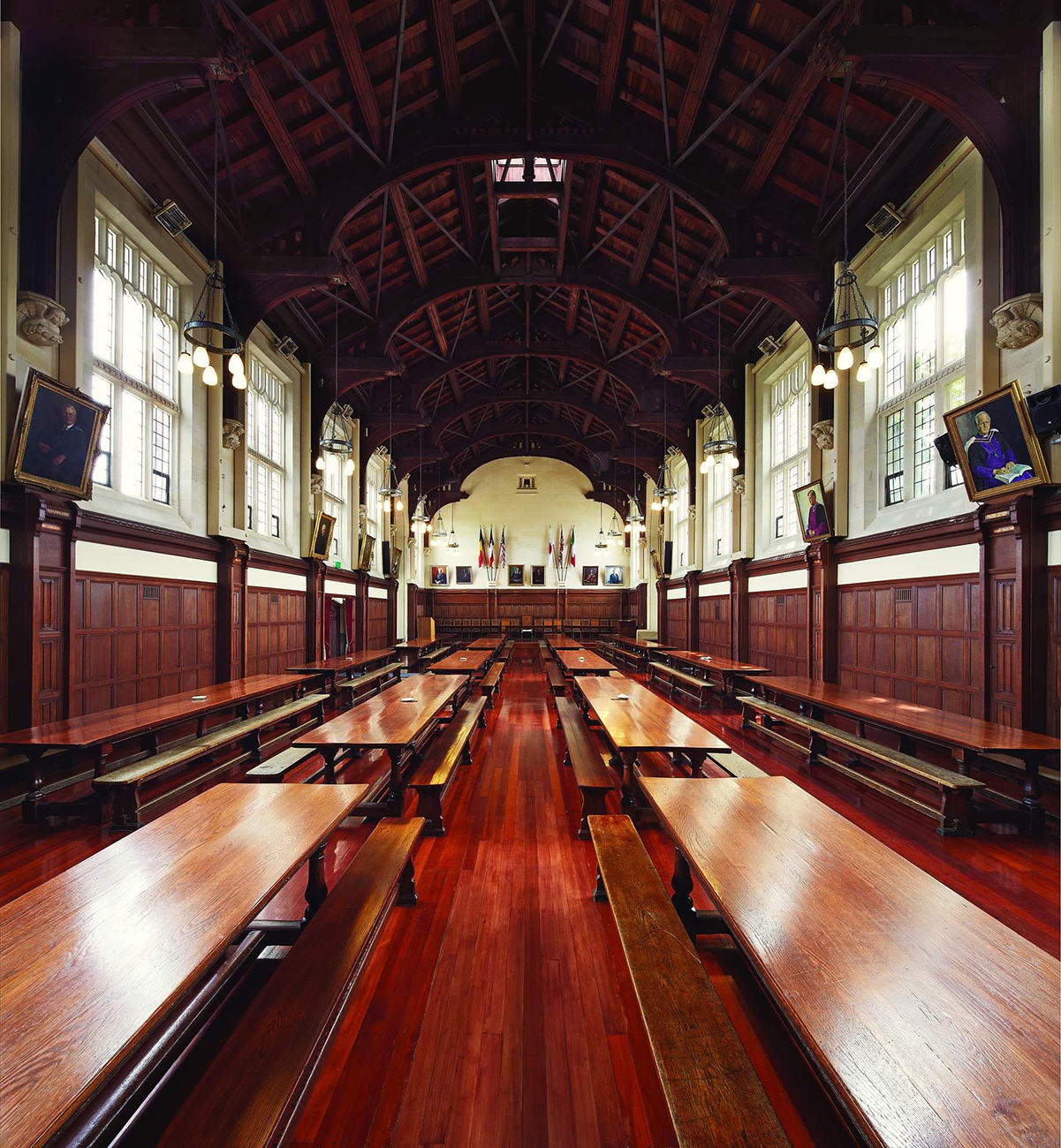
The interior of the dining hall was based upon the medieval manor halls of England and in particular on the Great Hall at Christ Church, Oxford. It is timber panelled to halfway up the wall and some of the panelling is linenfold, that is ornamented with a stylised representation of linen folded vertically. The upper part of the wall was lined with Oamaru stone. As was typical of medieval halls (and later collegiate examples) there is a raised dais at one end of the hall, which is lit by the two oriel-bay windows, and a 'musicians' gallery at the other end. The timber roof is supported on hammerbeam trusses, a style of construction made famous by its use in Westminster Hall (1394-1406). The carvings, in both wood and stone, that decorate the dining hall were undertaken by the noted Christchurch carver, Frederick Gurnsey (1868-1953).

Nearly twenty years after the hall was completed, Gurnsey also carved the lectern, to Wood's design, which holds the memorial register. This register was designed in the form of an illuminated manuscript by W. A. Sutton, a prominent Canterbury artist, and it lists the names of all Old Boys who served in the war. Traditionally a page is turned and read each day at lunchtime.

Christ's College Memorial Dining Hall has been described as Wood's masterpiece. At the time it was opened it was greatly appreciated by the architect Samuel Hurst Seager, who saw it as a fine example of traditional architectural principles with a modern note, and it was praised in contemporary newspaper reports. It is an important part of the Christ's College complex of buildings and part of the Gothic Revival townscape of Rolleston Avenue which includes the Canterbury Museum and the Christchurch Arts Centre. The architecture of the hall reflects the school's English origins and traditions and although it is a later addition to the quadrangle, it blends in with the earlier buildings. The hall is a significant memorial to the former pupils and staff of Christ's College who fought in the First World War and one of the major First World War memorials in Christchurch. It played a major role in increasing Wood' s reputation and stands alongside the best of contemporary Collegiate Gothic buildings in both Britain and the United States. The hall also contains many fine examples of Gurnsey's work.
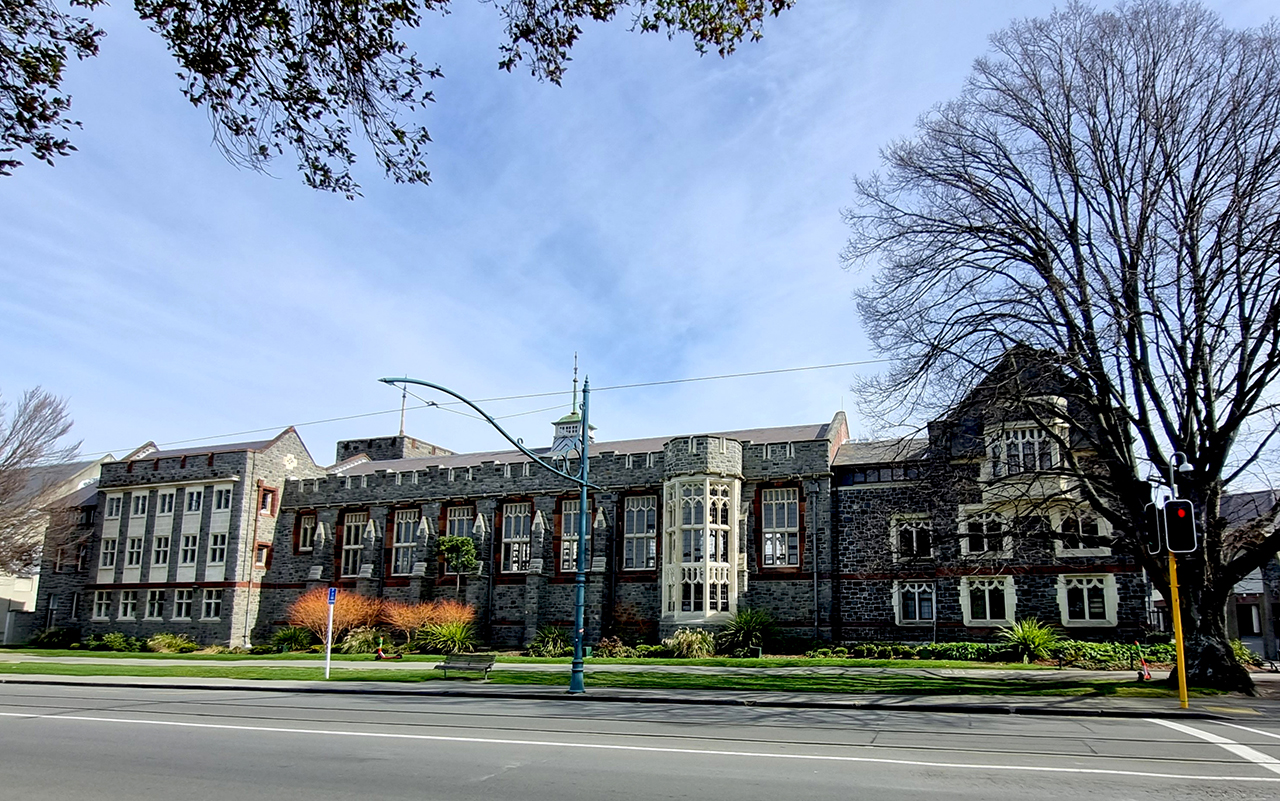
Christ's College Memorial Dining Room, Christchurch | Robyn Burgess | 07/09/2022 | Heritage New Zealand Pouhere Taonga
Christ's College Memorial Dining Room, Christchurch. CC BY-ND 2.0 Image courtesy of www.flickr.com | denisbin | 07/02/2017 | denisbin
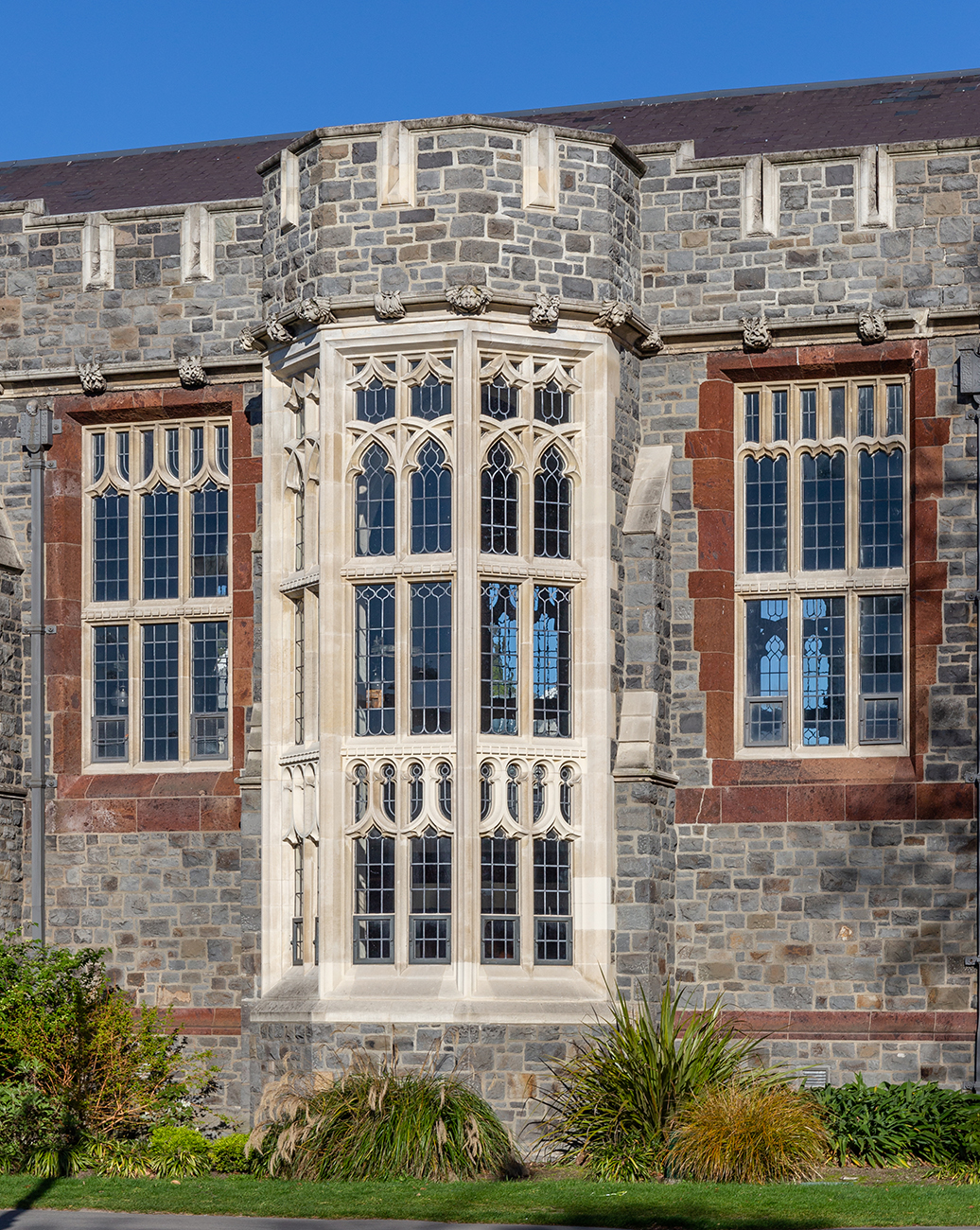
Christ's College Memorial Dining Room, Christchurch. Exterior detail CC BY-SA 4.0 Image courtesy of commons.wikimedia.org | Michal Kajban | 23/09/2020 | Michal Kajban - Wikimedia Commons
Christ's College Memorial Dining Room, Christchurch. Interior image courtesy of Christ's College photos facebook.com College's Dining Hall recognised with a 2022 Canterbury Architecture Award for Enduring Architecture | 20/07/2022 | © 2011 Lightworkx Photography
Christ's College Memorial Dining Room, Christchurch | Robyn Burgess | 07/09/2022 | Heritage New Zealand Pouhere Taonga
Christ's College Memorial Dining Room, Christchurch. CC BY-ND 2.0 Image courtesy of www.flickr.com | denisbin | 07/02/2017 | denisbin
Christ's College Memorial Dining Room, Christchurch. Exterior detail CC BY-SA 4.0 Image courtesy of commons.wikimedia.org | Michal Kajban | 23/09/2020 | Michal Kajban - Wikimedia Commons
Christ's College Memorial Dining Room, Christchurch. Interior image courtesy of Christ's College photos facebook.com College's Dining Hall recognised with a 2022 Canterbury Architecture Award for Enduring Architecture | 20/07/2022 | © 2011 Lightworkx Photography

List Entry Information

Overview

Status
Listed

List Entry Status
Historic Place Category 1

Access
Private/No Public Access

List Number
3276

Date Entered
27th June 1985

Date of Effect
27th June 1985

City/District Council
Christchurch City

Region
Canterbury Region

Legal description

*Pt Res 25

Location Description

On east side of Christ's College quadrangle. Borders Rolleston Avenue.

Detailed List Entry

Construction Professional

Name

Warren, Sir Miles

Type

Architect

Biography

No biography is currently available for this construction professional

Name

Gurnsey, Frederick George

Type

Carver

Biography

Frederick George Gurnsey (1868 - 1953) was born in Wales. He was apprenticed to Harry Hems and Company, a leading ecclesiastical carving firm in Exeter, and worked for them once his apprenticeship was complete. Gurnsey visited New Zealand in 1904-1905 and returned in 1907 when he was appointed as an instructor at the Canterbury College School of Art in Christchurch. At the School of Art he taught carving, modelling, casting, enamelling and metalwork, and was the acting director of the school from September 1917 to April 1920. He resigned in 1923 to become a full-time carver. Gurnsey executed thousands of carvings, in both wood and stone, for churches, civic buildings, public monuments and various private commissions. Some of his more prominent carvings include the reredos in the Christchurch cathedral, his work in the Chapel of St Michael and St George, the carvings on the Bridge of Remembrance in Christchurch (1924), those on the Massey Memorial in Wellington (1930), and those in the Church of the Good Shepherd at Tekapo.(1935). During the Depression Gurnsey diversified into making domestic furniture. He has been described as 'one of the greatest European carvers ever to have worked in New Zealand', although due to his personal modesty and the way in which carving falls somewhere between fine arts and craft, his achievements have, until recently, largely been unrecognised. Confident with carving in both wood and stone, Gurnsey was responsible for many beautiful works, particularly in the South Island.

Name

Wood, Cecil Walter

Type

Architect

Biography

Born in Christchurch, Wood (1878-1947) was articled to the local architect Frederick Strouts between 1894 and 1899. He worked for a short time as a draughtsman with the firm Clarkson and Ballantyne before travelling to England in 1901. Here Wood was exposed to a high quality of architectural design in the Edwardian Free Style, and was employed by two leading Edwardian architects Robert Weir Shultz and Leonard Stokes. In 1907 Wood returned to New Zealand to take up partnership with Samuel Hurst Seager. The partnership lasted for only one year for Wood set up his own practice in 1908. The years 1908-1915 were dominated by domestic commissions, but it was also during this time that he began his association with Christ's College, which included such commissions as Hare Memorial Library (1915), the Memorial Dining Hall (1923-5), Jacob's House (1931) and Open Air Classrooms (1932). During the 1920s Wood's practice began to expand and a Georgian influence can be seen in such works as Weston House Park Terrace (1923-4) and Bishopscourt (1926-7). A short lived partnership in 1927 with R S D Harman allowed Wood to travel to the United States while another in 1937 with Paul Pascoe allowed him to travel to England, Europe and the United States without neglecting his practice. During this second trip he made preparations for the design of St Paul's Anglican Cathedral in Wellington, which was erected after his death. During his life Wood had made a substantial contribution to the architecture of Christchurch, having an enthusiasm for both European and American styles.

Construction Details

Start Year

1922

Finish Year

1925

Type

Original Construction

Description

Foundation Stone laid

Start Year

1986

Finish Year

1988

Type

Addition

Description

Addition to north end. Designed by Sir Miles Warren and used as administration offices. T-plan, gabled roof, similar stone use in both exterior and facings

Start Year

1919

Type

Designed

Description

First plans for original site. Subsequently revised

Notable Features

The Memorial Dining Hall is the work of noted Canterbury architect Cecil Wood and is an accomplished example of the Collegiate Gothic style. Wood had earlier designed the Hare Memorial Library (1915-16) in the Edwardian Free Style but the Dining Hall is a more formal building with a strong emphasis on the verticality of its Gothic Revival influenced design. Wood was familiar with the Collegiate Gothic style in both its British and American contexts. The Hall has a rectangular footprint and features a crenelated parapet with finials on the Main Quadrangle (western) elevation, leaded glass windows with Perpendicular Gothic tracery, buttresses and two double height bay windows. Internally the dining hall is modelled on traditional public school dining halls with its heavily panelled timber walls, portraits, timber floor, roof trusses and decorative detail. Wood also designed the tower linking the Dining Hall to Mountfort's New Classrooms. In 1987-88 the addition of an Administration Building to the north wall of the Dining Hall was made to designs by the firm of Warren and Mahoney that follow Wood's original Dining Hall aesthetic.

Reference

Information Sources

Hamilton, 1991

Don Hamilton, The Buildings of Christ's College 1850 - 1990, Christchurch, 1991

Hamilton, 1996

Don Hamilton, College!: A history of Christ's College, Christchurch, 1996

Helms, 1996

Ruth M. Helms, 'The architecture of Cecil Wood', PhD thesis, University of Canterbury, 1996

Report Written By

This place was identified as significant under previous legislation with different information requirements. It remains significant under the current legislation. There is opportunity under our legislation and policies to add to this information. Further information about this place may be available from the Southern Regional Office of Heritage New Zealand Pouhere Taonga. Please note that entry on the New Zealand Heritage List/Rarangi Korero identifies only the heritage values of the property concerned, and should not be construed as advice on the state of the property, or as a comment of its soundness or safety, including in regard to earthquake risk, safety in the event of fire, or insanitary conditions.

Further Information

Current Usages

Uses: Education

Specific Usage: Education - other

Former Usages

General Usage:: Education

Specific Usage: Education - other

Themes

Web Links

description:

url: http://www.christscollege.com/

Overview

Status

Listed

List Entry Status

Historic Place Category 1

Access

Private/No Public Access

List Number

3276

Date Entered

27th June 1985

Date of Effect

27th June 1985

City/District Council

Christchurch City

Region

Canterbury Region

Legal description

*Pt Res 25

Location Description

On east side of Christ's College quadrangle. Borders Rolleston Avenue.

Status

Listed

List Entry Status

Historic Place Category 1

Access

Private/No Public Access

List Number

3276

Date Entered

27th June 1985

Date of Effect

27th June 1985

City/District Council

Christchurch City

Region

Canterbury Region

Legal description

*Pt Res 25

Location Description

On east side of Christ's College quadrangle. Borders Rolleston Avenue.

Construction Information

Construction Professional

Name

Warren, Sir Miles

Type

Architect

Biography

No biography is currently available for this construction professional

Name

Gurnsey, Frederick George

Type

Carver

Biography

Frederick George Gurnsey (1868 - 1953) was born in Wales. He was apprenticed to Harry Hems and Company, a leading ecclesiastical carving firm in Exeter, and worked for them once his apprenticeship was complete. Gurnsey visited New Zealand in 1904-1905 and returned in 1907 when he was appointed as an instructor at the Canterbury College School of Art in Christchurch. At the School of Art he taught carving, modelling, casting, enamelling and metalwork, and was the acting director of the school from September 1917 to April 1920. He resigned in 1923 to become a full-time carver. Gurnsey executed thousands of carvings, in both wood and stone, for churches, civic buildings, public monuments and various private commissions. Some of his more prominent carvings include the reredos in the Christchurch cathedral, his work in the Chapel of St Michael and St George, the carvings on the Bridge of Remembrance in Christchurch (1924), those on the Massey Memorial in Wellington (1930), and those in the Church of the Good Shepherd at Tekapo.(1935). During the Depression Gurnsey diversified into making domestic furniture. He has been described as 'one of the greatest European carvers ever to have worked in New Zealand', although due to his personal modesty and the way in which carving falls somewhere between fine arts and craft, his achievements have, until recently, largely been unrecognised. Confident with carving in both wood and stone, Gurnsey was responsible for many beautiful works, particularly in the South Island.

Name

Wood, Cecil Walter

Type

Architect

Biography

Born in Christchurch, Wood (1878-1947) was articled to the local architect Frederick Strouts between 1894 and 1899. He worked for a short time as a draughtsman with the firm Clarkson and Ballantyne before travelling to England in 1901. Here Wood was exposed to a high quality of architectural design in the Edwardian Free Style, and was employed by two leading Edwardian architects Robert Weir Shultz and Leonard Stokes. In 1907 Wood returned to New Zealand to take up partnership with Samuel Hurst Seager. The partnership lasted for only one year for Wood set up his own practice in 1908. The years 1908-1915 were dominated by domestic commissions, but it was also during this time that he began his association with Christ's College, which included such commissions as Hare Memorial Library (1915), the Memorial Dining Hall (1923-5), Jacob's House (1931) and Open Air Classrooms (1932). During the 1920s Wood's practice began to expand and a Georgian influence can be seen in such works as Weston House Park Terrace (1923-4) and Bishopscourt (1926-7). A short lived partnership in 1927 with R S D Harman allowed Wood to travel to the United States while another in 1937 with Paul Pascoe allowed him to travel to England, Europe and the United States without neglecting his practice. During this second trip he made preparations for the design of St Paul's Anglican Cathedral in Wellington, which was erected after his death. During his life Wood had made a substantial contribution to the architecture of Christchurch, having an enthusiasm for both European and American styles.

Construction Details

Start Year

1922

Finish Year

1925

Type

Original Construction

Description

Foundation Stone laid

Start Year

1986

startYearCirca

Finish Year

1988

Type

Addition

Description

Addition to north end. Designed by Sir Miles Warren and used as administration offices. T-plan, gabled roof, similar stone use in both exterior and facings

Start Year

1919

Type

Designed

Description

First plans for original site. Subsequently revised

Notable Features

The Memorial Dining Hall is the work of noted Canterbury architect Cecil Wood and is an accomplished example of the Collegiate Gothic style. Wood had earlier designed the Hare Memorial Library (1915-16) in the Edwardian Free Style but the Dining Hall is a more formal building with a strong emphasis on the verticality of its Gothic Revival influenced design. Wood was familiar with the Collegiate Gothic style in both its British and American contexts. The Hall has a rectangular footprint and features a crenelated parapet with finials on the Main Quadrangle (western) elevation, leaded glass windows with Perpendicular Gothic tracery, buttresses and two double height bay windows. Internally the dining hall is modelled on traditional public school dining halls with its heavily panelled timber walls, portraits, timber floor, roof trusses and decorative detail. Wood also designed the tower linking the Dining Hall to Mountfort's New Classrooms. In 1987-88 the addition of an Administration Building to the north wall of the Dining Hall was made to designs by the firm of Warren and Mahoney that follow Wood's original Dining Hall aesthetic.

Construction Professional

Name

Warren, Sir Miles

Type

Architect

Biography

No biography is currently available for this construction professional

Name

Gurnsey, Frederick George

Type

Carver

Biography

Frederick George Gurnsey (1868 - 1953) was born in Wales. He was apprenticed to Harry Hems and Company, a leading ecclesiastical carving firm in Exeter, and worked for them once his apprenticeship was complete. Gurnsey visited New Zealand in 1904-1905 and returned in 1907 when he was appointed as an instructor at the Canterbury College School of Art in Christchurch. At the School of Art he taught carving, modelling, casting, enamelling and metalwork, and was the acting director of the school from September 1917 to April 1920. He resigned in 1923 to become a full-time carver. Gurnsey executed thousands of carvings, in both wood and stone, for churches, civic buildings, public monuments and various private commissions. Some of his more prominent carvings include the reredos in the Christchurch cathedral, his work in the Chapel of St Michael and St George, the carvings on the Bridge of Remembrance in Christchurch (1924), those on the Massey Memorial in Wellington (1930), and those in the Church of the Good Shepherd at Tekapo.(1935). During the Depression Gurnsey diversified into making domestic furniture. He has been described as 'one of the greatest European carvers ever to have worked in New Zealand', although due to his personal modesty and the way in which carving falls somewhere between fine arts and craft, his achievements have, until recently, largely been unrecognised. Confident with carving in both wood and stone, Gurnsey was responsible for many beautiful works, particularly in the South Island.

Name

Wood, Cecil Walter

Type

Architect

Biography

Born in Christchurch, Wood (1878-1947) was articled to the local architect Frederick Strouts between 1894 and 1899. He worked for a short time as a draughtsman with the firm Clarkson and Ballantyne before travelling to England in 1901. Here Wood was exposed to a high quality of architectural design in the Edwardian Free Style, and was employed by two leading Edwardian architects Robert Weir Shultz and Leonard Stokes. In 1907 Wood returned to New Zealand to take up partnership with Samuel Hurst Seager. The partnership lasted for only one year for Wood set up his own practice in 1908. The years 1908-1915 were dominated by domestic commissions, but it was also during this time that he began his association with Christ's College, which included such commissions as Hare Memorial Library (1915), the Memorial Dining Hall (1923-5), Jacob's House (1931) and Open Air Classrooms (1932). During the 1920s Wood's practice began to expand and a Georgian influence can be seen in such works as Weston House Park Terrace (1923-4) and Bishopscourt (1926-7). A short lived partnership in 1927 with R S D Harman allowed Wood to travel to the United States while another in 1937 with Paul Pascoe allowed him to travel to England, Europe and the United States without neglecting his practice. During this second trip he made preparations for the design of St Paul's Anglican Cathedral in Wellington, which was erected after his death. During his life Wood had made a substantial contribution to the architecture of Christchurch, having an enthusiasm for both European and American styles.

Construction Details

Start Year

1922

Finish Year

1925

Type

Original Construction

Description

Foundation Stone laid

Start Year

1986

startYearCirca

Finish Year

1988

Type

Addition

Description

Addition to north end. Designed by Sir Miles Warren and used as administration offices. T-plan, gabled roof, similar stone use in both exterior and facings

Start Year

1919

Type

Designed

Description

First plans for original site. Subsequently revised

Notable Features

The Memorial Dining Hall is the work of noted Canterbury architect Cecil Wood and is an accomplished example of the Collegiate Gothic style. Wood had earlier designed the Hare Memorial Library (1915-16) in the Edwardian Free Style but the Dining Hall is a more formal building with a strong emphasis on the verticality of its Gothic Revival influenced design. Wood was familiar with the Collegiate Gothic style in both its British and American contexts. The Hall has a rectangular footprint and features a crenelated parapet with finials on the Main Quadrangle (western) elevation, leaded glass windows with Perpendicular Gothic tracery, buttresses and two double height bay windows. Internally the dining hall is modelled on traditional public school dining halls with its heavily panelled timber walls, portraits, timber floor, roof trusses and decorative detail. Wood also designed the tower linking the Dining Hall to Mountfort's New Classrooms. In 1987-88 the addition of an Administration Building to the north wall of the Dining Hall was made to designs by the firm of Warren and Mahoney that follow Wood's original Dining Hall aesthetic.

Reference

Historical and Associated Iwi / Hapū / Whānau

Information Sources

Hamilton, 1991

Don Hamilton, The Buildings of Christ's College 1850 - 1990, Christchurch, 1991

Hamilton, 1996

Don Hamilton, College!: A history of Christ's College, Christchurch, 1996

Helms, 1996

Ruth M. Helms, 'The architecture of Cecil Wood', PhD thesis, University of Canterbury, 1996

Other Information

This place was identified as significant under previous legislation with different information requirements. It remains significant under the current legislation. There is opportunity under our legislation and policies to add to this information. Further information about this place may be available from the Southern Regional Office of Heritage New Zealand Pouhere Taonga. Please note that entry on the New Zealand Heritage List/Rarangi Korero identifies only the heritage values of the property concerned, and should not be construed as advice on the state of the property, or as a comment of its soundness or safety, including in regard to earthquake risk, safety in the event of fire, or insanitary conditions.

Historical and Associated Iwi / Hapū / Whānau

Information Sources

Hamilton, 1991

Don Hamilton, The Buildings of Christ's College 1850 - 1990, Christchurch, 1991

Hamilton, 1996

Don Hamilton, College!: A history of Christ's College, Christchurch, 1996

Helms, 1996

Ruth M. Helms, 'The architecture of Cecil Wood', PhD thesis, University of Canterbury, 1996

Other Information

This place was identified as significant under previous legislation with different information requirements. It remains significant under the current legislation. There is opportunity under our legislation and policies to add to this information. Further information about this place may be available from the Southern Regional Office of Heritage New Zealand Pouhere Taonga. Please note that entry on the New Zealand Heritage List/Rarangi Korero identifies only the heritage values of the property concerned, and should not be construed as advice on the state of the property, or as a comment of its soundness or safety, including in regard to earthquake risk, safety in the event of fire, or insanitary conditions.

Further Information

Current Usages

Uses: Education

Specific Usage: Education - other

Former Usages

General Usage: Education

Specific Usage: Education - other

Web Links

description:

url: http://www.christscollege.com/

Current Usages

Uses: Education

Specific Usage: Education - other

Former Usages

General Usage: Education

Specific Usage: Education - other

Web Links

description:

url: http://www.christscollege.com/

Location

Loading
Related listings
Christ's College Chapel, Christchurch. Image used with permission from Kim Chan Events
Christ's College Chapel
Christ's College Jacobs House, Christchurch
Christ's College Jacobs House
Christ's College open air classrooms, Christchurch
Christ's College open air classrooms
Christ's College Big School, Christchurch
Christ's College Big School
Christ's College Hare Memorial Library, Christchurch
Christ's College Hare Memorial Library
Christ's College School House, Christchurch
Christ's College School House
Condells House (Former), Christs College, Christchurch. CC BY-SA 2.0 Image courtesy of www.flickr.com
Condells House (Former)
Christ's College Big School, Christchurch
Christ's College Big School
Christ's College Chapel, Christchurch. Image used with permission from Kim Chan Events
Christ's College Chapel
Christ's College Hare Memorial Library, Christchurch
Christ's College Hare Memorial Library
Christ's College Jacobs House, Christchurch
Christ's College Jacobs House
Christ's College School House, Christchurch
Christ's College School House
Christ's College open air classrooms, Christchurch
Christ's College open air classrooms
Condells House (Former), Christs College, Christchurch. CC BY-SA 2.0 Image courtesy of www.flickr.com
Condells House (Former)
Stay up to date with Heritage this month