

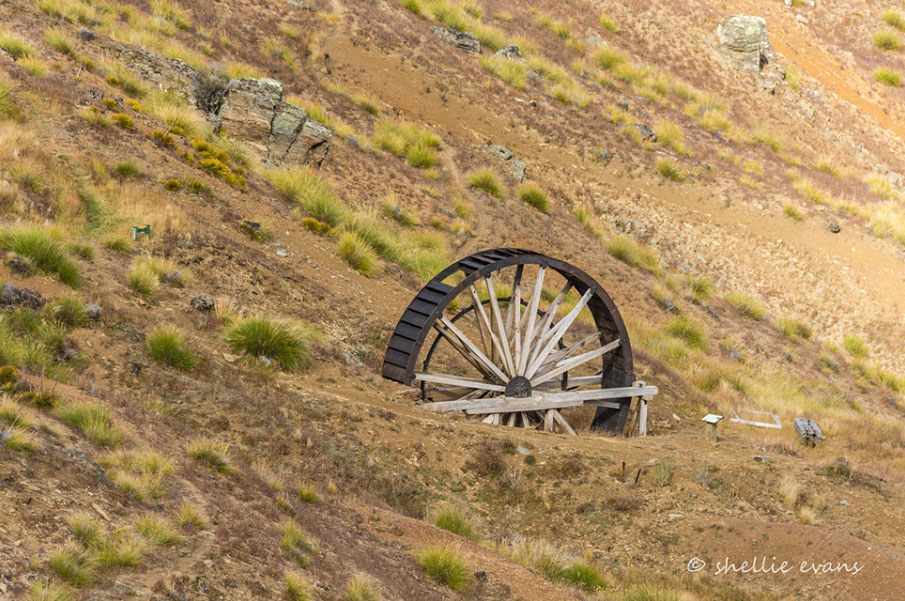
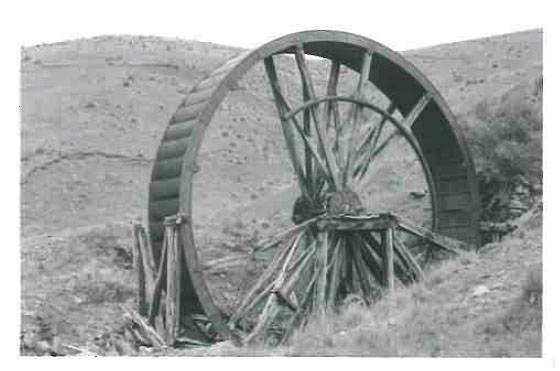
In the summer of 1874-1875, a large waterwheel almost 8 metres (26 feet) in diameter was built to power a stamper battery, a machine used to crush quartz. The wheel is of a kind known as an 'overshot' wheel. Water flowed onto the top of the wheel, then into buckets set in the rim. The collection of water in these buckets upset the balance of the wheel and forced it to turn. The support structure and framework of the wheel are made of wood, and the wheel has iron buckets around its perimeter, with an iron ring gear to drive the stamper battery. In 2001 the Department of Conservation replaced several of the wooden parts of the wheel, as deterioration over the years had made it unsafe.
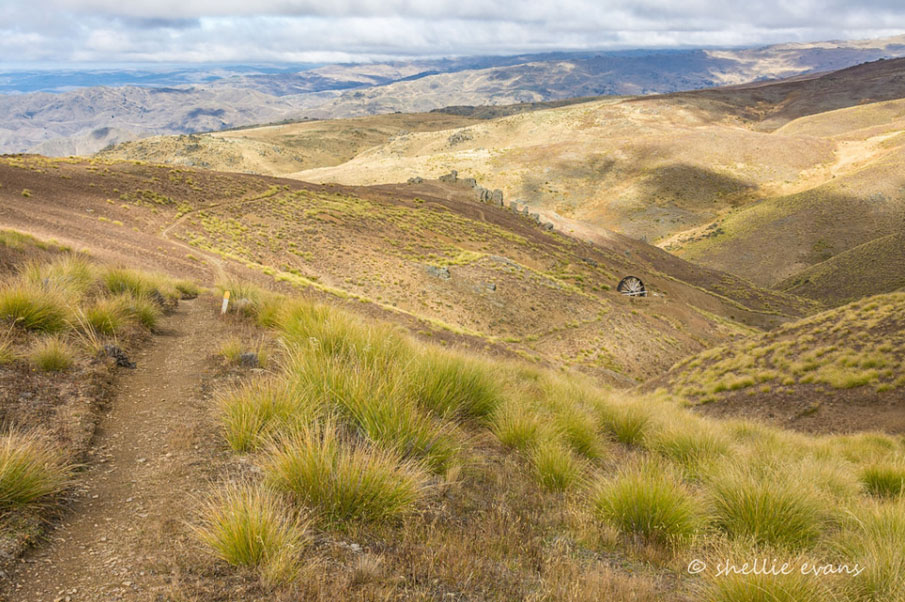
Because Otago is one of the driest areas of New Zealand, water was scarce, and to make this wheel operate, water had to be brought to the site along the 34km Carrick water race, the construction of which, in difficult terrain, was a major feat in itself. The line of the race is still evident on the hillside, and much of its length is still in use today for irrigation.
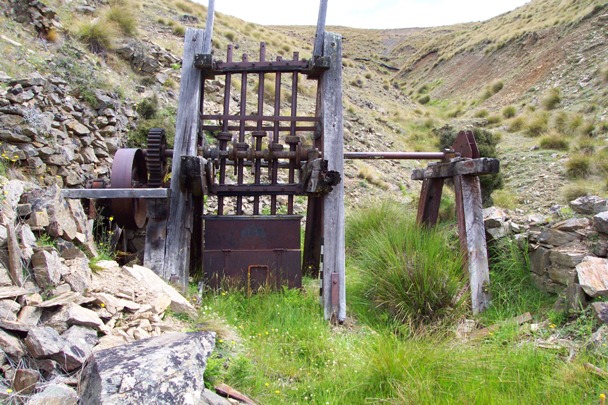
The wheel was in use for about ten years, after which the stamper battery (also registered as an historic place) was shifted to its current location, approximately one kilometre to the south-east. A flattened terrace adjacent to the wheel reveals where the battery used to be located. The area of the mine is now protected in the Young Australian Historic Reserve and is managed by the Department of Conservation.
The Young Australian water wheel is significant because it is one of the only remaining waterwheels still in place from the Central Otago goldrush. It demonstrates the process of quartz mining in the Otago region, and it is testimony to the efforts people expended to extract gold, within a harsh climate and difficult terrain. Despite the relocation of the stamper battery, the Young Australian mine site has remained more intact than many other quartz-mining sites in the region. The waterwheel also forms a dramatic reminder of the importance of water power in New Zealand's nineteenth-century industrial heritage.
List Entry Information
Status
Listed
List Entry Status
Historic Place Category 1
Access
Able to Visit
List Number
342
Date Entered
28th June 1984
Date of Effect
28th June 1984
City/District Council
Central Otago District
Region
Otago Region
Extent of List Entry
Extent includes part of the land described as Sec 2 Blk III Bannockburn SD, (RTs 3164, OT9B/221; NZ Gazette 1984, p. 493), Otago Land District and the structure known as the Young Australian Mine Company Waterwheel, thereon, and a 50m buffer from the waterwheel. Refer to the extent map tabled at the Heritage List/ Rārangi Kōrero Committee meeting on 10 December 2020
Legal description
Sec 2 Blk III Bannockburn SD, (RTs 3164, OT9B/221; NZ Gazette 1984, p. 493), Otago Land District
Status
Listed
List Entry Status
Historic Place Category 1
Access
Able to Visit
List Number
342
Date Entered
28th June 1984
Date of Effect
28th June 1984
City/District Council
Central Otago District
Region
Otago Region
Extent of List Entry
Extent includes part of the land described as Sec 2 Blk III Bannockburn SD, (RTs 3164, OT9B/221; NZ Gazette 1984, p. 493), Otago Land District and the structure known as the Young Australian Mine Company Waterwheel, thereon, and a 50m buffer from the waterwheel. Refer to the extent map tabled at the Heritage List/ Rārangi Kōrero Committee meeting on 10 December 2020
Legal description
Sec 2 Blk III Bannockburn SD, (RTs 3164, OT9B/221; NZ Gazette 1984, p. 493), Otago Land District
Construction Details
Start Year
1875
Type
Original Construction
Construction Details
Start Year
1875
Type
Original Construction
Historical and Associated Iwi / Hapū / Whānau
Public NZAA Number
F42/77
Completion Date
24th January 2002
Report Written By
Chris Jacomb
Information Sources
Carricktown, n.d.
Cromwell and District Information Centre and Museum pamphlet, 'Carricktown and Young Australian Mine'.
Salmon, 1963
J H M Salmon, J.H.M. 'A History of Goldmining in New Zealand', Wellington, 1963
Thornton, 1982
Geoffrey G. Thornton, New Zealand's Industrial Heritage, A.H. & A.W. Reed, Wellington, 1982
Other Information
This place was identified as significant under previous legislation with different information requirements. It remains significant under the current legislation. There is opportunity under our legislation and policies to add to this information. Further information about this place may be available from the Otago/Southland Office of Heritage New Zealand Pouhere Taonga. Please note that entry on the New Zealand Heritage List/Rarangi Korero identifies only the heritage values of the property concerned, and should not be construed as advice on the state of the property, or as a comment of its soundness or safety, including in regard to earthquake risk, safety in the event of fire, or insanitary conditions.
Historical and Associated Iwi / Hapū / Whānau
Public NZAA Number
F42/77
Completion Date
24th January 2002
Report Written By
Chris Jacomb
Information Sources
Carricktown, n.d.
Cromwell and District Information Centre and Museum pamphlet, 'Carricktown and Young Australian Mine'.
Salmon, 1963
J H M Salmon, J.H.M. 'A History of Goldmining in New Zealand', Wellington, 1963
Thornton, 1982
Geoffrey G. Thornton, New Zealand's Industrial Heritage, A.H. & A.W. Reed, Wellington, 1982
Other Information
This place was identified as significant under previous legislation with different information requirements. It remains significant under the current legislation. There is opportunity under our legislation and policies to add to this information. Further information about this place may be available from the Otago/Southland Office of Heritage New Zealand Pouhere Taonga. Please note that entry on the New Zealand Heritage List/Rarangi Korero identifies only the heritage values of the property concerned, and should not be construed as advice on the state of the property, or as a comment of its soundness or safety, including in regard to earthquake risk, safety in the event of fire, or insanitary conditions.
Current Usages
Uses: Civic Facilities
Specific Usage: Historic Property
Current Usages
Uses: Civic Facilities
Specific Usage: Historic Property
Sign up to hear more
Get the latest heritage news, features and events delivered
straight to your inbox.
