Quick links


Quick links
Quick links
Quick links
Quick links
Quick links
76A Main Road, Makaraka, GISBORNE
Public
Historic Place Category 2
List No. 3522
List Entry Information
Status
Listed
List Entry Status
Historic Place Category 2
Access
Able to Visit
List Number
3522
Date Entered
5th April 1984
Date of Effect
5th April 1984
City/District Council
Gisborne District
Region
Gisborne Region
Extent of List Entry
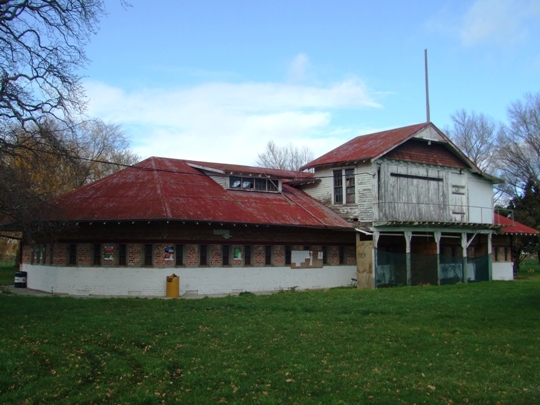
Extent includes the land described as Pt Lot 1 DP 1329 (RT 113531), Gisborne Land District and the structure known as Makaraka Racecourse Totalisator Building (Former) thereon, and its fittings and fixtures.
Legal description
Pt Lot 1 DP 1329 (RT 113531), Gisborne Land District
Status
Listed
List Entry Status
Historic Place Category 2
Access
Able to Visit
List Number
3522
Date Entered
5th April 1984
Date of Effect
5th April 1984
City/District Council
Gisborne District
Region
Gisborne Region
Extent of List Entry
Extent includes the land described as Pt Lot 1 DP 1329 (RT 113531), Gisborne Land District and the structure known as Makaraka Racecourse Totalisator Building (Former) thereon, and its fittings and fixtures.
Legal description
Pt Lot 1 DP 1329 (RT 113531), Gisborne Land District
Construction Professional
Name
Burr & Mirfield
Type
Architectural Partnership
Biography
J H Burr became an Associate of the New Zealand Institute of Architects in 1905. Mirfield began his career as a clerk of works before entering into partnership with Burr in 1912. Burr and Mirfield were responsible for many buildings in the Gisborne district including the Masonic Hotel (with Rene Natusch), the New Zealand Insurance Building, the Kaiti Memorial Church (with Clere and Williams, 1925), the Public Trust Office and some large residences in Gisborne. Buildings designed by the Gisborne architectural practice of Burr and Mirfield - other than the Rangatira Hotel - include the New Zealand Insurance Building (1915), 50 Childers Road, Gisborne (NZHPT Registration # 3553, Category II historic place); the Public Trust Building (1922), 40 Childers Road, Gisborne (NZHPT Registration # 3552, Category II historic place); a house (1925) at 233 Harris Street, Gisborne (NZHPT Registration # 3512, Category II historic place); the Kerridge House (1935), 75 The Esplanade, Gisborne (NZHPT Registration # 4421, Category I historic place); and the M. Zemba Ltd Building (1937), 63 Peel Street, Gisborne (NZHPT Registration # 3542, Category II historic place).
Construction Details
Start Year
1920
Type
Original Construction
Construction Professional
Name
Burr & Mirfield
Type
Architectural Partnership
Biography
J H Burr became an Associate of the New Zealand Institute of Architects in 1905. Mirfield began his career as a clerk of works before entering into partnership with Burr in 1912. Burr and Mirfield were responsible for many buildings in the Gisborne district including the Masonic Hotel (with Rene Natusch), the New Zealand Insurance Building, the Kaiti Memorial Church (with Clere and Williams, 1925), the Public Trust Office and some large residences in Gisborne. Buildings designed by the Gisborne architectural practice of Burr and Mirfield - other than the Rangatira Hotel - include the New Zealand Insurance Building (1915), 50 Childers Road, Gisborne (NZHPT Registration # 3553, Category II historic place); the Public Trust Building (1922), 40 Childers Road, Gisborne (NZHPT Registration # 3552, Category II historic place); a house (1925) at 233 Harris Street, Gisborne (NZHPT Registration # 3512, Category II historic place); the Kerridge House (1935), 75 The Esplanade, Gisborne (NZHPT Registration # 4421, Category I historic place); and the M. Zemba Ltd Building (1937), 63 Peel Street, Gisborne (NZHPT Registration # 3542, Category II historic place).
Construction Details
Start Year
1920
Type
Original Construction
Historical and Associated Iwi / Hapū / Whānau
Completion Date
21st June 2010
Report Written By
Damian Skinner, Gail Henry, Linda Pattison
Information Sources
Mackay, 1949
J A Mackay, Historic Poverty Bay and the East Coast, N.I., N.Z, Gisborne, 1949.
Poverty Bay Herald
Poverty Bay Herald
Costello and Finnegan, 1988
John Costello and Pat Finnegan, Tapestry of Turf: The History of New Zealand Racing, Auckland, Moa Publications, 1988
Other Information
This place was identified as significant under previous legislation with different information requirements. It remains significant under the current legislation. There is opportunity under our legislation and policies to add to this information. Further information about this place may be available from the Lower Northern Office of Heritage New Zealand Pouhere Taonga. A fully referenced report is available from the NZHPT Lower Northern Area office Please note that entry on the New Zealand Heritage List/Rarangi Korero identifies only the heritage values of the property concerned, and should not be construed as advice on the state of the property, or as a comment of its soundness or safety, including in regard to earthquake risk, safety in the event of fire, or insanitary conditions.
Historical and Associated Iwi / Hapū / Whānau
Completion Date
21st June 2010
Report Written By
Damian Skinner, Gail Henry, Linda Pattison
Information Sources
Mackay, 1949
J A Mackay, Historic Poverty Bay and the East Coast, N.I., N.Z, Gisborne, 1949.
Poverty Bay Herald
Poverty Bay Herald
Costello and Finnegan, 1988
John Costello and Pat Finnegan, Tapestry of Turf: The History of New Zealand Racing, Auckland, Moa Publications, 1988
Other Information
This place was identified as significant under previous legislation with different information requirements. It remains significant under the current legislation. There is opportunity under our legislation and policies to add to this information. Further information about this place may be available from the Lower Northern Office of Heritage New Zealand Pouhere Taonga. A fully referenced report is available from the NZHPT Lower Northern Area office Please note that entry on the New Zealand Heritage List/Rarangi Korero identifies only the heritage values of the property concerned, and should not be construed as advice on the state of the property, or as a comment of its soundness or safety, including in regard to earthquake risk, safety in the event of fire, or insanitary conditions.
Current Usages
Uses: Vacant
Specific Usage: Vacant
Former Usages
General Usage: Civic Facilities
Specific Usage: Horse racing course/track
Themes
Sport
Current Usages
Uses: Vacant
Specific Usage: Vacant
Former Usages
General Usage: Civic Facilities
Specific Usage: Horse racing course/track
Themes
Sport
Get the latest heritage news, features and events delivered
straight to your inbox.