DonateMembershipVisit Heritage
  • Tūrangawaewae
    Places
  • Tira Māori
    Māori Heritage
  • Poutairangahia
    Archaeology
  • Rauemi
    Resources
  • Mō Tātou
    About Us
  • New Zealand Heritage List
  • Nominate and submit
  • Explore the List
  • National Historic Landmarks
  • Plaques
  • Rainbow List Project
  • Lost heritage
  • Visit Heritage
  • Our properties
  • Turnbull House Project
  • Collections
  • Shop
  • Tohu Whenua
  • Tira Māori
  • Conserving Māori heritage
  • Marae built heritage
  • Māori heritage on the List
  • Hinemihi—Te Hokinga Mai
  • What is archaeology?
  • Is there a site on my property?
  • What are my legal requirements?
  • Affecting an archaeological site
  • Declaring an archaeological site
  • Archaeology FAQs
  • Archaeology Digital Library
  • Archaeology guidelines and templates
  • Resources
  • Funding
  • Publications
  • Sustainable management guides
  • Disaster recovery
  • Podcasts & digital resources
  • Education Hub
  • Conservation plans
  • About
  • Board
  • Māori Heritage Council
  • Senior Staff
  • Offices
  • Contact us
  • Careers
  • Covenants
  • Fast-track
  • Corporate documents
  • Currently consulting on
  • Our submissions
  • News
  • Covid-19 response
Quick links
Rārangi Kōrero | The List
Explore the List
National Historic Landmarks
Ngā Manawhenua o Aotearoa me ōna Kōrero Tūturu
Quick links
Tapuwae
A Vision for Places of Māori Heritage
Funding for Māori Heritage
Resources
Quick links
Archaeological Authority Portal
Applying for an archaeological authority
Archaeology FAQs
Browse the most frequently asked questions about archaeological authorities and the archaeological process.
Quick links
Quick links
News
News Keep up to date with Heritage New Zealand Pouhere Taonga
Membership
Membership Find out more and sign up today
DonateMembershipVisit Heritage
  • Tūrangawaewae
    Places
  • Tira Māori
    Māori Heritage
  • Poutairangahia
    Archaeology
  • Rauemi
    Resources
  • Mō Tātou
    About Us
  • New Zealand Heritage List
  • Nominate and submit
  • Explore the List
  • National Historic Landmarks
  • Plaques
  • Rainbow List Project
  • Lost heritage
  • Visit Heritage
  • Our properties
  • Turnbull House Project
  • Collections
  • Shop
  • Tohu Whenua
  • Tira Māori
  • Conserving Māori heritage
  • Marae built heritage
  • Māori heritage on the List
  • Hinemihi—Te Hokinga Mai
  • What is archaeology?
  • Is there a site on my property?
  • What are my legal requirements?
  • Affecting an archaeological site
  • Declaring an archaeological site
  • Archaeology FAQs
  • Archaeology Digital Library
  • Archaeology guidelines and templates
  • Resources
  • Funding
  • Publications
  • Sustainable management guides
  • Disaster recovery
  • Podcasts & digital resources
  • Education Hub
  • Conservation plans
  • About
  • Board
  • Māori Heritage Council
  • Senior Staff
  • Offices
  • Contact us
  • Careers
  • Covenants
  • Fast-track
  • Corporate documents
  • Currently consulting on
  • Our submissions
  • News
  • Covid-19 response
Quick links
Rārangi Kōrero | The List
Explore the List
National Historic Landmarks
Ngā Manawhenua o Aotearoa me ōna Kōrero Tūturu
Quick links
Tapuwae
A Vision for Places of Māori Heritage
Funding for Māori Heritage
Resources
Quick links
Archaeological Authority Portal
Applying for an archaeological authority
Archaeology FAQs
Browse the most frequently asked questions about archaeological authorities and the archaeological process.
Quick links
Quick links
News
News Keep up to date with Heritage New Zealand Pouhere Taonga
Membership
Membership Find out more and sign up today
  • Places
  • Nominate and submit
  • National Historic Landmarks
  • Places
  • Nominate and submit
  • National Historic Landmarks
  • Tira Māori
  • Conserving Māori heritage
  • Marae built heritage
  • Tira Māori
  • Conserving Māori heritage
  • Marae built heritage
  • Archaeological authorities
  • Archaeology Digital Library
  • Archaeological authorities
  • Archaeology Digital Library
  • All resources
  • Publications
  • Funding
  • All resources
  • Publications
  • Funding
  • FAQs
  • FAQs
Follow us on:
Places
  • Places
  • Nominate and submit
  • National Historic Landmarks
Tira Māori
  • Tira Māori
  • Conserving Māori heritage
  • Marae built heritage
Archaeology
  • Archaeological authorities
  • Archaeology Digital Library
Resources
  • All resources
  • Publications
  • Funding
FAQs
  • FAQs
Follow us on
HomePrivacyTerms and conditionsAbout this site
© Heritage New Zealand Pouhere Taonga 2026.
 
Makaraka Racecourse Old Grandstand

76A Main Road, Makaraka, GISBORNE

Public

Historic Place Category 2

List No. 3523

Quick links:
List GalleryLocationDetails
Built by the Poverty Bay Turf Club, the earliest such club in the Tairawhiti region, the Makaraka Racecourse Old Grandstand represents the rich history of horse racing in the region. It is located on the grounds of the Makaraka Racecourse (Roseland) on the outskirts of Gisborne. The proliferation of turf clubs in the sparsely settled Poverty Bay region was quite remarkable and no fewer than five survived well into the twentieth Century. The Club held its first meeting in 1870, and for the first few years it held its race days on privately owned paddocks.

By 1875 the Turf Club began looking for a more permanent course, and land was purchased at Makaraka in the late 1880s. The course, including the Old Grandstand building, was completed by 1891. The Poverty Bay Herald, describing the grounds and newly erected buildings, proclaimed that, 'As far as can be judged not a necessary detail has been omitted to render the Roseland course one of the best in the Colony.' Of note was the grandstand, designed by William Peter Finneran, and built by W.O. Skeet. The grandstand was considered to be a most sightly structure of its class.

The Makaraka Racecourse Old Grandstand is approximately three storey's high. Its exterior is timber clad with a corrugated iron roof. The space in front of the stand is occupied by shallow concrete steps, also used as seating, that have replaced the original wooden steps that gave access into the stand. The width of the stand has also been increased, so the north elevation is longer than it was when first built. All the additional timber posts and balustrades were constructed to match those existing. The stand's interior is timber, with flights of steps up the centre and at each side. A diagonal topped wall runs down each side of the stand, leaving most of the area open to the roof. The walls are lined with tongue-and-groove boards, also running diagonally. The short gap between the back wall of the stand and the ceiling is covered by coloursteel, which now sheathes the exterior rear wall of the stand. The one storey section at the back of the stand was built after 1891, but the use of rusticated timber cladding, double-hung windows and small cylindrical roof ventilators harmonises with the original part of the stand. It is probable that it was added in 1906, when £3000 was spent to improve the amenities. The Grandstand was extended, moved back forty feet, and the dining room, stewards room and ladies toilets improved. Since then, a number of modifications have taken place, including the addition of new structures to the grounds, such as the Stewards grandstand, erected in 1915.

The Makaraka Racecourse Old Grandstand is architecturally significant as an example of the work of Peter William Finneran, who designed a number of buildings in the Gisborne region, some of which are registered with the New Zealand Historic Places Trust (NZHPT). While the grandstand has been altered since it was built in 1891, stand seating, balustrades, ceiling and roof have been maintained in their original style ensuring that the Grandstand retains much of its original architectural character. It is one of what are becoming increasingly rare survivors of the type of ornate and well-proportioned grandstands built at racecourses around the country in the late nineteenth century. It also has social history importance as part of the built environment at Makaraka Racecourse, as a visually powerful reminder of the Poverty Bay Turf Club, and the important role that horse racing has played in the social life of the Tairawhiti region. It creates a rich picture of the sport of horse racing and the activities and behaviours of people who attended the races in the late nineteenth and twentieth centuries.
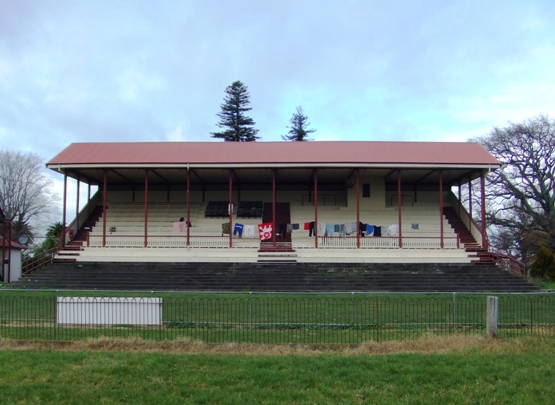
Makaraka Racecourse Old Grandstand | 23/06/2009 | NZ Historic Places Trust

List Entry Information

Overview

Status
Listed

List Entry Status
Historic Place Category 2

Access
Able to Visit

List Number
3523

Date Entered
5th April 1984

Date of Effect
5th April 1984

City/District Council
Gisborne District

Region
Gisborne Region

Extent of List Entry

Extent includes the land described as Pt Lot 1 DP 1329 (RT 113531), Gisborne Land District and the structure known as Makaraka Racecourse Old Grandstand thereon, and its fittings and fixtures.

Legal description

Pt Lot 1 DP 1329 (RT 113531), Gisborne Land District

Detailed List Entry

Construction Professional

Name

Skeet, W O

Type

Builder

Biography

William Oswald Skeet established the City Timber Yards in Gladstone Road in 1880. W.O. Skeet, builder, was listed on East Coast electoral roll in 1881 and 1887. His 1896 directory listing is a large notice for Skeet as “Builder and Timber Merchant, Gladstone Road and Cobden Street” as well as an advertisement. Another advertisement at the time the Club was being built shows the business was a timber merchants, building and contracting, as well as supplying ironmongery. Skeet worked with Finneran as builder on several of Finneran's projects.. He designed as well as built the alterations to the Club building in 1903 and 1905.

Name

Finneran, W P

Type

Designer

Biography

(1) William Peter Finneran (c.1837-1911) practised in Gisborne as an architect since 1878 and “designed and supervised the erection of a large number of public and private buildings in the district”. Several buildings known to have been designed by Finneran are still in existence, but records of his work are incomplete. In 1879 Finneran was calling for tenders for building the hospital and in 1881 tenders for the brewery. The brewery with its four-storey tower was a significant landmark and lookout point over the town. It is assumed he designed these buildings. In 1901 he supplied designs for a new building. Some uncertainty existed around whether he designed the band rotunda, as entrants for the design competition had entered anonymously. However, it was disclosed at a council meeting that “Mr Finneran was the designer of the beautiful plan selected by the Council” even though he had submitted his design anonymously under Parnell & Co.'s name. His other work includes the Masonic Hall, still standing but modified, in Childers Road, built 1895 and opened 2 January 1896. The Hall was enlarged in 1897 and is registered as Category II. The Poverty Bay Club is stylistically very similar to two of Finneran's better-known works, the Opou Station homestead (extant) and Whataupoko sheep station homestead (burnt down), the home of Percival Barker. Opou Homestead, Manutuke, (formerly known as Riverslea when built for owner Thomas Bloomfield in 1883; Register # 7170, Category I historic place) is described as “restrained Victorian classicism...[with] stately proportions and vast room heights”. Another more modest building attributed to Finneran [cited as P Fineran] is a “Two-way Bay Villa for Captain Martin” in 1900, the drawings for which “show a preoccupation with details such as the half-drawn blinds and curtains”. Finneran was responsible for designing the enlargement of the Holy Trinity Anglican Church (subsequently the Anglican Church Hall) with the chancel and transept of the wooden church being added. However, these changes were not approved by all: “some details of decorative style were introduced by the Gisborne architect, Mr Finneran, which marred the “pure” Gothic style of the first stage of the building.” The only other architects known to be working in Gisborne in the 1880s-early 1900s are W J Quigley from 1882 , James O Barnard , and Andrew Y Ross. Little is known of Finneran's life and family. In an 1881 New Zealand-wide directory, W.P. Finneran is listed twice, once as a carpenter in the Napier electorate with freehold qualification in Gisborne; and again as an architect with residential qualification in Gisborne, in the East Coast electorate. His name is listed in directories for 1883-84, 1894, 1896 (in Gladstone Rd) and 1898-99. He and his wife Margaret are listed on the Waiapu electoral roll for 1902, and in the Borough of Gisborne Roll 1901 as being at 34 Lowe Street, Gisborne, but are not listed for 1900 or 1903. However, in 1904 he is again listed as being architect, Gisborne, but is not in the nationwide directories for 1906, 1908 and 1909. William P Finneran died on August 25, 1911, at Ponsonby, Auckland, aged 74 years and survived by his wife Margaret Ann. The funeral cortege was to leave from his former residence at Mason's Rd, Herne Bay for the Waikumete Cemetery.

Construction Details

Finish Year

1891

Type

Original Construction

Description

Grandstand completed

Start Year

1906

Type

Addition

Description

Grandstand extended

Start Year

1906

Type

Relocation

Description

Grandstand moved 40 feet

Start Year

1906

Type

Addition

Description

One storey section constructed at rear

Start Year

1915

Type

Modification

Description

Improvements to dining room, and ladies toilets

Reference

Completion Date

21st June 2010

Report Written By

Damian Skinner, Gail Henry, Linda Pattison

Information Sources

Mackay, 1949

J A Mackay, Historic Poverty Bay and the East Coast, N.I., N.Z, Gisborne, 1949.

Poverty Bay Herald

Poverty Bay Herald

Costello and Finnegan, 1988

John Costello and Pat Finnegan, Tapestry of Turf: The History of New Zealand Racing, Auckland, Moa Publications, 1988

Report Written By

This place was identified as significant under previous legislation with different information requirements. It remains significant under the current legislation. There is opportunity under our legislation and policies to add to this information. Further information about this place may be available from the Lower Northern Office of Heritage New Zealand Pouhere Taonga. Please note that entry on the New Zealand Heritage List/Rarangi Korero identifies only the heritage values of the property concerned, and should not be construed as advice on the state of the property, or as a comment of its soundness or safety, including in regard to earthquake risk, safety in the event of fire, or insanitary conditions.

Further Information

Current Usages

Uses: Civic Facilities

Specific Usage: Grandstand

Former Usages

General Usage:: Civic Facilities

Specific Usage: Grandstand

Themes

Sport

Web Links

Overview

Status

Listed

List Entry Status

Historic Place Category 2

Access

Able to Visit

List Number

3523

Date Entered

5th April 1984

Date of Effect

5th April 1984

City/District Council

Gisborne District

Region

Gisborne Region

Extent of List Entry

Extent includes the land described as Pt Lot 1 DP 1329 (RT 113531), Gisborne Land District and the structure known as Makaraka Racecourse Old Grandstand thereon, and its fittings and fixtures.

Legal description

Pt Lot 1 DP 1329 (RT 113531), Gisborne Land District

Status

Listed

List Entry Status

Historic Place Category 2

Access

Able to Visit

List Number

3523

Date Entered

5th April 1984

Date of Effect

5th April 1984

City/District Council

Gisborne District

Region

Gisborne Region

Extent of List Entry

Extent includes the land described as Pt Lot 1 DP 1329 (RT 113531), Gisborne Land District and the structure known as Makaraka Racecourse Old Grandstand thereon, and its fittings and fixtures.

Legal description

Pt Lot 1 DP 1329 (RT 113531), Gisborne Land District

Construction Information

Construction Professional

Name

Skeet, W O

Type

Builder

Biography

William Oswald Skeet established the City Timber Yards in Gladstone Road in 1880. W.O. Skeet, builder, was listed on East Coast electoral roll in 1881 and 1887. His 1896 directory listing is a large notice for Skeet as “Builder and Timber Merchant, Gladstone Road and Cobden Street” as well as an advertisement. Another advertisement at the time the Club was being built shows the business was a timber merchants, building and contracting, as well as supplying ironmongery. Skeet worked with Finneran as builder on several of Finneran's projects.. He designed as well as built the alterations to the Club building in 1903 and 1905.

Name

Finneran, W P

Type

Designer

Biography

(1) William Peter Finneran (c.1837-1911) practised in Gisborne as an architect since 1878 and “designed and supervised the erection of a large number of public and private buildings in the district”. Several buildings known to have been designed by Finneran are still in existence, but records of his work are incomplete. In 1879 Finneran was calling for tenders for building the hospital and in 1881 tenders for the brewery. The brewery with its four-storey tower was a significant landmark and lookout point over the town. It is assumed he designed these buildings. In 1901 he supplied designs for a new building. Some uncertainty existed around whether he designed the band rotunda, as entrants for the design competition had entered anonymously. However, it was disclosed at a council meeting that “Mr Finneran was the designer of the beautiful plan selected by the Council” even though he had submitted his design anonymously under Parnell & Co.'s name. His other work includes the Masonic Hall, still standing but modified, in Childers Road, built 1895 and opened 2 January 1896. The Hall was enlarged in 1897 and is registered as Category II. The Poverty Bay Club is stylistically very similar to two of Finneran's better-known works, the Opou Station homestead (extant) and Whataupoko sheep station homestead (burnt down), the home of Percival Barker. Opou Homestead, Manutuke, (formerly known as Riverslea when built for owner Thomas Bloomfield in 1883; Register # 7170, Category I historic place) is described as “restrained Victorian classicism...[with] stately proportions and vast room heights”. Another more modest building attributed to Finneran [cited as P Fineran] is a “Two-way Bay Villa for Captain Martin” in 1900, the drawings for which “show a preoccupation with details such as the half-drawn blinds and curtains”. Finneran was responsible for designing the enlargement of the Holy Trinity Anglican Church (subsequently the Anglican Church Hall) with the chancel and transept of the wooden church being added. However, these changes were not approved by all: “some details of decorative style were introduced by the Gisborne architect, Mr Finneran, which marred the “pure” Gothic style of the first stage of the building.” The only other architects known to be working in Gisborne in the 1880s-early 1900s are W J Quigley from 1882 , James O Barnard , and Andrew Y Ross. Little is known of Finneran's life and family. In an 1881 New Zealand-wide directory, W.P. Finneran is listed twice, once as a carpenter in the Napier electorate with freehold qualification in Gisborne; and again as an architect with residential qualification in Gisborne, in the East Coast electorate. His name is listed in directories for 1883-84, 1894, 1896 (in Gladstone Rd) and 1898-99. He and his wife Margaret are listed on the Waiapu electoral roll for 1902, and in the Borough of Gisborne Roll 1901 as being at 34 Lowe Street, Gisborne, but are not listed for 1900 or 1903. However, in 1904 he is again listed as being architect, Gisborne, but is not in the nationwide directories for 1906, 1908 and 1909. William P Finneran died on August 25, 1911, at Ponsonby, Auckland, aged 74 years and survived by his wife Margaret Ann. The funeral cortege was to leave from his former residence at Mason's Rd, Herne Bay for the Waikumete Cemetery.

Construction Details

Finish Year

1891

Type

Original Construction

Description

Grandstand completed

Start Year

1906

Type

Addition

Description

Grandstand extended

Start Year

1906

startYearCirca

Type

Relocation

Description

Grandstand moved 40 feet

Start Year

1906

startYearCirca

Type

Addition

Description

One storey section constructed at rear

Start Year

1915

startYearCirca

Type

Modification

Description

Improvements to dining room, and ladies toilets

Construction Professional

Name

Skeet, W O

Type

Builder

Biography

William Oswald Skeet established the City Timber Yards in Gladstone Road in 1880. W.O. Skeet, builder, was listed on East Coast electoral roll in 1881 and 1887. His 1896 directory listing is a large notice for Skeet as “Builder and Timber Merchant, Gladstone Road and Cobden Street” as well as an advertisement. Another advertisement at the time the Club was being built shows the business was a timber merchants, building and contracting, as well as supplying ironmongery. Skeet worked with Finneran as builder on several of Finneran's projects.. He designed as well as built the alterations to the Club building in 1903 and 1905.

Name

Finneran, W P

Type

Designer

Biography

(1) William Peter Finneran (c.1837-1911) practised in Gisborne as an architect since 1878 and “designed and supervised the erection of a large number of public and private buildings in the district”. Several buildings known to have been designed by Finneran are still in existence, but records of his work are incomplete. In 1879 Finneran was calling for tenders for building the hospital and in 1881 tenders for the brewery. The brewery with its four-storey tower was a significant landmark and lookout point over the town. It is assumed he designed these buildings. In 1901 he supplied designs for a new building. Some uncertainty existed around whether he designed the band rotunda, as entrants for the design competition had entered anonymously. However, it was disclosed at a council meeting that “Mr Finneran was the designer of the beautiful plan selected by the Council” even though he had submitted his design anonymously under Parnell & Co.'s name. His other work includes the Masonic Hall, still standing but modified, in Childers Road, built 1895 and opened 2 January 1896. The Hall was enlarged in 1897 and is registered as Category II. The Poverty Bay Club is stylistically very similar to two of Finneran's better-known works, the Opou Station homestead (extant) and Whataupoko sheep station homestead (burnt down), the home of Percival Barker. Opou Homestead, Manutuke, (formerly known as Riverslea when built for owner Thomas Bloomfield in 1883; Register # 7170, Category I historic place) is described as “restrained Victorian classicism...[with] stately proportions and vast room heights”. Another more modest building attributed to Finneran [cited as P Fineran] is a “Two-way Bay Villa for Captain Martin” in 1900, the drawings for which “show a preoccupation with details such as the half-drawn blinds and curtains”. Finneran was responsible for designing the enlargement of the Holy Trinity Anglican Church (subsequently the Anglican Church Hall) with the chancel and transept of the wooden church being added. However, these changes were not approved by all: “some details of decorative style were introduced by the Gisborne architect, Mr Finneran, which marred the “pure” Gothic style of the first stage of the building.” The only other architects known to be working in Gisborne in the 1880s-early 1900s are W J Quigley from 1882 , James O Barnard , and Andrew Y Ross. Little is known of Finneran's life and family. In an 1881 New Zealand-wide directory, W.P. Finneran is listed twice, once as a carpenter in the Napier electorate with freehold qualification in Gisborne; and again as an architect with residential qualification in Gisborne, in the East Coast electorate. His name is listed in directories for 1883-84, 1894, 1896 (in Gladstone Rd) and 1898-99. He and his wife Margaret are listed on the Waiapu electoral roll for 1902, and in the Borough of Gisborne Roll 1901 as being at 34 Lowe Street, Gisborne, but are not listed for 1900 or 1903. However, in 1904 he is again listed as being architect, Gisborne, but is not in the nationwide directories for 1906, 1908 and 1909. William P Finneran died on August 25, 1911, at Ponsonby, Auckland, aged 74 years and survived by his wife Margaret Ann. The funeral cortege was to leave from his former residence at Mason's Rd, Herne Bay for the Waikumete Cemetery.

Construction Details

Finish Year

1891

Type

Original Construction

Description

Grandstand completed

Start Year

1906

Type

Addition

Description

Grandstand extended

Start Year

1906

startYearCirca

Type

Relocation

Description

Grandstand moved 40 feet

Start Year

1906

startYearCirca

Type

Addition

Description

One storey section constructed at rear

Start Year

1915

startYearCirca

Type

Modification

Description

Improvements to dining room, and ladies toilets

Reference

Historical and Associated Iwi / Hapū / Whānau

Completion Date

21st June 2010

Report Written By

Damian Skinner, Gail Henry, Linda Pattison

Information Sources

Mackay, 1949

J A Mackay, Historic Poverty Bay and the East Coast, N.I., N.Z, Gisborne, 1949.

Poverty Bay Herald

Poverty Bay Herald

Costello and Finnegan, 1988

John Costello and Pat Finnegan, Tapestry of Turf: The History of New Zealand Racing, Auckland, Moa Publications, 1988

Other Information

This place was identified as significant under previous legislation with different information requirements. It remains significant under the current legislation. There is opportunity under our legislation and policies to add to this information. Further information about this place may be available from the Lower Northern Office of Heritage New Zealand Pouhere Taonga. Please note that entry on the New Zealand Heritage List/Rarangi Korero identifies only the heritage values of the property concerned, and should not be construed as advice on the state of the property, or as a comment of its soundness or safety, including in regard to earthquake risk, safety in the event of fire, or insanitary conditions.

Historical and Associated Iwi / Hapū / Whānau

Completion Date

21st June 2010

Report Written By

Damian Skinner, Gail Henry, Linda Pattison

Information Sources

Mackay, 1949

J A Mackay, Historic Poverty Bay and the East Coast, N.I., N.Z, Gisborne, 1949.

Poverty Bay Herald

Poverty Bay Herald

Costello and Finnegan, 1988

John Costello and Pat Finnegan, Tapestry of Turf: The History of New Zealand Racing, Auckland, Moa Publications, 1988

Other Information

This place was identified as significant under previous legislation with different information requirements. It remains significant under the current legislation. There is opportunity under our legislation and policies to add to this information. Further information about this place may be available from the Lower Northern Office of Heritage New Zealand Pouhere Taonga. Please note that entry on the New Zealand Heritage List/Rarangi Korero identifies only the heritage values of the property concerned, and should not be construed as advice on the state of the property, or as a comment of its soundness or safety, including in regard to earthquake risk, safety in the event of fire, or insanitary conditions.

Further Information

Current Usages

Uses: Civic Facilities

Specific Usage: Grandstand

Former Usages

General Usage: Civic Facilities

Specific Usage: Grandstand

Themes

Sport

Current Usages

Uses: Civic Facilities

Specific Usage: Grandstand

Former Usages

General Usage: Civic Facilities

Specific Usage: Grandstand

Themes

Sport

Location

Loading
Related listings
Makaraka Racecourse Totalisator Building
Makaraka Racecourse Totalisator Building (Former)
Makaraka Racecourse Totalisator Building
Makaraka Racecourse Totalisator Building (Former)
Stay up to date with Heritage this month