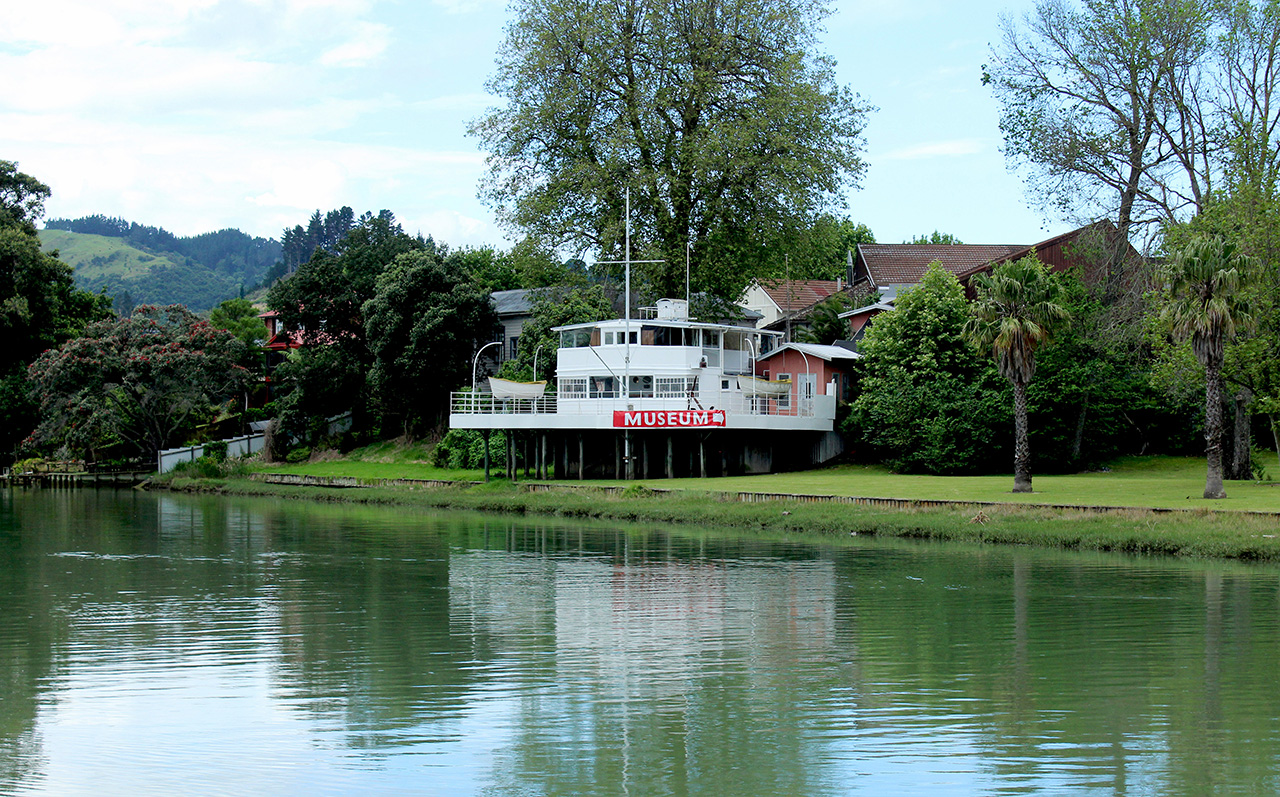
The Captain’s cabin and bridge of the Star of Canada, now located on the bank of the Taruheru River beside the Tairawhiti Museum in Gisborne, are part of a wreck that has achieved a high measure of local fame, mostly because of the post ocean history of these structures. The Star of Canada was built by Workman, Clark and Co. of Belfast for the Tysar Line, and made its first voyage to New Zealand in 1910 in order to transport frozen meat and other produce from Australia and New Zealand back to England. The ship was 7280 tons (7396 tonnes); 470 feet, 3 inches long (151 metres), and had a carrying capacity of 130,000 carcases of mutton. After having been sailing for two and a half years, during which time she made six trips to New Zealand, on 23 June 1912 the Star of Canada ran aground off Kaiti Beach. Strenuous efforts were made to refloat the ship, however all hope of saving the vessel was eventually abandoned after several days.
The Captain’s cabin, chartroom and wheel house were salvaged by A.C. Mitchell, and purchased first by Mr Miller, a tobacconist, and then by W. Good, (a Gisborne jeweller), for £104. The structure was moved by greased railway lines and a steam roller to a section beside Good’s house at 274 Childers Road. In this location the house became a tourist attraction, ‘something to delight the landlubber and bring back memories to old salts who no longer sail the seas’, as a newspaper article from the house’s heyday put it. Set in a ‘sea’ of green lawn and concrete paths, the original cabin and deckhouse were supplemented by additional rooms downstairs, including a kitchen, dining room, bathroom and hall, ‘with the construction so adapted that there is no lack of harmony.’ The house was originally occupied by Mrs L. Woodfield, Good’s daughter, who lived there for a few years before moving next door to her father’s house and childhood home. On her death in 1983 Woodfield left the Star of Canada to the city of Gisborne. In 1985 it was moved from Childers Road to its current site in Kelvin Park, behind the main museum buildings, and converted into a maritime museum. The moving project was largely organised by Gisborne West Rotary Club, who ran fundraising events for the purpose. The move itself was a public parade including representatives of many local clubs and organisations.
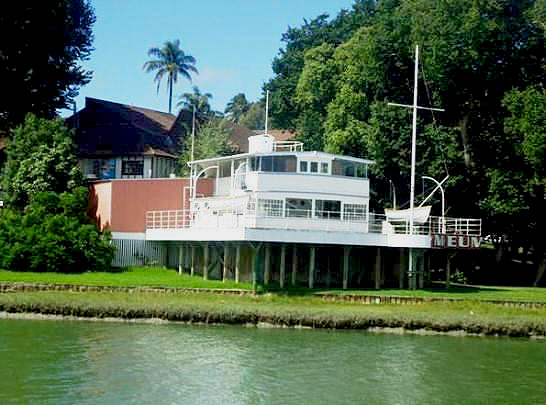
The present Star of Canada is of timber construction with iron beams in the first floor, with exterior cladding of vertical teak boards and a number of small matching leadlight windows on the ground floor. The captain’s cabin has oak and walnut panelling and brass fittings, as well as the original desk, clock, barometer and other equipment. The Captain’s cabin area has been little changed, but parts of the structure added by Good when the building was a residence are now used to exhibit maritime arts and history. The structure is mounted on timber poles about one storey above ground level. Because of the slope of the land, the entrance to the structure’s lower floor is at ground level at the top of the rise on the north side. The ground floor area has been increased by the addition of a wide verandah around the entire structure. On the north side the verandah is roofed between the entrance turnstile and the door to the museum proper. Additional security is given by a picket fence reaching to the roof on this side. The three other sides are open decks with a galvanized steel safety rail. On the east and west sides, lifeboats are suspended above the deck. A mast is fitted into the deck on the building’s south side.
The Star of Canada has historical significance as a physical reminder of a well known maritime disaster in the Gisborne region, and therefore as a built structure that points to the importance of maritime history in the development of Gisborne (and the Tairawhiti region). With its rich legacy as, firstly a ship, and secondly a house, and thirdly a museum exhibit, the Star of Canada links strongly to local history and has a high level of community significance and appreciation.
The Captain’s cabin, chartroom and wheel house were salvaged by A.C. Mitchell, and purchased first by Mr Miller, a tobacconist, and then by W. Good, (a Gisborne jeweller), for £104. The structure was moved by greased railway lines and a steam roller to a section beside Good’s house at 274 Childers Road. In this location the house became a tourist attraction, ‘something to delight the landlubber and bring back memories to old salts who no longer sail the seas’, as a newspaper article from the house’s heyday put it. Set in a ‘sea’ of green lawn and concrete paths, the original cabin and deckhouse were supplemented by additional rooms downstairs, including a kitchen, dining room, bathroom and hall, ‘with the construction so adapted that there is no lack of harmony.’ The house was originally occupied by Mrs L. Woodfield, Good’s daughter, who lived there for a few years before moving next door to her father’s house and childhood home. On her death in 1983 Woodfield left the Star of Canada to the city of Gisborne. In 1985 it was moved from Childers Road to its current site in Kelvin Park, behind the main museum buildings, and converted into a maritime museum. The moving project was largely organised by Gisborne West Rotary Club, who ran fundraising events for the purpose. The move itself was a public parade including representatives of many local clubs and organisations.
The present Star of Canada is of timber construction with iron beams in the first floor, with exterior cladding of vertical teak boards and a number of small matching leadlight windows on the ground floor. The captain’s cabin has oak and walnut panelling and brass fittings, as well as the original desk, clock, barometer and other equipment. The Captain’s cabin area has been little changed, but parts of the structure added by Good when the building was a residence are now used to exhibit maritime arts and history. The structure is mounted on timber poles about one storey above ground level. Because of the slope of the land, the entrance to the structure’s lower floor is at ground level at the top of the rise on the north side. The ground floor area has been increased by the addition of a wide verandah around the entire structure. On the north side the verandah is roofed between the entrance turnstile and the door to the museum proper. Additional security is given by a picket fence reaching to the roof on this side. The three other sides are open decks with a galvanized steel safety rail. On the east and west sides, lifeboats are suspended above the deck. A mast is fitted into the deck on the building’s south side.
The Star of Canada has historical significance as a physical reminder of a well known maritime disaster in the Gisborne region, and therefore as a built structure that points to the importance of maritime history in the development of Gisborne (and the Tairawhiti region). With its rich legacy as, firstly a ship, and secondly a house, and thirdly a museum exhibit, the Star of Canada links strongly to local history and has a high level of community significance and appreciation.