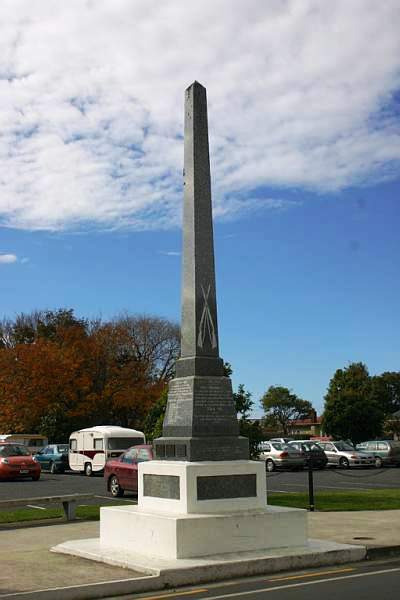
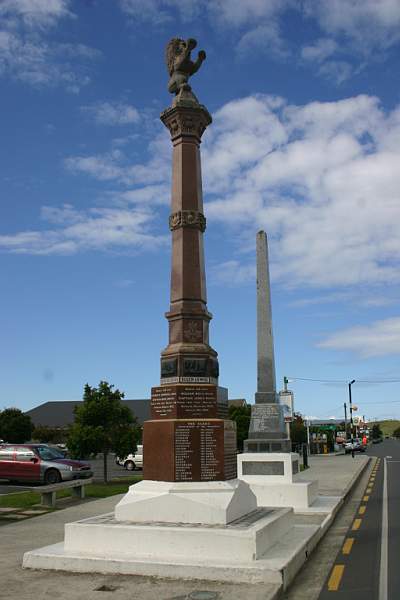
Erected in 1920-21, the World War One Memorial in Waipū is a relatively early built monument to the fallen of the Great War (1914-18). Of historical, social and spiritual significance, its comparatively rapid construction reflects the large proportion of Waipū citizens who volunteered for overseas service, as well as the strong identity and close-knit nature of the local community - whose largely Nova Scotian and Highland Scottish origins emphasised the importance of kinship, community service and collective endeavour. Consisting of a stone obelisk on a concrete plinth, the memorial is prominently situated on Waipū’s main throughfare, immediately next to an earlier monument to the town’s Nova Scotian settlers. Subsequently a focus for annual Anzac Day commemorations for more than a century, the obelisk additionally remembers those who fell in the Second World War (1939-45) and who served in later international conflicts. It remains a significant part of a wider commemorative landscape in Waipū linked with the township’s origins and history.
The area south of Whangārei is associated with many iwi and hapū. Situated west of Paepae-o-Tū (Bream Bay), Waipū lies within the rohe of Patuharakeke. Traditional settlement in the locality is evidenced by numerous pā and other sites, including midden on the river flats in what is now central Waipū. Although disrupted by the Musket Wars or taua of the 1820s and 1830s, the area remained in Māori occupation in 1854 when the British Crown acquired large blocks of land as a ‘special settlement’ for Nova Scotian migrants from present-day Canada. Of earlier Scottish origin, the new settlers established small farm holdings, sustained by strong kinship networks that emphasised collective endeavour and communal self-reliance. By the First World War (1914-18), Waipū remained a ‘Nova Scotian’ settlement although increasingly diverse in its population and integrated into the national economy. At the outbreak of war, members of the community enlisted in large numbers with the last single man eligible for service having reportedly left for the front by mid-1915. A contingent fought at Gallipoli, where several individuals lost their lives. Others fought and died in Palestine and France. Moves to remember those who served began in July 1915, when their commemoration on the recently erected Nova Scotian Settlers Memorial was considered. In early 1920, a roll of honour was unveiled in Coronation Hall.
In August 1920, the relatives of fallen combatants met to discuss creating a permanent memorial, resolving to build a monument for which competitive designs were to be invited. The structure erected the following year consisted of an Australian granite obelisk with concrete base, collectively measuring 7.62 metres (25 feet) high. Obelisks were the most common form for First World War memorials in New Zealand, having long-standing connections with remembering the dead, military victory and affirming the supremacy of spiritual values. The Waipū memorial’s particular use of Australian stone likely symbolised connections forged with other ANZAC forces during the conflict. Erected close to the settlement’s main public meeting and religious facilities as well as the Nova Scotian Settlers Memorial, the monument conformed to tendencies for built war memorials to be located in places that were prominent, relatively central and commonly used for congregation. Initial inscriptions on the monument included a crossed rifle symbol on the front face of the obelisk and the names of all local servicemen who died.
The memorial was unveiled in January 1921 by the former Liberal Prime Minister and wartime High Commissioner to the United Kingdom, Sir Thomas Mackenzie (1853-1930). A Scottish-born politician and diplomat, Mackenzie had served on both the Imperial War Graves Commission and the royal commission into the Dardanelles campaign, and also participated in the 1919 Paris Peace Conference. In front of a large crowd, Mackenzie spoke critically of many British government actions preceding and during the war, while also extolling the contributions of New Zealand’s servicemen and home communities. In relation to Waipū, ‘he supposed that for its size, no other part of New Zealand had sent so many men in proportion to its population’. Other speakers included Francis Mander, Member of Parliament for Marsden and father of New Zealand novelist Jane Mander.
The monument subsequently formed a focus for Anzac Day commemorations, with undenominational services at the nearby Presbyterian church being followed by wreath-laying and addresses at the memorial. In 1933, an Anzac Day procession to the church and memorial included a pipe band for the first time. Gatherings during the Second World War (1939-45) were especially large, with an additional inscription to those who fell in this conflict unveiled on Anzac Day 1947. Still in use for annual and broader remembrance, the memorial remains a notable part of a wider commemorative landscape that also includes the adjacent Nova Scotian Settlers Memorial, the Waipū Scottish Migration Museum (opened in 1953 as the House of Memories) and Caledonian Park’s Memorial Gates (1941).
The area south of Whangārei is associated with many iwi and hapū. Situated west of Paepae-o-Tū (Bream Bay), Waipū lies within the rohe of Patuharakeke. Traditional settlement in the locality is evidenced by numerous pā and other sites, including midden on the river flats in what is now central Waipū. Although disrupted by the Musket Wars or taua of the 1820s and 1830s, the area remained in Māori occupation in 1854 when the British Crown acquired large blocks of land as a ‘special settlement’ for Nova Scotian migrants from present-day Canada. Of earlier Scottish origin, the new settlers established small farm holdings, sustained by strong kinship networks that emphasised collective endeavour and communal self-reliance. By the First World War (1914-18), Waipū remained a ‘Nova Scotian’ settlement although increasingly diverse in its population and integrated into the national economy. At the outbreak of war, members of the community enlisted in large numbers with the last single man eligible for service having reportedly left for the front by mid-1915. A contingent fought at Gallipoli, where several individuals lost their lives. Others fought and died in Palestine and France. Moves to remember those who served began in July 1915, when their commemoration on the recently erected Nova Scotian Settlers Memorial was considered. In early 1920, a roll of honour was unveiled in Coronation Hall.
In August 1920, the relatives of fallen combatants met to discuss creating a permanent memorial, resolving to build a monument for which competitive designs were to be invited. The structure erected the following year consisted of an Australian granite obelisk with concrete base, collectively measuring 7.62 metres (25 feet) high. Obelisks were the most common form for First World War memorials in New Zealand, having long-standing connections with remembering the dead, military victory and affirming the supremacy of spiritual values. The Waipū memorial’s particular use of Australian stone likely symbolised connections forged with other ANZAC forces during the conflict. Erected close to the settlement’s main public meeting and religious facilities as well as the Nova Scotian Settlers Memorial, the monument conformed to tendencies for built war memorials to be located in places that were prominent, relatively central and commonly used for congregation. Initial inscriptions on the monument included a crossed rifle symbol on the front face of the obelisk and the names of all local servicemen who died.
The memorial was unveiled in January 1921 by the former Liberal Prime Minister and wartime High Commissioner to the United Kingdom, Sir Thomas Mackenzie (1853-1930). A Scottish-born politician and diplomat, Mackenzie had served on both the Imperial War Graves Commission and the royal commission into the Dardanelles campaign, and also participated in the 1919 Paris Peace Conference. In front of a large crowd, Mackenzie spoke critically of many British government actions preceding and during the war, while also extolling the contributions of New Zealand’s servicemen and home communities. In relation to Waipū, ‘he supposed that for its size, no other part of New Zealand had sent so many men in proportion to its population’. Other speakers included Francis Mander, Member of Parliament for Marsden and father of New Zealand novelist Jane Mander.
The monument subsequently formed a focus for Anzac Day commemorations, with undenominational services at the nearby Presbyterian church being followed by wreath-laying and addresses at the memorial. In 1933, an Anzac Day procession to the church and memorial included a pipe band for the first time. Gatherings during the Second World War (1939-45) were especially large, with an additional inscription to those who fell in this conflict unveiled on Anzac Day 1947. Still in use for annual and broader remembrance, the memorial remains a notable part of a wider commemorative landscape that also includes the adjacent Nova Scotian Settlers Memorial, the Waipū Scottish Migration Museum (opened in 1953 as the House of Memories) and Caledonian Park’s Memorial Gates (1941).