

After the Wellington-Manawatu Railway’s completion in 1886, the township of Manakau was established. With the growth in the town’s population there were three practicing religions. The Anglican, Methodist, and Brethren congregations held services in different buildings throughout the town, with St Andrew’s Anglican Church being the first purpose-built church in this township. The land for St Andrew’s Church was donated by Rev. James McWilliam, a CMS missionary in Otaki. The church was erected by voluntary contributions aided with a loan from the Diocesan Pension Fund Trustees, and was opened on December 23 1894 and consecrated on Palm Sunday, April 7 1895.
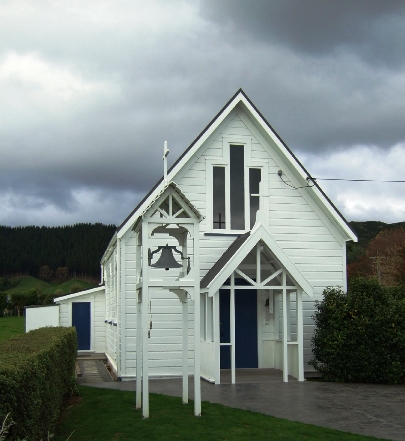
St Andrew’s Church was designed in Neo-Gothic style by Frederick de Jersey Clere and is one of the smallest and simplest churches he designed, among over a hundred others of his in the province of Wellington. The church was built to seat 80 people by local builder Charles Nees, who also built the neighbouring Manakau School. The timber church has a narrow nave, a separate chancel at the east end with a lean-to for the vestry, and steeply pitched roof originally with a distinctive bell tower. The church also features decorative crosses at the west end, lancet windows, and a porch on the western aspect that moves away from the traditional Gothic style to suit New Zealand weather conditions.
St Andrew’s has been well maintained over the years. It has been repainted several times and underwent a considerable amount of repairing and strengthening in 1952. The minutes from the church vestry meetings reveals that St Andrew’s acquired a Gospel Hall previously used by the Plymouth Brethren in 1909, and moved this hall to St Andrew’s in either in 1910 or 1911, but it was blown down in a spectacular gale in February 1936. In 1913, the original church bell was given to Te Horo after a new one was donated to St Andrew’s. In 1995 the old bell belonging to St Andrew’s was rediscovered and a new belfry based on the original belfry on the roof was built and installed outside on the lawn near the church doors.
With the establishment of the Parish of Otaki, outlying vestries collapsed into one in Otaki and St Andrew’s lost a large number of its congregation. St Andrew’s today is still a functioning church and is part of the Anglican Parish of Otaki.
List Entry Information
Status
Listed
List Entry Status
Historic Place Category 2
Access
Private/No Public Access
List Number
4070
Date Entered
5th September 1985
Date of Effect
5th September 1985
City/District Council
Horowhenua District
Region
Horizons (Manawatū-Whanganui) Region
Extent of List Entry
Extent includes part of the land described as Sec 38 DP 420 (RT WN54/115), Wellington Land District, and the building known as St Andrew’s Church (Anglican) thereon.
Legal description
Sec 38 DP 420 (RT WN54/115), Wellington Land District
Status
Listed
List Entry Status
Historic Place Category 2
Access
Private/No Public Access
List Number
4070
Date Entered
5th September 1985
Date of Effect
5th September 1985
City/District Council
Horowhenua District
Region
Horizons (Manawatū-Whanganui) Region
Extent of List Entry
Extent includes part of the land described as Sec 38 DP 420 (RT WN54/115), Wellington Land District, and the building known as St Andrew’s Church (Anglican) thereon.
Legal description
Sec 38 DP 420 (RT WN54/115), Wellington Land District
Construction Professional
Name
Clere, Frederick De Jersey
Type
Architect
Biography
Clere (1856-1952) was born in Lancashire, the son of an Anglican clergyman, and was articled to Edmund Scott, an ecclesiastical architect of Brighton. He then became chief assistant to R J Withers, a London architect. Clere came to New Zealand in 1877, practising first in Feilding and then in Wanganui. He later came to Wellington and practised there for 58 years. He was elected a Fellow of the Royal Institute of British Architects in 1886 and held office for 50 years as one of four honorary secretaries in the Empire. In 1883 he was appointed Diocesan Architect of the Anglican Church; he designed more than 100 churches while he held this position. Clere was a pioneer in reinforced concrete construction; the outstanding example of his work with this material is the Church of St Mary of the Angels (1922), Wellington. As well as being pre-eminent in church design, Clere was responsible for many domestic and commercial buildings including Wellington's Harbour Board Offices and Bond Store (1891) and Overton in Marton. Clere was also involved in the design of large woolsheds in Hawkes Bay and Wairarapa. He was active in the formation of the New Zealand Institute of Architects and served on their council for many years. He was a member of the Wellington City Council until 1895, and from 1900 a member of the Wellington Diocesan Synod and the General Synod. He was also a member of the New Zealand Academy of Fine Arts.
Name
Charlie Nees
Type
Builder
Biography
No biography is currently available for this construction professional
Construction Details
Start Year
1952
Type
Structural upgrade
Description
Extensive repair and strengthening work done
Start Year
1995
Type
Addition
Description
Return of original church bell and construction of replica belfry
Start Year
1884
Type
Original Construction
Type
Modification
Description
Belfry removed from roof
Period
Unknown
Construction Professional
Name
Clere, Frederick De Jersey
Type
Architect
Biography
Clere (1856-1952) was born in Lancashire, the son of an Anglican clergyman, and was articled to Edmund Scott, an ecclesiastical architect of Brighton. He then became chief assistant to R J Withers, a London architect. Clere came to New Zealand in 1877, practising first in Feilding and then in Wanganui. He later came to Wellington and practised there for 58 years. He was elected a Fellow of the Royal Institute of British Architects in 1886 and held office for 50 years as one of four honorary secretaries in the Empire. In 1883 he was appointed Diocesan Architect of the Anglican Church; he designed more than 100 churches while he held this position. Clere was a pioneer in reinforced concrete construction; the outstanding example of his work with this material is the Church of St Mary of the Angels (1922), Wellington. As well as being pre-eminent in church design, Clere was responsible for many domestic and commercial buildings including Wellington's Harbour Board Offices and Bond Store (1891) and Overton in Marton. Clere was also involved in the design of large woolsheds in Hawkes Bay and Wairarapa. He was active in the formation of the New Zealand Institute of Architects and served on their council for many years. He was a member of the Wellington City Council until 1895, and from 1900 a member of the Wellington Diocesan Synod and the General Synod. He was also a member of the New Zealand Academy of Fine Arts.
Name
Charlie Nees
Type
Builder
Biography
No biography is currently available for this construction professional
Construction Details
Start Year
1952
Type
Structural upgrade
Description
Extensive repair and strengthening work done
Start Year
1995
Type
Addition
Description
Return of original church bell and construction of replica belfry
Start Year
1884
Type
Original Construction
Type
Modification
Description
Belfry removed from roof
Period
Unknown
Historical and Associated Iwi / Hapū / Whānau
Completion Date
29th September 2016
Report Written By
Nicola Bowden
Information Sources
Hammond, 1994
Hammond, Sheila, 'St Andrew's Manakau 1894-1994: A Centenary Booklet', The Church, Manakau, 1994.
Rolston, 1956
Rolston, W. H., Sixty-six Years of Assembly in Southern Manawatu, W. H. Rolston, Levin, 1956.
Other Information
This place was identified as significant under previous legislation with different information requirements. It remains significant under the current legislation. There is opportunity under our legislation and policies to add to this information. Further information about this place may be available from the Central Regional Office of Heritage New Zealand Pouhere Taonga. Please note that entry on the New Zealand Heritage List/Rarangi Korero identifies only the heritage values of the property concerned, and should not be construed as advice on the state of the property, or as a comment of its soundness or safety, including in regard to earthquake risk, safety in the event of fire, or insanitary conditions. A fully referenced upgrade report is available on request from the Central Region Office of Heritage New Zealand.
Historical and Associated Iwi / Hapū / Whānau
Completion Date
29th September 2016
Report Written By
Nicola Bowden
Information Sources
Hammond, 1994
Hammond, Sheila, 'St Andrew's Manakau 1894-1994: A Centenary Booklet', The Church, Manakau, 1994.
Rolston, 1956
Rolston, W. H., Sixty-six Years of Assembly in Southern Manawatu, W. H. Rolston, Levin, 1956.
Other Information
This place was identified as significant under previous legislation with different information requirements. It remains significant under the current legislation. There is opportunity under our legislation and policies to add to this information. Further information about this place may be available from the Central Regional Office of Heritage New Zealand Pouhere Taonga. Please note that entry on the New Zealand Heritage List/Rarangi Korero identifies only the heritage values of the property concerned, and should not be construed as advice on the state of the property, or as a comment of its soundness or safety, including in regard to earthquake risk, safety in the event of fire, or insanitary conditions. A fully referenced upgrade report is available on request from the Central Region Office of Heritage New Zealand.
Current Usages
Uses: Religion
Specific Usage: Belfry/Bell tower
Uses: Religion
Specific Usage: Church
Current Usages
Uses: Religion
Specific Usage: Belfry/Bell tower
Uses: Religion
Specific Usage: Church
Sign up to hear more
Get the latest heritage news, features and events delivered
straight to your inbox.
