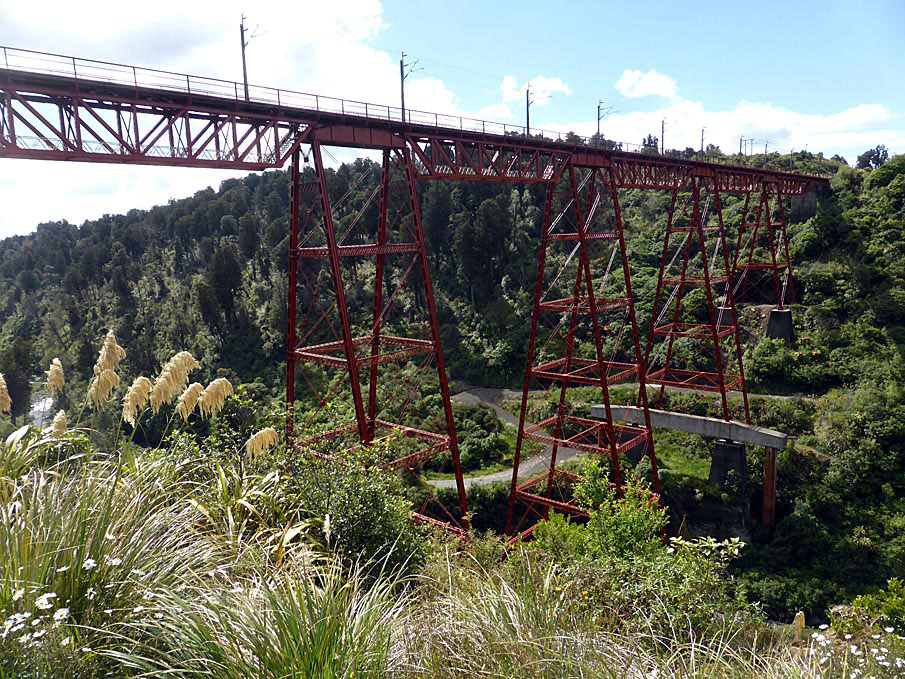
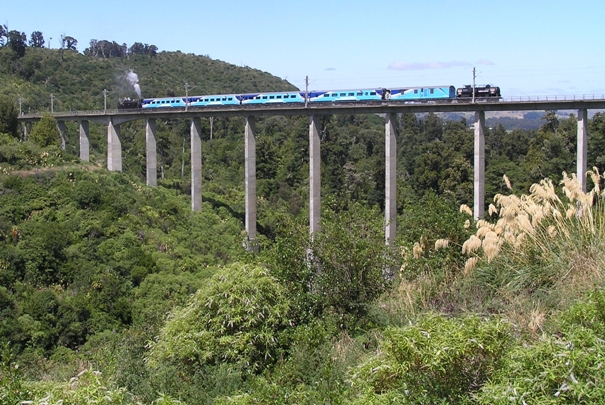
The 130 m (425 feet) long Waiteti Viaduct was built on the North Island Main Trunk Railway in 1889 and is one of the earliest iron viaducts in New Zealand. Located 3 km south of Te Kuiti, its construction was the first of several major engineering works as the railway was extended southwards from the Waikato into the King Country. The line was part of a long-term plan to connect Auckland with Wellington, and to open up the interior of the North Island for farming and forestry. Its construction through the King Country proceeded after reassurances were provided to local Maori that it would not be accompanied by land confiscation or the introduction of liquor to the region. Work on the Mokau section - including the viaduct - was based at Te Kuiti, providing much-needed employment during the economic depression of the 1880s. The contract was let by the government to the engineering firm of J. & A. Anderson of Christchurch, who had produced the first New Zealand-made steam engines in 1857. The project was the first of many carried out by Andersons in the North Island, having previously been involved in railway construction in and around Canterbury.
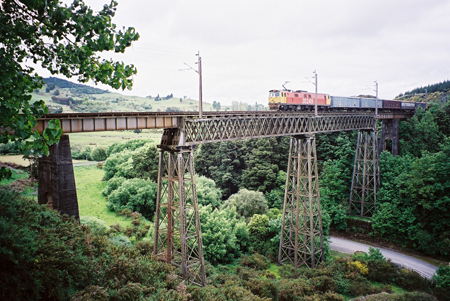
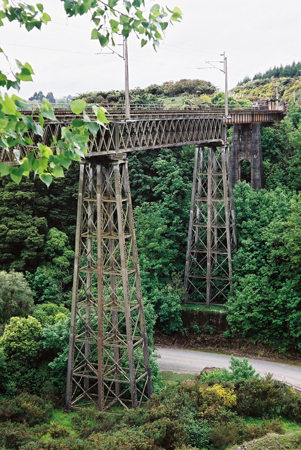
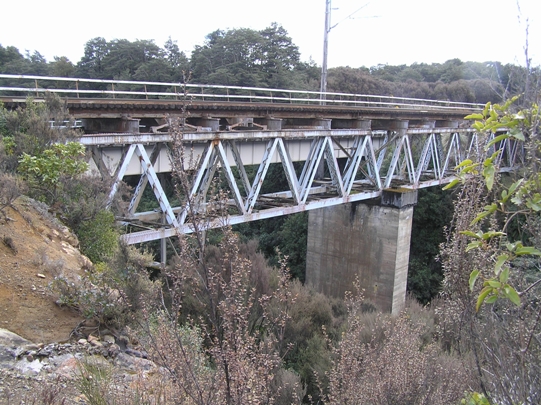
Designed by the Public Works Department, the viaduct is of trestle design and crosses the Waiteti stream at a height of 35 m (115 feet) above river level. It was built using several horizontal lattice girders of equal length, supported by three lattice piers held in mass concrete abutments and foundations. All wrought iron elements were made in a foundry established by Andersons in Te Kuiti, then riveted together on site to form the major bridge components. The rail track and footway are carried above, on a rolled iron transom. The bridge was strengthened in the early twentieth century, when plate girders replaced each end span and reinforced concrete piers were added. This was carried out without serious interruption to rail traffic, an unusual achievement at the time. Greater weight-bearing capacity allowed more powerful locomotives to be employed on the line, increasing the speed of travel and amount of freight carried. Further strengthening and repairs were carried out in the 1950s and 1970s, enabling the bridge to continue in everyday use.
The Waiteti Viaduct is nationally significant as the earliest iron viaduct built in the North Island and is only the second of its type in New Zealand. It is notable for its early use of riveted wrought iron components, produced locally by J. & A. Anderson, a firm of national renown. The bridge demonstrates the importance accorded to the rail network in the economic development of the country, and the employment of expertise from all parts of the country. It is significant for its connections with unemployment relief, the use of private companies for major government contracts and the development of relationships between Pakeha and Kingite Maori, which includes attitudes to land confiscation and alcohol. Its construction was an important stimulus to the development of nearby Te Kuiti, providing the precedent for the town's subsequent association with heavy industry. Later alterations are significant for showing the increasing capacity of rail transport, and innovative engineering solutions in the 1920s. The viaduct is important for its association with other engineering achievements on the same trunk line and has considerable landmark value as a prominent visual feature, high above the Waiteti stream.
Designed by the Public Works Department, the viaduct is of trestle design and crosses the Waiteti stream at a height of 35 m (115 feet) above river level. It was built using several horizontal lattice girders of equal length, supported by three lattice piers held in mass concrete abutments and foundations. All wrought iron elements were made in a foundry established by Andersons in Te Kuiti, then riveted together on site to form the major bridge components. The rail track and footway are carried above, on a rolled iron transom. The bridge was strengthened in the early twentieth century, when plate girders replaced each end span and reinforced concrete piers were added. This was carried out without serious interruption to rail traffic, an unusual achievement at the time. Greater weight-bearing capacity allowed more powerful locomotives to be employed on the line, increasing the speed of travel and amount of freight carried. Further strengthening and repairs were carried out in the 1950s and 1970s, enabling the bridge to continue in everyday use.
The Waiteti Viaduct is nationally significant as the earliest iron viaduct built in the North Island and is only the second of its type in New Zealand. It is notable for its early use of riveted wrought iron components, produced locally by J. & A. Anderson, a firm of national renown. The bridge demonstrates the importance accorded to the rail network in the economic development of the country, and the employment of expertise from all parts of the country. It is significant for its connections with unemployment relief, the use of private companies for major government contracts and the development of relationships between Pakeha and Kingite Maori, which includes attitudes to land confiscation and alcohol. Its construction was an important stimulus to the development of nearby Te Kuiti, providing the precedent for the town's subsequent association with heavy industry. Later alterations are significant for showing the increasing capacity of rail transport, and innovative engineering solutions in the 1920s. The viaduct is important for its association with other engineering achievements on the same trunk line and has considerable landmark value as a prominent visual feature, high above the Waiteti stream.