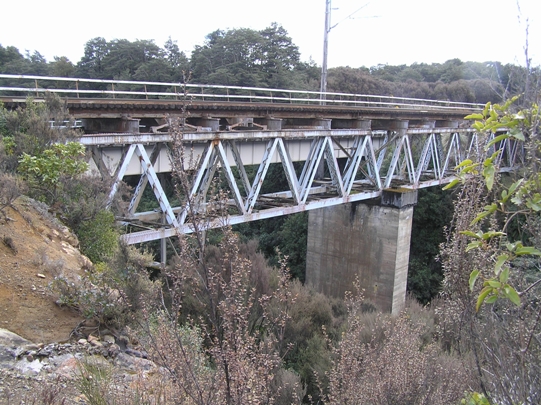
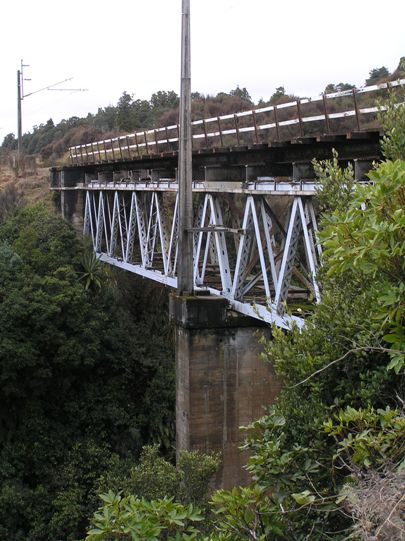
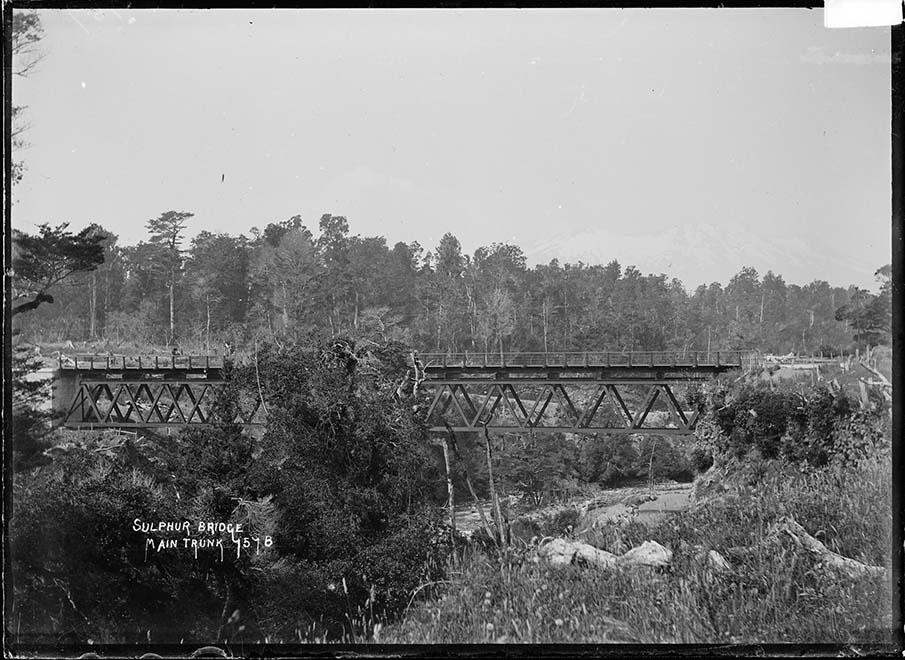
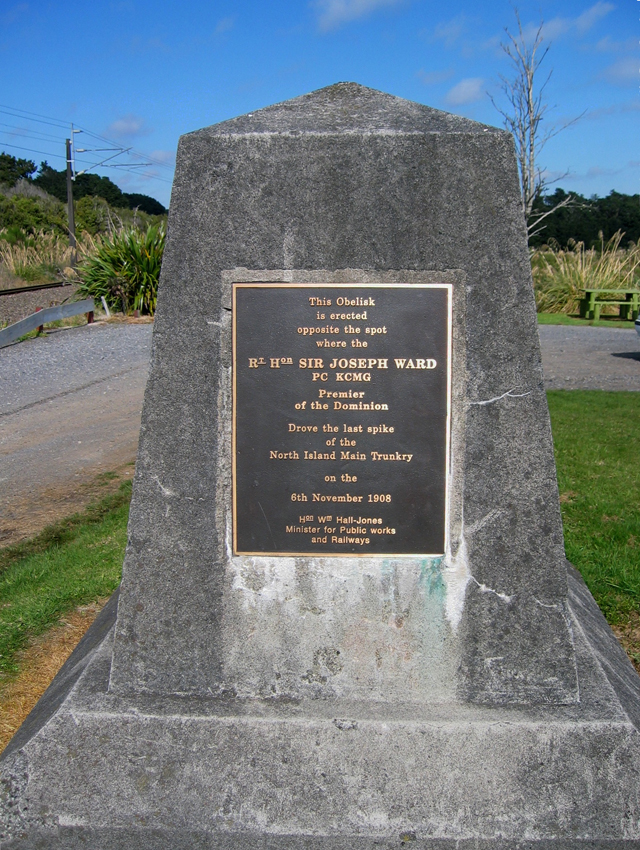
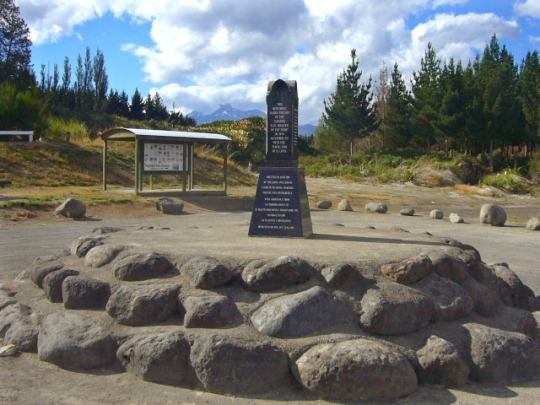
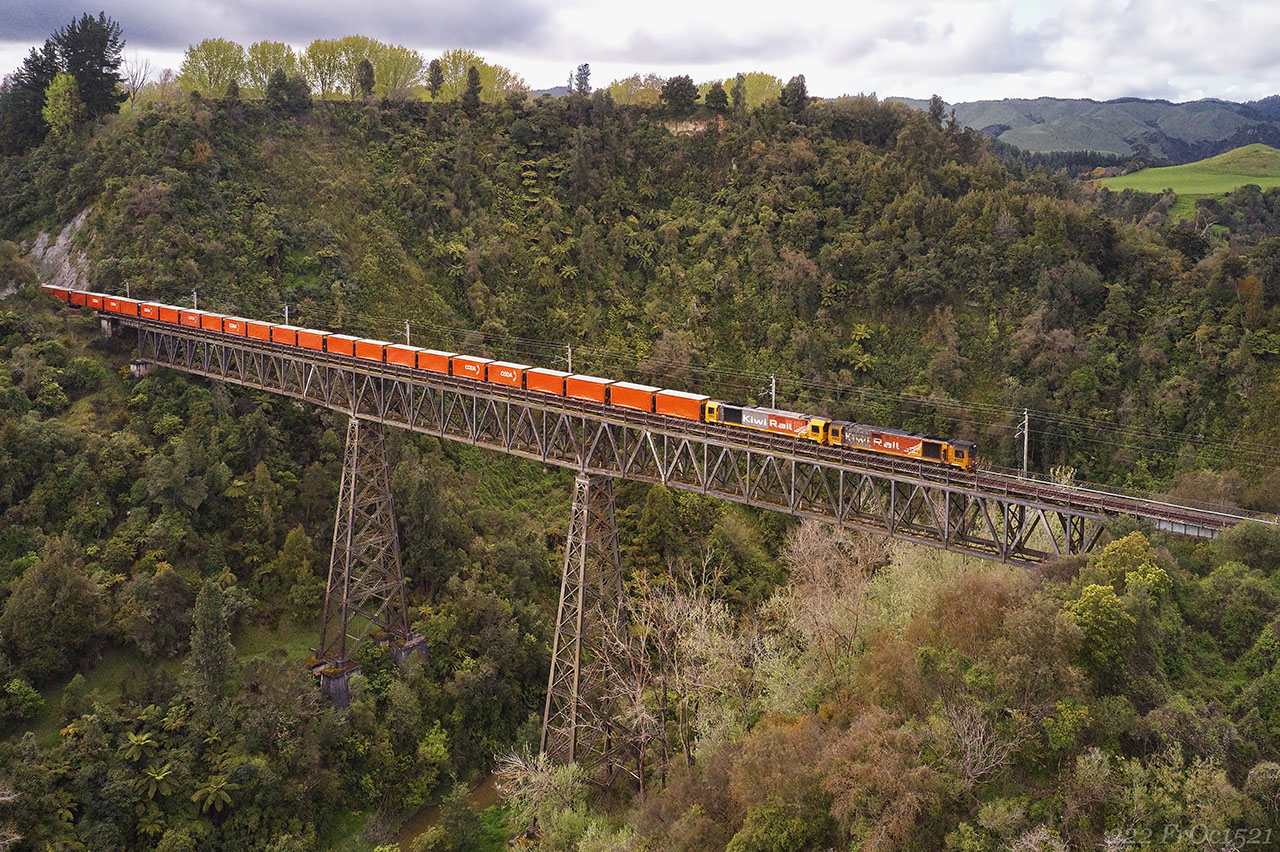
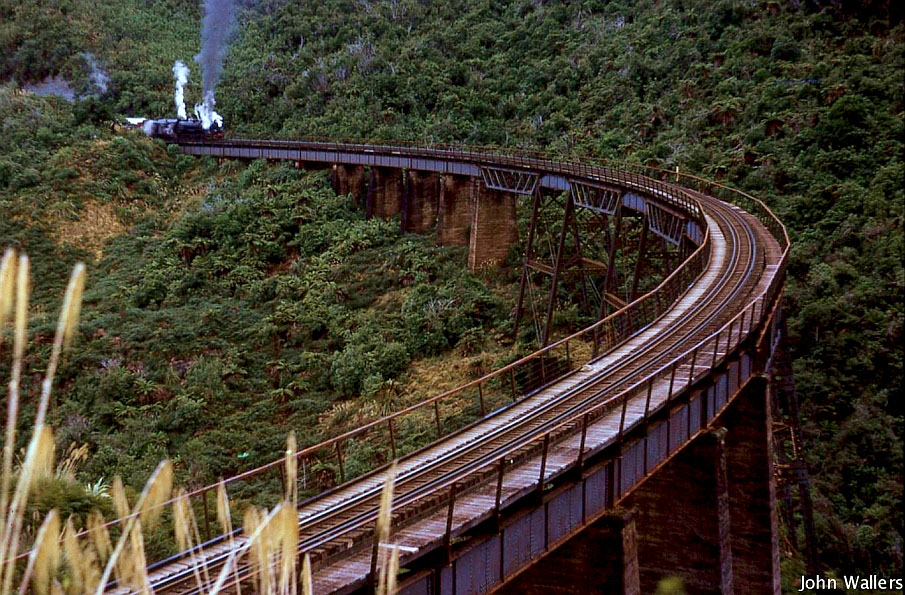
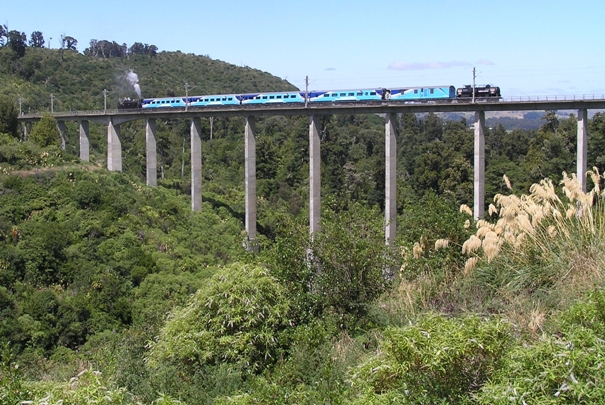
The Mangaturuturu Viaduct is situated between Horopito and Pokaka in the North Island's Central Plateau and is the highest railway structure above sea level in New Zealand. Constructed between 1907 and 1908, the viaduct was an integral part of the 'final push' to complete the NIMT, and by association was important to the settlement of the central North Island and the development of New Zealand's economy in the early-mid 20th century.
The NIMT journey:
The concept of the NIMT was promoted by Julius Vogel (1835-1899), then the Colonial Treasurer in William Fox's government, as part of his bold expansionist policy which was adopted by the House in 1870. From a purely practical standpoint, the NIMT was necessary because it established a direct transport route between New Zealand's two major cities, Auckland and Wellington. For the 20 years prior to the NIMT's completion, goods and passenger traffic between these cities was typically directed from Auckland to New Plymouth via coastal shipping and then continued by ship or train onto Wellington. This was by no means an ideal, or efficient, means of freight or passenger transport.
However, the most direct route for this railway link was through the King Country. From the mid-1860s Maori in the central North Island had repelled European encroachment by establishing, and staunchly upholding, the restricted area known as the Rohe Potae, and the governments of the late 19th century saw the construction of the NIMT as a tool for gaining access to the King Country. In 1883, after a decade of persistent approaches from the government regarding the area, talks between officials and some King Country chiefs regarding the establishment of the railway through their land began in earnest. A series of rigorous negotiations was then initiated with two Ngati Maniapoto leaders, Wahanui Hautare and Rewi Maniapoto.
There seems to have been a feeling that the railway and European incursion into the King Country was inevitable, but these chiefs wanted to make sure that it was on their terms. In late 1884 Wahanui announced his intention to cooperate with the government over the railway, and he laid out a set of conditions before the House of Representatives on 1 November 1884. The conditions included the right of the King movement to manage their own affairs, the banning of liquor from Waikato-Ngati Maniapoto territory, the right of his people to have sole responsibility for administering their ancestral lands, and that they were compensated for the land which was used. Following this, in early 1885 surveyors were allowed into the Rohe Potae to locate possible railway routes. Because of the tenuous relationship between the Crown and King Country iwi it was felt that the negotiation process was essential. However, by only consulting with Wahanui and Maniapoto the government purposely side-stepped King Tawhiao and other leaders who opposed the railway. Therefore, this initial agreement was not universal and accordingly there were instances of resistance, such as the destruction of surveying marks.
Despite some opposition, surveying and construction plans continued and on 15 April 1885 it was Wahanui who wielded the shovel that turned the NIMT's first sod, which was then ceremonially wheeled away by Premier Robert Stout. Prior to the chiefs allowing surveyors into the Rohe Potae, possible railway corridors through the King Country were only speculative because there had not been any previous opportunity to map it in detail. There were several proposed routes for the NIMT and John Rochfort (1832-1893) surveyed for a possible corridor through the Central Plateau between 1883 and 1887. This was said to be his tour de force because he had to start from scratch and cover a large, and topographically complex, area. After much debate and delay it was Rochfort's route for the NIMT that was followed. The Maori land that this route required progressively passed into Crown ownership under the Public Works Acts of 1882 and 1894. This legislation stipulated that construction could not begin until the governor issued a proclamation detailing the middle-line that each successive section would take.
Another key part of Vogel's scheme was to use the construction project as the basis for bringing thousands of assisted immigrants to New Zealand. His policy drew heavily on the model formulated in the United States of America, which used railways to gain access to previously remote areas, then to create settlements in these areas using the construction workers as the foundation of the local populous. The NIMT can be viewed as successful realisation of this model. It was also the catalyst for demographic change for the existing Maori population. In the Central Plateau Maori settlement was mostly concentrated around the Manganui-o-te-ao River. However, the NIMT caused a population shift, and by 1900 the various settlements around the river were largely depopulated because many inhabitants gained employment as labourers on the railway. Once construction was complete it appears that local Maori then gravitated toward the newly established NIMT towns. Therefore, the NIMT is responsible for radically changing the social landscape of the Central Plateau.
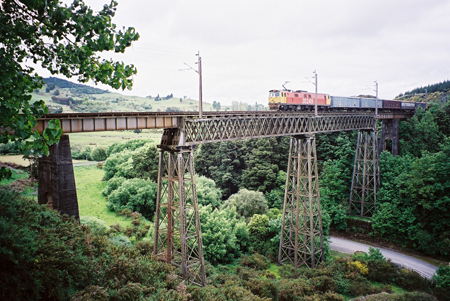
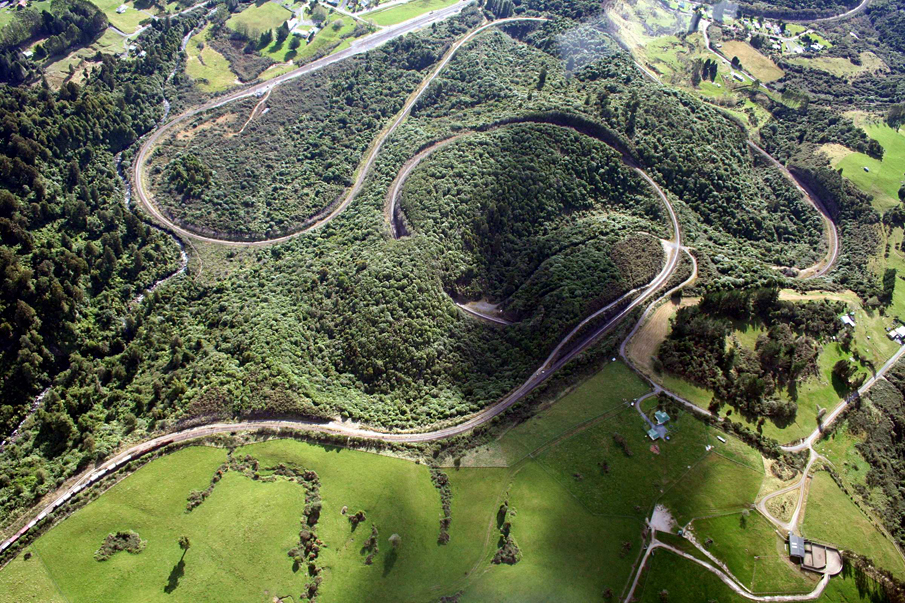
The initial stages in NIMT history were protracted, and once the route was resolved and the required land obtained, the construction progress followed this early pattern and laboured along. The NIMT was eventually completed in 1908 having taken 23 years to complete due to various political and financial impediments including the economic depression of the 1890s. The slow progress bred public dissatisfaction and this had reached such a pitch by 1900 that it motivated parliament to inject significantly more money and manpower to the project in the hope that this would bring it to a quick resolution. This created a last flurry of activity which saw the remaining section between the Makohine Viaduct and Taumarunui completed in just six years. Within this area, the 'final push' and was no easy task, despite the increase in resources, because of its difficult geography which was noted for its steep grades, deep ravines, and heavy bush, not to mention the often inclement weather. Given the topography and the almost complete reliance on physical labour for construction, the completion of this section was relatively quick and remarkable. It also has many significant structures. These include the iconic Makatote and three other surviving viaducts, and important earthworks of which the Raurimu Spiral is an internationally recognised engineering achievement, as well as a number of other tunnels and smaller bridges. The Mangaturuturu and Makatote Viaducts are the only construction era viaducts in this area which remain a functioning part of the NIMT.
The area north of Ohakune provided challenging obstacles for those designing and constructing the structures on the NIMT. The fact that the landscape would not yield willingly to a railway was widely recognised, and was acknowledged in newspapers during the 'final push':
Both Mangaturuturu and Manganui, and Makatote as well, are deep mountain clefts formed in some convulsion of nature and the trachyte rocks bestew the beds of the torrents that run in the gorge-bottoms. High overhanging walls of embedded boulders look as if they are ready to fall on the head of the beholder, but the vegetation which partly wraps them proves that they have stood like this for generations.
The challenges associated with navigating this landscape with a railway make the NIMT's ‘final push' section a recognised engineering achievement and one which concluded New Zealand's ‘pioneering bridge and railway building days...'
Constructing the Mangaturuturu Viaduct:
The Mangaturuturu Viaduct, and its other NIMT contemporaries, are products of the iron and steel construction age of the late 19th and early 20th centuries. The industrial revolution and resulting technologies, such as railways, demanded the development of construction materials which were long lasting, relatively light, and could be mass produced. Iron and steel fulfilled these criteria, but it was not until the late 19th century that a technique was developed which reduced the cost of steel production and made it as cost effective as iron. As a consequence of the international railway boom engineers, such as Eiffel, pioneered the construction of steel viaducts. From this period, steel fabrication was favoured for viaducts, and other large self-supporting structures. Lightness was particularly important for viaducts ‘because it is only in such structures that the weight of the metal forms a prominent item in the strains.' Although, not as monumental as the viaducts built by Eiffel, or even others on the NIMT like the Makatote, the Mangaturuturu Viaduct is representative of this trend. Years later in 1955 when the current highway bridge next to the viaduct was being planned, the District Commissioner of Works sited similar reasons for constructing that bridge using steel, and it was not until after this period that construction using prestressed concrete became a predominant material for bridges in New Zealand.
The engineer responsible for designing the Mangaturuturu Viaduct, and many other ‘final push' structures, was Peter Seton Hay. Hay is noteworthy because he was the first person to graduate from the University of Otago with a Bachelor of Arts in 1877. He then joined the Public Works Department (PWD) and gradually progressed through its ranks to become the engineer-in-chief by the time he died prematurely in 1907. Hay's designs for the Makohine, Mangaweka, Hapuawhenua, Taonui, Mangaturuturu, Manganui-o-te-ao, and Makatote viaducts were all based on classic North American trestle viaducts and are recognised, alongside his pioneering research into New Zealand's hydroelectric capabilities, as his most important legacies.
The Mangaturuturu Viaduct and the original Manganui-o-te-ao Viaduct were closely related in design, as they were both two span steel Warren truss bridges with a central concrete pier. They were also a similar length with the Mangaturuturu being 196ft (60m) and the Manganui-o-te-ao 224ft (68m), although at 60 ft (18m) tall, Mangaturuturu was shorter than its counterpart. Mangaturuturu and, while it survived, Manganui-o-te-ao were always dwarfed by their spectacular sibling, the Makatote Viaduct. However, in general the Mangaturuturu Viaduct's height and length make it a representative NIMT bridge. The Manganui-o-te-ao Viaduct was replaced in 1967 and therefore the Mangaturuturu Viaduct is the only noted remaining Hay viaduct of this design on the NIMT.
The Mangaturuturu Viaduct was designed and partially constructed by the PWD. At both Mangaturuturu and the nearby Manganui-o-te-ao Viaduct, the Department was responsible for constructing the concrete piers and abutments. At Mangaturuturu they had completed this by mid-1907. However, the superstructure was manufactured and constructed by J & A Andersons Ltd of Christchurch who were awarded the contract in 1906. Andersons was a well established firm, and had constructed railways and viaducts in the South Island, and also on the NIMT having built the Te Kuiti to Mokau section (1887-89) which included the Waiteti Viaduct. Despite this experience, Andersons were primarily given the contract because of the close proximity of their Makatote workshop and its ability to produce the steelwork at a time when it was impossible for the PWD workshop at Mangaonoho to do so because it was backed-up manufacturing the steelwork for the Hapuawhenua and Taonui viaducts.
Despite the foundation work being completed by the PWD in a timely manner, the Mangaturuturu Viaduct was not completed until mid-1908 because apparently there were not enough workers available. This was because the main construction focus of the area was on completing the nearby, and well behind schedule, Makatote Viaduct. This diversion of resources meant that the Mangaturuturu contract ran six months overtime and was completed only one month prior to the ‘Parliamentary Special' journey at the beginning of August: the first through trip from Wellington to Auckland. Despite this it was still finished before the Makatote Viaduct and just before the Manganui-o-te-ao.
Even when workers were available, the altitude of the viaduct would have inhibited progress. The work environment at the Mangaturuturu Viaduct site was described as such:
So little sun comes here that the ground is hard and frost-bound all day, and it is even colder than on the snow-clad slope of Waiouru and Turangarere. Yet men must toil here, napping stones and mixing concrete, and praying for the advent of summer.
The inclemency of the local climate and the problems this posed in terms of working conditions and worker health is demonstrated by the fact that Hay is said to have made only one visit to the construction sites around Mangaturuturu while taking a general tour of the works in the area, and it was on this trip that he contracted the pneumonia which caused his death in March 1907. Consequently, Hay did not live to see the last three viaducts he designed come to fruition and was acknowledged posthumously for his central role in the successful completion of the NIMT.
Even with the Mangaturuturu Viaduct's high elevation the workers at the site typically slept in tents which were standard issue along with a pick, long handled shovel, and an axe; the hand tools responsible for building most of the NIMT. Due to Mangaturuturu being a smaller scale project it was not necessary to employ the same innovative machine-powered techniques that were employed in the construction of the Makatote Viaduct, and therefore manual labour prevailed. Because of its similar size, and because the superstructure construction was contracted to the same company, it is probable that the Mangaturuturu was constructed in the same manner as Manganui-o-te-ao Viaduct. This was done by building a temporary timber skeletal scaffold between the central and flanking piers that had a wooden support at the top to hold the prefabricated components of the spans as they were assembled in situ. Therefore, it is largely due to manual brawn and forbearance that structures like the Mangaturuturu, and the NIMT in general, were constructed.
The completion of the NIMT in late 1908 is described as ‘...one of the pivotal moments in New Zealand history' and ‘...arguably the New Zealand state's greatest achievement, at least in the first century after 1840, and certainly its greatest financial commitment.' Upon its completion the NIMT revolutionised passenger and freight transport in the North Island and directly influenced the development of New Zealand's economy in the first half of the 20th century. Vogel's strategy for gaining access to, and promoting settlement in, previously remote regions was a resounding success. In this respect ‘final push' structures, such as the Mangaturuturu Viaduct, are notable contributors to New Zealand history.
Still standing: the Mangaturuturu post-construction:
Railway structures, like the Mangaturuturu Viaduct, were built and operated based around the principle of continuous improvement and repair. Therefore, additions and alterations to the viaduct were an integral part of its, and the NIMT's, story and reflect larger historical changes in railway operations and technology. For example, along with other bridges and viaducts on the NIMT, the Mangaturuturu would have had its spans strengthened between 1925 and 1932 to ensure it could bear the heavier class of locomotive that was being introduced. This and some other changes to the viaduct were dictated by technological developments, but attention to the structure was also a result of its connection to the active volcano, Mount Ruapehu.
Rail transport was the main means of passenger and freight traffic within New Zealand for the first half of the 20th century. However, by the 50th anniversary of the completion of the NIMT, the pre-eminence of rail was being challenged and was eventually overtaken by road transport. This focus on road building is demonstrated by the fact that it was estimated in the mid-1960s that the opening of one road bridge per day was needed to keep up with demand. Therefore, it is no surprise that in the late 1950s a highway bridge was built parallel to the Mangaturuturu Viaduct. The close positioning of the bridge resulted because encroachment on the railway reserve reduced the amount of unused land between the two structures and presumably this also meant a smaller area of land that the PWD had to acquisition for the bridge and adjoining road. Another affect of the closeness of the road bridge was to diminish the visual impact of the viaduct. However, it did also afford easy viewing access of the viaducts features, such as the girders, which is impossible at larger structures such as the Makatote Viaduct.
Over the years the Mangaturuturu River and Viaduct's proximity to Mount Ruapehu has been cause for concern, particularly after the 1953 Tangiwai Disaster. This tragedy was New Zealand's worst rail disaster and was the result of a lahar knocking down the central concrete piers of the Whangaehu River Rail Bridge. In an attempt to minimise the risk of a repeat of the Tangiwai Disaster, a thorough analysis of the structural integrity and foundations of bridges and viaducts which crossed rivers running down from Mount Ruapehu was undertaken over the few years after the tragedy.
The analysis of the foundations of the Mangaturuturu Viaduct's pier in 1956 was driven by the Tangiwai Disaster and given particular emphasis because of the river's link to Mount Ruapehu and its history of being affected by volcanic activity. At the time the Mangaturuturu Viaduct was constructed, the Mangaturuturu River was also known as Sulphur River or Creek. It was reported that the water was ‘heavily impregnated with sulphur' and it was common knowledge that horses were not to be watered there. It is uncertain when and what event caused the sulphur levels in the river, so it is correspondingly unclear whether it affected Maori settlements during the 19th century which were concentrated around the Manganui-o-te-ao River that the Mangaturuturu River leads into, or if it discouraged them from using the river and its resources. By 1912 the water was reported to have cleared, but the memory of this was the foundation of concern that the viaduct could be threatened by a lahar.
The conclusion drawn from the analysis of the viaduct's foundations was that the structure had not been adversely affected by any volcanic activity in the 50 years since it was constructed and that it was not at risk of failure, in a normal flood at least. However, this was contradicted in 1969 when another report was sparked by an upsurge in volcanic activity on Mount Ruapehu. This found that the depth of the original foundation was insufficient which, in the engineer's opinion, left it susceptible to a ‘Tangiwai type washout.' The direct result of this was that the viaduct was underpinned in 1970-71.
This remedial work proved timely and fortunate because in late April 1975 a lahar swept down the Mangaturuturu River. This event caused severe scouring in the river bed with the flow being 7ft (2.1m) above flood level and it also changed the course of the river. The torrent uplifted the central pier of the old highway bridge upstream, which weighed approximately 80 tonnes, and hurtled it downstream depositing it against the viaduct's central concrete pier. This was lucky because, while the viaduct incurred no serious damage, if the concrete slab had continued on and hit the new highway bridge's steel pier its speed and weight would have caused serious structural damage to the bridge, if the not complete failure. Unlike the highway bridge, the viaduct did not require further underpinning as a result of the lahar and the old highway bridge's pier was removed in 1976.
Perhaps the most significant change in the operation and appearance of the NIMT over time was the electrification of the railway in the late 1980s. In preparation a comprehensive upgrading programme was initiated which included the strengthening of older bridges so that they could bear the new Class 30 locomotives which were to be introduced, and also the installing of electrification masts along the length of the NIMT. Subsequently the Mangaturuturu underwent changes at this time which reflect this event in the NIMT's history. These alterations and additions included the replacing of the ironbark railbeams with steel equivalents, and the addition of the electrification mast and parapet, or railing, between 1986 and 1987.
The longevity of the Mangaturuturu Viaduct is a tribute to the skill of the designer, the contractor, and the workers who constructed it. On at least one occasion the Railways Department undertook a systematic assessment of the structures on the NIMT which resulted in some being replaced because, unlike Mangaturuturu, they could not be upgraded in step with changes in locomotives, or because age meant that replacement was necessary for safety. This is emphasised by the fact that only 23% of bridges and viaducts still used in New Zealand's rail network are over 90 years old. However, many of the older structures still in use are subject to speed restrictions. The Mangaturuturu Viaduct had a speed restriction in place in 2004 because faults were found with the steel railbeam to diaphragm connections, even though these railbeams had only replaced a few decades earlier. This temporary speed restriction was lifted when the problematic areas were fixed. Therefore, the Mangaturuturu Viaduct is currently statistically exceptional for its age, due to the design and technical skill exhibited during its construction, but also because of the ongoing maintenance of the structure.