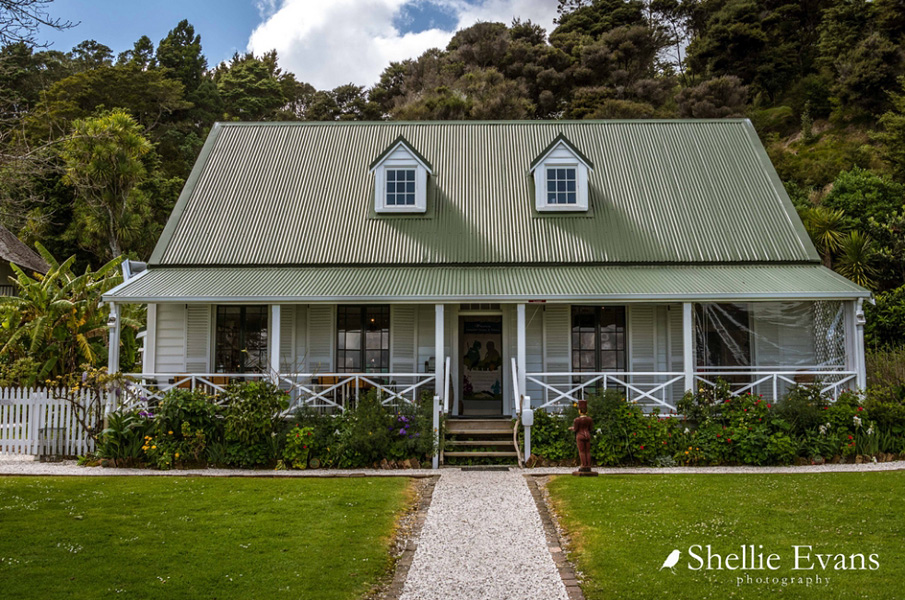
Clendon Cottage in Russell, now part of the Pompallier House Historic Reserve, was built for James Reddy Clendon, possibly as early as 1834, on land that was originally sold to a succession of Pakeha owners by the chief Rewa in 1833. A house was built on the land in 1834, but it is not certain if any of that original building survives in the present structure. Clendon acquired formal title to the land in 1844, as compensation for his loss in a trading venture, having assumed ownership of the land in 1835. After many years as a private residence, a boarding house named 'The Bungalow' from 1911 and a motel named 'Pompallier Lodge' from 1963, Clendon Cottage was acquired by the Crown in 1976 to prevent a proposed apartment development detracting from the neighbouring Pompallier Mission site.
Ngati Manu chief Rewa sold this land, as part of a larger block, to R. Cunningham in December 1833. When Cunningham sold the land to John Ritchie in 1834, it is recorded that there was by then a house on the land. In March 1835, Ritchie sold the land to James Harvey, a business partner of James Reddy Clendon, variously merchant, Resident Magistrate and United States Consul. When Harvey absconded with the ship Fortitude he had chartered from Clendon in 1835, title in the land was granted by Governor Fitzroy to Clendon in 1844, after the resolution of a dispute with other claimants. James Reddy Clendon lived here from 1850 with his first wife Sarah, who died in 1855, and his second wife Jane, whom he married in 1856, before moving away in 1859. Clendon's successor as Resident Magistrate, R C Barstow, rented the cottage from Clendon's son-in-law Rev Frank Gould until 1872, when Gould sold the property to Annie Mason. She owned it until 1907-8, letting it to a Mrs Johnson who operated a boarding house. Between 1911 and 1953 the Bisset family operated the boarding house, which they named 'The Bungalow'. Over the years there were many additions to the original simple gabled cottage, as successive owners added further accommodation, both for use as a private dwelling and as a boarding house and eventually motel. The cottage itself had a dormer added, a lean-to at the southern end and the rear and an extension at the northern end, with verandahs in filled. By 1976 there were also a four unit motel at the south end, a dormitory on the northern boundary with Pompallier House, a toilet behind the house, and possibly other structures. The motel units may have replaced an earlier garage, and were on or near the site of a house owned by James Deary in 1890. Working for the NZHPT after the Crown took the property; the Ministry of Works removed all the additional structures in 1977, and substantially rebuilt the house to recreate a simple cottage form thought to resemble the original. It appears little of the original fabric was re-used. Subsequently, the Cottage has provided accommodation for the NZHPT curator of Pompallier Mission.
Clendon Cottage is significant for its association with a number of figures in the early nineteenth century history of Kororareka and New Zealand, including Rewa, James Reddy Clendon and his wives Sarah and Jane, and Clendon's son-in-law Rev Frank Gould and his wife Fanny. Although probably dating from after the Northern War of 1845, it is one of only a small number of mid-nineteenth century buildings to survive in Kororareka. In its current configuration, it represents the simple cottage form that was once common in the town. Its acquisition was a rare if not unique instance in New Zealand of the application by the Crown of the Public Works Act 1928 to take property in order to prevent harmful effects on an adjacent place with historic heritage values.