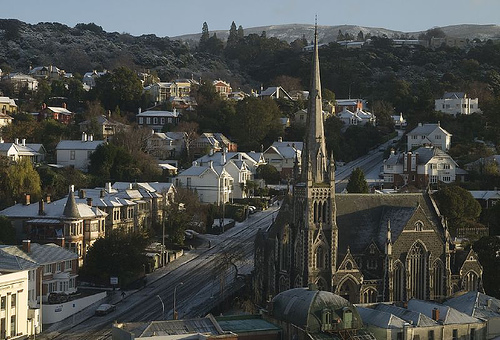
Knox Church has outstanding historical and architectural values as a significant ecclesiastical building which remains an important centre of worship in the Dunedin community. Situated on the corner of Pitt Street and George Street, Knox Church, was built for a mixed group of United Presbyterians, Congregationalists and Methodists and opened in 1876. It has important architectural significance as an example of architect Robert Arthur Lawson's (1833-1902) work. As the only large church on the main street, the spire is a significant landmark at the north end of Dunedin's commercial centre.
Both iwi history and archaeological evidence show Māori occupation in the Ōtākou / Otago region since the 12th century. Today, Kāi Tahu mana whenua is recognised over a large part of Te Wai Pounamu. Kāti Māmoe and Waitaha shared occupation are always acknowledged. The hapū Kai Te Pahi, Kāti Moki, and Kāti Taoka still maintain their presence and responsibility as kaitiaki in this region. While there were no permanent settlements around George Street, the area near the Toitū Tauraka waka (List No. 9774) at the site of the Exhange Plaza on Princes Street, was known as Ōtepoti.
Two large Presbyterian churches were built in Dunedin between 1868 and 1876 with First Church opened in 1873 and Knox Church in 1876. The first smaller Knox Church was erected on the corner of Great King and Frederick Streets in 1859-60. With only 600 seats it ceased to meet the needs of the growing community. It was resolved by a congregational meeting to purchase a section on Pitt and George Street with a new church planned.
A Building Committee of Knox Church was established for the project in 1871 and launched a design competition and call for submissions. The Committee required that the plans must be to a quarter scale, accommodation must be provided for 1000 persons, it was to be built of bluestone with Kakanui white stone facings and should not exceed £5000. They received 17 entries. The original winner of the competition was R.A. Lawson’s design but it was too expensive. The Church chose David Ross’s design, who began the work, albeit slowly. Trouble arose with the contract and the Church had to dismiss Ross on 16 January 1873. To preserve his reputation, Ross took the Knox Church committee to court but lost his case. In the meantime, the committee started the process again and accepted the more expensive design from R. A. Lawson at £18,000. By letting contracts to smaller firms and employing day labourers the committee managed to cut costs and by 1892 the church was debt free.
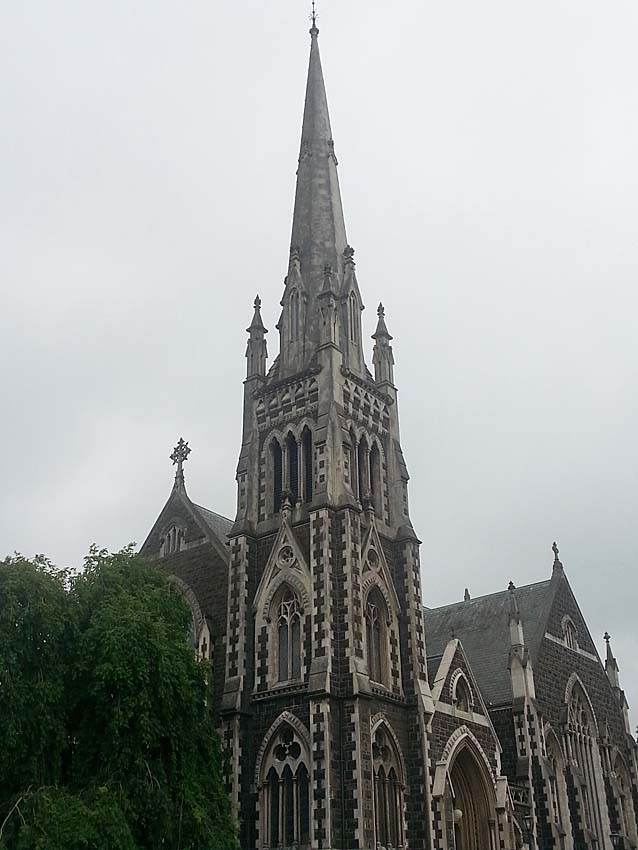
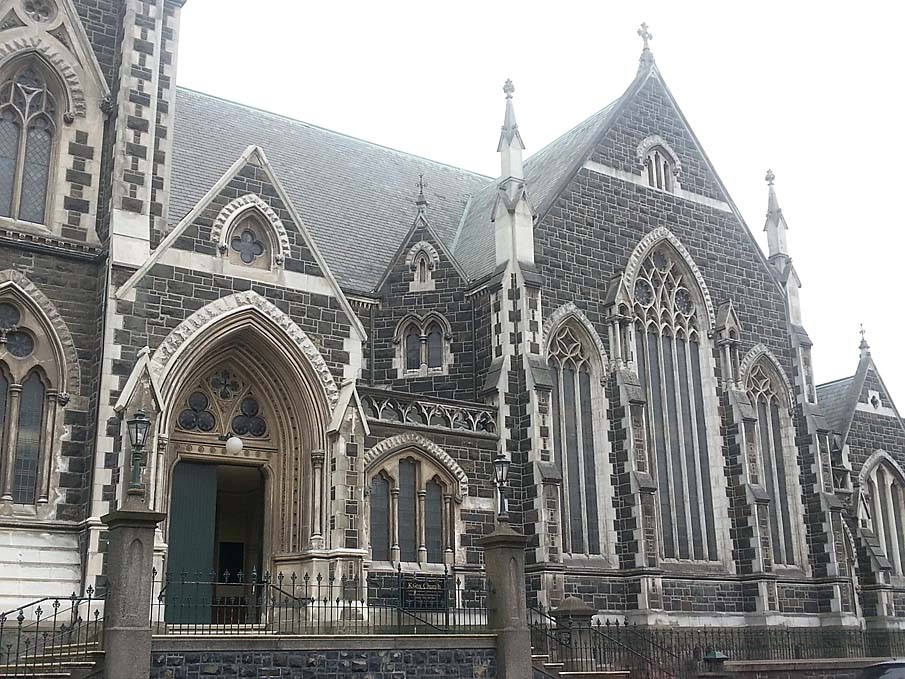
The style of Knox Church is thirteenth century gothic with high arched windows and a spire 50.3 meters high. Materials used were Port Chalmers breccia for the basement, Leith Valley andesite for the walls with Oamaru stone facings, and slate from the MacKerras Creek Slate quarry for the roof. Inside four cast iron pillars help support the gallery and the roof. The roof is constructed on the hammer-beam principle. The plan of the building is in the form of a Latin cross, with the intersecting angles cut off at an angle of forty-five degrees. The seating is arranged to rise from the centre, both in the transepts and in the nave, from the line of intersection. The cast iron railings above a bluestone wall surrounding the church are impressive and included for classification.
The large stained-glass window in the south wall was installed in 1896 in memory of Rev. Dr. Donald McNaughton Stuart (1819-1894). A minister's vestry was added in the 1931 along with a new organ, involving some alterations to the interior. The Church was further re-modelled in 1962 to reveal the northern arch window which had been behind the organ. The pulpit was moved, the choir moved to under the west gallery and the communion table made more central. In 1964 a stained glass window was erected as a tribute to the women of Knox on the southern wall and a decade later the organ underwent a major refurbishment in 1973-74.
Because of maintenance requirements and the need to install a new fire sprinkler system, the church was closed for the first time in June 2008 and reopened in September 2008. The Church also took the opportunity to restore the windows at this time. In 2023 Knox Church remains an important place of worship for Presbyterians in Dunedin.
Both iwi history and archaeological evidence show Māori occupation in the Ōtākou / Otago region since the 12th century. Today, Kāi Tahu mana whenua is recognised over a large part of Te Wai Pounamu. Kāti Māmoe and Waitaha shared occupation are always acknowledged. The hapū Kai Te Pahi, Kāti Moki, and Kāti Taoka still maintain their presence and responsibility as kaitiaki in this region. While there were no permanent settlements around George Street, the area near the Toitū Tauraka waka (List No. 9774) at the site of the Exhange Plaza on Princes Street, was known as Ōtepoti.
Two large Presbyterian churches were built in Dunedin between 1868 and 1876 with First Church opened in 1873 and Knox Church in 1876. The first smaller Knox Church was erected on the corner of Great King and Frederick Streets in 1859-60. With only 600 seats it ceased to meet the needs of the growing community. It was resolved by a congregational meeting to purchase a section on Pitt and George Street with a new church planned.
A Building Committee of Knox Church was established for the project in 1871 and launched a design competition and call for submissions. The Committee required that the plans must be to a quarter scale, accommodation must be provided for 1000 persons, it was to be built of bluestone with Kakanui white stone facings and should not exceed £5000. They received 17 entries. The original winner of the competition was R.A. Lawson’s design but it was too expensive. The Church chose David Ross’s design, who began the work, albeit slowly. Trouble arose with the contract and the Church had to dismiss Ross on 16 January 1873. To preserve his reputation, Ross took the Knox Church committee to court but lost his case. In the meantime, the committee started the process again and accepted the more expensive design from R. A. Lawson at £18,000. By letting contracts to smaller firms and employing day labourers the committee managed to cut costs and by 1892 the church was debt free.
The style of Knox Church is thirteenth century gothic with high arched windows and a spire 50.3 meters high. Materials used were Port Chalmers breccia for the basement, Leith Valley andesite for the walls with Oamaru stone facings, and slate from the MacKerras Creek Slate quarry for the roof. Inside four cast iron pillars help support the gallery and the roof. The roof is constructed on the hammer-beam principle. The plan of the building is in the form of a Latin cross, with the intersecting angles cut off at an angle of forty-five degrees. The seating is arranged to rise from the centre, both in the transepts and in the nave, from the line of intersection. The cast iron railings above a bluestone wall surrounding the church are impressive and included for classification.
The large stained-glass window in the south wall was installed in 1896 in memory of Rev. Dr. Donald McNaughton Stuart (1819-1894). A minister's vestry was added in the 1931 along with a new organ, involving some alterations to the interior. The Church was further re-modelled in 1962 to reveal the northern arch window which had been behind the organ. The pulpit was moved, the choir moved to under the west gallery and the communion table made more central. In 1964 a stained glass window was erected as a tribute to the women of Knox on the southern wall and a decade later the organ underwent a major refurbishment in 1973-74.
Because of maintenance requirements and the need to install a new fire sprinkler system, the church was closed for the first time in June 2008 and reopened in September 2008. The Church also took the opportunity to restore the windows at this time. In 2023 Knox Church remains an important place of worship for Presbyterians in Dunedin.