DonateSupporterVisit Heritage
  • Tūrangawaewae
    Places
  • Tira Māori
    Māori Heritage
  • Poutairangahia
    Archaeology
  • Rauemi
    Resources
  • Mō Tātou
    About Us
  • New Zealand Heritage List
  • Nominate and submit
  • Explore the List
  • National Historic Landmarks
  • Plaques
  • Rainbow List Project
  • Lost heritage
  • Visit Heritage
  • Our properties
  • Turnbull House Project
  • Collections
  • Shop
  • Tohu Whenua
  • Tira Māori
  • Conserving Māori heritage
  • Marae built heritage
  • Māori heritage on the List
  • Hinemihi—Te Hokinga Mai
  • What is archaeology?
  • Is there a site on my property?
  • What are my legal requirements?
  • Affecting an archaeological site
  • Declaring an archaeological site
  • Archaeology FAQs
  • Archaeology Digital Library
  • Archaeology guidelines and templates
  • Resources
  • Funding
  • Publications
  • Sustainable management guides
  • Disaster recovery
  • Podcasts & digital resources
  • Education Hub
  • Conservation plans
  • About
  • Board
  • Māori Heritage Council
  • Senior Staff
  • Offices
  • Contact us
  • Careers
  • Covenants
  • Fast-track
  • Corporate documents
  • Currently consulting on
  • Our submissions
  • News
  • Covid-19 response
Quick links
Rārangi Kōrero | The List
Explore the List
National Historic Landmarks
Ngā Manawhenua o Aotearoa me ōna Kōrero Tūturu
Quick links
Tapuwae
A Vision for Places of Māori Heritage
Funding for Māori Heritage
Resources
Quick links
Archaeological Authority Portal
Applying for an archaeological authority
Archaeology FAQs
Browse the most frequently asked questions about archaeological authorities and the archaeological process.
Quick links
Quick links
Contact us
Offices
DonateSupporterVisit Heritage
  • Tūrangawaewae
    Places
  • Tira Māori
    Māori Heritage
  • Poutairangahia
    Archaeology
  • Rauemi
    Resources
  • Mō Tātou
    About Us
  • New Zealand Heritage List
  • Nominate and submit
  • Explore the List
  • National Historic Landmarks
  • Plaques
  • Rainbow List Project
  • Lost heritage
  • Visit Heritage
  • Our properties
  • Turnbull House Project
  • Collections
  • Shop
  • Tohu Whenua
  • Tira Māori
  • Conserving Māori heritage
  • Marae built heritage
  • Māori heritage on the List
  • Hinemihi—Te Hokinga Mai
  • What is archaeology?
  • Is there a site on my property?
  • What are my legal requirements?
  • Affecting an archaeological site
  • Declaring an archaeological site
  • Archaeology FAQs
  • Archaeology Digital Library
  • Archaeology guidelines and templates
  • Resources
  • Funding
  • Publications
  • Sustainable management guides
  • Disaster recovery
  • Podcasts & digital resources
  • Education Hub
  • Conservation plans
  • About
  • Board
  • Māori Heritage Council
  • Senior Staff
  • Offices
  • Contact us
  • Careers
  • Covenants
  • Fast-track
  • Corporate documents
  • Currently consulting on
  • Our submissions
  • News
  • Covid-19 response
Quick links
Rārangi Kōrero | The List
Explore the List
National Historic Landmarks
Ngā Manawhenua o Aotearoa me ōna Kōrero Tūturu
Quick links
Tapuwae
A Vision for Places of Māori Heritage
Funding for Māori Heritage
Resources
Quick links
Archaeological Authority Portal
Applying for an archaeological authority
Archaeology FAQs
Browse the most frequently asked questions about archaeological authorities and the archaeological process.
Quick links
Quick links
Contact us
Offices
  • Places
  • Nominate and submit
  • National Historic Landmarks
  • Places
  • Nominate and submit
  • National Historic Landmarks
  • Tira Māori
  • Conserving Māori heritage
  • Marae built heritage
  • Tira Māori
  • Conserving Māori heritage
  • Marae built heritage
  • Archaeological authorities
  • Archaeology Digital Library
  • Archaeological authorities
  • Archaeology Digital Library
  • All resources
  • Publications
  • Funding
  • All resources
  • Publications
  • Funding
  • FAQs
  • FAQs
Follow us on:
Places
  • Places
  • Nominate and submit
  • National Historic Landmarks
Tira Māori
  • Tira Māori
  • Conserving Māori heritage
  • Marae built heritage
Archaeology
  • Archaeological authorities
  • Archaeology Digital Library
Resources
  • All resources
  • Publications
  • Funding
FAQs
  • FAQs
Follow us on
HomePrivacyTerms and conditionsAbout this site
© Heritage New Zealand Pouhere Taonga 2026.
 
Stuart Memorial

Queens Gardens, DUNEDIN

Public

Historic Place Category 1

List No. 4758

Quick links:
List GalleryLocationDetails
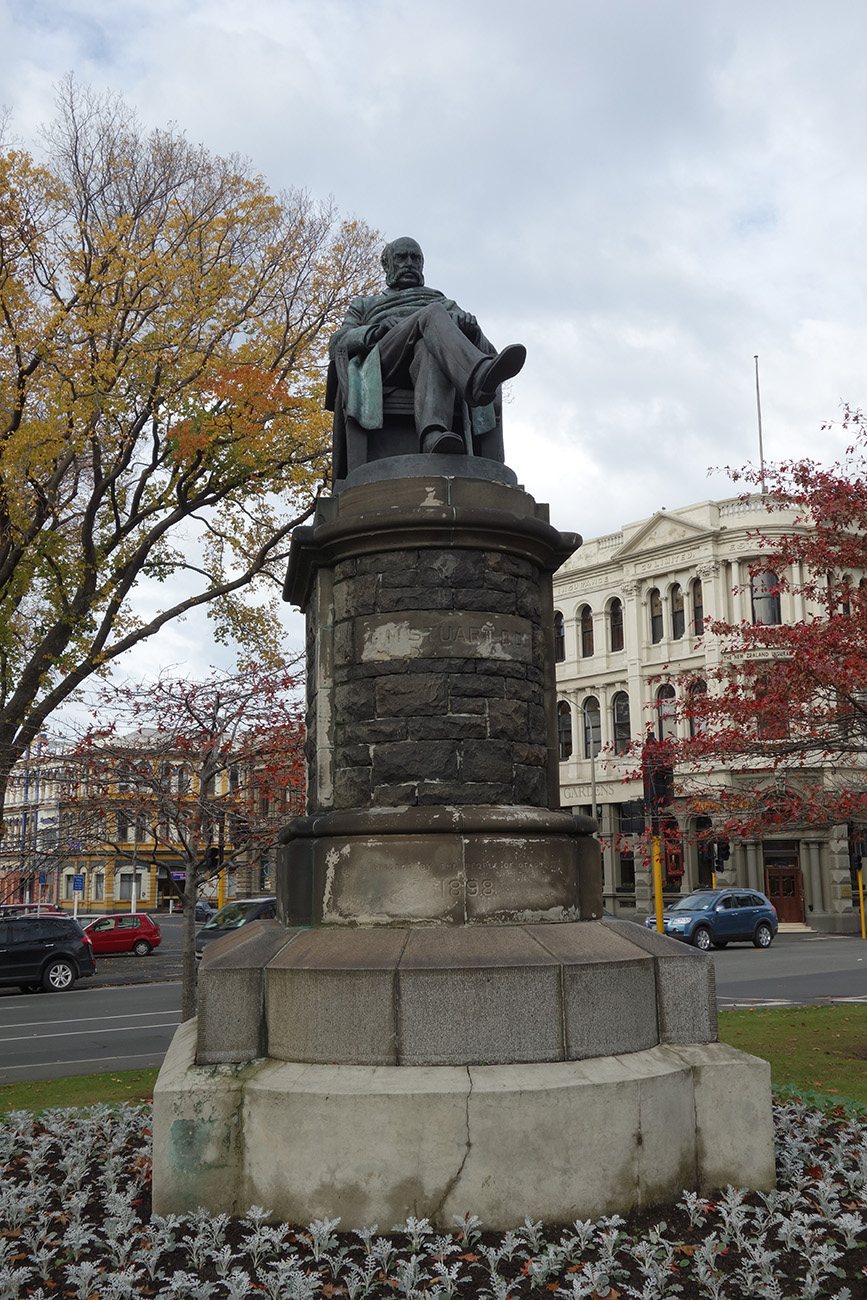
Now largely shrouded by trees, the bronze cast Stuart Memorial sits opposite Queens Gardens in Central Dunedin within the extent of the Queens Gardens Historic Area (List No. 9286). Installed in 1898, the statue commemorates the life of Rev. Dr. Donald McNaughton Stuart (1819-1894) who had an immense impact on the people of Dunedin and the wider Presbyterian community through his roles as a church leader and educationalist. This monument has historical and aesthetic significance.

The area where the memorial stands was once a wide mudflat near the mouth of the Toitū stream which emptied into awa Ōtakou / Otago Harbour, close to the site of the Toitū Tauraka Waka (List No.9774) which provided Kāti Mamoe and Kāi Tahu peoples access to fresh water and mahika kai sites. Nearby was the early settlement of Ōtepoti. This land was reclaimed in the 1870s using material from the reduction of Ngā Moana e Rua / Bell Hill and is close to some of the earliest sites established after the Free Church Settlement in 1848.

Born in Scotland in 1819, Donald McNaughton Stuart was educated at the parish school of Kenmore, worked as a teacher, and later accepted a position at a school in Windsor, England while also studying theology. He completed his studies in Edinburgh after which he became a minister of the Free Church of Scotland. Stuart married Janet ‘Jessie’ Robertson in 1850 and in 1860 seized the opportunity to emigrate to Otago, ‘panting for the exciting labours of planting the gospel in some part of our great Colonial Empire’. In May 1860 he was appointed as first minister of Knox Church (1860-1894).

Stuart was a respected, popular and influential public figure known for his ‘genial manner, ready smile, and compassionate interest in people, and for his tolerance and deep commitment to the social expression of his Christian principles’. He was an active member of the Synod of the Presbyterian Church and the synod’s University, Theological College and Church extension committees. In 1872 Stuart was awarded a Doctor of Divinity by the University of St Andrews. A devoted educationalist, Stuart was chairman of the Otago Boys’ and Girls’ High Schools board between 1879 and 1894. He was elected Vice Chancellor of the Otago University council in 1871 where he remained until he was elected Chancellor in 1879. During this time Stuart made significant contributions to the development of the University adding the schools of mines, medicine and law to its foundation subjects. ‘Though Scottish to the backbone and Presbyterian to the marrow’, Stuart was appreciated for his openminded approach to marriage, and was prepared to marry people from different denominations. Stuart’s sudden death in 1894 rocked the citizens of Dunedin and the wider province. He lay in state in Knox Church where he was visited by thousands of people. The day of his funeral was declared a holiday to enable citizens to attend; shops closed, and 15-20 thousand people are reported to have attended.

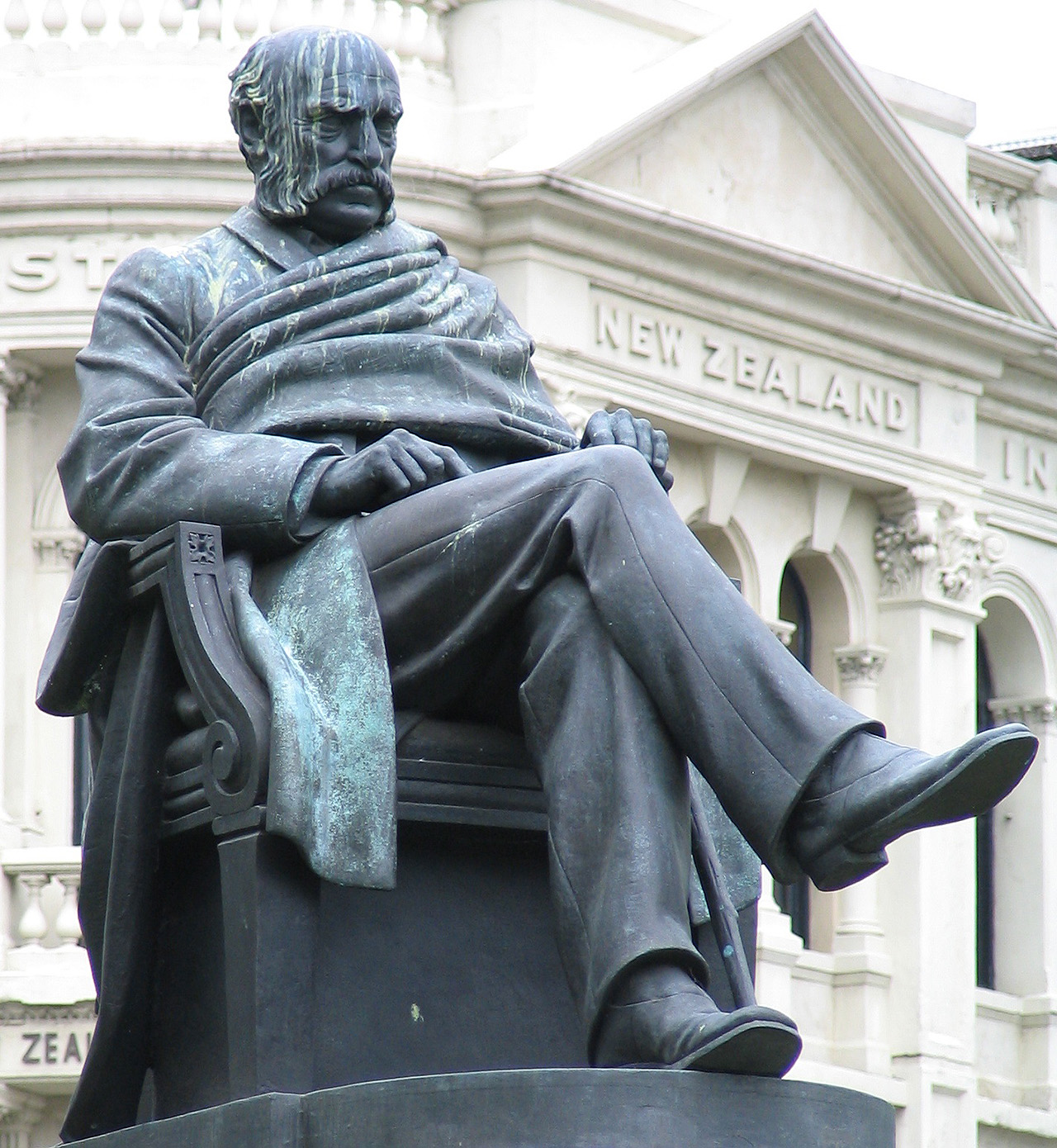
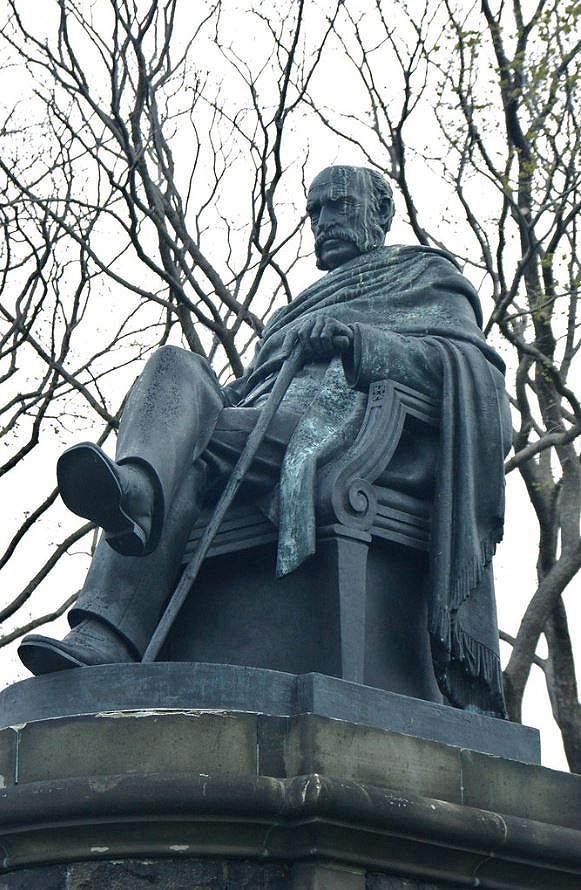
In May 1894, the citizens of Dunedin decided to erect a memorial in recognition of Stuart. The Secretary of the Stuart Memorial Committee wrote to the Council requesting the site where the ‘large lamp stands, near the Triangle’ be granted for the statue. Funds were raised and a premium of 25 guineas granted for the best proposal. In 1896 the proposal by Mr William Leslie Morison who ran Morison’s Art School in Wellington was chosen. The statue is significant as the first major civic commission to be granted to a New Zealand resident artist. Morison depicted Stuart seated cross-legged, wrapped in his ubiquitous plaid, holding a walking stick and sitting in a ‘curule chair’. The plaster model was shipped to England in pieces for casting in bronze. The statue was ‘admitted into the colony free of duty’ and was unveiled on 22 June 1898. Dunn describes the likeness as a work of, ‘uncompromising realism … Stuart emanates energy’.

The Statue of Rev. Dr Stuart returned to the eye of the public in 1922 when it was proposed that it and the statue of Queen Victoria be removed to other sites. The area surrounding the memorial was to be transformed into a tramway balloon loop. Other sites were proposed however the tramway balloon was cleared in readiness by July 1922. At the beginning of August it was reported that the statue had been ‘re-erected upon its old site, but with a difference.’ This being that Stuart had been rotated 90 degrees so he faced the Bank of Australasia building. His statue was placed on a pedestal 5 foot higher (1.5 m) built of Leith blue stone and Hobart sandstone and incorporating seating and a flower garden. Despite discussions about moving the statue to coincide with the 125th anniversary of Stuart’s death, and the University’s 150th celebrations, Rev. Dr Stuart remains in the Queens Gardens area today.
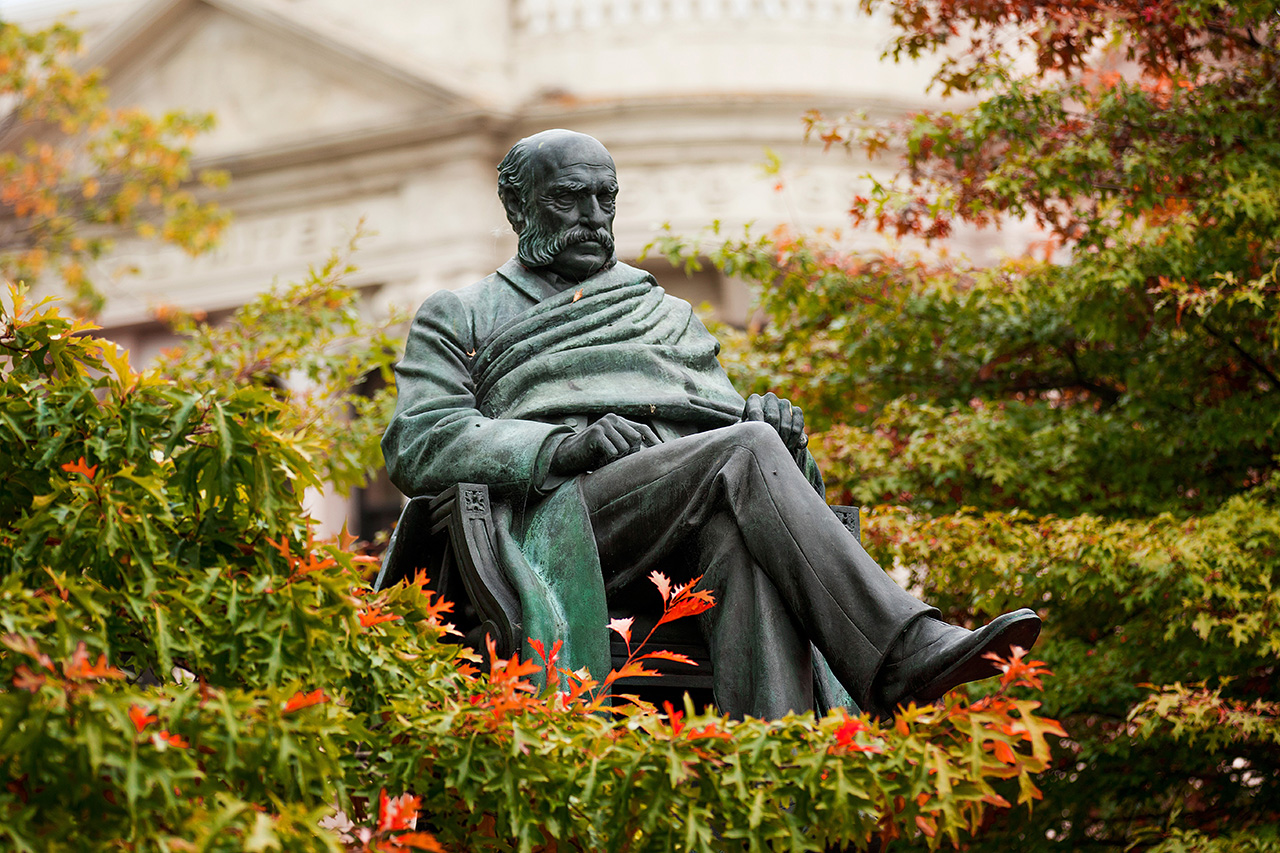
Stuart Memorial, Dunedin. CC BY Licence | John Caswell | 28/03/2021 | John Caswell
Stuart Memorial, Dunedin. Donald Stuart Statue CC BY-SA 3.0 Image courtesy of commons.wikimedia.org | Schwede66 | 28/04/2013 | Schwede66 - Wikimedia Commons
Stuart Memorial, Dunedin. CC BY-SA 3.0 Image courtesy of commons.wikimedia.org | Ben Hill | 02/01/2010 | Benchill - Wikimedia Commons
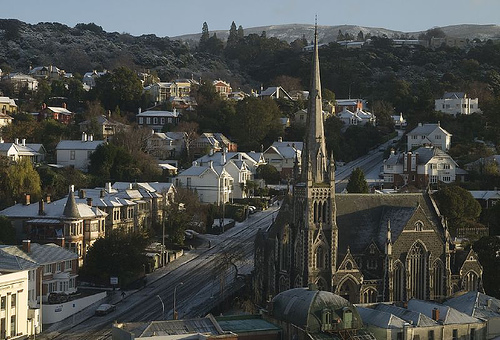
Stuart Memorial, Dunedin. Image courtesy of www.flickr.com | PhilBee NZ - Phil Braithwaite | 15/09/2012 | Phil Braithwaite
Stuart Memorial, Dunedin. CC BY Licence | John Caswell | 28/03/2021 | John Caswell
Stuart Memorial, Dunedin. Donald Stuart Statue CC BY-SA 3.0 Image courtesy of commons.wikimedia.org | Schwede66 | 28/04/2013 | Schwede66 - Wikimedia Commons
Stuart Memorial, Dunedin. CC BY-SA 3.0 Image courtesy of commons.wikimedia.org | Ben Hill | 02/01/2010 | Benchill - Wikimedia Commons
Stuart Memorial, Dunedin. Image courtesy of www.flickr.com | PhilBee NZ - Phil Braithwaite | 15/09/2012 | Phil Braithwaite

List Entry Information

Overview

Status
Listed

List Entry Status
Historic Place Category 1

Access
Able to Visit

List Number
4758

Date Entered
26th November 1987

Date of Effect
26th November 1987

City/District Council
Dunedin City

Region
Otago Region

Extent of List Entry

Extent includes part of the land described as Sec 1 Blk LIV Town of Dunedin (RT 62155), Otago Land District and the Stuart Memorial, thereon.

Legal description

Sec 1 Blk LIV Town of Dunedin (RT 62155), Otago Land District

Detailed List Entry
Significance

Historic Significance

Historical Significance or Value Dr D M Stuart was born in 1819 at Kenmore on the River Tay. He was educated in the parish school and took up school teaching to enable him to attend ST Andrews University for four years. He studied theology at both Edinburgh and London. He ministered to the Presbyterians of Falstone on the English border for 10 years, until he received the call to go to Knox at the end of 1859. He arrived with his sick wife at Port Chalmers in January 1860. His wife died two years later in 1862, leaving three sons. Two of them died in 1883 and 1889 respectively. Early in his ministry Dr Stuart started Sunday morning Bible Classes which he saw as profoundly important. He saw his great work to be that of building up and holding together a large congregation in which he succeeded to such a degree that the Knox congregation was reputed to be the largest Presbyterian congregation in Australasia and noted throughout its history for its 'liberality, enterprise, works of faith and labour of love' (A Ross, They built in faith). The Knox Library was established in 1866 and is now a valuable archive. In 1861 the Presbyterian Church of Otago appointed ministers to visit the goldfields in rotation, and in August 1861 Dr Stuart preached at Gabriel's Gully, riding there on horseback and living in a tent lined with woollen stuff which fell on him during one night of heavy snow storms. He preached at Clyde, Cornwell and Naseby and opened a church at Hamiltons in midwinter. He was instrumental in getting the first Presbyterian minister for the Maniototo, as well as a 'roving' minister for the Clyde - Cromwell area. In 1872 the University of St Andrews conferred an honorary degree of Doctor of Divinity on him. He was a tall man and habitually wore a shepherd's plaid round his shoulders as shown on the statue. He died in 1894.

Physical Significance

ARCHITECTURAL SIGNIFICANCE: A carefully executed memorial typical of its period. TOWNSCAPE/LANDMARK SIGNIFICANCE: The monument is placed on a large island immediately below the old commercial centre of Dunedin where three major roads meet.

Construction Professional

Name

Morison, William Leslie (1849-1935)

Type

Sculptor

Biography

Born 1849 Scotland, Morison was a certified teacher and medalist from the Royal Scottish Academy of Art and architecture in Edinburgh. He emigrated to New Zealand in June 1887 where he settled in Wellington, and remained there until his death. On his arrival he advertised as a teacher available to teach at schools and for private classes in drawing, painting and modelling. He quickly became established in the local art scene, teaching sculpture at the School of Design, taking classes in modelling, casting and terracotta in 1887. The following year he is recorded as holding the position of Honorary Secretary of the Fine Arts Association. In 1889 Morison established Morison’s School of Art in the Exchange Building on Lambton Quay, Wellington. He registered a patent in 1891 for an invention entitled, ‘Morison’s Drawing Instructor’. Morison won the commission for a memorial statue of Rev. Dr DM Stuart in Dunedin, 1894. The statue is significant as the first major civic commission to be granted to a New Zealand resident artist. Morison was the contractor for the memorials to Premier John Balance (1839-1893) at Parliament (List No.211) and in Whanganui (List No.967) in 1898. He is also noted as submitting drawings for the Queen Victoria memorial in Auckland. In 1904 and 1908 he exhibited sketch modes of Sir John Campbell and Prime Minister Richard Seddon.

Name

H S Bingham & Co.

Type

Builder

Biography

Stonemason Henry Sydney Bingham formed H.S. Bingham Monumental Masons about 1911. Later the company was known as H.S. Bingham and Co. The company was involved in many of Dunedin’s major building projects, including the renovation of First Church in 1933 and Knox College. The company also built a number of memorials including the cenotaph at Queens Gardens, the North East Valley War Memorial, the war memorial gates at High Street School and the McKenzie Memorial Cairn on Puketapu hill above Palmerston. (Source: Information Upgrade Report, Heather Bauchop, Apr 2014)

Name

Wainwright, Marcus

Type

Stonemason

Biography

No biography is currently available for this construction professional

Construction Details

Start Year

2020

Type

Restoration

Description

Cleaning and repairs

Start Year

1896

Type

Original Construction

Description

The monument carries the inscription D M Stuart, Erected by the people of Otago 1898.

Start Year

1922

Type

Modification

Description

The statue was raised on a pedestal in 1922.

Construction Materials

The figure is in bronze, now green with age, and the plinth has a stepped base of concrete and granite with a pillar of andesite which has facings of Hobart sandstone on the squared corners at the rear. The whole monument is about five metres high.

Notable Features

Its landmark quality at a major cross roads. Also it forms a pair with a bronze statue of Queen Victoria on the edge of Queens Gardens nearby.

Physical Description

ARCHITECTURAL DESCRIPTION (Style): A typically Victorian statue well raised on a plinth with the figure done in realistic form seated on a Roman chair. The pose is solemn and brooding, with a shepherds plaid wrapped around the shoulders of the figure rather like a toga. MODIFICATION: In 1922 it was raised on its pedestal and turned so as not to have its back to the statue of Queen Victoria.

Reference

Public NZAA Number

I44/735

Report Written By

Sarah Gallagher

Information Sources

Hislop, 1892

J Hislop, The History of Knox Church, Dunedin, 1892

Ross, 1976

A Ross, They built in faith, 1976

Dunn, 2002

Dunn, Michael, New Zealand Sculpture: A History, Auckland University Press, Auckland, 2002.

Morgan, M., Stuart

Morgan, M., Stuart, Donald McNaughton, Dictionary of New Zealand Biography, first published in 1993. Te Ara - the Encyclopedia of New Zealand, https://teara.govt.nz/en/biographies/2s50/stuart-donald-mcnaughton

Report Written By

This historic place was registered under the Historic Places Act 1980. This report includes the text from the original Building Classification Committee report considered by the NZHPT Board at the time of registration Please note that entry on the New Zealand Heritage List/Rarangi Korero identifies only the heritage values of the property concerned, and should not be construed as advice on the state of the property, or as a comment of its soundness or safety, including in regard to earthquake risk, safety in the event of fire, or insanitary conditions.

Further Information

Current Usages

Uses: Civic Facilities

Specific Usage: Statue/public art

Uses: Commemoration

Specific Usage: Memorial - Particular person or group

Former Usages

General Usage:: Civic Facilities

Specific Usage: Statue/public art

General Usage:: Commemoration

Specific Usage: Memorial - Particular person or group

Themes

Web Links

Overview

Status

Listed

List Entry Status

Historic Place Category 1

Access

Able to Visit

List Number

4758

Date Entered

26th November 1987

Date of Effect

26th November 1987

City/District Council

Dunedin City

Region

Otago Region

Extent of List Entry

Extent includes part of the land described as Sec 1 Blk LIV Town of Dunedin (RT 62155), Otago Land District and the Stuart Memorial, thereon.

Legal description

Sec 1 Blk LIV Town of Dunedin (RT 62155), Otago Land District

Status

Listed

List Entry Status

Historic Place Category 1

Access

Able to Visit

List Number

4758

Date Entered

26th November 1987

Date of Effect

26th November 1987

City/District Council

Dunedin City

Region

Otago Region

Extent of List Entry

Extent includes part of the land described as Sec 1 Blk LIV Town of Dunedin (RT 62155), Otago Land District and the Stuart Memorial, thereon.

Legal description

Sec 1 Blk LIV Town of Dunedin (RT 62155), Otago Land District

Significance

Why is this place significant?

Historic Significance

Historical Significance or Value Dr D M Stuart was born in 1819 at Kenmore on the River Tay. He was educated in the parish school and took up school teaching to enable him to attend ST Andrews University for four years. He studied theology at both Edinburgh and London. He ministered to the Presbyterians of Falstone on the English border for 10 years, until he received the call to go to Knox at the end of 1859. He arrived with his sick wife at Port Chalmers in January 1860. His wife died two years later in 1862, leaving three sons. Two of them died in 1883 and 1889 respectively. Early in his ministry Dr Stuart started Sunday morning Bible Classes which he saw as profoundly important. He saw his great work to be that of building up and holding together a large congregation in which he succeeded to such a degree that the Knox congregation was reputed to be the largest Presbyterian congregation in Australasia and noted throughout its history for its 'liberality, enterprise, works of faith and labour of love' (A Ross, They built in faith). The Knox Library was established in 1866 and is now a valuable archive. In 1861 the Presbyterian Church of Otago appointed ministers to visit the goldfields in rotation, and in August 1861 Dr Stuart preached at Gabriel's Gully, riding there on horseback and living in a tent lined with woollen stuff which fell on him during one night of heavy snow storms. He preached at Clyde, Cornwell and Naseby and opened a church at Hamiltons in midwinter. He was instrumental in getting the first Presbyterian minister for the Maniototo, as well as a 'roving' minister for the Clyde - Cromwell area. In 1872 the University of St Andrews conferred an honorary degree of Doctor of Divinity on him. He was a tall man and habitually wore a shepherd's plaid round his shoulders as shown on the statue. He died in 1894.

Physical Significance

ARCHITECTURAL SIGNIFICANCE: A carefully executed memorial typical of its period. TOWNSCAPE/LANDMARK SIGNIFICANCE: The monument is placed on a large island immediately below the old commercial centre of Dunedin where three major roads meet.

Why is this place significant?

Historic Significance

Historical Significance or Value Dr D M Stuart was born in 1819 at Kenmore on the River Tay. He was educated in the parish school and took up school teaching to enable him to attend ST Andrews University for four years. He studied theology at both Edinburgh and London. He ministered to the Presbyterians of Falstone on the English border for 10 years, until he received the call to go to Knox at the end of 1859. He arrived with his sick wife at Port Chalmers in January 1860. His wife died two years later in 1862, leaving three sons. Two of them died in 1883 and 1889 respectively. Early in his ministry Dr Stuart started Sunday morning Bible Classes which he saw as profoundly important. He saw his great work to be that of building up and holding together a large congregation in which he succeeded to such a degree that the Knox congregation was reputed to be the largest Presbyterian congregation in Australasia and noted throughout its history for its 'liberality, enterprise, works of faith and labour of love' (A Ross, They built in faith). The Knox Library was established in 1866 and is now a valuable archive. In 1861 the Presbyterian Church of Otago appointed ministers to visit the goldfields in rotation, and in August 1861 Dr Stuart preached at Gabriel's Gully, riding there on horseback and living in a tent lined with woollen stuff which fell on him during one night of heavy snow storms. He preached at Clyde, Cornwell and Naseby and opened a church at Hamiltons in midwinter. He was instrumental in getting the first Presbyterian minister for the Maniototo, as well as a 'roving' minister for the Clyde - Cromwell area. In 1872 the University of St Andrews conferred an honorary degree of Doctor of Divinity on him. He was a tall man and habitually wore a shepherd's plaid round his shoulders as shown on the statue. He died in 1894.

Physical Significance

ARCHITECTURAL SIGNIFICANCE: A carefully executed memorial typical of its period. TOWNSCAPE/LANDMARK SIGNIFICANCE: The monument is placed on a large island immediately below the old commercial centre of Dunedin where three major roads meet.

Construction Information

Construction Professional

Name

Morison, William Leslie (1849-1935)

Type

Sculptor

Biography

Born 1849 Scotland, Morison was a certified teacher and medalist from the Royal Scottish Academy of Art and architecture in Edinburgh. He emigrated to New Zealand in June 1887 where he settled in Wellington, and remained there until his death. On his arrival he advertised as a teacher available to teach at schools and for private classes in drawing, painting and modelling. He quickly became established in the local art scene, teaching sculpture at the School of Design, taking classes in modelling, casting and terracotta in 1887. The following year he is recorded as holding the position of Honorary Secretary of the Fine Arts Association. In 1889 Morison established Morison’s School of Art in the Exchange Building on Lambton Quay, Wellington. He registered a patent in 1891 for an invention entitled, ‘Morison’s Drawing Instructor’. Morison won the commission for a memorial statue of Rev. Dr DM Stuart in Dunedin, 1894. The statue is significant as the first major civic commission to be granted to a New Zealand resident artist. Morison was the contractor for the memorials to Premier John Balance (1839-1893) at Parliament (List No.211) and in Whanganui (List No.967) in 1898. He is also noted as submitting drawings for the Queen Victoria memorial in Auckland. In 1904 and 1908 he exhibited sketch modes of Sir John Campbell and Prime Minister Richard Seddon.

Name

H S Bingham & Co.

Type

Builder

Biography

Stonemason Henry Sydney Bingham formed H.S. Bingham Monumental Masons about 1911. Later the company was known as H.S. Bingham and Co. The company was involved in many of Dunedin’s major building projects, including the renovation of First Church in 1933 and Knox College. The company also built a number of memorials including the cenotaph at Queens Gardens, the North East Valley War Memorial, the war memorial gates at High Street School and the McKenzie Memorial Cairn on Puketapu hill above Palmerston. (Source: Information Upgrade Report, Heather Bauchop, Apr 2014)

Name

Wainwright, Marcus

Type

Stonemason

Biography

No biography is currently available for this construction professional

Construction Details

Start Year

2020

Type

Restoration

Description

Cleaning and repairs

Start Year

1896

Type

Original Construction

Description

The monument carries the inscription D M Stuart, Erected by the people of Otago 1898.

Start Year

1922

Type

Modification

Description

The statue was raised on a pedestal in 1922.

Construction Materials

The figure is in bronze, now green with age, and the plinth has a stepped base of concrete and granite with a pillar of andesite which has facings of Hobart sandstone on the squared corners at the rear. The whole monument is about five metres high.

Notable Features

Its landmark quality at a major cross roads. Also it forms a pair with a bronze statue of Queen Victoria on the edge of Queens Gardens nearby.

Construction Professional

Name

Morison, William Leslie (1849-1935)

Type

Sculptor

Biography

Born 1849 Scotland, Morison was a certified teacher and medalist from the Royal Scottish Academy of Art and architecture in Edinburgh. He emigrated to New Zealand in June 1887 where he settled in Wellington, and remained there until his death. On his arrival he advertised as a teacher available to teach at schools and for private classes in drawing, painting and modelling. He quickly became established in the local art scene, teaching sculpture at the School of Design, taking classes in modelling, casting and terracotta in 1887. The following year he is recorded as holding the position of Honorary Secretary of the Fine Arts Association. In 1889 Morison established Morison’s School of Art in the Exchange Building on Lambton Quay, Wellington. He registered a patent in 1891 for an invention entitled, ‘Morison’s Drawing Instructor’. Morison won the commission for a memorial statue of Rev. Dr DM Stuart in Dunedin, 1894. The statue is significant as the first major civic commission to be granted to a New Zealand resident artist. Morison was the contractor for the memorials to Premier John Balance (1839-1893) at Parliament (List No.211) and in Whanganui (List No.967) in 1898. He is also noted as submitting drawings for the Queen Victoria memorial in Auckland. In 1904 and 1908 he exhibited sketch modes of Sir John Campbell and Prime Minister Richard Seddon.

Name

H S Bingham & Co.

Type

Builder

Biography

Stonemason Henry Sydney Bingham formed H.S. Bingham Monumental Masons about 1911. Later the company was known as H.S. Bingham and Co. The company was involved in many of Dunedin’s major building projects, including the renovation of First Church in 1933 and Knox College. The company also built a number of memorials including the cenotaph at Queens Gardens, the North East Valley War Memorial, the war memorial gates at High Street School and the McKenzie Memorial Cairn on Puketapu hill above Palmerston. (Source: Information Upgrade Report, Heather Bauchop, Apr 2014)

Name

Wainwright, Marcus

Type

Stonemason

Biography

No biography is currently available for this construction professional

Construction Details

Start Year

2020

Type

Restoration

Description

Cleaning and repairs

Start Year

1896

Type

Original Construction

Description

The monument carries the inscription D M Stuart, Erected by the people of Otago 1898.

Start Year

1922

Type

Modification

Description

The statue was raised on a pedestal in 1922.

Construction Materials

The figure is in bronze, now green with age, and the plinth has a stepped base of concrete and granite with a pillar of andesite which has facings of Hobart sandstone on the squared corners at the rear. The whole monument is about five metres high.

Notable Features

Its landmark quality at a major cross roads. Also it forms a pair with a bronze statue of Queen Victoria on the edge of Queens Gardens nearby.

Physical Description

ARCHITECTURAL DESCRIPTION (Style): A typically Victorian statue well raised on a plinth with the figure done in realistic form seated on a Roman chair. The pose is solemn and brooding, with a shepherds plaid wrapped around the shoulders of the figure rather like a toga. MODIFICATION: In 1922 it was raised on its pedestal and turned so as not to have its back to the statue of Queen Victoria.

ARCHITECTURAL DESCRIPTION (Style): A typically Victorian statue well raised on a plinth with the figure done in realistic form seated on a Roman chair. The pose is solemn and brooding, with a shepherds plaid wrapped around the shoulders of the figure rather like a toga. MODIFICATION: In 1922 it was raised on its pedestal and turned so as not to have its back to the statue of Queen Victoria.

Reference

Historical and Associated Iwi / Hapū / Whānau

Public NZAA Number

I44/735

Report Written By

Sarah Gallagher

Information Sources

Hislop, 1892

J Hislop, The History of Knox Church, Dunedin, 1892

Ross, 1976

A Ross, They built in faith, 1976

Dunn, 2002

Dunn, Michael, New Zealand Sculpture: A History, Auckland University Press, Auckland, 2002.

Morgan, M., Stuart

Morgan, M., Stuart, Donald McNaughton, Dictionary of New Zealand Biography, first published in 1993. Te Ara - the Encyclopedia of New Zealand, https://teara.govt.nz/en/biographies/2s50/stuart-donald-mcnaughton

Other Information

This historic place was registered under the Historic Places Act 1980. This report includes the text from the original Building Classification Committee report considered by the NZHPT Board at the time of registration Please note that entry on the New Zealand Heritage List/Rarangi Korero identifies only the heritage values of the property concerned, and should not be construed as advice on the state of the property, or as a comment of its soundness or safety, including in regard to earthquake risk, safety in the event of fire, or insanitary conditions.

Historical and Associated Iwi / Hapū / Whānau

Public NZAA Number

I44/735

Report Written By

Sarah Gallagher

Information Sources

Hislop, 1892

J Hislop, The History of Knox Church, Dunedin, 1892

Ross, 1976

A Ross, They built in faith, 1976

Dunn, 2002

Dunn, Michael, New Zealand Sculpture: A History, Auckland University Press, Auckland, 2002.

Morgan, M., Stuart

Morgan, M., Stuart, Donald McNaughton, Dictionary of New Zealand Biography, first published in 1993. Te Ara - the Encyclopedia of New Zealand, https://teara.govt.nz/en/biographies/2s50/stuart-donald-mcnaughton

Other Information

This historic place was registered under the Historic Places Act 1980. This report includes the text from the original Building Classification Committee report considered by the NZHPT Board at the time of registration Please note that entry on the New Zealand Heritage List/Rarangi Korero identifies only the heritage values of the property concerned, and should not be construed as advice on the state of the property, or as a comment of its soundness or safety, including in regard to earthquake risk, safety in the event of fire, or insanitary conditions.

Further Information

Current Usages

Uses: Civic Facilities

Specific Usage: Statue/public art

Uses: Commemoration

Specific Usage: Memorial - Particular person or group

Former Usages

General Usage: Civic Facilities

Specific Usage: Statue/public art

General Usage: Commemoration

Specific Usage: Memorial - Particular person or group

Current Usages

Uses: Civic Facilities

Specific Usage: Statue/public art

Uses: Commemoration

Specific Usage: Memorial - Particular person or group

Former Usages

General Usage: Civic Facilities

Specific Usage: Statue/public art

General Usage: Commemoration

Specific Usage: Memorial - Particular person or group

Location

Loading
Related listings
Knox Church (Presbyterian). Photo taken after a snowstorm in 2007, has been a place of worship since 1876
Knox Church (Presbyterian)
University of Otago Clock Tower Building, Dunedin
University of Otago Clock Tower Building
Arthur's Stone, Waimate North Road, Kerikeri
Arthur's Stone
University of Otago Clock Tower Building, Dunedin
University of Otago Clock Tower Building
Knox Church (Presbyterian). Photo taken after a snowstorm in 2007, has been a place of worship since 1876
Knox Church (Presbyterian)
Arthur's Stone, Waimate North Road, Kerikeri
Arthur's Stone
Sign up to hear more

Get the latest heritage news, features and events delivered
straight to your inbox.

Subscribe