

Mangaore Village was established in 1920 with the building of four bungalows for engineering staff working on the construction of the Mangahao Hydroelectric Power Station. By 1923, seven additional bungalows were arrayed on sections along three sides of the recreation reserve at the centre of the village. These modern, well-designed houses and the overall landscape plan formed the nucleus of a permanent community for workers employed at the power station after it became operational late in 1924. No further bungalows appear to have been constructed until 1936-37, and in the interim housing needs were met in part through the continued use of roughly built wooden huts. As the system of allocating housing preferenced married workers, it is likely that most, if not all, of the unmarried workers initially lived in these huts.
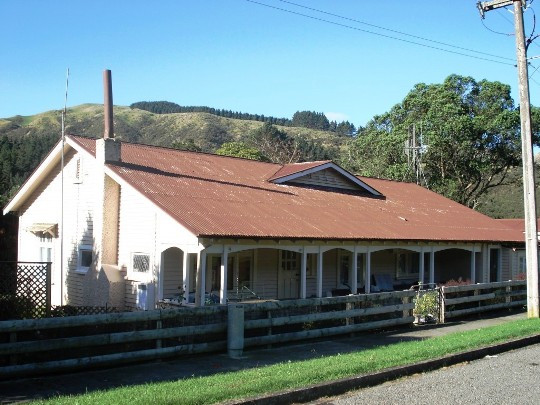
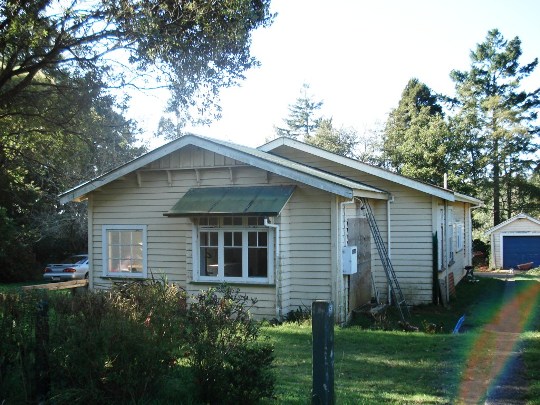
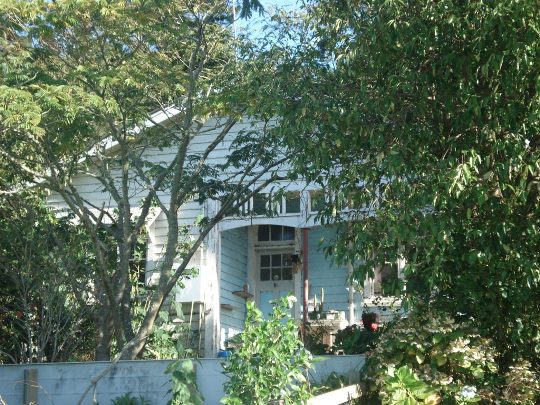
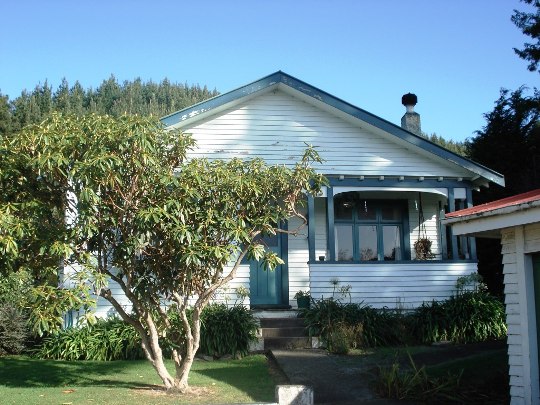
Built in 1929, the single men’s quarters or staff hostel afforded a level of comfort and modernity equal to that of the bungalows. Stylistically, the building’s form was, arguably, the most bungaloid in the village with a broad, low-pitched, side gable roof that extending low over a wide front verandah. A small, decorative cross gable ‘dormer’ provided the only break in the sweep of the roof. The overall form, centred cross gable, and full-width verandah obscured the functional division within, evident only by two front doors. The one on the left opened into an L-shaped hallway providing access to a sitting room with fireplace, three bedrooms, a WC, and a bathroom. The door on the right opened into a spacious dining room bounded by a kitchen and other service spaces. The residential side had internal access into the kitchen. The portion of the verandah outside the dining room was partitioned from the rest, suggesting that the dining facility might have also been used by workers living beyond the hostel.
In 1936, the portion of the verandah fronting the dining room was fully enclosed with weatherboards and sliding casement windows above built-in seats along two walls, creating a ‘small lounge or common-room for those using the Hostel.’ This was thought necessary because ‘at present there is nothing available of this nature except the dining room itself, which is not desirable to use for this purpose,’ suggesting that the original sitting room may have been used as a fourth bedroom. A succession of government entities owned the accommodation at Mangaore until sold off in the mid-1990s as part of the privatisation of New Zealand’s electricity sector. With the exception of the addition of a single-stall garage, the property is largely unchanged on the exterior and now exists as a four-bedroom, one-bathroom house for a single household.
List Entry Information
Status
Listed
List Entry Status
Historic Place Category 2
Access
Private/No Public Access
List Number
4500
Date Entered
5th September 1985
Date of Effect
5th September 1985
City/District Council
Horowhenua District
Region
Horizons (Manawatū-Whanganui) Region
Extent of List Entry
Extent includes the land described as Lot 3 DP 71906 (RT WN41C/859), Wellington Land District, and the building known as Staff Hostel (Former) thereon.
Legal description
Lot 3 DP 71906 (RT WN 41C/859), Wellington Land District
Status
Listed
List Entry Status
Historic Place Category 2
Access
Private/No Public Access
List Number
4500
Date Entered
5th September 1985
Date of Effect
5th September 1985
City/District Council
Horowhenua District
Region
Horizons (Manawatū-Whanganui) Region
Extent of List Entry
Extent includes the land described as Lot 3 DP 71906 (RT WN41C/859), Wellington Land District, and the building known as Staff Hostel (Former) thereon.
Legal description
Lot 3 DP 71906 (RT WN 41C/859), Wellington Land District
Construction Professional
Name
Public Works Department
Type
Builder
Biography
No biography is currently available for this construction professional
Construction Details
Start Year
1929
Type
Original Construction
Start Year
1936
Type
Modification
Description
Enclosure of a portion of front porch for use as a lounge
Construction Professional
Name
Public Works Department
Type
Builder
Biography
No biography is currently available for this construction professional
Construction Details
Start Year
1929
Type
Original Construction
Start Year
1936
Type
Modification
Description
Enclosure of a portion of front porch for use as a lounge
Historical and Associated Iwi / Hapū / Whānau
Completion Date
7th February 2017
Report Written By
James A. Jacobs
Information Sources
Salmond, 1986
Jeremy Salmond, Old New Zealand Houses 1800-1940, Auckland, 1986, Reed Methuen
Institute of Professional Engineers in NZ (IPENZ)
Institute of Professional Engineers in NZ
Te Ara - The Encyclopedia of New Zealand
www.TeAra.govt.nz
Other Information
This place was identified as significant under previous legislation with different information requirements. It remains significant under the current legislation. There is opportunity under our legislation and policies to add to this information. Further information about this place may be available from the Central Regional Office of Heritage New Zealand Pouhere Taonga. Please note that entry on the New Zealand Heritage List/Rarangi Korero identifies only the heritage values of the property concerned, and should not be construed as advice on the state of the property, or as a comment of its soundness or safety, including in regard to earthquake risk, safety in the event of fire, or insanitary conditions. A fully referenced upgrade report is available on request from the Central region Office of Heritage New Zealand.
Historical and Associated Iwi / Hapū / Whānau
Completion Date
7th February 2017
Report Written By
James A. Jacobs
Information Sources
Salmond, 1986
Jeremy Salmond, Old New Zealand Houses 1800-1940, Auckland, 1986, Reed Methuen
Institute of Professional Engineers in NZ (IPENZ)
Institute of Professional Engineers in NZ
Te Ara - The Encyclopedia of New Zealand
www.TeAra.govt.nz
Other Information
This place was identified as significant under previous legislation with different information requirements. It remains significant under the current legislation. There is opportunity under our legislation and policies to add to this information. Further information about this place may be available from the Central Regional Office of Heritage New Zealand Pouhere Taonga. Please note that entry on the New Zealand Heritage List/Rarangi Korero identifies only the heritage values of the property concerned, and should not be construed as advice on the state of the property, or as a comment of its soundness or safety, including in regard to earthquake risk, safety in the event of fire, or insanitary conditions. A fully referenced upgrade report is available on request from the Central region Office of Heritage New Zealand.
Former Usages
General Usage: Accommodation
Specific Usage: Public Service Hostel
Former Usages
General Usage: Accommodation
Specific Usage: Public Service Hostel
Sign up to hear more
Get the latest heritage news, features and events delivered
straight to your inbox.
