Early history of the site
The northern shores of the Waitemata Harbour are of significance to several iwi, having been explored and occupied since early human arrival in New Zealand. According to oral tradition, the Arawa canoe under Tama Te Kapua investigated the Waitemata. The Tainui canoe also landed at Te Hau Kapua (Torpedo Bay) in present-day Devonport before travelling to its eventual heartland in the Waikato. Recorded archaeological sites at Ngataringa Bay, Stanley Bay and the west Devonport foreshore include middens and oven stones. Following Ngapuhi incursions in the 1820s, much of the North Shore was depopulated, assisting its purchase by the British Crown after formal colonisation in 1840. A small Maori settlement at Te Hau Kapua remained inhabited until 1863.
In the 1840s, a British naval station was established at the foot of Victoria Road. Crown land in the area was subdivided into suburban farms in 1850 and offered for sale. Although settlement intensified around nuclei in Church Street and subsequently Victoria Road, large-scale development emerged primarily during the economic boom of the 1870s and 1880s. With the establishment of good quality ferry services to and from Auckland, Devonport became a well-established residential suburb and a significant seaside resort in the late nineteenth and early twentieth centuries.
The site of St Augustine’s Church was located to the west of the main centre of colonial settlement in Devonport, on the Stanley Bay peninsula. Occupying elevated land to the south of Calliope Road, the site formed part of a larger parcel, Allotment 32, which was issued as a Crown Grant in 1853. During the mid- to late nineteenth century, the land was owned by a succession of individuals that included notable Auckland businessmen and newspaper proprietors, John Williamson (1815-1875) and J.C. Wilson. House sections in the Sunnyside estate to the north of Calliope Road were offered for sale in 1882. The opening of what was said to be the largest dry dock in the Southern Hemisphere immediately to the south of Allotment 32 in 1888 helped to stimulate further development.
In 1892, Allotment 32 was subdivided by William Chisholm Wilson McDowell, a medical practitioner, and J.C. Wilson’s sons, William and Joseph Wilson. The latter were partners in the firm of Wilson and Horton, which owned the New Zealand Herald and Auckland Weekly News. Following subdivision, the site formed part of Lot 68 which was bought by a Madeline Donny in 1899. A house is said to have been erected on the property, but was removed when the land was purchased for the establishment of an Anglican Mission Hall a decade later.
Creation of the Mission Hall (1910)
The creation of a mission hall by September 1910 marked the first step in Anglican use of the site for worship and other activities in the burgeoning residential area. It represented an expansion of the local Anglican mission from its main centre at Holy Trinity Church, which was located in the eastern part of Devonport. Establishment of the mission hall broadly coincided with adjoining land at Calliope Dock being officially declared a naval base for the Royal Navy. In preceding years, religious halls belonging to other denominations had also opened beside Calliope Road, by now one of Devonport’s main residential streets.
The hall was created by relocating part of an earlier timber building that had belonged to the Holy Trinity Church complex in Church Street. This structure had initially been erected in 1886 by eminent architect Edward Bartley (1839-1919) as an addition to an 1872 Sunday School, for use as a schoolroom and parish hall. Bartley has been referred to as the Anglican Diocesan architect, and as a resident of Devonport had particularly close links with Holy Trinity Church. The addition formed part of wider alterations to the Holy Trinity site in the mid 1880s, which encompassed creating an enlarged church (1884-6); moving the Sunday School back on the site and adding its extension (1886); and erecting a large parsonage (1887). The Sunday School addition is reported to have been built with material from the old Holy Trinity Church, supplemented by new timber, to create a large room measuring 45 feet x 30 feet. The old church had been built in 1865 as one of the earliest and most important Anglican churches on the North Shore, and incorporated an extension added in 1874. Activites other than religious education that subsequently took place in the enlarged Sunday School included gymnastics and dancing classes.
In June 1910, Bartley advertised tenders for the removal of the Sunday School extension from Trinity Church to the new site in Calliope Road. A contemporary plan indicates that in its new position, the relocated structure was to include a porch on its north side, and external lavatories on the south. Following the sale of the rear part of the property in February 1911, the building occupied a position near the back of the retained section. Internally, the main part of the building contained a single large room. A font was provided by ‘Friends outside of the Parish’.
The opening service was held in 25 September 1910, with the Reverend Canon George MacMurray officiating. MacMurray has been regarded as a central figure in Auckland diocesan affairs, and was to become Archdeacon. The structure was evidently subsequently used for a variety purposes, including weekly worship and as a Sunday School.
Dedication as St Augustine’s Church (1914)
In 1914, the building and its furnishings were formally dedicated as St Augustine’s Church. The dedication is said to have been sought by the men of the congregation ‘in order that the building might be used purely for church purposes.’ The dedication service was held in May, on St Augustine’s Day. It was led by the recently-appointed Bishop of Auckland, Dr Alfred Walter Averill (1865-1957).
Bishop (later Archbishop) Averill was a significant figure in the development of the Anglican Church in New Zealand in the early twentieth century: he had been made Bishop of Waiapu in 1910, became Bishop of Auckland in 1914 and was later appointed Archbishop of New Zealand in 1925. During his episcopacy, there was a strong connection between the Anglican Church and English cultural life and identity. Anglicans in Auckland are said to have seemed particularly dutiful in upholding concepts of imperial patriotism and loyalty to the Crown.
Three months after the church was dedicated, Britain declared war on Germany. Many men from Devonport enlisted to assist the British cause. Several who had worshipped in St Augustine’s Church died during the First World War (1914-18), including at Gallipoli, Ypres and the Somme.
Some of the dead were related to prominent citizens. Flight Sub-Lieutenant L.H. Brett was the son of publisher Arthur Brett and grandson of Sir Henry Brett, founder of the Auckland Star and a Mayor of Auckland. Gunner R.L. Gribbin was the son of solicitor, George Arthur Gribbin, whose business partner was Oliver Nicholson, a Mayor of Mt Eden Borough and ‘a power in the Auckland business world’. The father of Private K.E. Wight was Edward Wight, a former manager of the Ralph coal mine in Huntly, who lived in Stanley Bay. Second Lieutenant I. O’Neill, who enlisted with the Second Maori Battalion, and Private W.N. Philson were both related to local body politicians. Philson was one of 147 New Zealanders who died on the first day of the landings at Anzac Cove (25 April 1915) - since commemorated as Anzac Day.
Construction of St Augustine’s Memorial Church (1930)
In 1919, a scheme was proposed to build a new church in memory of those who had died. In June 1920, the Church Committee agreed to commission a brass plate for the church bearing the names of those who had fallen and served.
After Stanley Bay became an independent parish in 1924, fundraising for a new church occurred with the intention that the structure should be ‘very beautiful and dignified, fitting for its high use and purpose’. The creation of new parishes within the Auckland Diocese formed part of an extension programme overseen by Bishop Averill as population growth and changing settlement patterns necessitated shifts in organisation. By this time, Stanley Bay accommodated the recently-formed New Zealand Division of the Royal Navy, and was the base for its first service ship, HMS Chatham, and its training centre, HMS Philomel.
Working plans for a new church were initially prepared by the architect H. F. Robinson. By 1926, however, William Swanson Read Bloomfield (1885-1968) of the firm Bloomfield and Hunt - and later Bloomfield, Owen and Morgan - was involved as a member of the vestry’s Building Committee.
Considered likely to be the first person of Maori descent to attend architecture school and practice as an architect, Bloomfield had direct experience of the conflict for which the church was to be a memorial. He had fought as a captain in the Royal Flying Corps, and after being shot down behind enemy lines in 1917 was held as a prisoner until the war had ended. He was also related to one of the men to be commemorated by the church, having married Audrey Gribbin, the sister of Gunner R.L. Gribbin, in 1920. By the mid-1920s, Bloomfield was designing and erecting notable structures in the centre of Auckland, including Yorkshire House (1926-28).
In 1927, Bloomfield prepared working plans and specifications for a grand brick building of Gothic Revival style with a large crenelated tower. After tenders indicated that this was too expensive, he oversaw revised designs for a church of very different appearance in the first half of 1929. The presence of the initials ‘VAB’ on one of the revised drawings suggests that the draughting skills of the noted architect, Vernon Akitt Brown (1905-1965) were employed for at least some of the work. Brown worked as a draughtsman for several Auckland-based firms - including Bloomfield, Owen and Morgan - after his arrival from England in 1927, and was later to become an influential figure in the development of New Zealand architecture.
New tenders for the redesigned church were sought in October 1929, but were again not accepted due to a shortfall in funds. A contract was eventually signed in the following year, after parishioners had been asked for further donations and the lowest tenderer, J. B. Ferguson, had submitted a reduced quote. The final cost of £2144 was mostly raised through the activities of the local Ladies Guild and gifts from parishioners and other donors, including £100 from the estate of J. Wilson and a small amount from George Winstone of the building supplies firm Winstone Limited. These enabled the church to be erected free of debt, in spite of increasingly difficult economic times as the Great Depression approached.
In October 1930, the foundation stone was laid in a ceremony conducted by Archdeacon MacMurray, who had opened the initial church. The new building was sufficiently complete by December 1930 for an opening service to be led by Archbishop Averill.
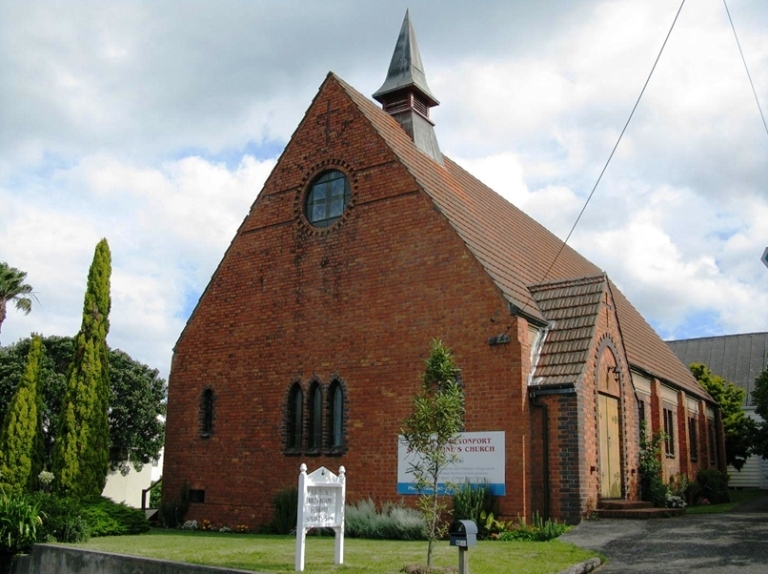
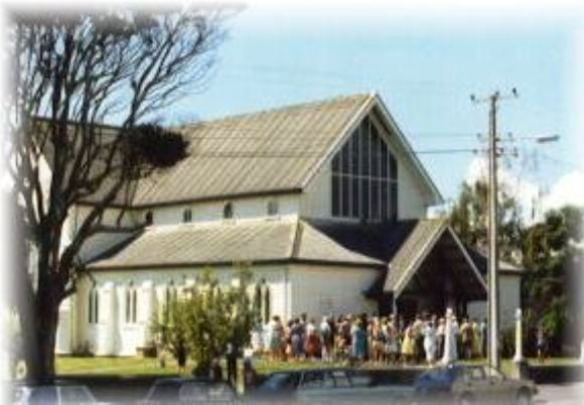
The design of the church can be seen as stemming from the English Arts and Crafts tradition. Grander than the earlier hall, its style has been said to illustrate ‘a successful melding of the human scale normally associated with domestic buildings and the "corporate" scale typical of places of assembly.’ At the time of its opening, the new church was described as:
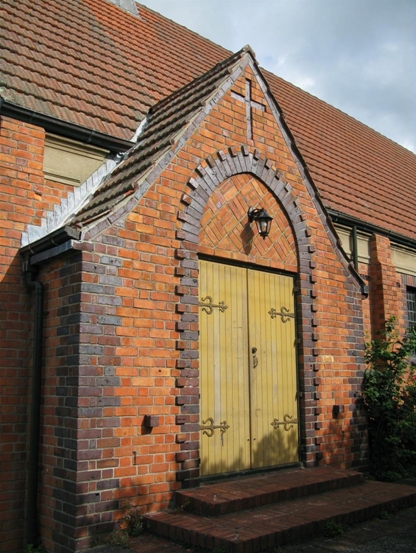
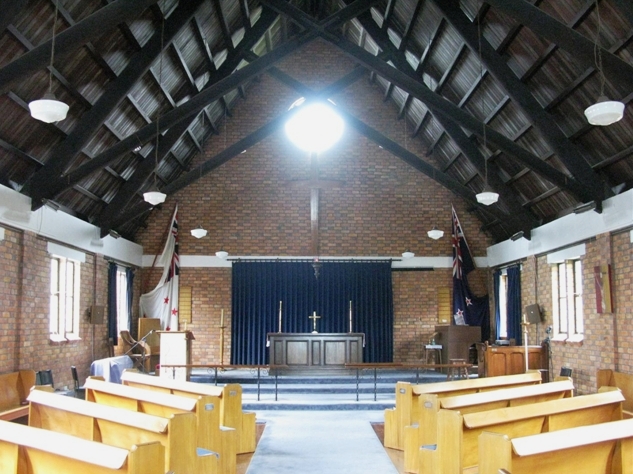
‘a simple nave of red brick built with hollow walls, and strong pillars in the walls under the roof principals, there is a top course of reinforced concrete finished with plastering. The ornamentally laid brick of the porch front and other detail parts give a pleasing finish to it...The roof is highpitched and covered with tiles. A bell turret with a bell newly presented for this Church rises from the roof near the "west" end. The Sanctuary is the full width of the Church...The porch or vestibule, Baptistery and Vestry are at the "west" end and above them the Choir gallery, the building is a good one for sound and the effect of a choir behind the congregation has surpassed all our expectations...’
Surviving specifications suggest that an initial intent to plaster the interior was modified in favour of exposed bricks. The brickwork was to employ local products, specifically Duder’s bricks. The North Shore had been known for its brick production since the early colonial period, and R. and R. Duder was a notable Devonport manufacturer. The large scissor-brace roof, which formed a major feature of the new building, was of imported Oregon.
Some furnishings and other elements were transferred from the earlier church, which was now transformed for use as a church hall. These included the font, altar rails, two military flags presented shortly after the First World War and, possibly a commemorative brass plaque commissioned in 1920. Other furniture and fixtures were evidently obtained through donations and gifts.
Construction broadly coincided with the arrival of a new vicar, Reverend William Edward Lush (1862-1951), who held numerous posts in the Anglican Church before his arrival at Stanley Bay, including chaplain of the Order of the Good Shepherd in Greys Avenue from 1906. He was the youngest son of the significant early Auckland cleric Vicesimus Lush, and was to become an honorary canon of St Mary’s Cathedral, Parnell, in 1939.
Subsequent use of St Augustine’s Memorial Church and church hall
The earlier church was evidently used as a Sunday School immediately after construction of the new building, and was also offered to the Stanley Bay school for use. A Hall Committee was established ‘to arrange for church socials and other forms of entertainment’ - and other use - so that parish funds could be augmented. By 1932, the hall was being used for gymnasium classes for both boys and girls. In 1936, there were proposals to extend its length. Increasing the size of the stage in 1938-9 enabled a kindergarten department to be accommodated behind a curtain, separately from the rest of the Sunday School class.
During the Second World War (1939-45), the hall was offered free of charge to the Devonport branch of the Navy League for the continuation of its work with trainees aboard H.M.S. Philomel. The Navy League had been founded in London in 1895 to promote the importance of maintaining a strong navy, and first became established in New Zealand at Auckland in 1896. Links with the adjoining naval base were strengthened following the re-amalgamation of Stanley Bay with Devonport parish in 1948. The naval chaplain, Reverend H. Mayo-Harris, initially assisted with Holy Communion, and in 1958 became parish priest. Mayo-Harris had served in the Second World War, attaining the rank of Commander. One of his successors in the 1960s, the Reverend F.O. Dawson had also served in the conflict as an Army chaplain, earning a Military Cross and mentions in despatches.
Expansion of the adjoining naval base had involved the excavation of a tunnel beneath the church to connect two parts of the military complex. In 1949, Bloomfield was asked if cracks in the church building were due to this tunnelling. Repairs had previously been undertaken to the northeast corner of the brick church in 1940. Leaks in the hall roof also caused its covering to be replaced in 1949.
The church continued to be used to commemorate people who had served or fallen in the First World War. In 1962, donated hymn boards included one for Fred Hooper who had died at Gallipoli in 1915.
In 1979, the church was leased out to the Royal New Zealand Navy as a chapel. This arrangement lasted until the early 1990s, and the Navy finally withdrew from involvement with the church in 1997. The church celebrated a century of worship on the site with a service in 2011.
The church continues to be regularly used for services, including christenings, weddings and funerals. The hall also remains in active use for church and community events.