DonateMembershipVisit Heritage
  • Tūrangawaewae
    Places
  • Tira Māori
    Māori Heritage
  • Poutairangahia
    Archaeology
  • Rauemi
    Resources
  • Mō Tātou
    About Us
  • New Zealand Heritage List
  • Nominate and submit
  • Explore the List
  • National Historic Landmarks
  • Plaques
  • Rainbow List Project
  • Lost heritage
  • Visit Heritage
  • Our properties
  • Turnbull House Project
  • Collections
  • Shop
  • Tohu Whenua
  • Tira Māori
  • Conserving Māori heritage
  • Marae built heritage
  • Māori heritage on the List
  • Hinemihi—Te Hokinga Mai
  • What is archaeology?
  • Is there a site on my property?
  • What are my legal requirements?
  • Affecting an archaeological site
  • Declaring an archaeological site
  • Archaeology FAQs
  • Archaeology Digital Library
  • Archaeology guidelines and templates
  • Resources
  • Funding
  • Publications
  • Sustainable management guides
  • Disaster recovery
  • Podcasts & digital resources
  • Education Hub
  • Conservation plans
  • About
  • Board
  • Māori Heritage Council
  • Senior Staff
  • Offices
  • Contact us
  • Careers
  • Covenants
  • Fast-track
  • Corporate documents
  • Currently consulting on
  • Our submissions
  • News
  • Covid-19 response
Quick links
Rārangi Kōrero | The List
Explore the List
National Historic Landmarks
Ngā Manawhenua o Aotearoa me ōna Kōrero Tūturu
Quick links
Tapuwae
A Vision for Places of Māori Heritage
Funding for Māori Heritage
Resources
Quick links
Archaeological Authority Portal
Applying for an archaeological authority
Archaeology FAQs
Browse the most frequently asked questions about archaeological authorities and the archaeological process.
Quick links
Quick links
News
News Keep up to date with Heritage New Zealand Pouhere Taonga
Membership
Membership Find out more and sign up today
DonateMembershipVisit Heritage
  • Tūrangawaewae
    Places
  • Tira Māori
    Māori Heritage
  • Poutairangahia
    Archaeology
  • Rauemi
    Resources
  • Mō Tātou
    About Us
  • New Zealand Heritage List
  • Nominate and submit
  • Explore the List
  • National Historic Landmarks
  • Plaques
  • Rainbow List Project
  • Lost heritage
  • Visit Heritage
  • Our properties
  • Turnbull House Project
  • Collections
  • Shop
  • Tohu Whenua
  • Tira Māori
  • Conserving Māori heritage
  • Marae built heritage
  • Māori heritage on the List
  • Hinemihi—Te Hokinga Mai
  • What is archaeology?
  • Is there a site on my property?
  • What are my legal requirements?
  • Affecting an archaeological site
  • Declaring an archaeological site
  • Archaeology FAQs
  • Archaeology Digital Library
  • Archaeology guidelines and templates
  • Resources
  • Funding
  • Publications
  • Sustainable management guides
  • Disaster recovery
  • Podcasts & digital resources
  • Education Hub
  • Conservation plans
  • About
  • Board
  • Māori Heritage Council
  • Senior Staff
  • Offices
  • Contact us
  • Careers
  • Covenants
  • Fast-track
  • Corporate documents
  • Currently consulting on
  • Our submissions
  • News
  • Covid-19 response
Quick links
Rārangi Kōrero | The List
Explore the List
National Historic Landmarks
Ngā Manawhenua o Aotearoa me ōna Kōrero Tūturu
Quick links
Tapuwae
A Vision for Places of Māori Heritage
Funding for Māori Heritage
Resources
Quick links
Archaeological Authority Portal
Applying for an archaeological authority
Archaeology FAQs
Browse the most frequently asked questions about archaeological authorities and the archaeological process.
Quick links
Quick links
News
News Keep up to date with Heritage New Zealand Pouhere Taonga
Membership
Membership Find out more and sign up today
  • Nominate and submit
  • National Historic Landmarks
  • Nominate and submit
  • National Historic Landmarks
  • Conserving Māori heritage
  • Marae built heritage
  • Conserving Māori heritage
  • Marae built heritage
  • Archaeological authorities
  • Archaeology Digital Library
  • Archaeological authorities
  • Archaeology Digital Library
  • All resources
  • Publications
  • Funding
  • All resources
  • Publications
  • Funding
  • FAQs
  • FAQs
Follow us on:
Places
  • Nominate and submit
  • National Historic Landmarks
Tira Māori
  • Conserving Māori heritage
  • Marae built heritage
Archaeology
  • Archaeological authorities
  • Archaeology Digital Library
Resources
  • All resources
  • Publications
  • Funding
FAQs
  • FAQs
Follow us on
HomePrivacyTerms and conditionsAbout this site
© Heritage New Zealand Pouhere Taonga 2026.
 
P Hayman & Co. Warehouse (Former)

14-18 Customs Street East and Galway Street, AUCKLAND

Private

Historic Place Category 2

List No. 4576

Quick links:
List GalleryLocationDetails
The P. Hayman and Co. Warehouse (Former) was constructed in 1899 - 1900 as a merchandising warehouse for P. Hayman and Co. Merchants. Haymans were importers of a wide range of household goods but particularly of watches and jewellery. The company had been simultaneously established in Birmingham (as Hayman and Co.) and in Melbourne (as P. Hayman & Co.) in 1850 by brothers Louis and Philip Hayman. The Otago goldrush led P. Hayman & Co. to commence business in New Zealand in 1861 with a branch in Dunedin. Further branches were subsequently established in the other three main centres of Christchurch, Wellington and Auckland. The company commenced trading in Auckland from a leased warehouse on the south side of Customs Street East in 1883.

P. Hayman and Co. secured a 50-year lease on three adjoining lots on Customs Street East at auction in May 1898. The sites were part of the reclamation undertaken between Customs and Quay Streets over the period 1879 to 1886. As the area between Fort and Customs Streets had been reclaimed by the early 1860s, the north side of Customs Street marked the wharf frontage from this time until 1879 when the next phase of reclamation began. By 1882 much of the infill was complete, using material from Point Britomart (the site of an earlier pa). It is likely that part of the impressive stone sea wall and the 1879 foreshore lies beneath the land later developed by P. Hayman and Co. The leases of Hayman's lots (along with 16 others) had been auctioned by the Auckland Harbour Board in December 1882 and realised the highest prices in Auckland to that date for leasehold property per foot. Taken up in the boom conditions of the early 1880s these lots (and many others in the area now known as the Britomart precinct) remained vacant as development became uneconomic following the collapse of Auckland property prices in 1885. Entrepreneur Thomas Russell, lessee of Lots 94 and 95, had invested heavily in land and lost his Customs Street property in 1892. These two leases, along with that for Lot 93 - held by another party, were surrendered to the Auckland Harbour Board who put them up for auction again six years later.

Proximity to the new Railway Station (along the north side of Galway Street), the waterfront, the customhouse and the city's commercial centre made Customs Street East a desirable location for the business houses of the mercantile community when the local economy improved in the late 1890s. P. Hayman and Co. commissioned architect John Currie to design their new premises. Currie had designed L.D. Nathan's warehouse in 1897, built almost opposite the sites that Hayman's leased the following year. Nathan's warehouse, one of the largest mercantile buildings of its kind in the city, was notable for its utilisation of space and for its size and strength.

Haymans' premises, designed on similar principles, was one of a row of buildings whose construction was viewed with anticipation in the Auckland Star 's Auckland Exhibition issue of 1 December 1898. The new warehouses of uniform size were seen as representing an impressive façade on the north side of Customs Street, making a valuable addition to the town's architecture, for although Auckland had many fine public and commercial buildings, it did not convey the impression of being 'well-built'. Notwithstanding that the warehouse buildings constructed around the turn of the twentieth century represented growing prosperity, they were a source of concern for the Auckland Fire Board who viewed their innovative large cubic capacity and lack of internal brick walls as a serious risk to fire-fighters.

Completed by April 1900, Hayman's warehouse was constructed by Messrs Jones and Co. who won the tender with a price of £12,000 exclusive of fittings. The building's basement housed Hayman's packing and shipping department; the ground floor with its strong-room contained the jewellery department and counting house, and had plenty of space for a large number of clerks. The three storeys above provided accommodation for various other departments, the principal ones being crockery, drugs, musical goods, toiletries, stationery, saddlery and brush ware and the tobacconist. The principals in London, Messrs Henry and Lachman Hayman, were so pleased with report's of the architect's work that they requested their Auckland manager to select and have suitably engraved, the best watch in the establishment for Mr Currie as a token of appreciation of his professional services.

By 1934 the firm was also trading as Hayman's Open Warehouse. Alterations had been made to the ground floor entrance onto Customs Street East two years before and large display windows had been installed along an entrance arcade. Three years later, however, the leasehold was advertised for auction. Particular reference was made to the building's suitability for use as a retail shopping centre, as an increasing number of shops had become established in the immediate vicinity. Farmers' Co-operative Auctioneering Company purchased the building for £8,050. Parts were leased to tenants who by 1940 included the shipping company Port Line, notable for several 'firsts' in the trade between New Zealand and the United Kingdom. Between the 1940s and the 1960s Port Line set new trends in the styling of ships, giving rise to the era of streamlining later adopted by other shipping lines.

Towards the end of the 1960s the ground floor and basement were altered for fine art dealers, John Cordy Ltd. By this time Port Line had been joined by a number of tenants with a maritime focus including Lloyds' Register of Shipping, a master mariner and marine and cargo surveyors. In 1968 the building was sold to Columbus House Limited a company connected with the German-owned Hamburg-Sud trading as Columbus Line. Columbus Line introduced the first fully cellular container service to New Zealand in 1971. The building's interior was refurbished and a lobby with new staircase and lift was created. The building re-opened in 1970 as 'Columbus House'. By this time tenants with strong maritime connections included customs agents, travel agents and Columbus Line's local shipping agent Maritime Services Ltd, which was also the managing agent for Columbus House Ltd. Between 1984 and early 1988, the leasehold was sold several times. Leaseholders during this time included a French Polynesian shipping company Sofrana Lines, one of two companies whose vessels served the Pacific Islands. The building was known as 'Sofrana House' during this period.

In 1992 the property, along with the former Central Post Office and other land in the extended block bounded by Customs Street East, Britomart Place, Quay Street and Queen Elizabeth Square, was transferred to the Auckland City Council and Auckland Regional Council and became the site of Auckland's Britomart Transport Centre and the associated redevelopment project. The building faced an uncertain future. Following a reassessment of the project, however, Auckland City Council commissioned conservation plans for the late nineteenth/early twentieth-century buildings. These properties, with restrictive covenants imposed to protect heritage values, were on-sold to Britomart Group. Britomart Group has commenced a $350 million redevelopment project over the 5.2ha precinct. There are plans to redevelop the former P. Hayman and Co. Warehouse - along with the adjoining Barrington Building - into a boutique hotel. The property is currently (2005) vacant.
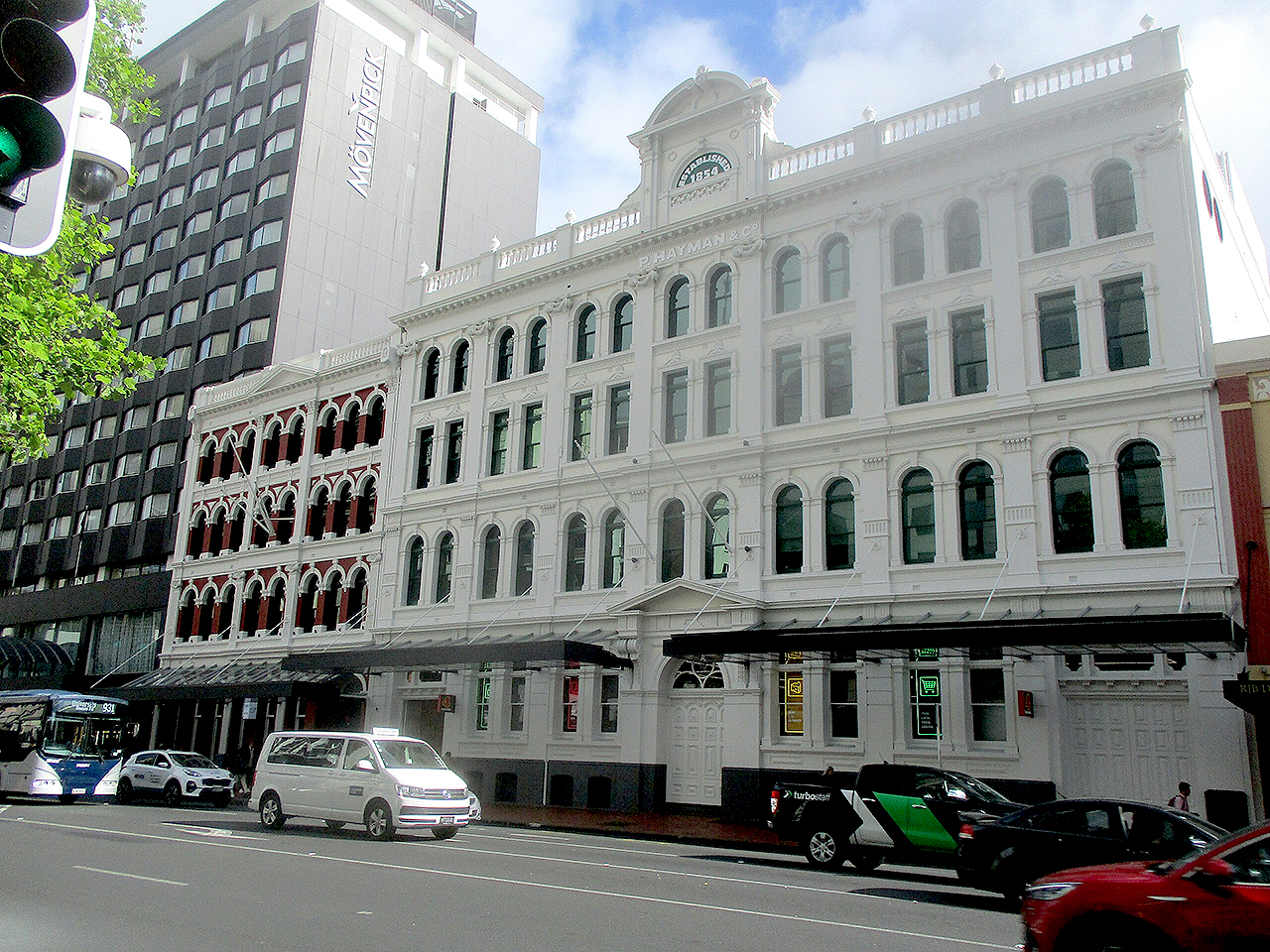
P Hayman & Co. Warehouse (Former), Auckland CC BY-SA 4.0 Image courtesy of commons.wikimedia.org | Ulrich Lange, Bochum, Germany | 04/01/2017 | Ulrich Lange, Bochum, Germany - Wikimedia Commons
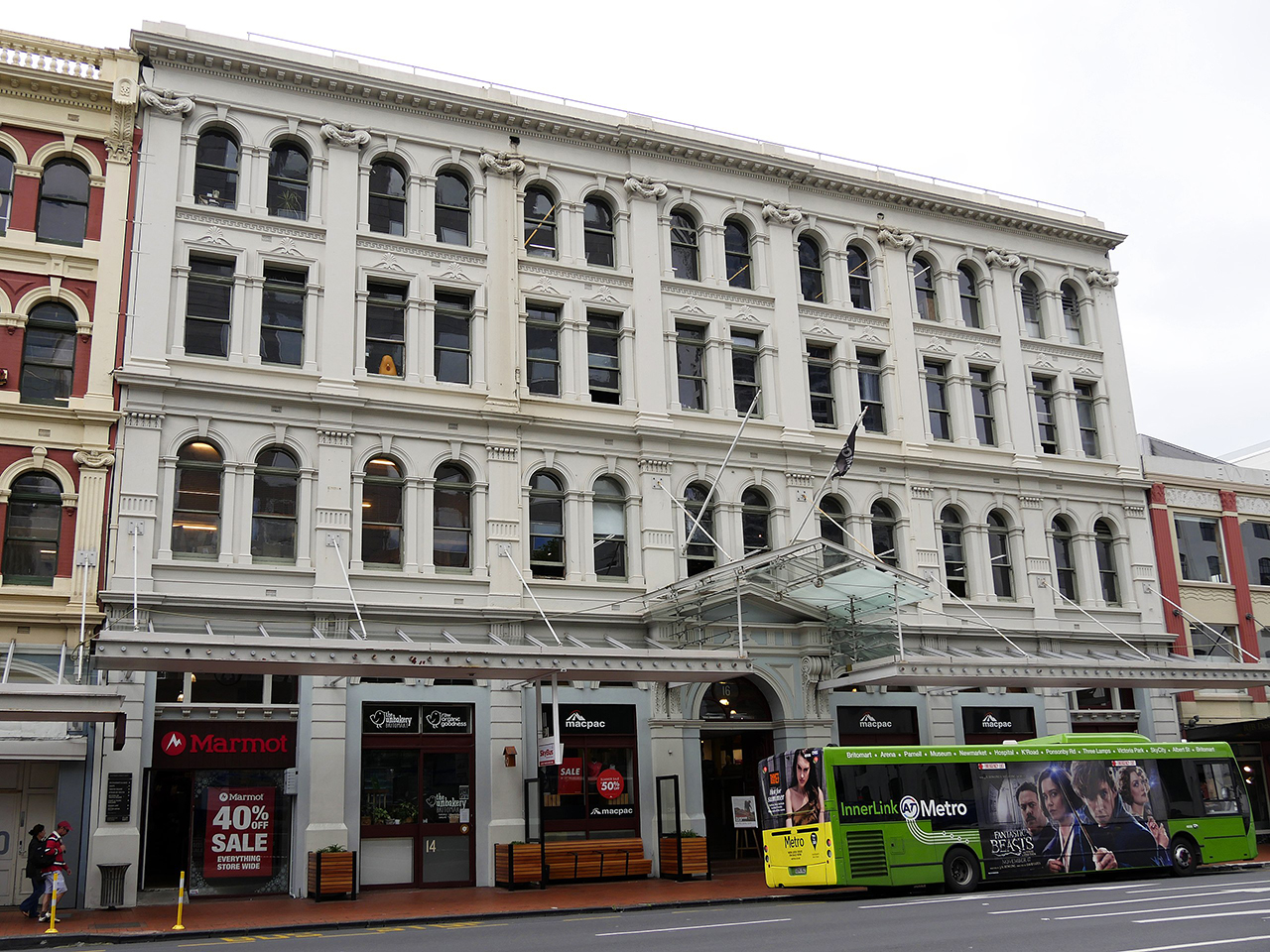
P Hayman & Co. Warehouse (Former), Auckland. Public Domain. Image courtesy of commons.wikimedia.org | August Dominus | 12/11/2023 | No Known Copyright Restrictions
P Hayman & Co. Warehouse (Former), Auckland CC BY-SA 4.0 Image courtesy of commons.wikimedia.org | Ulrich Lange, Bochum, Germany | 04/01/2017 | Ulrich Lange, Bochum, Germany - Wikimedia Commons
P Hayman & Co. Warehouse (Former), Auckland. Public Domain. Image courtesy of commons.wikimedia.org | August Dominus | 12/11/2023 | No Known Copyright Restrictions

List Entry Information

Overview

Status
Listed

List Entry Status
Historic Place Category 2

Access
Private/No Public Access

List Number
4576

Date Entered
9th December 2005

Date of Effect
9th December 2005

City/District Council
Auckland Council

Region
Auckland Council

Extent of List Entry

Extent includes part of the land described as Lot 1 DP 361575 (RT 250578), North Auckland Land District, and the building known as P. Hayman & Co. Warehouse (Former) thereon, and its fittings and fixtures.

Legal description

Lot 1 DP 361575 (RT 250578), North Auckland Land District

Detailed List Entry
Significance

Historic Significance

Historical Significance or Value The building has historical value as a late-Victorian mercantile warehouse designed for P. Hayman and Co., a significant chain in New Zealand from the 1860s until the 1930s. It is also historically significant as the offices of shipping and maritime interests that maintained shipping services between New Zealand and the Pacific Islands, the UK, Europe and America.

Physical Significance

The P. Hayman and Co. Warehouse (Former) has high aesthetic importance for its ornate Customs Street East façade and the contribution the building makes to the streetscape as one of a group of historic, multi-storey warehouses on the north side of Customs Street East. The place has archaeological significance as part of the historic railway station reclamation undertaken between 1879 and 1886 that used fill from Point Britomart (the site of an earlier pa) to cover the historic Customs Street sea wall and several wharves. The building is architecturally significant as a notable example of the adoption of the Victorian Italianate Renaissance Palazzo style for a mercantile warehouse. It is also architecturally significant as the work of noted Auckland architect John Currie, the designer of a number of significant warehouses and other buildings.

Detail Of Assessed Criteria

a) The extent to which the place reflects important or representative aspects of New Zealand history The former P. Hayman and Co. Warehouse reflects the importance of merchandising warehouses to New Zealand cities. In a colony that lacked substantial manufacturing industries, importing was an important business activity. The building, as one of a number of grand warehouses erected on Customs Street East, is representative of the development of the colonial economy and port infrastructure at the end of the nineteenth century. This infrastructure superseded earlier development that had sprung up on the foreshore at Fort Street from 1840 onwards. (b) The association of the place with events, persons, or ideas of importance in New Zealand history The former P. Hayman and Co. Warehouse is associated with P. Hayman and Co., a significant trading venture. It was later associated with Hamburg-based Hamburg-Sud, trading as Columbus Line, which introduced cellular shipping container services to New Zealand Ports in June 1971. (e)The community association with, or public esteem for, the place The building is one of a number of late nineteenth/early twentieth-century warehouse buildings within the Britomart precinct, located at the interface between the waterfront and the CBD. These were the subject of an intense campaign during the 1990s to prevent their demolition. (f) The potential of the place for public education One of a group of imposing late nineteenth/early twentieth-century warehouses close to the waterfront and transport centre at the foot of Auckland's Queen Street, the building has the potential for public education on the importance of merchandising warehouses in Auckland's early twentieth-century commercial centre. It can also provide information about New Zealand architecture, particularly the adoption of the Victorian Italianate Renaissance Palazzo style by business interests to portray an impression of wealth and prosperity. (g)The technical accomplishment or value, or design of the place The building is significant as a late nineteenth-century warehouse designed with minimal internal brick walls, so as to maximise usable space. The design is also architecturally significant as an example of the adoption of the Victorian Italianate Renaissance Palazzo style for a mercantile warehouse building. (k) The extent to which the place forms part of a wider historical and cultural complex or historical and cultural landscape The former P. Hayman and Co. Warehouse is within one of Auckland's valued heritage precincts, which incorporates an historical landscape of commercial and maritime structures along Customs, Queen and Quay Streets. The historic significance of the location is recognised by three historic areas: the Harbour Historic Area (NZHPT Registration # 7158); the Quay Street Historic Area (NZHPT Registration # 7159); and the Customs Street East Historic Area (NZHPT Registration # 7160). Registered buildings in the immediate area include: The former Customhouse (NZHPT Registration # 104, Category I historic place); the former Chief Post Office (NZHPT Registration # 101, Category I historic place); Endeans Building (NZHPT Registration # 4597, Category II historic place); Barrington Building (NZHPT Registration # 7291, Category II historic place); Levy Building (NZHPT Registration # 7292, Category II historic place); former Excelsior Building (NZHPT Registration # 7293, Category II historic place); Stanbeth House (NZHPT Registration # 7294, Category II historic place); Masonic Club/Buckland Building (NZHPT Registration # 7295, Category II historic place); A.H. Nathan Warehouse and Condiments Factory (NZHPT Registration # 7296, Category II historic place); Australis House (NZHPT Registration # 4577, Category I historic place); Wharf Police Building (NZHPT Registration # 4575, Category I historic place); Union Fish Company Building (NZHPT Registration # 666, Category I historic place); and, the Northern Steamship Building (NZHPT Registration # 622, Category I historic place). The land on which the building stands is part of a larger archaeological site (R11/1379) that encompasses an extensive reclamation undertaken between 1879 and 1886, and may contain remains of early activities of the city, wharves/jetties and hulks.

Construction Professional

Name

Jones and Co.

Type

Builder

Biography

No biography is currently available for this construction professional

Name

Currie, John

Type

Architect

Biography

John Currie (c.1859-1921) was born in Ireland. He immigrated to New Zealand in 1874 and practised architecture in Auckland on his own account. In 1879 the firm of L.D. Nathan became a major client. Accordingly much of Currie's work was in the designing of commercial and warehouse buildings. Few of these survive with the exception of L.D. Nathan & Co. Bond Store (now Archilles House, 1902) and P. Hayman's Warehouse (now Sofrana House, 1899-1900). Currie also designed buildings for Moss Davis, the Auckland brewer. The two best known works from this association were the Rob Roy Tavern, Freeman's Bay (1884), and the restoration of the interior of the Grand Hotel in Princes Street after fire in 1901. The latter building was designed by H.D. Skinner in 1879, although is sometimes erroneously attributed to Currie. In addition to hotels and commercial work, Currie also undertook residential commissions. The best known of these is "Wickford" in Princes Street. Originally the home of Mr N.A. Nathan, it now accommodates the Registry Office of the University of Auckland. Currie was one of the original members of the New Zealand Institute of Architects formed in 1905. Currie died in Ponsonby in 1921 aged 70.

Construction Details

Start Year

1879

Finish Year

1886

Type

Other

Description

Pre-construction. Reclamation of underlying ground.

Start Year

1899

Finish Year

1900

Type

Original Construction

Start Year

1932

Type

Modification

Description

Terrazzo flooring introduced to entrance arcade.

Start Year

1935

Type

Modification

Description

Internal and external alterations unspecified.

Start Year

1950

Type

Modification

Description

Cart dock added.

Type

Modification

Description

Balustraded parapet and central pediment removed.

Start Year

1960

Type

Modification

Description

Ground floor basement altered; new windows and entry added to front of building at ground floor level.

Start Year

1968

Type

Modification

Description

Ground floor windows replaced with metal-framed windows, Customs Street East Frontage

Start Year

1969

Type

Modification

Description

Lobby with new main staircase and lift created; building refurbished, some original elements re-used in interior fit out; some kauri T & G wall linings removed to expose brick (some brick interior walls sandblasted).

Start Year

1969

Type

Modification

Description

Ceilings sprayed with plaster.

Start Year

1979

Type

Modification

Description

Shop formed fronting Galway Street.

Start Year

2002

Type

Modification

Description

Removal of additions constructed previously against Galway Street façade.

Construction Materials

Strip footings and pads; un-reinforced brick masonry perimeter walls; timber post and beam internal frame; timber floors and roof structure; corrugated iron roof.

Physical Description

The former P. Hayman and Co. Warehouse is one of a group of late nineteenth/early twentieth-century warehouses situated within the Britomart precinct in downtown Auckland. The precinct, currently the site of an extensive redevelopment proposal, lies between Britomart Place, Customs Street East, Quay Street and Queen Elizabeth Square. The site upon which the building stands has frontage to Customs Street East to the south, and Galway Street to the north. The former P. Hayman and Co. Warehouse, which is currently vacant, is flanked to the east by the three-storey Levy Building (c.1896); and to the west by the four-storey Barrington Building (1905). The four-storey brick building with basement stands on reclaimed land one block from the Waitemata Harbour. It is one of a group of imposing late-Victorian and Edwardian warehouses extending for three blocks along the north side of Customs Street East. The four-storey Customs Street East elevation (the principal facade) is in the Victorian Italianate Renaissance Palazzo style. It is divided into three tiers by cornices between the ground and first floors; and between the first and second floors. The building is seven bays wide. The pilasters defining the central bay are slightly deeper than those of the other bays. The ground floor openings have been extensively modified and are now boarded up. However, the upper sections of the original openings at street level survive to indicate the location of substantial entrance doorways at the east and west ends of the building. A pedimented door head supported on heavy consoles is located above what was formerly the grand central entrance. The keystone above the doorway bears the letters 'PH', the initials of the firm for which the building was constructed. The first floor (middle tier) is divided into bays by pilasters with Corinthian capitals. Each bay has a pair of round-headed windows. The paired windows on the second and third floors (upper tier) have square-heads with scallop-like mouldings above; and round heads respectively. The pilasters have unusual capitals in the form of volutes hung with festoons. The building is topped with a dentilled cornice and a parapet. The roof (not visible from the street) consists of three parallel, hipped sections. The Galway Street elevation is comparatively simple. Cornices define each of the floor levels. The openings on the ground floor have been bricked in or are boarded up. The upper levels have a continuous series of segmental-headed windows. In terms of layout, an internal brick wall running north/south defines the western third of the building. The remaining two-thirds of the floor space, originally open apart from posts supporting the ceiling beams, has been substantially partitioned into offices and hallways. Much of the partitioning has been vandalised. Sections of the original board and batten ceiling survive in some areas; in others battens have been removed. Timber floors, posts and beams, trusses and roof sarking remain; along with most of the moulded window architraves. A large safe survives on the ground floor. A blocked stairwell prevented inspection of the basement.

Reference

Completion Date

9th December 2005

Report Written By

Joan McKenzie

Information Sources

Cyclopedia of New Zealand, 1902

Cyclopedia Company, Industrial, descriptive, historical, biographical facts, figures, illustrations, Wellington, N.Z, 1897-1908, Vol.2, Christchurch, 1902

Cyclopedia of New Zealand, 1905

Cyclopedia Company, Industrial, descriptive, historical, biographical facts, figures, illustrations, Wellington, N.Z, 1897-1908, Vol. 4 Otago and Southland, Cyclopedia Company, Christchurch, 1905

Gillon, 1985

G.M. Gillon, United to Protect: An Historical Account of the Auckland Fire Brigade 1848-1985, Auckland, 1985.

McLean, 2001

Gavin McLean, Captain's Log: New Zealand's Maritime History, Auckland, 2001

Report Written By

A fully referenced registration report is available from the NZHPT Northern Region Office Please note that entry on the New Zealand Heritage List/Rarangi Korero identifies only the heritage values of the property concerned, and should not be construed as advice on the state of the property, or as a comment of its soundness or safety, including in regard to earthquake risk, safety in the event of fire, or insanitary conditions.

Further Information

Current Usages

Uses: Vacant

Specific Usage: Vacant

Former Usages

General Usage:: Trade

Specific Usage: Office building/Offices

General Usage:: Trade

Specific Usage: Restaurant/cafe/tearoom

General Usage:: Trade

Specific Usage: Shop

General Usage:: Trade

Specific Usage: Warehouse/storage area

Themes

Web Links

Overview

Status

Listed

List Entry Status

Historic Place Category 2

Access

Private/No Public Access

List Number

4576

Date Entered

9th December 2005

Date of Effect

9th December 2005

City/District Council

Auckland Council

Region

Auckland Council

Extent of List Entry

Extent includes part of the land described as Lot 1 DP 361575 (RT 250578), North Auckland Land District, and the building known as P. Hayman & Co. Warehouse (Former) thereon, and its fittings and fixtures.

Legal description

Lot 1 DP 361575 (RT 250578), North Auckland Land District

Status

Listed

List Entry Status

Historic Place Category 2

Access

Private/No Public Access

List Number

4576

Date Entered

9th December 2005

Date of Effect

9th December 2005

City/District Council

Auckland Council

Region

Auckland Council

Extent of List Entry

Extent includes part of the land described as Lot 1 DP 361575 (RT 250578), North Auckland Land District, and the building known as P. Hayman & Co. Warehouse (Former) thereon, and its fittings and fixtures.

Legal description

Lot 1 DP 361575 (RT 250578), North Auckland Land District

Significance

Why is this place significant?

Historic Significance

Historical Significance or Value The building has historical value as a late-Victorian mercantile warehouse designed for P. Hayman and Co., a significant chain in New Zealand from the 1860s until the 1930s. It is also historically significant as the offices of shipping and maritime interests that maintained shipping services between New Zealand and the Pacific Islands, the UK, Europe and America.

Physical Significance

The P. Hayman and Co. Warehouse (Former) has high aesthetic importance for its ornate Customs Street East façade and the contribution the building makes to the streetscape as one of a group of historic, multi-storey warehouses on the north side of Customs Street East. The place has archaeological significance as part of the historic railway station reclamation undertaken between 1879 and 1886 that used fill from Point Britomart (the site of an earlier pa) to cover the historic Customs Street sea wall and several wharves. The building is architecturally significant as a notable example of the adoption of the Victorian Italianate Renaissance Palazzo style for a mercantile warehouse. It is also architecturally significant as the work of noted Auckland architect John Currie, the designer of a number of significant warehouses and other buildings.

Why is this place Category 1 / Category 2?

Detail Of Assessed Criteria

a) The extent to which the place reflects important or representative aspects of New Zealand history The former P. Hayman and Co. Warehouse reflects the importance of merchandising warehouses to New Zealand cities. In a colony that lacked substantial manufacturing industries, importing was an important business activity. The building, as one of a number of grand warehouses erected on Customs Street East, is representative of the development of the colonial economy and port infrastructure at the end of the nineteenth century. This infrastructure superseded earlier development that had sprung up on the foreshore at Fort Street from 1840 onwards. (b) The association of the place with events, persons, or ideas of importance in New Zealand history The former P. Hayman and Co. Warehouse is associated with P. Hayman and Co., a significant trading venture. It was later associated with Hamburg-based Hamburg-Sud, trading as Columbus Line, which introduced cellular shipping container services to New Zealand Ports in June 1971. (e)The community association with, or public esteem for, the place The building is one of a number of late nineteenth/early twentieth-century warehouse buildings within the Britomart precinct, located at the interface between the waterfront and the CBD. These were the subject of an intense campaign during the 1990s to prevent their demolition. (f) The potential of the place for public education One of a group of imposing late nineteenth/early twentieth-century warehouses close to the waterfront and transport centre at the foot of Auckland's Queen Street, the building has the potential for public education on the importance of merchandising warehouses in Auckland's early twentieth-century commercial centre. It can also provide information about New Zealand architecture, particularly the adoption of the Victorian Italianate Renaissance Palazzo style by business interests to portray an impression of wealth and prosperity. (g)The technical accomplishment or value, or design of the place The building is significant as a late nineteenth-century warehouse designed with minimal internal brick walls, so as to maximise usable space. The design is also architecturally significant as an example of the adoption of the Victorian Italianate Renaissance Palazzo style for a mercantile warehouse building. (k) The extent to which the place forms part of a wider historical and cultural complex or historical and cultural landscape The former P. Hayman and Co. Warehouse is within one of Auckland's valued heritage precincts, which incorporates an historical landscape of commercial and maritime structures along Customs, Queen and Quay Streets. The historic significance of the location is recognised by three historic areas: the Harbour Historic Area (NZHPT Registration # 7158); the Quay Street Historic Area (NZHPT Registration # 7159); and the Customs Street East Historic Area (NZHPT Registration # 7160). Registered buildings in the immediate area include: The former Customhouse (NZHPT Registration # 104, Category I historic place); the former Chief Post Office (NZHPT Registration # 101, Category I historic place); Endeans Building (NZHPT Registration # 4597, Category II historic place); Barrington Building (NZHPT Registration # 7291, Category II historic place); Levy Building (NZHPT Registration # 7292, Category II historic place); former Excelsior Building (NZHPT Registration # 7293, Category II historic place); Stanbeth House (NZHPT Registration # 7294, Category II historic place); Masonic Club/Buckland Building (NZHPT Registration # 7295, Category II historic place); A.H. Nathan Warehouse and Condiments Factory (NZHPT Registration # 7296, Category II historic place); Australis House (NZHPT Registration # 4577, Category I historic place); Wharf Police Building (NZHPT Registration # 4575, Category I historic place); Union Fish Company Building (NZHPT Registration # 666, Category I historic place); and, the Northern Steamship Building (NZHPT Registration # 622, Category I historic place). The land on which the building stands is part of a larger archaeological site (R11/1379) that encompasses an extensive reclamation undertaken between 1879 and 1886, and may contain remains of early activities of the city, wharves/jetties and hulks.

Why is this place significant?

Historic Significance

Historical Significance or Value The building has historical value as a late-Victorian mercantile warehouse designed for P. Hayman and Co., a significant chain in New Zealand from the 1860s until the 1930s. It is also historically significant as the offices of shipping and maritime interests that maintained shipping services between New Zealand and the Pacific Islands, the UK, Europe and America.

Physical Significance

The P. Hayman and Co. Warehouse (Former) has high aesthetic importance for its ornate Customs Street East façade and the contribution the building makes to the streetscape as one of a group of historic, multi-storey warehouses on the north side of Customs Street East. The place has archaeological significance as part of the historic railway station reclamation undertaken between 1879 and 1886 that used fill from Point Britomart (the site of an earlier pa) to cover the historic Customs Street sea wall and several wharves. The building is architecturally significant as a notable example of the adoption of the Victorian Italianate Renaissance Palazzo style for a mercantile warehouse. It is also architecturally significant as the work of noted Auckland architect John Currie, the designer of a number of significant warehouses and other buildings.

Why is this place Category 1 / Category 2?

Detail Of Assessed Criteria

a) The extent to which the place reflects important or representative aspects of New Zealand history The former P. Hayman and Co. Warehouse reflects the importance of merchandising warehouses to New Zealand cities. In a colony that lacked substantial manufacturing industries, importing was an important business activity. The building, as one of a number of grand warehouses erected on Customs Street East, is representative of the development of the colonial economy and port infrastructure at the end of the nineteenth century. This infrastructure superseded earlier development that had sprung up on the foreshore at Fort Street from 1840 onwards. (b) The association of the place with events, persons, or ideas of importance in New Zealand history The former P. Hayman and Co. Warehouse is associated with P. Hayman and Co., a significant trading venture. It was later associated with Hamburg-based Hamburg-Sud, trading as Columbus Line, which introduced cellular shipping container services to New Zealand Ports in June 1971. (e)The community association with, or public esteem for, the place The building is one of a number of late nineteenth/early twentieth-century warehouse buildings within the Britomart precinct, located at the interface between the waterfront and the CBD. These were the subject of an intense campaign during the 1990s to prevent their demolition. (f) The potential of the place for public education One of a group of imposing late nineteenth/early twentieth-century warehouses close to the waterfront and transport centre at the foot of Auckland's Queen Street, the building has the potential for public education on the importance of merchandising warehouses in Auckland's early twentieth-century commercial centre. It can also provide information about New Zealand architecture, particularly the adoption of the Victorian Italianate Renaissance Palazzo style by business interests to portray an impression of wealth and prosperity. (g)The technical accomplishment or value, or design of the place The building is significant as a late nineteenth-century warehouse designed with minimal internal brick walls, so as to maximise usable space. The design is also architecturally significant as an example of the adoption of the Victorian Italianate Renaissance Palazzo style for a mercantile warehouse building. (k) The extent to which the place forms part of a wider historical and cultural complex or historical and cultural landscape The former P. Hayman and Co. Warehouse is within one of Auckland's valued heritage precincts, which incorporates an historical landscape of commercial and maritime structures along Customs, Queen and Quay Streets. The historic significance of the location is recognised by three historic areas: the Harbour Historic Area (NZHPT Registration # 7158); the Quay Street Historic Area (NZHPT Registration # 7159); and the Customs Street East Historic Area (NZHPT Registration # 7160). Registered buildings in the immediate area include: The former Customhouse (NZHPT Registration # 104, Category I historic place); the former Chief Post Office (NZHPT Registration # 101, Category I historic place); Endeans Building (NZHPT Registration # 4597, Category II historic place); Barrington Building (NZHPT Registration # 7291, Category II historic place); Levy Building (NZHPT Registration # 7292, Category II historic place); former Excelsior Building (NZHPT Registration # 7293, Category II historic place); Stanbeth House (NZHPT Registration # 7294, Category II historic place); Masonic Club/Buckland Building (NZHPT Registration # 7295, Category II historic place); A.H. Nathan Warehouse and Condiments Factory (NZHPT Registration # 7296, Category II historic place); Australis House (NZHPT Registration # 4577, Category I historic place); Wharf Police Building (NZHPT Registration # 4575, Category I historic place); Union Fish Company Building (NZHPT Registration # 666, Category I historic place); and, the Northern Steamship Building (NZHPT Registration # 622, Category I historic place). The land on which the building stands is part of a larger archaeological site (R11/1379) that encompasses an extensive reclamation undertaken between 1879 and 1886, and may contain remains of early activities of the city, wharves/jetties and hulks.

Construction Information

Construction Professional

Name

Jones and Co.

Type

Builder

Biography

No biography is currently available for this construction professional

Name

Currie, John

Type

Architect

Biography

John Currie (c.1859-1921) was born in Ireland. He immigrated to New Zealand in 1874 and practised architecture in Auckland on his own account. In 1879 the firm of L.D. Nathan became a major client. Accordingly much of Currie's work was in the designing of commercial and warehouse buildings. Few of these survive with the exception of L.D. Nathan & Co. Bond Store (now Archilles House, 1902) and P. Hayman's Warehouse (now Sofrana House, 1899-1900). Currie also designed buildings for Moss Davis, the Auckland brewer. The two best known works from this association were the Rob Roy Tavern, Freeman's Bay (1884), and the restoration of the interior of the Grand Hotel in Princes Street after fire in 1901. The latter building was designed by H.D. Skinner in 1879, although is sometimes erroneously attributed to Currie. In addition to hotels and commercial work, Currie also undertook residential commissions. The best known of these is "Wickford" in Princes Street. Originally the home of Mr N.A. Nathan, it now accommodates the Registry Office of the University of Auckland. Currie was one of the original members of the New Zealand Institute of Architects formed in 1905. Currie died in Ponsonby in 1921 aged 70.

Construction Details

Start Year

1879

Finish Year

1886

Type

Other

Description

Pre-construction. Reclamation of underlying ground.

Start Year

1899

Finish Year

1900

Type

Original Construction

Start Year

1932

Type

Modification

Description

Terrazzo flooring introduced to entrance arcade.

Start Year

1935

Type

Modification

Description

Internal and external alterations unspecified.

Start Year

1950

Type

Modification

Description

Cart dock added.

Type

Modification

Description

Balustraded parapet and central pediment removed.

Start Year

1960

Type

Modification

Description

Ground floor basement altered; new windows and entry added to front of building at ground floor level.

Start Year

1968

Type

Modification

Description

Ground floor windows replaced with metal-framed windows, Customs Street East Frontage

Start Year

1969

Type

Modification

Description

Lobby with new main staircase and lift created; building refurbished, some original elements re-used in interior fit out; some kauri T & G wall linings removed to expose brick (some brick interior walls sandblasted).

Start Year

1969

Type

Modification

Description

Ceilings sprayed with plaster.

Start Year

1979

Type

Modification

Description

Shop formed fronting Galway Street.

Start Year

2002

startYearCirca

Type

Modification

Description

Removal of additions constructed previously against Galway Street façade.

Construction Materials

Strip footings and pads; un-reinforced brick masonry perimeter walls; timber post and beam internal frame; timber floors and roof structure; corrugated iron roof.

Construction Professional

Name

Jones and Co.

Type

Builder

Biography

No biography is currently available for this construction professional

Name

Currie, John

Type

Architect

Biography

John Currie (c.1859-1921) was born in Ireland. He immigrated to New Zealand in 1874 and practised architecture in Auckland on his own account. In 1879 the firm of L.D. Nathan became a major client. Accordingly much of Currie's work was in the designing of commercial and warehouse buildings. Few of these survive with the exception of L.D. Nathan & Co. Bond Store (now Archilles House, 1902) and P. Hayman's Warehouse (now Sofrana House, 1899-1900). Currie also designed buildings for Moss Davis, the Auckland brewer. The two best known works from this association were the Rob Roy Tavern, Freeman's Bay (1884), and the restoration of the interior of the Grand Hotel in Princes Street after fire in 1901. The latter building was designed by H.D. Skinner in 1879, although is sometimes erroneously attributed to Currie. In addition to hotels and commercial work, Currie also undertook residential commissions. The best known of these is "Wickford" in Princes Street. Originally the home of Mr N.A. Nathan, it now accommodates the Registry Office of the University of Auckland. Currie was one of the original members of the New Zealand Institute of Architects formed in 1905. Currie died in Ponsonby in 1921 aged 70.

Construction Details

Start Year

1879

Finish Year

1886

Type

Other

Description

Pre-construction. Reclamation of underlying ground.

Start Year

1899

Finish Year

1900

Type

Original Construction

Start Year

1932

Type

Modification

Description

Terrazzo flooring introduced to entrance arcade.

Start Year

1935

Type

Modification

Description

Internal and external alterations unspecified.

Start Year

1950

Type

Modification

Description

Cart dock added.

Type

Modification

Description

Balustraded parapet and central pediment removed.

Start Year

1960

Type

Modification

Description

Ground floor basement altered; new windows and entry added to front of building at ground floor level.

Start Year

1968

Type

Modification

Description

Ground floor windows replaced with metal-framed windows, Customs Street East Frontage

Start Year

1969

Type

Modification

Description

Lobby with new main staircase and lift created; building refurbished, some original elements re-used in interior fit out; some kauri T & G wall linings removed to expose brick (some brick interior walls sandblasted).

Start Year

1969

Type

Modification

Description

Ceilings sprayed with plaster.

Start Year

1979

Type

Modification

Description

Shop formed fronting Galway Street.

Start Year

2002

startYearCirca

Type

Modification

Description

Removal of additions constructed previously against Galway Street façade.

Construction Materials

Strip footings and pads; un-reinforced brick masonry perimeter walls; timber post and beam internal frame; timber floors and roof structure; corrugated iron roof.

Physical Description

The former P. Hayman and Co. Warehouse is one of a group of late nineteenth/early twentieth-century warehouses situated within the Britomart precinct in downtown Auckland. The precinct, currently the site of an extensive redevelopment proposal, lies between Britomart Place, Customs Street East, Quay Street and Queen Elizabeth Square. The site upon which the building stands has frontage to Customs Street East to the south, and Galway Street to the north. The former P. Hayman and Co. Warehouse, which is currently vacant, is flanked to the east by the three-storey Levy Building (c.1896); and to the west by the four-storey Barrington Building (1905). The four-storey brick building with basement stands on reclaimed land one block from the Waitemata Harbour. It is one of a group of imposing late-Victorian and Edwardian warehouses extending for three blocks along the north side of Customs Street East. The four-storey Customs Street East elevation (the principal facade) is in the Victorian Italianate Renaissance Palazzo style. It is divided into three tiers by cornices between the ground and first floors; and between the first and second floors. The building is seven bays wide. The pilasters defining the central bay are slightly deeper than those of the other bays. The ground floor openings have been extensively modified and are now boarded up. However, the upper sections of the original openings at street level survive to indicate the location of substantial entrance doorways at the east and west ends of the building. A pedimented door head supported on heavy consoles is located above what was formerly the grand central entrance. The keystone above the doorway bears the letters 'PH', the initials of the firm for which the building was constructed. The first floor (middle tier) is divided into bays by pilasters with Corinthian capitals. Each bay has a pair of round-headed windows. The paired windows on the second and third floors (upper tier) have square-heads with scallop-like mouldings above; and round heads respectively. The pilasters have unusual capitals in the form of volutes hung with festoons. The building is topped with a dentilled cornice and a parapet. The roof (not visible from the street) consists of three parallel, hipped sections. The Galway Street elevation is comparatively simple. Cornices define each of the floor levels. The openings on the ground floor have been bricked in or are boarded up. The upper levels have a continuous series of segmental-headed windows. In terms of layout, an internal brick wall running north/south defines the western third of the building. The remaining two-thirds of the floor space, originally open apart from posts supporting the ceiling beams, has been substantially partitioned into offices and hallways. Much of the partitioning has been vandalised. Sections of the original board and batten ceiling survive in some areas; in others battens have been removed. Timber floors, posts and beams, trusses and roof sarking remain; along with most of the moulded window architraves. A large safe survives on the ground floor. A blocked stairwell prevented inspection of the basement.

The former P. Hayman and Co. Warehouse is one of a group of late nineteenth/early twentieth-century warehouses situated within the Britomart precinct in downtown Auckland. The precinct, currently the site of an extensive redevelopment proposal, lies between Britomart Place, Customs Street East, Quay Street and Queen Elizabeth Square. The site upon which the building stands has frontage to Customs Street East to the south, and Galway Street to the north. The former P. Hayman and Co. Warehouse, which is currently vacant, is flanked to the east by the three-storey Levy Building (c.1896); and to the west by the four-storey Barrington Building (1905). The four-storey brick building with basement stands on reclaimed land one block from the Waitemata Harbour. It is one of a group of imposing late-Victorian and Edwardian warehouses extending for three blocks along the north side of Customs Street East. The four-storey Customs Street East elevation (the principal facade) is in the Victorian Italianate Renaissance Palazzo style. It is divided into three tiers by cornices between the ground and first floors; and between the first and second floors. The building is seven bays wide. The pilasters defining the central bay are slightly deeper than those of the other bays. The ground floor openings have been extensively modified and are now boarded up. However, the upper sections of the original openings at street level survive to indicate the location of substantial entrance doorways at the east and west ends of the building. A pedimented door head supported on heavy consoles is located above what was formerly the grand central entrance. The keystone above the doorway bears the letters 'PH', the initials of the firm for which the building was constructed. The first floor (middle tier) is divided into bays by pilasters with Corinthian capitals. Each bay has a pair of round-headed windows. The paired windows on the second and third floors (upper tier) have square-heads with scallop-like mouldings above; and round heads respectively. The pilasters have unusual capitals in the form of volutes hung with festoons. The building is topped with a dentilled cornice and a parapet. The roof (not visible from the street) consists of three parallel, hipped sections. The Galway Street elevation is comparatively simple. Cornices define each of the floor levels. The openings on the ground floor have been bricked in or are boarded up. The upper levels have a continuous series of segmental-headed windows. In terms of layout, an internal brick wall running north/south defines the western third of the building. The remaining two-thirds of the floor space, originally open apart from posts supporting the ceiling beams, has been substantially partitioned into offices and hallways. Much of the partitioning has been vandalised. Sections of the original board and batten ceiling survive in some areas; in others battens have been removed. Timber floors, posts and beams, trusses and roof sarking remain; along with most of the moulded window architraves. A large safe survives on the ground floor. A blocked stairwell prevented inspection of the basement.

Reference

Historical and Associated Iwi / Hapū / Whānau

Completion Date

9th December 2005

Report Written By

Joan McKenzie

Information Sources

Cyclopedia of New Zealand, 1902

Cyclopedia Company, Industrial, descriptive, historical, biographical facts, figures, illustrations, Wellington, N.Z, 1897-1908, Vol.2, Christchurch, 1902

Cyclopedia of New Zealand, 1905

Cyclopedia Company, Industrial, descriptive, historical, biographical facts, figures, illustrations, Wellington, N.Z, 1897-1908, Vol. 4 Otago and Southland, Cyclopedia Company, Christchurch, 1905

Gillon, 1985

G.M. Gillon, United to Protect: An Historical Account of the Auckland Fire Brigade 1848-1985, Auckland, 1985.

McLean, 2001

Gavin McLean, Captain's Log: New Zealand's Maritime History, Auckland, 2001

Other Information

A fully referenced registration report is available from the NZHPT Northern Region Office Please note that entry on the New Zealand Heritage List/Rarangi Korero identifies only the heritage values of the property concerned, and should not be construed as advice on the state of the property, or as a comment of its soundness or safety, including in regard to earthquake risk, safety in the event of fire, or insanitary conditions.

Historical and Associated Iwi / Hapū / Whānau

Completion Date

9th December 2005

Report Written By

Joan McKenzie

Information Sources

Cyclopedia of New Zealand, 1902

Cyclopedia Company, Industrial, descriptive, historical, biographical facts, figures, illustrations, Wellington, N.Z, 1897-1908, Vol.2, Christchurch, 1902

Cyclopedia of New Zealand, 1905

Cyclopedia Company, Industrial, descriptive, historical, biographical facts, figures, illustrations, Wellington, N.Z, 1897-1908, Vol. 4 Otago and Southland, Cyclopedia Company, Christchurch, 1905

Gillon, 1985

G.M. Gillon, United to Protect: An Historical Account of the Auckland Fire Brigade 1848-1985, Auckland, 1985.

McLean, 2001

Gavin McLean, Captain's Log: New Zealand's Maritime History, Auckland, 2001

Other Information

A fully referenced registration report is available from the NZHPT Northern Region Office Please note that entry on the New Zealand Heritage List/Rarangi Korero identifies only the heritage values of the property concerned, and should not be construed as advice on the state of the property, or as a comment of its soundness or safety, including in regard to earthquake risk, safety in the event of fire, or insanitary conditions.

Further Information

Current Usages

Uses: Vacant

Specific Usage: Vacant

Former Usages

General Usage: Trade

Specific Usage: Office building/Offices

General Usage: Trade

Specific Usage: Restaurant/cafe/tearoom

General Usage: Trade

Specific Usage: Shop

General Usage: Trade

Specific Usage: Warehouse/storage area

Current Usages

Uses: Vacant

Specific Usage: Vacant

Former Usages

General Usage: Trade

Specific Usage: Office building/Offices

General Usage: Trade

Specific Usage: Restaurant/cafe/tearoom

General Usage: Trade

Specific Usage: Shop

General Usage: Trade

Specific Usage: Warehouse/storage area

Location

Loading
Related listings
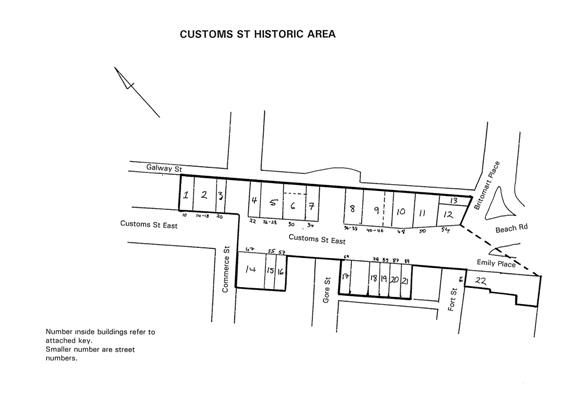
Customs Street Historic Area, Auckland. Plan of Historic Area from registration report
Customs Street Historic Area
Customs Street Historic Area, Auckland. Plan of Historic Area from registration report
Customs Street Historic Area
Stay up to date with Heritage this month