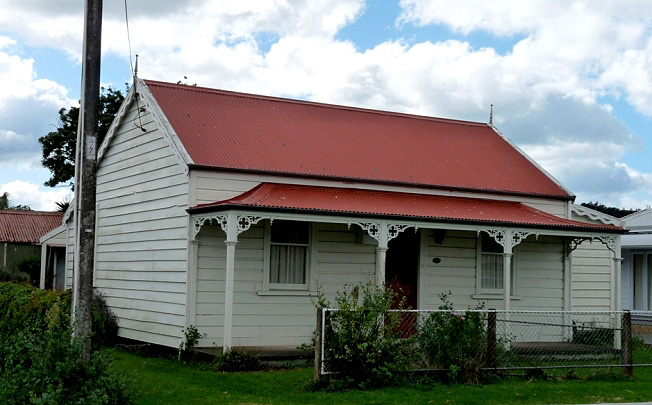
The former Postmaster’s House is one of a group of surviving residences in central Whitianga linked with the expansion of nineteenth-century European settlement on the west side of the Whitianga Harbour. Possibly erected in 1888, the single-storey timber dwelling is connected with government administration in Mercury Bay through its first long-term owner, postmaster Edwin John White and his family, who occupied the residence until the early 1900s. Whitianga’s growth during this period was fuelled by industrial-scale sawmilling on a new site at the mouth of the Harbour and the felling of extensive kauri forests. Subsequent owners of the property were directly associated with this industry, including James Dykes, a contractor for the Kauri Timber Company, and then bushman Adolphus Creed. Of gabled, double-box cottage design, the dwelling reflects the relatively modest nature of residential accommodation owned by skilled working-class and middle-class citizens, including government employees, in an expanding timber town.
Te Whitianga o Kupe (Whitianga) has a long history extending back to the navigator Kupe and ancestral migrations from Hawaiki. The area forms a stronghold of Ngāti Hei, descended from the eponymous Hei who arrived on the Arawa waka. Although heavily impacted by early nineteenth-century conflicts including the tāua or so-called Musket Wars of the 1820s and 1830s, Ngāti Hei retained a distinct presence. Local Māori communities engaged significantly with early European entrepreneurs and settlers involved in the timber industry and other activity at Whitianga from the 1830s.
In 1866, the Karamuramu Block beside the Whitianga Harbour was held by Peneamene Tanui, of Te Rapupo hapū. By early 1880 the land had been acquired by Thomas Peacock, a prominent Auckland businessman and politician who helped found the emerging township’s Mercury Bay Timber Company. In 1883, this enterprise relocated Whitianga’s sawmill from an earlier site on the east side of the harbour to a modern, 24-hour facility near the Karamuramu Block. While the latter was being built, Peacock laid out private sections a short distance to the south, attracting both residential and commercial purchasers. In 1885, Lots 64 and 69 were purchased by Harriet Hughes, wife of local boatbuilder William Henry Hughes, who may have constructed the current house before onselling Lot 64 in 1888 to postmaster Edwin John White. By December 1885, ‘an unbroken chain of residences, some of them very pretty villas with trim and well stocked flower and kitchen gardens’ had been erected upstream of the mill.
White’s new dwelling consisted of a timber-built cottage a short distance from Whitianga’s post office. A recent arrival in the township, White had been appointed postmaster, telegraphist and Registrar of Births, Deaths and Marriages for Mercury Bay by late 1887 - shortly after government authorities had provided telephone connections to the growing settlement (1883) and erected a new post office and courthouse in response to settler requests (1886). Post offices formed important communication hubs in late nineteenth-century New Zealand towns, and postmasters were people of prestige and responsibility. White and his wife Mary (née McGhee) had several children, suggesting that their residence was a family dwelling.
Of broadly symmetrical appearance, the cottage was centrally positioned on its section with a relatively small front garden and slightly larger backyard. Its double-box design incorporated a gabled roof with inbuilt catslide rear component to create an overall structure of saltbox type. Internally, its layout featured two front rooms - likely a parlour and main bedroom - accessed either side of a half-hallway, with another bedroom and large living area - perhaps a kitchen - behind. Rusticated weatherboards and a verandah on its front elevation contrast with the plainer appearance of nearby mill labourers’ dwellings, potentially reflecting White’s relatively elevated status within Whitianga’s working community. When the Mercury Bay Undenominational Church was opened on the opposite side of Owen Street in 1898, White was appointed a trustee.
After White was transferred to the South Island in the early 1900s, the property was acquired by James Dykes, a contractor who oversaw extensive tree-felling for the Kauri Timber Company at Pungapunga and elsewhere. Dykes owned the residence until 1910, during which period he also became licensee of the Tairua Hotel. The property was subsequently transferred to Adolphus Creed, a bushman of both Māori and Pākehā parentage who had similarly resided at Pungapunga while Dykes ran operations there. Creed and his wife Margaret (née McLeod) owned the house until their deaths in the 1950s. A corrugated-iron outbuilding in the rear garden held Creed’s tools as well as likely being used for other purposes. By the 1940s, improvements to the main building included a rear kitchen extension and a small side bathroom. The property was subsequently retained by the couple’s descendants into the twenty-first century as Whitianga increasingly developed into a substantial holiday resort, and remains in private residential use.