John Sidey arrived in Otago on the ship Blundell in 1848 and set up as a businessman and general merchant, trading out of his town section at the corner of Princes Street and High Street. By the late 1850s he had sold his town business to cultivate and reside on land, bought ‘two years previously,’ at Corstorphine. Here he built a modest residence, where he lived from about 1857 to 1864.
Part of Corstorphine House was completed in about 1864. No contemporary description of the early building remains, but the core of the early building endures in the eastern side of the current building.
The house was extended in about 1910, which added an extra wing on the eastern side of the original building. The building was sold by John Sidey’s grandson, Stuart, to the Presbyterian Church in order to ‘establish there a home for mentally-deficient women’ in the late 1950s. This institution remained operating out of the residence, with little noted change to the interior or exteriors, until the building was sold in 1993. It then operated as a boutique hotel. It currently is run as a venue for weddings and corporate functions.
List Entry Information
Status
Listed
List Entry Status
Historic Place Category 1
Access
Private/No Public Access
List Number
4760
Date Entered
27th July 1988
Date of Effect
27th July 1988
City/District Council
Dunedin City
Region
Otago Region
Legal description
Lot 2 DP 24719 (RT 8033), Otago Land District
Status
Listed
List Entry Status
Historic Place Category 1
Access
Private/No Public Access
List Number
4760
Date Entered
27th July 1988
Date of Effect
27th July 1988
City/District Council
Dunedin City
Region
Otago Region
Legal description
Lot 2 DP 24719 (RT 8033), Otago Land District
Why is this place significant?
Historic Significance
Historical Significance or Value Corstorphine House was the home of the Sidey family from the early 1860s until 1957. John Sidey is said to have built a small cottage on the property after his marriage in 1858 and began work on the present house in 1863. This does not tally with the Land Registry records which show that David Calder, settler, was given the grant on the land in 1862, received the freehold by application in 1872 and sold to John Sidey in 1874. However, in the land records for the section owned by John Sidey on which the Southern Cross Hotel stands, Sidey is described in 1860 as settler of Corstorphine near Dunedin. He also raised a mortgage of 300 pounds in 1857 and gave up his store on the High Street land at the same time. It is likely that the land ownership of Corstorphine was delayed in being transferred because of difficulties with the Crown grant system. The northern wing of the house was built first and had its front door where a hall ends at the big stained glassed window. In 1909 the land was transferred to the names of John and his two sons, Thomas and Arthur. About 1910 when John Sidey was in his eighties, the house was extended to about triple its size, presumably for the sake of T K Sidey, by then joint owner of the property. The latter had been Mayor of Caversham (1894-1899, 1901) and held the Caversham seat and after 1908 the Dunedin South seat in Parliament. He introduced the Dentists' Bill in 1904 which led to the establishment of the Dental School in Dunedin. He was also Chancellor of the University (1925-1933). The family presented the University with a clock for the clock tower in 1927 to commemorate Sir Thomas's success in introducing a Daylight Saving bill which he had promoted since 1909. His son, T K S Sidey, has been Councillor and Mayor of Dunedin.
Physical Significance
Architectural Significance: This is a large but simply designed version of the Dunedin villa without the usual double storied bay windows. It is one of the few Dunedin villas showing Palladian influence. Townscape/landmark Significance: The gardens form a significant green space in the suburban slope above Caversham.
Why is this place significant?
Historic Significance
Historical Significance or Value Corstorphine House was the home of the Sidey family from the early 1860s until 1957. John Sidey is said to have built a small cottage on the property after his marriage in 1858 and began work on the present house in 1863. This does not tally with the Land Registry records which show that David Calder, settler, was given the grant on the land in 1862, received the freehold by application in 1872 and sold to John Sidey in 1874. However, in the land records for the section owned by John Sidey on which the Southern Cross Hotel stands, Sidey is described in 1860 as settler of Corstorphine near Dunedin. He also raised a mortgage of 300 pounds in 1857 and gave up his store on the High Street land at the same time. It is likely that the land ownership of Corstorphine was delayed in being transferred because of difficulties with the Crown grant system. The northern wing of the house was built first and had its front door where a hall ends at the big stained glassed window. In 1909 the land was transferred to the names of John and his two sons, Thomas and Arthur. About 1910 when John Sidey was in his eighties, the house was extended to about triple its size, presumably for the sake of T K Sidey, by then joint owner of the property. The latter had been Mayor of Caversham (1894-1899, 1901) and held the Caversham seat and after 1908 the Dunedin South seat in Parliament. He introduced the Dentists' Bill in 1904 which led to the establishment of the Dental School in Dunedin. He was also Chancellor of the University (1925-1933). The family presented the University with a clock for the clock tower in 1927 to commemorate Sir Thomas's success in introducing a Daylight Saving bill which he had promoted since 1909. His son, T K S Sidey, has been Councillor and Mayor of Dunedin.
Physical Significance
Architectural Significance: This is a large but simply designed version of the Dunedin villa without the usual double storied bay windows. It is one of the few Dunedin villas showing Palladian influence. Townscape/landmark Significance: The gardens form a significant green space in the suburban slope above Caversham.
Construction Details
Type
Other
Description
John Sidey purchases land in Ocean Beach SD
Period
Mid-1850s
Start Year
1910
Type
Addition
Description
A new wing constructed
Start Year
1958
Type
Modification
Description
Building interior partly modified for care home
Type
Modification
Description
Building interior partly modified for hotel
Period
1990s
Start Year
1864
Type
Original Construction
Construction Materials
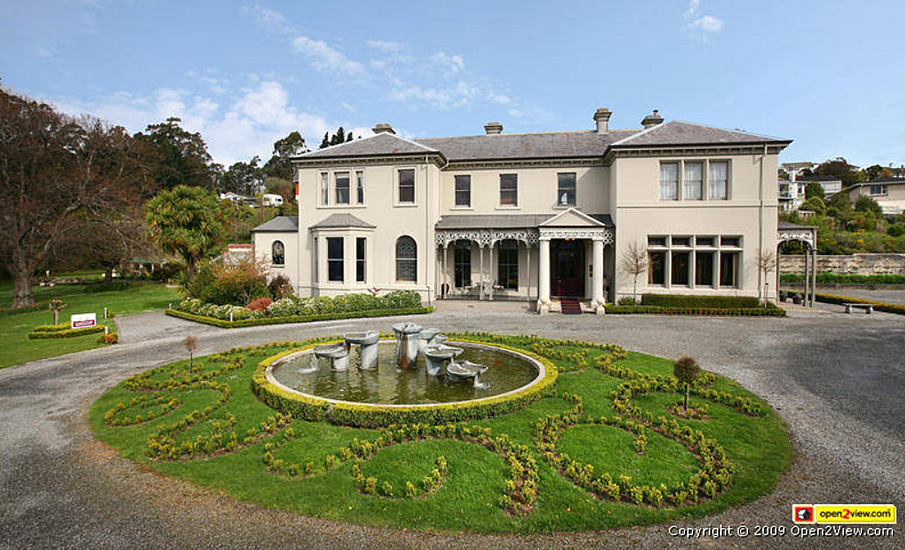
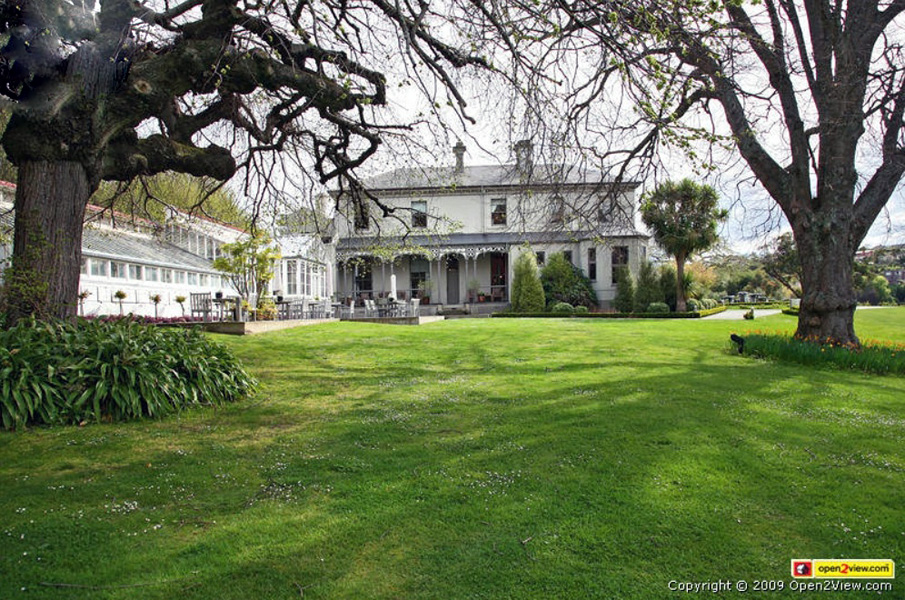
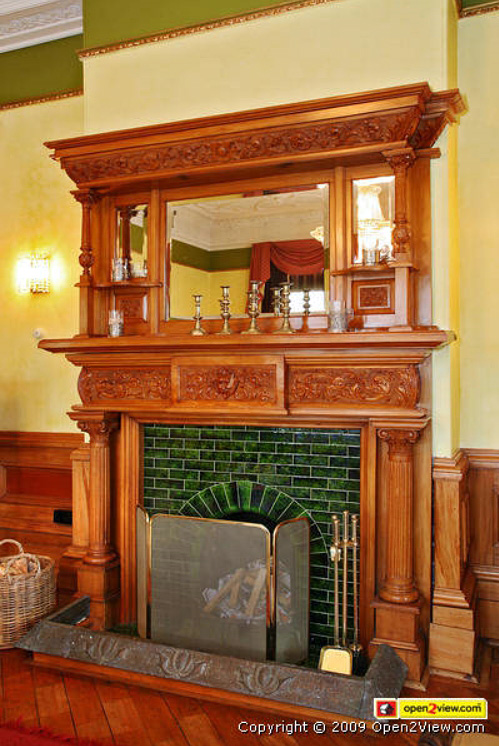
This is a long two storied house of two wings with a large middle section set back behind a verandah with a wrought iron frieze and double posts alongside a classical porch of columns and a pediment at the front door. There are three main living rooms downstairs - the billiard room, the gold drawing room with an ornate coffered ceiling, and the dining room - and seven bedrooms upstairs. The interior retains its splendid plaster ceilings, the original fireplaces, wooden panelling and joinery and much of the Sidey furniture. There is a particularly ornate sideboard. The stained glass window of 1910 is a fine piece of Art Nouveau work.
Notable Features
Its early date, its Palladian design, the unmodified interior, especially the gold drawing room and large art nouveau window, its garden setting and its association with the Sidey family who have served the city for over 100 years.
Construction Details
Type
Other
Description
John Sidey purchases land in Ocean Beach SD
Period
Mid-1850s
Start Year
1910
Type
Addition
Description
A new wing constructed
Start Year
1958
Type
Modification
Description
Building interior partly modified for care home
Type
Modification
Description
Building interior partly modified for hotel
Period
1990s
Start Year
1864
Type
Original Construction
Construction Materials
This is a long two storied house of two wings with a large middle section set back behind a verandah with a wrought iron frieze and double posts alongside a classical porch of columns and a pediment at the front door. There are three main living rooms downstairs - the billiard room, the gold drawing room with an ornate coffered ceiling, and the dining room - and seven bedrooms upstairs. The interior retains its splendid plaster ceilings, the original fireplaces, wooden panelling and joinery and much of the Sidey furniture. There is a particularly ornate sideboard. The stained glass window of 1910 is a fine piece of Art Nouveau work.
Notable Features
Its early date, its Palladian design, the unmodified interior, especially the gold drawing room and large art nouveau window, its garden setting and its association with the Sidey family who have served the city for over 100 years.
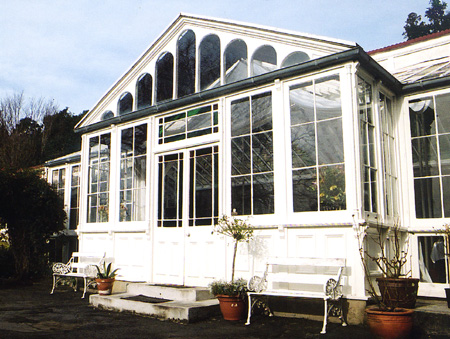
Born in Edinburgh in March 1823, John Sidey was trained as a builder and contractor, the business of his father. In the 1840s he purchased his passage to Otago along with ‘50 acres of rural land in the new settlement, 10 acres of suburban land, and a town section of a quarter of an acre.’ He arrived on the ship Blundell in 1848, settling on his 10-acre suburban land parcel between Dunedin and Port Chalmers. Sidey set up as a businessman and general merchant, trading out of his town section at the corner of Princes Street and High Street; this business included a ‘butcher’s stall’ from at least 1853. He ceased this operation in 1857 in order to cultivate and reside on land, bought ‘two years previously,’ at Corstorphine. Sidey lived and worked on his estate for the next 58 years, until his death in 1915. The Crown Grant for the thirty-six Ocean Beach sections that would make up the bulk of his holdings here was carried out in 1865. Just prior to this, in 1863, Sidey advertised for tenders from masons ‘for the Building of Stables and Outhouses’ at Corstorphine. That same year, his son – the future MP for Caversham, T.K. Sidey – was born ‘at Corstorphine, near Caversham.’ According to local histories, Sidey completed his new home, now a part of the current Corstorphine House, in 1864. It is possible that construction work also carried on into 1865/6 as Sidey advertised for brickmakers ‘to make and burn kiln of bricks’ in December 1865. It is also possible that Sidey’s prior residence was still on site for some time after the completion of Corstorphine House – in 1871, tenders were called for the ‘taking down and re-erecting [of a] wooden house, with new verandas, gates, &c.’ There is likely to have been a vinery or hothouse on site by the end of the 1880s – a drawing, stamped ‘7- SEP 86’ by James Boyd & Sons of Paisley, shows a design for a heat piping system for John Sidey. James Boyd & Sons were a well-known Scottish company that designed hothouses ‘for prominent clients’ of the day. The house was extended in about 1910, which added an extra wing on the eastern side of the original building; it was reported that even at 87 years old, John Sidey could be seen climbing the scaffolding in order to oversee construction. Dunedin City Council Archives hold a building plan for a ‘fernery’ for ‘Mr. Sidey, Corstorphine’, which dates to 1911. However, the shape and proportions of the building in the drawing differ immensely from any building currently on site, and it is possible that the building shown in the plans was never built. Following John Sidey’s death in 1915, the ownership of the property passed to his son, Thomas. Thomas Kay Sidey (1863-1933) was a Dunedin lawyer, civic leader, and long-serving Liberal and United Party politician best known for campaigning for daylight saving time in New Zealand, successfully passing legislation in 1927 after years of advocacy. He served as Attorney-General and Minister of Justice, and was deeply involved in education, notably as Chancellor of the University of Otago. Knighted in 1930, Sidey also contributed to legal reform and community life. He left a scientific legacy, honoured by the Royal Society’s T. K. Sidey Medal for ‘outstanding scientific research concerning electromagnetic radiation.’ Following his death in 1933, Thomas’ widow, Lady Helena, lived at the property until her death in 1956. During this time, she hosted Governor-General Sir Bernard Freyberg and his wife during the 1948 Otago Centenary celebrations. The Sidey family continued to live at Corstorphine House into the 1950s; near the end of that decade, Stuart Sidey, T. K. Sidey’s son, sold the property to the Presbyterian Church, with part of the payment funded through a government subsidy. The subsidy was provided as the Church’s intent was to ‘establish there a home for mentally-deficient women.’ This institution was still running when the house was visited by historian Lois Galer in the 1980s – she recalls: ‘…the ravishes of modernisation have not gone beyond the front door…[a]part from the kitchen area which one would expect to find extensively upgraded for the home’s current purpose, there is nothing you could term “clinical” anywhere. The main rooms are virtually as they were, complete with elegant fire surrounds [and] sculpted plaster ceilings…’ When the building was added to the then Historic Places Trust Register in 1988, it was described as… ‘…a long two storied house of two wings with a large middle section set back behind a veranda with a wrought iron frieze and double posts alongside a classical porch of columns and a pediment at the front door. There are three main living rooms downstairs – the billiards room, the gold drawing room with an ornate coffered ceiling, and the dining room – and seven bedrooms upstairs. The interior retains its splendid plaster ceilings, the original fireplaces, wooden panelling and joinery and much of the Sidey furniture. There is a particularly ornate sideboard. The stained-glass window of 1910 is a fine piece of Art Nouveau work.’ In 1993, the Presbyterian Support Services put the property up for sale; the completion of a residential care complex elsewhere in the city meant that Corstorphine House was surplus to requirements. The property was subsequently sold in 1994. For a considerable period the property was run as a boutique hotel, hosting the likes of Gwyneth Paltrow, the then Prince of Wales, and Governor-General Dame Silvia Cartwright. From about 2011, extensive works were carried out on the Conservatory building, which included replacing structural elements. As of 2025, the property is run as a venue for weddings and corporate functions.
Born in Edinburgh in March 1823, John Sidey was trained as a builder and contractor, the business of his father. In the 1840s he purchased his passage to Otago along with ‘50 acres of rural land in the new settlement, 10 acres of suburban land, and a town section of a quarter of an acre.’ He arrived on the ship Blundell in 1848, settling on his 10-acre suburban land parcel between Dunedin and Port Chalmers. Sidey set up as a businessman and general merchant, trading out of his town section at the corner of Princes Street and High Street; this business included a ‘butcher’s stall’ from at least 1853. He ceased this operation in 1857 in order to cultivate and reside on land, bought ‘two years previously,’ at Corstorphine. Sidey lived and worked on his estate for the next 58 years, until his death in 1915. The Crown Grant for the thirty-six Ocean Beach sections that would make up the bulk of his holdings here was carried out in 1865. Just prior to this, in 1863, Sidey advertised for tenders from masons ‘for the Building of Stables and Outhouses’ at Corstorphine. That same year, his son – the future MP for Caversham, T.K. Sidey – was born ‘at Corstorphine, near Caversham.’ According to local histories, Sidey completed his new home, now a part of the current Corstorphine House, in 1864. It is possible that construction work also carried on into 1865/6 as Sidey advertised for brickmakers ‘to make and burn kiln of bricks’ in December 1865. It is also possible that Sidey’s prior residence was still on site for some time after the completion of Corstorphine House – in 1871, tenders were called for the ‘taking down and re-erecting [of a] wooden house, with new verandas, gates, &c.’ There is likely to have been a vinery or hothouse on site by the end of the 1880s – a drawing, stamped ‘7- SEP 86’ by James Boyd & Sons of Paisley, shows a design for a heat piping system for John Sidey. James Boyd & Sons were a well-known Scottish company that designed hothouses ‘for prominent clients’ of the day. The house was extended in about 1910, which added an extra wing on the eastern side of the original building; it was reported that even at 87 years old, John Sidey could be seen climbing the scaffolding in order to oversee construction. Dunedin City Council Archives hold a building plan for a ‘fernery’ for ‘Mr. Sidey, Corstorphine’, which dates to 1911. However, the shape and proportions of the building in the drawing differ immensely from any building currently on site, and it is possible that the building shown in the plans was never built. Following John Sidey’s death in 1915, the ownership of the property passed to his son, Thomas. Thomas Kay Sidey (1863-1933) was a Dunedin lawyer, civic leader, and long-serving Liberal and United Party politician best known for campaigning for daylight saving time in New Zealand, successfully passing legislation in 1927 after years of advocacy. He served as Attorney-General and Minister of Justice, and was deeply involved in education, notably as Chancellor of the University of Otago. Knighted in 1930, Sidey also contributed to legal reform and community life. He left a scientific legacy, honoured by the Royal Society’s T. K. Sidey Medal for ‘outstanding scientific research concerning electromagnetic radiation.’ Following his death in 1933, Thomas’ widow, Lady Helena, lived at the property until her death in 1956. During this time, she hosted Governor-General Sir Bernard Freyberg and his wife during the 1948 Otago Centenary celebrations. The Sidey family continued to live at Corstorphine House into the 1950s; near the end of that decade, Stuart Sidey, T. K. Sidey’s son, sold the property to the Presbyterian Church, with part of the payment funded through a government subsidy. The subsidy was provided as the Church’s intent was to ‘establish there a home for mentally-deficient women.’ This institution was still running when the house was visited by historian Lois Galer in the 1980s – she recalls: ‘…the ravishes of modernisation have not gone beyond the front door…[a]part from the kitchen area which one would expect to find extensively upgraded for the home’s current purpose, there is nothing you could term “clinical” anywhere. The main rooms are virtually as they were, complete with elegant fire surrounds [and] sculpted plaster ceilings…’ When the building was added to the then Historic Places Trust Register in 1988, it was described as… ‘…a long two storied house of two wings with a large middle section set back behind a veranda with a wrought iron frieze and double posts alongside a classical porch of columns and a pediment at the front door. There are three main living rooms downstairs – the billiards room, the gold drawing room with an ornate coffered ceiling, and the dining room – and seven bedrooms upstairs. The interior retains its splendid plaster ceilings, the original fireplaces, wooden panelling and joinery and much of the Sidey furniture. There is a particularly ornate sideboard. The stained-glass window of 1910 is a fine piece of Art Nouveau work.’ In 1993, the Presbyterian Support Services put the property up for sale; the completion of a residential care complex elsewhere in the city meant that Corstorphine House was surplus to requirements. The property was subsequently sold in 1994. For a considerable period the property was run as a boutique hotel, hosting the likes of Gwyneth Paltrow, the then Prince of Wales, and Governor-General Dame Silvia Cartwright. From about 2011, extensive works were carried out on the Conservatory building, which included replacing structural elements. As of 2025, the property is run as a venue for weddings and corporate functions.
Architect/Engineer/Designer: John Sidey probably designed the first part himself Mandeno and Fraser upgraded the house in the 1920s. Significance of Architect/Engineer/Designer: John Sidey arrived in New Zealand in 1848, after being in business in London with his father as a building contractor. Architectural Description (Style): The house is relatively sober and classical in its styling, more Georgian than Victorian, though it lacks the strict symmetry of Georgian houses. The two wings on either side of a central section reflect Palladian classical design. The wrought iron friezes over the verandahs add a colonial touch. The window heads are square except for the arched stained glass window in the place of the old front door. Modifications: The house has been relatively little modified in its conversion to a home for disabled women. The exterior is unmodified and still retains seven acres of large gardens.
Architect/Engineer/Designer: John Sidey probably designed the first part himself Mandeno and Fraser upgraded the house in the 1920s. Significance of Architect/Engineer/Designer: John Sidey arrived in New Zealand in 1848, after being in business in London with his father as a building contractor. Architectural Description (Style): The house is relatively sober and classical in its styling, more Georgian than Victorian, though it lacks the strict symmetry of Georgian houses. The two wings on either side of a central section reflect Palladian classical design. The wrought iron friezes over the verandahs add a colonial touch. The window heads are square except for the arched stained glass window in the place of the old front door. Modifications: The house has been relatively little modified in its conversion to a home for disabled women. The exterior is unmodified and still retains seven acres of large gardens.
Historical and Associated Iwi / Hapū / Whānau
Completion Date
23rd September 2025
Report Written By
Andrew Winter
Information Sources
Galer, 1984
L Galer, Further Houses and Homes, Dunedin, 1984
Rutherford, 1978
Alma Rutherford, The Edge of the Town: historic Caversham as seen through its streets and buildings, Dunedin, McIndoe, 1978.
Other Information
This historic place was registered under the Historic Places Act 1980. A fully referenced copy of the Upgrade Report is available upon request from the Otago/Southland Area Office of Heritage New Zealand Pouhere Taonga. Disclaimer Please note that entry on the New Zealand Heritage List/Rārangi Kōrero identifies only the heritage values of the property concerned, and should not be construed as advice on the state of the property, or as a comment of its soundness or safety, including in regard to earthquake risk, safety in the event of fire, or insanitary conditions. Archaeological sites are protected by the Heritage New Zealand Pouhere Taonga Act 2014, regardless of whether they are entered on the New Zealand Heritage List/Rārangi Kōrero or not. Archaeological sites include ‘places associated with pre-1900 human activity, where there may be evidence relating to the history of New Zealand’. This List entry report should not be read as a statement on whether or not the archaeological provisions of the Act apply to the property(s) concerned. Please contact your local Heritage New Zealand office for archaeological advice.
Historical and Associated Iwi / Hapū / Whānau
Completion Date
23rd September 2025
Report Written By
Andrew Winter
Information Sources
Galer, 1984
L Galer, Further Houses and Homes, Dunedin, 1984
Rutherford, 1978
Alma Rutherford, The Edge of the Town: historic Caversham as seen through its streets and buildings, Dunedin, McIndoe, 1978.
Other Information
This historic place was registered under the Historic Places Act 1980. A fully referenced copy of the Upgrade Report is available upon request from the Otago/Southland Area Office of Heritage New Zealand Pouhere Taonga. Disclaimer Please note that entry on the New Zealand Heritage List/Rārangi Kōrero identifies only the heritage values of the property concerned, and should not be construed as advice on the state of the property, or as a comment of its soundness or safety, including in regard to earthquake risk, safety in the event of fire, or insanitary conditions. Archaeological sites are protected by the Heritage New Zealand Pouhere Taonga Act 2014, regardless of whether they are entered on the New Zealand Heritage List/Rārangi Kōrero or not. Archaeological sites include ‘places associated with pre-1900 human activity, where there may be evidence relating to the history of New Zealand’. This List entry report should not be read as a statement on whether or not the archaeological provisions of the Act apply to the property(s) concerned. Please contact your local Heritage New Zealand office for archaeological advice.
Current Usages
Uses: Civic Facilities
Specific Usage: Wedding Venue
Former Usages
General Usage: Accommodation
Specific Usage: Hotel
General Usage: Accommodation
Specific Usage: House
General Usage: Civic Facilities
Specific Usage: Welfare Services/Charitable Aid
General Usage: Trade
Specific Usage: Restaurant/cafe/tearoom
Web Links
description:
Current Usages
Uses: Civic Facilities
Specific Usage: Wedding Venue
Former Usages
General Usage: Accommodation
Specific Usage: Hotel
General Usage: Accommodation
Specific Usage: House
General Usage: Civic Facilities
Specific Usage: Welfare Services/Charitable Aid
General Usage: Trade
Specific Usage: Restaurant/cafe/tearoom
Web Links
description: