Reefton’s War Memorial Obelisk was built, most probably in the early 1920s, to memorialise those from the Inangahua district who died in World War One. Its plaques were subsequently replaced and include remembrance also to the district’s dead from World War Two. The War Memorial Obelisk reflects the widespread trend for communities to erect a permanent memorial to their men lost in those significant world events.
Thirty six perches of land on Church Street and Buller Road, Reefton, was purchased by Philip Alexander in 1875 and subsequently had a number of other owners. None appears to have built at the extreme corner part of the parcel where the War Memorial Obelisk now stands. In 1907 the Inangahua County Council purchased the vacant corner section of land. After the war of 1914-18 ended, this corner site, opposite the Inangahua County Council Chambers, St Stephen’s Church and Sacred Heart Church, was chosen as the place to build a memorial.
Situated at the intersection of Church Street and Buller Road, and surrounded by a low concrete fence, the War Memorial Obelisk is a prominent feature of Reefton. The inscription on the memorial reads ‘Roll of Honour of men from Inangahua district who laid down their lives in defence of the empire’. It carries four black plaques, two for the men of the First New Zealand Expeditionary Force (in other words, those from World War One), one for those from the Second Expeditionary Force, and one blank. The low fence comprises small concrete posts which are also four-sided obelisks, joined with a double metal rails. Immediately to the north-west is the King George V Memorial Park, so named in 1935, which has been set aside as a recreation reserve and contains the town’s bandstand.
Four-sided tapering obelisk memorials, such as this one, were a common choice for many small towns after World War One. Around 30% of all World War One memorials built in New Zealand were of this form. The form had its attractions. It was a style that communities were familiar with from cemetery headstones, it formed a prominent landmark, and provided a space for adding names and inscriptions, and for laying wreaths. It also has a possible Christian meaning, pointing heavenward, without being overtly religious.
A few changes have been made to the War Memorial Obelisk from the time when it was first constructed. The original World War One plaques were replaced after World War Two with the current plaques. The fenced area was once surrounded by blossom trees, but now has a low garden around the outside. The memorial remains the centre of Anzac Day celebrations in Reefton, when people march to the obelisk and lay wreaths and poppies.

War Memorial Obelisk. Reefton, West Coast, includes War Memorial, gardens and township. Whites Aviation Ltd: Photographs’, taken October 1956. Ref: WA-42333-F. http://natlib.govt.nz/records/30646526. Permission of the Alexander Turnbull Library must be obtained before reuse of this image. | Alexander Turnbull Library, Wellington
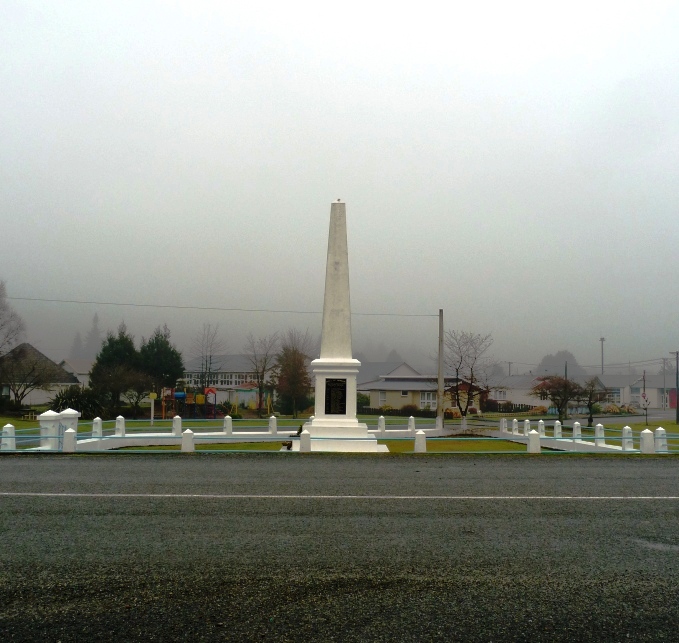
War Memorial Obelisk | Mike Vincent | 20/06/2012 | Heritage New Zealand Pouhere Taonga
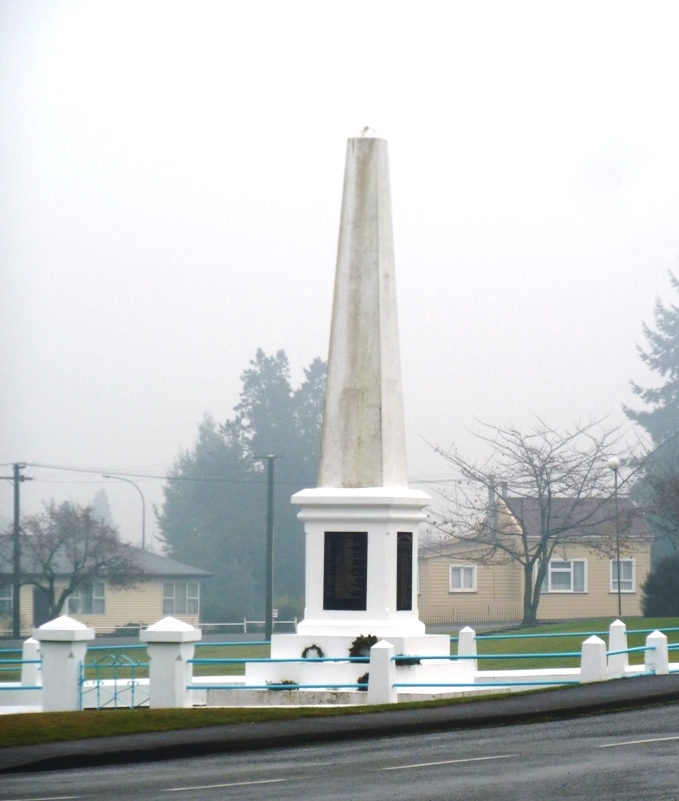
War Memorial Obelisk | Mike Vincent | 20/06/2012 | Heritage New Zealand Pouhere Taonga
War Memorial Obelisk. Reefton, West Coast, includes War Memorial, gardens and township. Whites Aviation Ltd: Photographs’, taken October 1956. Ref: WA-42333-F. http://natlib.govt.nz/records/30646526. Permission of the Alexander Turnbull Library must be obtained before reuse of this image. | Alexander Turnbull Library, Wellington
War Memorial Obelisk | Mike Vincent | 20/06/2012 | Heritage New Zealand Pouhere Taonga
War Memorial Obelisk | Mike Vincent | 20/06/2012 | Heritage New Zealand Pouhere Taonga